About
Sunglasses usually sit on a face by gripping it. The Persol 649 was designed for men who had to wear theirs for an entire shift, so gripping was never going to be enough.
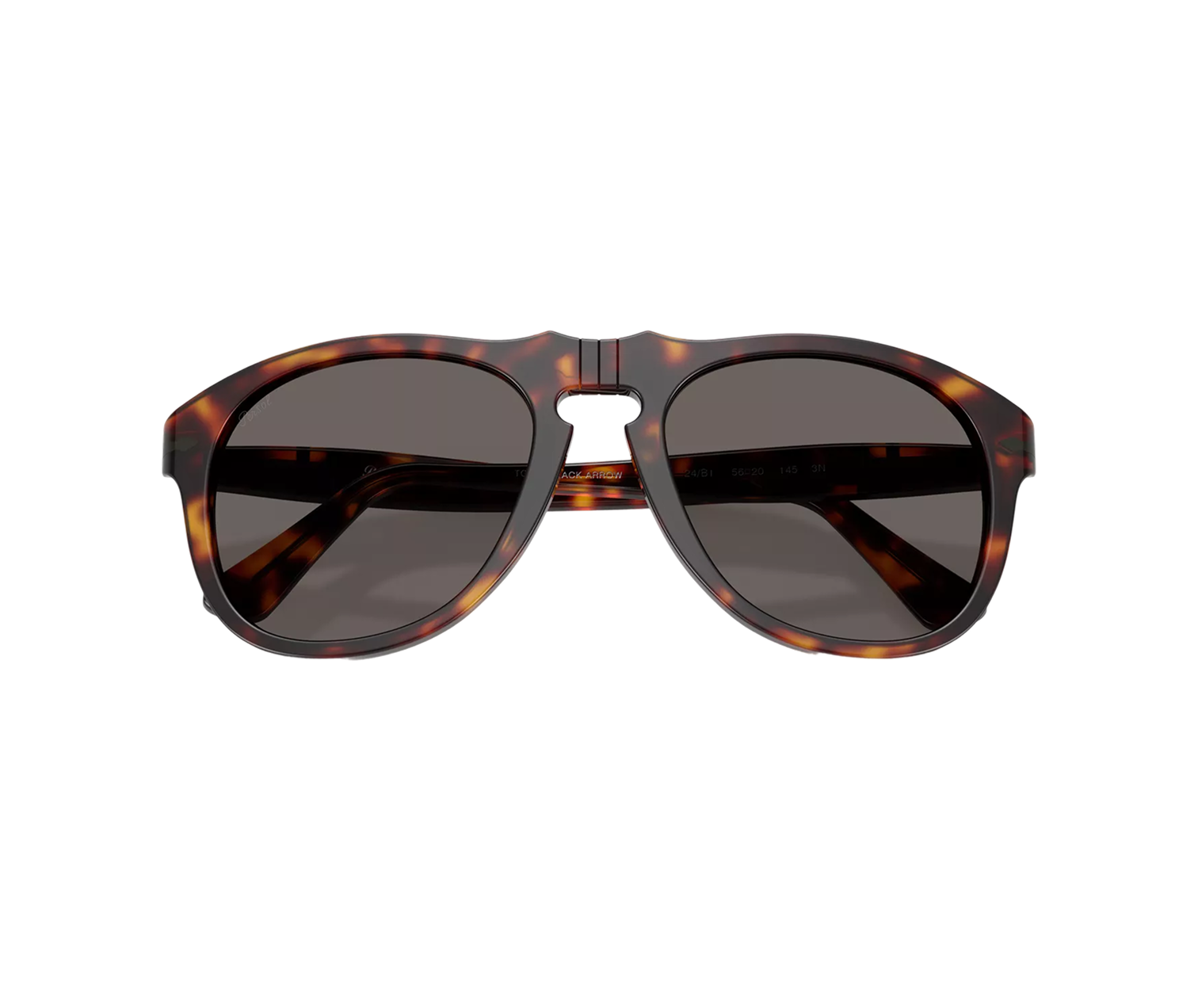
The 649 was first made in 1957 for the tram drivers of Turin, whose eyes needed keeping clear of dust and glare through a whole day at the wheel, and the arms are the reason it stays put. Persol patented the Meflecto system in the 1930s: a flexible stem that gives as the frame goes on instead of clamping, so the temples settle to the width of a head and then stop pressing on it. Between the lenses sits a keyhole bridge, the notched cut-out that drops the weight onto either side of the nose rather than the top of it. The acetate is Persol's own mix of cotton and powdery pigment, poured so the marbling comes out differently in every frame.
The lenses are crystal, which is Persol's word for glass, ground from what the company calls the most precious optical materials and sold from plain tints through to polarised. The frame front comes in three widths, 52, 54 and 56 millimetres, each on a 20 millimetre bridge with 140 millimetre temples, and the lens stands 27 millimetres tall. The whole thing is made by hand in Italy.
Marcello Mastroianni wore a pair in Divorce Italian Style in 1961, and the 649 became the first Persol shape to be treated as an icon. Up to three letters can be engraved into the left temple arrow, the emblem founder Giuseppe Ratti took from the swords of ancient warriors.
- Designed & made in
- Italy
- Material
- Acetate frame with crystal lenses
- Size
- 54 mm lens, 20 mm bridge, 140 mm temple
- Sizes
- 52, 54 and 56 mm frame front
- Lens
- 27 mm lens height, tints to polarised
Figures as published by the manufacturer. Source