About
Before 1933, making coffee at home meant waiting for water to fall. Gravity did the work, and the coffee tasted like it.
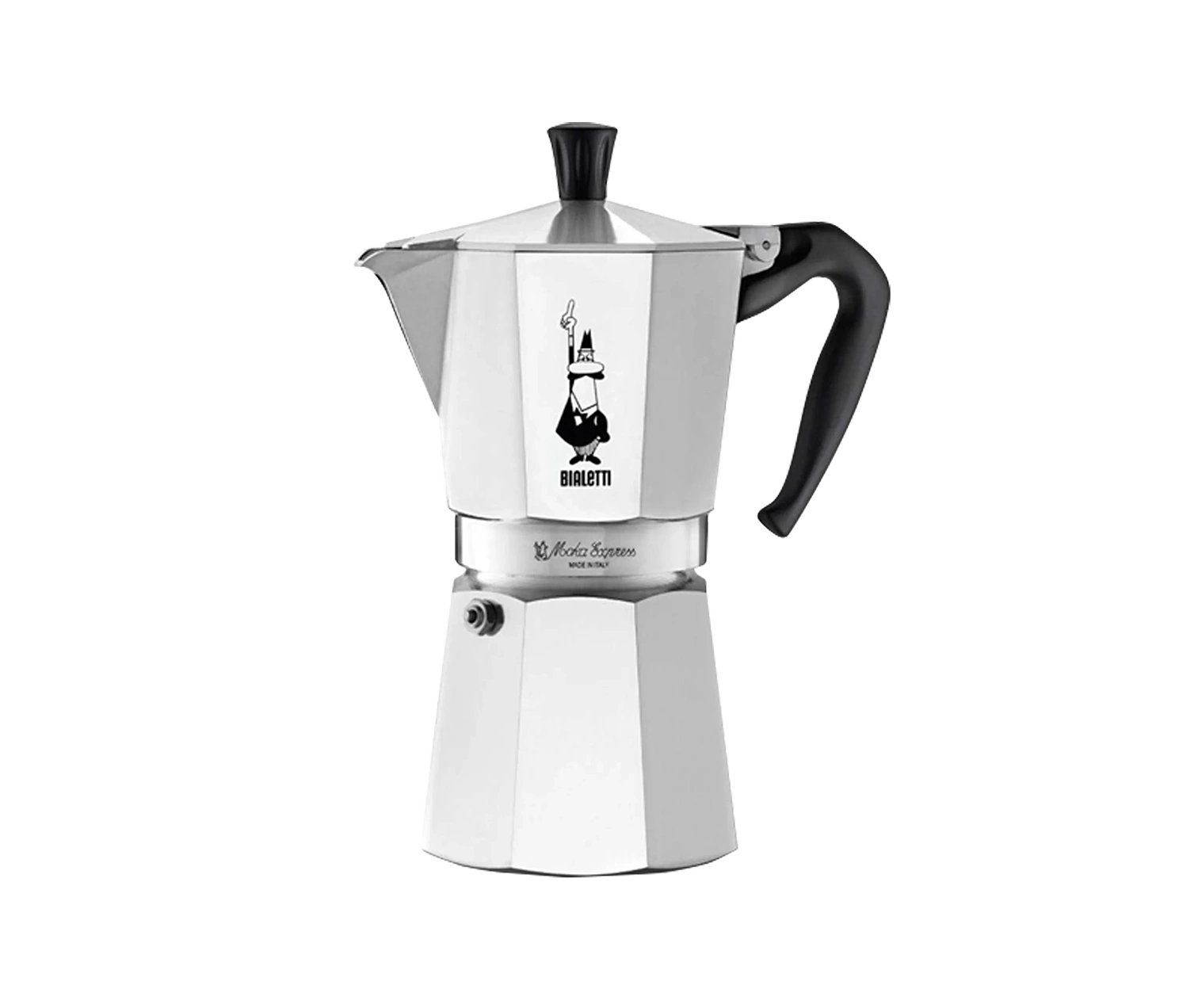
Bialetti's Moka Express, invented by Alfonso Bialetti in 1933, was the first home coffee maker to brew with pressure rather than gravity. The Italian kitchens it arrived into had two options, both passive. The Neapolitan pot is flipped upside down once the water boils so it drains through a filter of grounds; the Milanese boils water up through a colander of coffee. Neither pushes. The Moka seals water into a bottom chamber and heats it until the steam builds roughly 1.5 bars, which drives the water up through a funnel filter of ground coffee and into the collector above. Bialetti sets that figure against the 9 bars a modern espresso machine runs, and the comparison places moka coffee exactly where it sits on the tongue: past filter, short of espresso.
The safety valve on the boiler is part of the same mechanism rather than an addition to it. Grind too fine, pack the funnel, or run the flame too hot, and the water stops passing the filter while the pressure keeps climbing; the valve opens and vents the steam. Bialetti also uses it as a measure, telling you to fill the boiler to just below it, so the part that stops the pot going wrong is the part that tells you when to stop pouring. Washing is warm water only, no detergent and no dishwasher, which is less a piece of care advice than a consequence of the aluminium body. The moustached man printed on the side is the company's own mark, the omino coi baffi.
- Designed & made in
- Italy

- inventor
- Alfonso Bialetti
- Materials
- Sizes
- 1, 2, 3, 4, 6, 9, 12 and 18 cups
- Fits
- Gas and electric hobs; induction with the Bialetti adapter
Figures as published by the manufacturer. Source
You might also like
More in Coffee
See all

Staff Pick
Demi
$795
Staff Pick
Linea Micra
$4,500