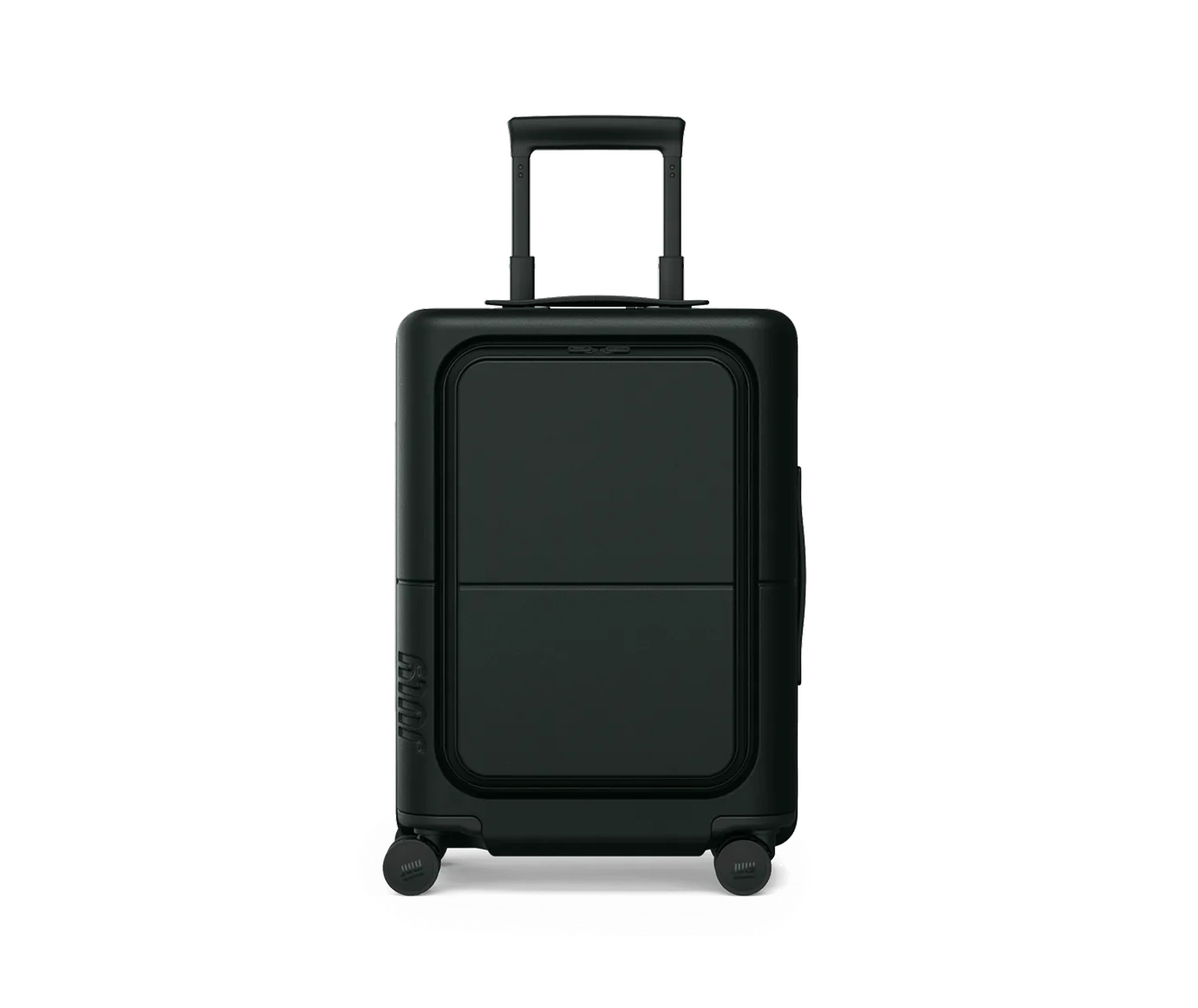
The Check-in
$750

About
Most check-in luggage still guards a whole trip's clothing with a padlock looped through two zip pulls, which is a closure a baggage handler can open with a pen and a determined thumb. Carl Friedrik built the Check-in the other way round.
The Check-in's TSA-approved lock closes into the aluminium frame that holds the shell, so the case seals shut with an audible click rather than clamping a zip. That frame carries a shell of Makrolon, a German-engineered polycarbonate, which means the structural part of the case and the locking part of the case are the same part. The handle follows the same logic. Most telescopic handles stop at two or three fixed heights, so a hand lands somewhere between comfortable and not, and stays there for the length of a terminal. Carl Friedrik calls this one an any-stop trolley system: it locks at any point along its extension, at whatever height happens to suit the person pulling it.
Inside, the packing hardware is doubled up. Both compartments take compression straps and a separate compression pad with its own pocket, so clothes travel flat rather than shifting into folds, and two narrow zipped pockets keep smaller things where they were put. The leather trim is vegetable-tanned Vachetta from Artigiano del Cuoio in Italy. The rest of the parts are named too, which is unusual at this end of the market and easy to check: Hinomoto wheels and YKK zips, both made in Japan, on a case built in Guangzhou at a factory Carl Friedrik says has supplied established luggage brands for decades.
- Designed in
- United Kingdom

- Made in
- China

- Materials
- Shell
- Makrolon polycarbonate, aluminium lock frame
- Leather
- Vegetable-tanned Vachetta, Artigiano del Cuoio, Italy

- Controls
- Any-stop telescopic trolley handle
Figures as published by the manufacturer. Source