Staff Pick
About
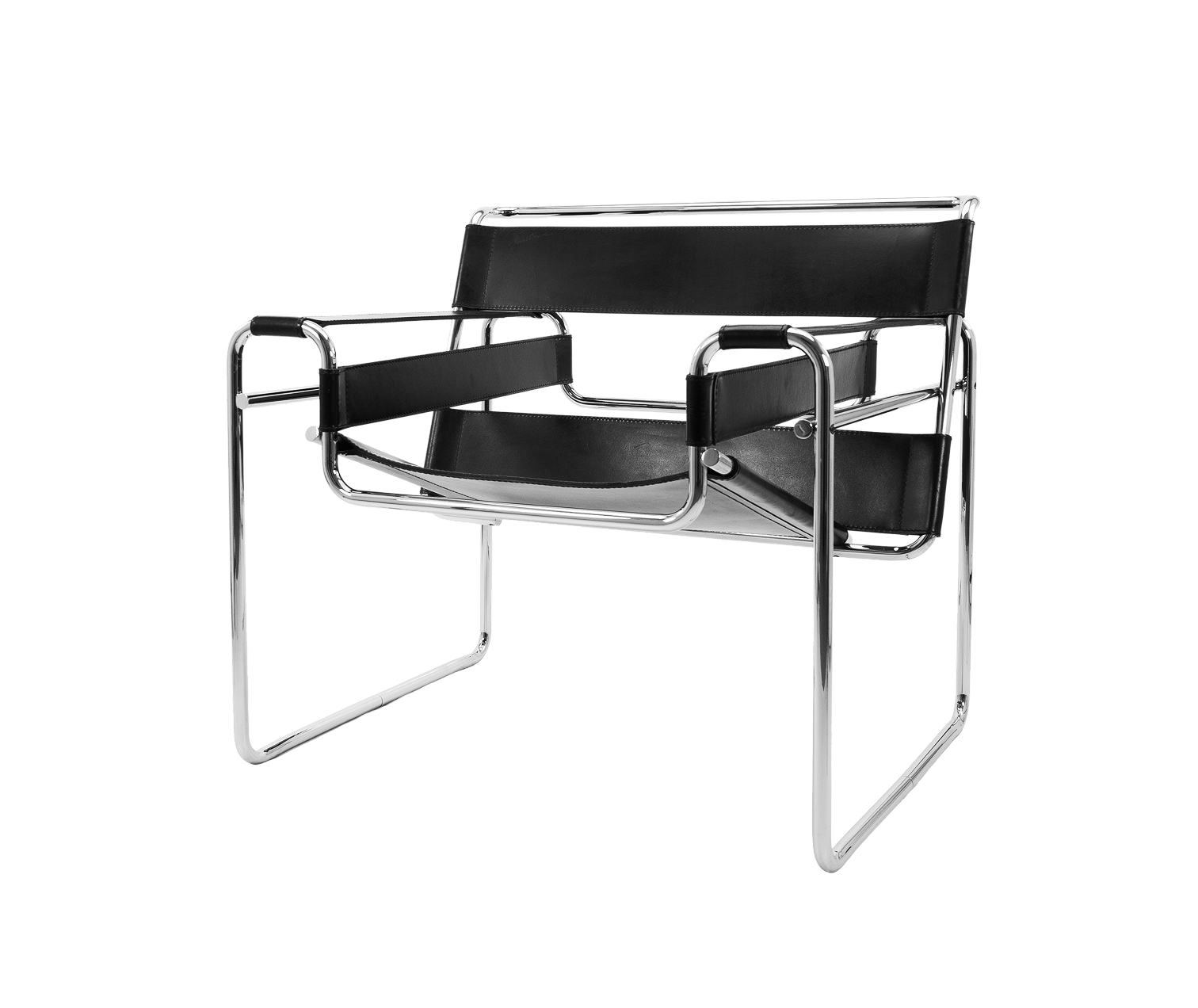
A club armchair is normally the heaviest thing in a room: a frame of solid timber, wadding, springs, and enough upholstery to hide all of it. Marcel Breuer took the same silhouette and left out everything inside it.
Knoll's Wassily chair reduces a club armchair to two elements, a frame of bent tubular steel and slings of leather or canvas stretched across it as seat, back and arms. Breuer designed it in 1925 while still an apprentice at the Bauhaus, borrowing the construction of a bicycle frame, and Knoll calls it the first chair of its kind. Nothing in it is solid. The sitter rests on tensioned straps suspended inside the steel outline, which is why the chair reads as a heavy armchair from across the room and yet can be seen straight through, and why at 25 pounds it moves with one hand. The seat sits low, 16 and a half inches, in a frame 31 inches wide and 27 deep, which places it as a reading chair rather than everyday seating.
Knoll builds the frame in polished chrome as standard, with 18 karat gold-plated and ultra-matte powder-coated versions alongside. The slings come in vegetable-tanned, aniline-dyed Spinneybeck belting leather, plain cotton canvas, or haired cowhide. The leather is the one that changes: it marks and softens over years of use while the steel stays exactly as bent, so the chair ages in one material and not the other.
The name arrived after the fact. An early prototype intrigued Breuer's associate Wassily Kandinsky, and the chair has carried his name ever since, which means the most famous piece of Bauhaus seating is named for a painter who did not design it.
- Designed in
- United States

- designer
- Marcel Breuer
- Materials
- Dimensions
- 31 in wide, 27 in deep, 28.75 in high
- Weight
- 25 lb
- Finish
- Polished chrome, 18k gold-plated or ultra-matte powder-coat
Figures as published by the manufacturer. Source