About
Nearly every hardcover notebook has an argument with you about staying open. Press one flat on a desk and the spine pushes back. That is why so much note taking happens at an angle, one hand pinning the corner while the other writes.
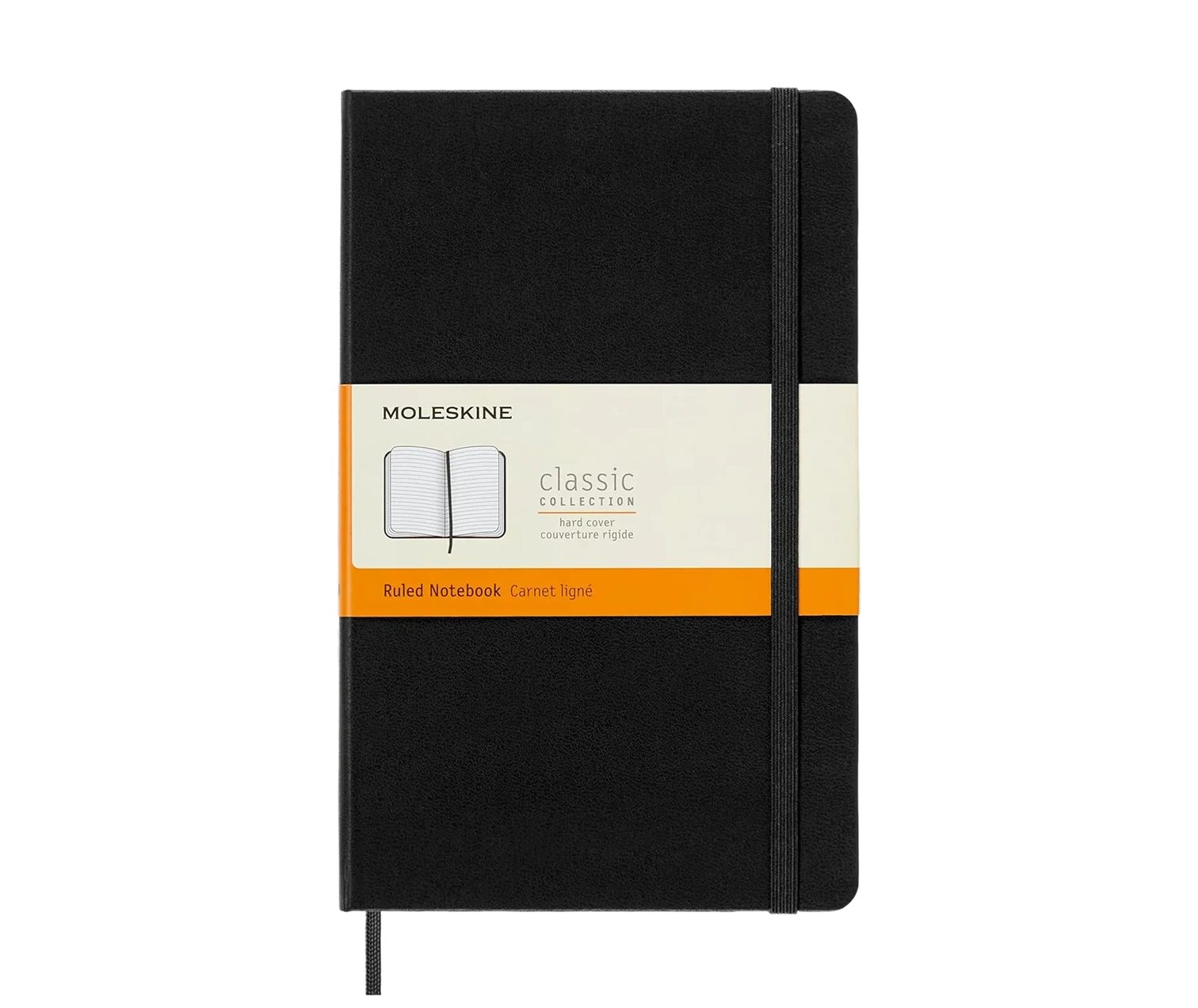
The Moleskine Classic Notebook opens at 180 degrees and lies flat there, so a spread stays put and you can write across the gutter rather than steering around it. It set the format the rest of the category borrowed: rounded corners, an elastic band across the front, a ribbon marker sewn into the binding, 70 g/m² ivory paper inside. That paper is acid-free, the stock that resists yellowing as the years pass. Moleskine says it comes from FSC certified forests and other controlled sources.
The back cover holds an expandable pocket for the paper that collects around a notebook: receipts, tickets, a page torn out of something else. On the flyleaf there is a printed 'In case of loss' line, waiting for a name and whatever reward you think the contents are worth. Even the paperband around the outside is reusable, printed with extra tools rather than torn off and binned on the way home. Each of the five sizes comes ruled, dotted, squared or plain.
The name comes from Bruce Chatwin's The Songlines, where he mourns the black oilcloth notebooks he used to buy in Paris. The small family firm in Tours that made the originals closed in 1986. Eleven years later, in 1997, the company known today as Moleskine brought the format back.
- Designed in
- Italy

- Material
- Sizes
- Pocket 3.5 x 5.5 in, Medium 4.5 x 6.9 in, Large 5 x 8.25 in, XL 7.5 x 9.75 in, XXL 8.5 x 11 in
- Colours
- Black, red, blue and others
Figures as published by the manufacturer. Source