Notebooks for writing and journaling, from MUJI to Ugmonk
Notebooks for writing and journaling, from the indexed Leuchtturm1917 A5 and Midori's thread-sewn MD Notebook to a leather journal bound on brass discs.
The notebooks for writing and journaling worth owning differ on three things you can check before you buy: how heavy the paper is, what holds the pages together, and whether you can find anything in the book once it is full. The six here run from a five-pack that costs less than a coffee to a leather journal whose pages come out and go back in.
Three are A5 hardbacks, the size most journals are sold in, and they part ways on paper weight and on what they do for an archive. One is a pocket book. One is a thin school exercise book bought in a set of five. The last is refillable, and on it you set the page order, not the binding. Prices run from $6 to $129. A table at the end lines up size, page count, paper and binding for all six.
1.Leuchtturm1917 A5 Notebook – $42
Pros
- 251 numbered pages and a contents page make a finished book searchable
- Eight perforated sheets tear out without leaving a stub
Cons
- At 423 g and 145 mm wide it is the bulkiest of the hardbacks
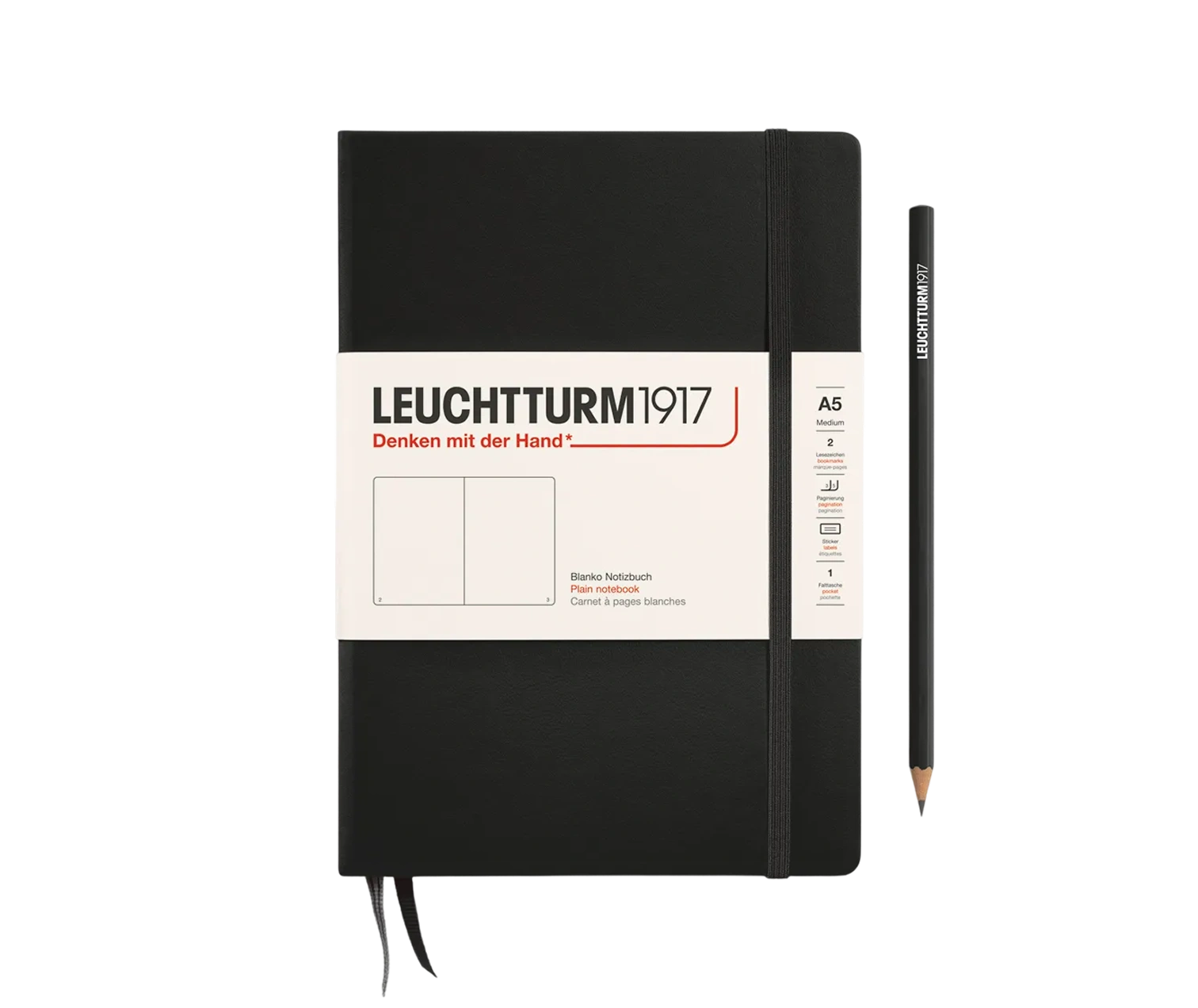
Every one of its 251 pages is numbered, and a blank contents page at the front turns those numbers into an index.
Most people write a journal front to back and never open it again, because finding one entry means reading the whole book. Leuchtturm1917 prints a page number in the corner of every page and leaves the first spread empty for a table of contents. Write the date and subject of an entry there as you go, and a book you finished two years ago can still be searched in a minute.
The rest of the kit points the same way. A sheet of stickers comes with every notebook, for labelling the spine and the cover. A shelf of finished books with dates on their spines is the result Leuchtturm1917 has in mind. Eight sheets at the back are perforated, so a page you mean to hand to someone tears out along a line and leaves no ragged stub in the gutter. Two ribbon markers keep your place in two sections at once, and a gusseted pocket inside the back cover takes loose paper.
The page is 145 by 210 mm, and the paper is 80 g/m², a slightly cream stock that is easier to read handwriting off than bright white. The finished book weighs 423 grams. It comes plain, ruled, dotted or squared.
Of the three hardbacks here it holds the most pages, eleven more than the Moleskine, and it is the one built for the shelf as much as for the bag. The firm has traded under the lighthouse name since 1917.
- Page size
- 145 × 210 mm (A5)
- Pages
- 251, numbered, with a blank contents page
- Paper weight
- 80 g/m²
- Binding
- Hardcover, elastic closure
- Weight
- 423 g
Specifications as published by the manufacturer. Source
2.Moleskine Classic Notebook – $26
Pros
- Almost 2 cm narrower than A5, so it fits smaller bags
- Acid-free paper resists yellowing in a journal kept for years
Cons
- 70 g/m² is the lightest paper of the three hardbacks
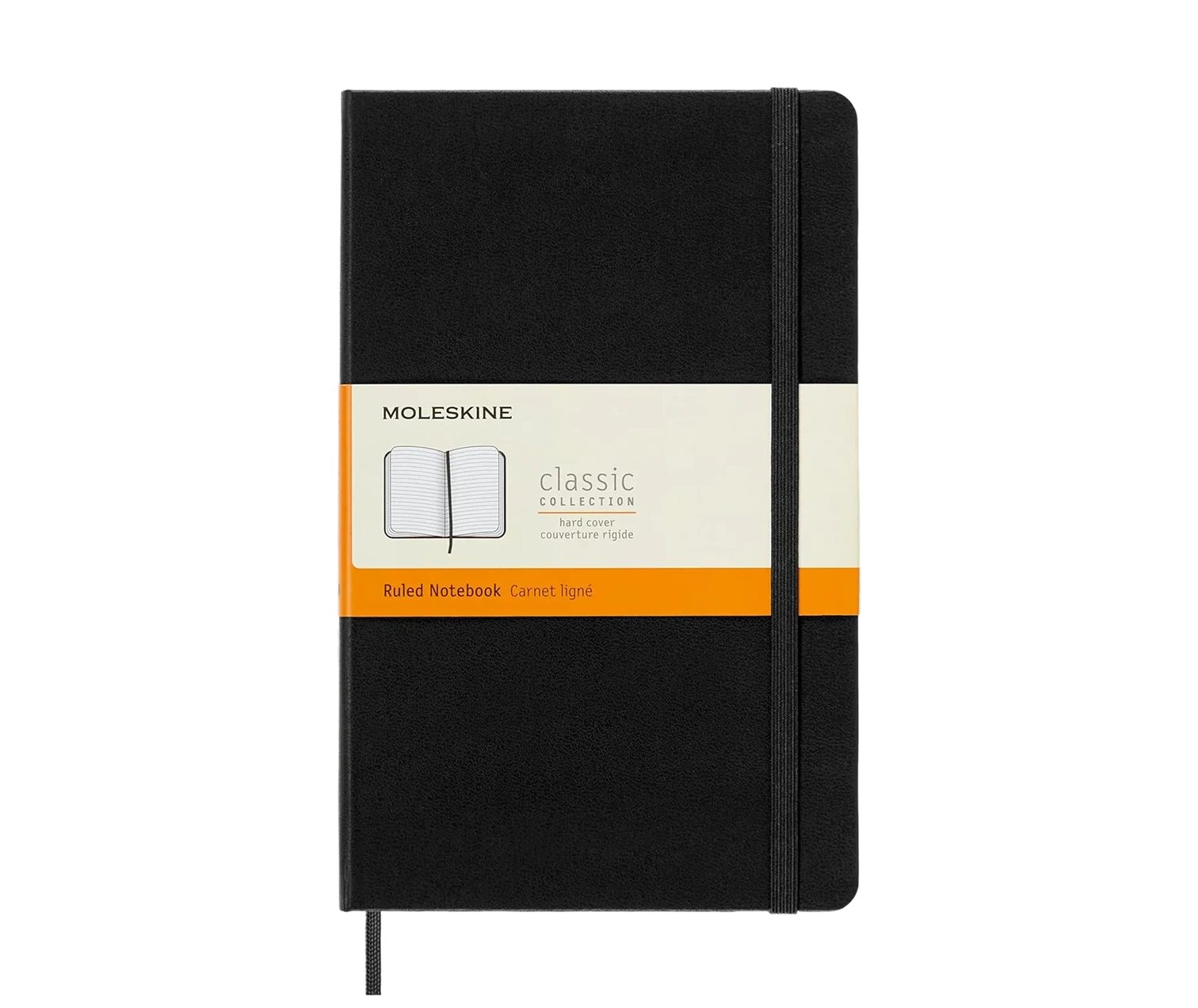
The format the rest of this list borrows from: rounded corners, an elastic band, a ribbon, a pocket in the back.
A hardback with a stiff spine fights you when you press it flat, so most writing in one happens at an angle with a hand pinning the page. The Moleskine Classic opens to 180 degrees and stays there, which means you can write across both pages of a spread, gutter included. In the Large size the page measures 5 by 8.25 inches, about 13 by 21 cm, narrower than true A5 by almost 2 cm. That small difference is why it slips into bags that the Leuchtturm1917 has to be pushed into.
Inside are 240 pages of ivory, acid-free paper at 70 g/m². Acid-free paper does not go yellow and brittle the way cheap paper does over decades, which matters in a journal you mean to keep. At 70 g/m² it is the lightest paper of the three hardbacks, and the tradeoff is plain: thinner paper makes a thinner, lighter book, and a wet ink shows through it more readily than through the 80 g/m² sheets in the Leuchtturm1917 or the Midori.
On the flyleaf there is a printed "In case of loss" line, with a space for a name and a reward. The expandable pocket inside the back cover is where receipts and tickets end up.
The name comes from Bruce Chatwin's The Songlines, in which he mourns the black oilcloth notebooks he used to buy in Paris. The small firm in Tours that made them closed in 1986. The company now called Moleskine brought the format back in 1997, and it comes in five sizes and four rulings.
- Page size
- 5 × 8.25 in (13 × 21 cm), Large
- Pages
- 240
- Paper weight
- 70 g/m², ivory, acid-free
- Binding
- Hardcover, opens to 180°
Specifications as published by the manufacturer. Source
3.Midori MD Notebook A5 – $10
Pros
- Same 80 g/m² paper weight as the Leuchtturm1917 at a quarter of the price
- Five layouts, including a 5 mm dot grid and a framed blank page
Cons
- No pocket, elastic or page numbers, and a soft paper cover
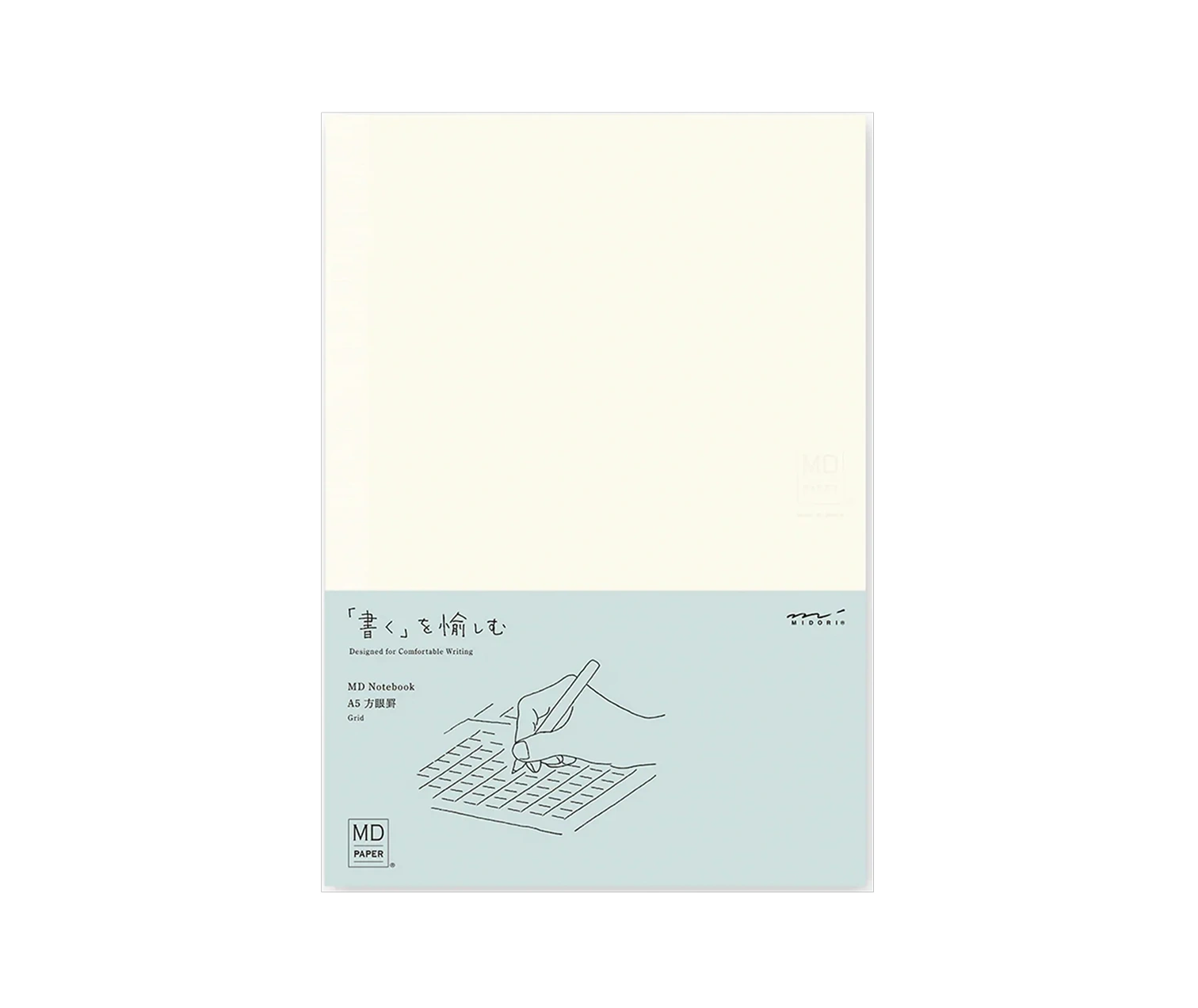
Cover, endpapers and all 176 pages are one paper, sewn with thread and left without a hard cover.
Most notebooks hide how they are made. Board gets wrapped, spines get glued, and the part that decides whether the book lies flat is out of sight. Midori leaves it showing. The pages are folded into bundles, called quires, and stitched with thread at the spine, and the cover is just MD paper, the same sheet as the pages. Nothing is laminated over it.
What that buys is a book that opens flat on its first page as easily as on its last, and a cover that wears the way the pages do. Each notebook ships in a glassine wrapper, the thin translucent paper once used to jacket books, which you can keep on as a dust cover or throw away. A bookmark string and a sheet of index stickers come with it.
The paper is the reason people buy it. MD paper is 80 g/m², the same weight as the Leuchtturm1917's, and Midori has made it since the 1960s. The A5 measures 210 by 148 mm and 10 mm thick, and weighs about 258 grams. It comes in five layouts: blank, lined at 7 mm, grid at 5 mm, dot grid at 5 mm, and a blank page with a printed frame.
At $10 it is a quarter of the price of the Leuchtturm1917, with the same paper weight and 75 fewer pages. It has no pocket, no elastic and no numbered pages. Midori sells leather and paper covers separately for anyone who wants one.
- Page size
- 148 × 210 mm (A5), 10 mm thick
- Pages
- 176
- Paper weight
- 80 g/m² MD paper
- Binding
- Thread-stitched quires, paper cover in glassine
- Weight
- About 258 g
Specifications as published by the manufacturer. Source
4.Ugmonk Discbound Heirloom Journal – $129
Pros
- Pages come off and go back on anywhere, and refills mean no last page
- Lies completely flat, with no spine to resist
Cons
- 120 pages as shipped, under half the Leuchtturm1917's 251
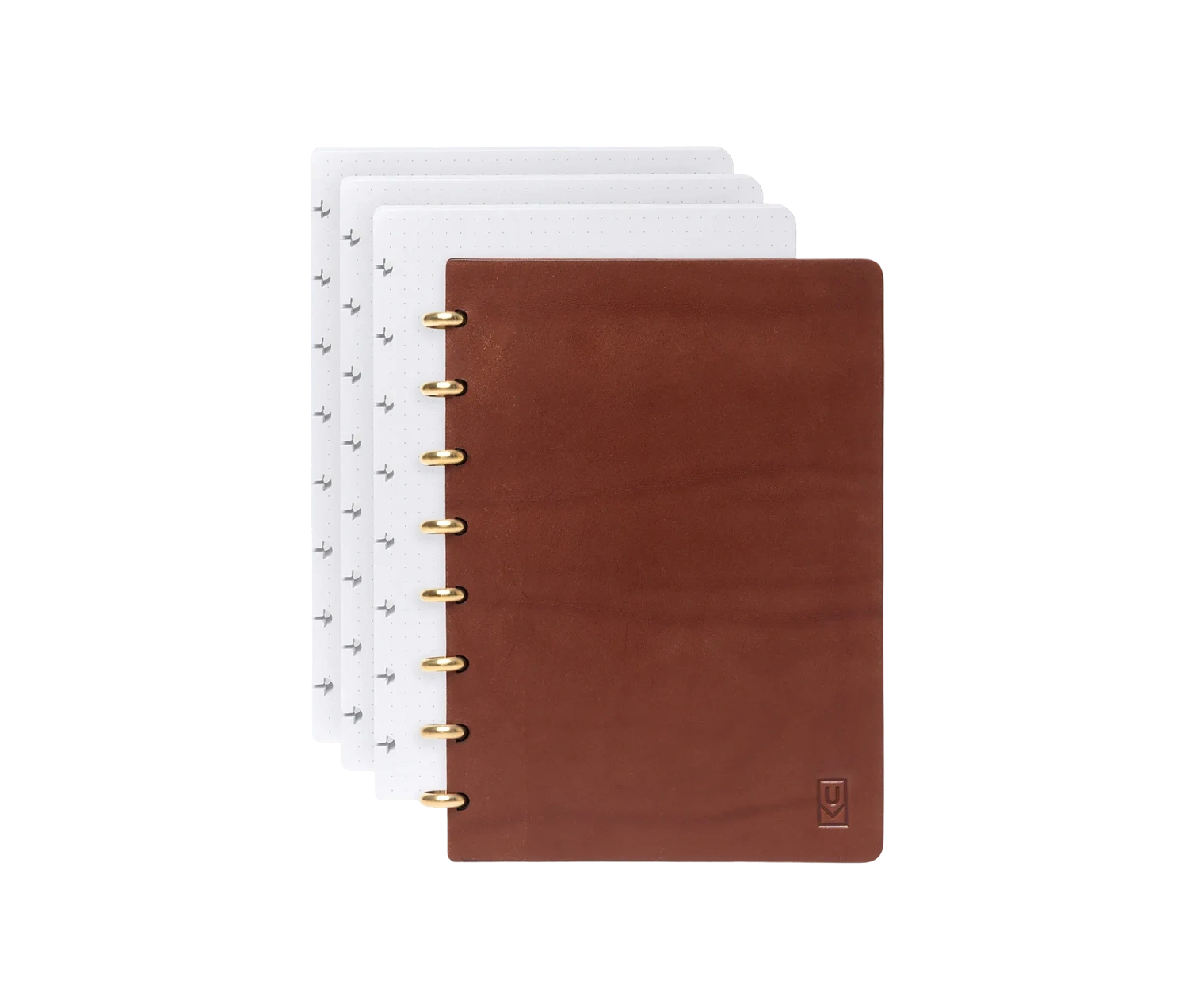
The only notebook here where a page can leave the book and come back somewhere else.
Sewn or glued, a notebook fixes its page order on the day it is made. The only edit you get later is tearing a page out. Ugmonk binds its journal on eight solid brass discs instead. Each page has a row of mushroom-shaped slots along its edge that grip the rim of the discs, so a page peels off and presses back on anywhere in the stack. A finished project comes out and goes into a box. A blank refill goes in at the front.
As it ships, the journal holds 120 dot grid pages of 70 lb smooth white paper, cut 6 by 8.5 inches. The 70 lb figure is a US measure on a different scale from g/m², so it cannot be read straight against the 80 g/m² of the Leuchtturm1917. Ugmonk says the paper is heavy enough to stop ink bleeding through. Lined and blank refills sit alongside the dot grid, and a journal bundled with three refills sells for $165.
Each cover is cut from one piece of full-grain leather, the top layer of the hide with its surface left on. That surface is why the markings vary from one journal to the next, and why the leather darkens where your hands rest on it. It lies completely flat, because there is no spine to resist.
It is made in the USA, by a small team in Pennsylvania. It ships with 120 pages, under half the Leuchtturm1917's 251, and on this book that is the least important number. Refilled, the book has no last page.
- Page size
- 6 × 8.5 in
- Pages
- 120 dot grid, refillable
- Paper weight
- 70 lb smooth white (US measure)
- Binding
- Eight solid brass discs, full-grain leather covers
Specifications as published by the manufacturer. Source
5.The James Brand TJB Daily Notebooks – $15
Pros
- 157 gsm is nearly double the paper weight of the A5 hardbacks
- Thread spine instead of staples, so nothing snags on a pocket
Cons
- 48 pages per book fills quickly with daily use
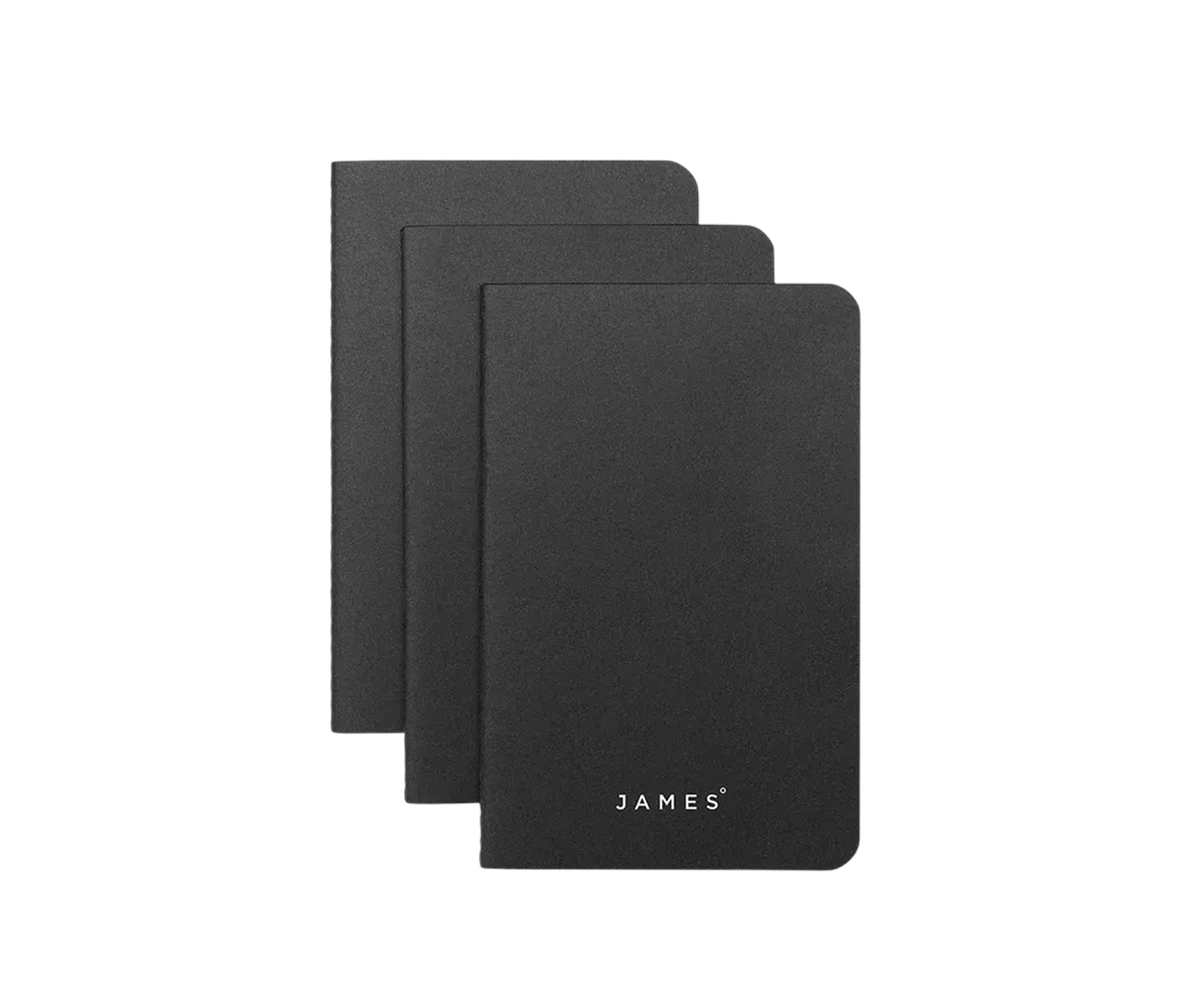
Pocket books with the heaviest paper here, 157 gsm, nearly double the A5 hardbacks.
A pocket notebook spends its life going in and out of a back pocket, and the two wire staples in the spine of most memo books are what give out first. The James Brand stitches the spine with black thread instead. Thread does not snag on a pocket lining the way a staple end does, and the book lies flatter when it is open.
Each book is 3.5 by 5.5 inches with 48 pages, and they come three to a pack, 144 pages in all. The paper is 157 gsm art paper, which is the same unit as g/m² under another name. At nearly twice the weight of the Leuchtturm1917's paper, it takes a soft pencil or a fountain pen without much showing on the page behind. The ruling is a dot grid. Dots guide a line of writing without crossing a sketch the way ruled lines do.
The James Brand makes knives and carry tools, and the notebooks are sized for its own notebook sleeves as well as a back pocket. The covers are plain apart from a small stamp, so one sits beside a pen and a knife in a sleeve without adding a logo to the set.
These are for notes taken standing up: lists, measurements, a phone number. Fill one, start the next, and the finished ones take up almost no room in a drawer.
- Page size
- 3.5 × 5.5 in (8.9 × 14 cm)
- Pages
- 48 per book, three books
- Paper weight
- 157 gsm art paper, dot grid
- Binding
- Stitched with black thread
Specifications as published by the manufacturer. Source
6.MUJI Planted Tree Paper Notebooks – $6
Pros
- Five colour-coded books for about a dollar each
- Sold as bleed-proof for highlighters and pens
Cons
- MUJI does not publish the paper weight, and there is no hard cover
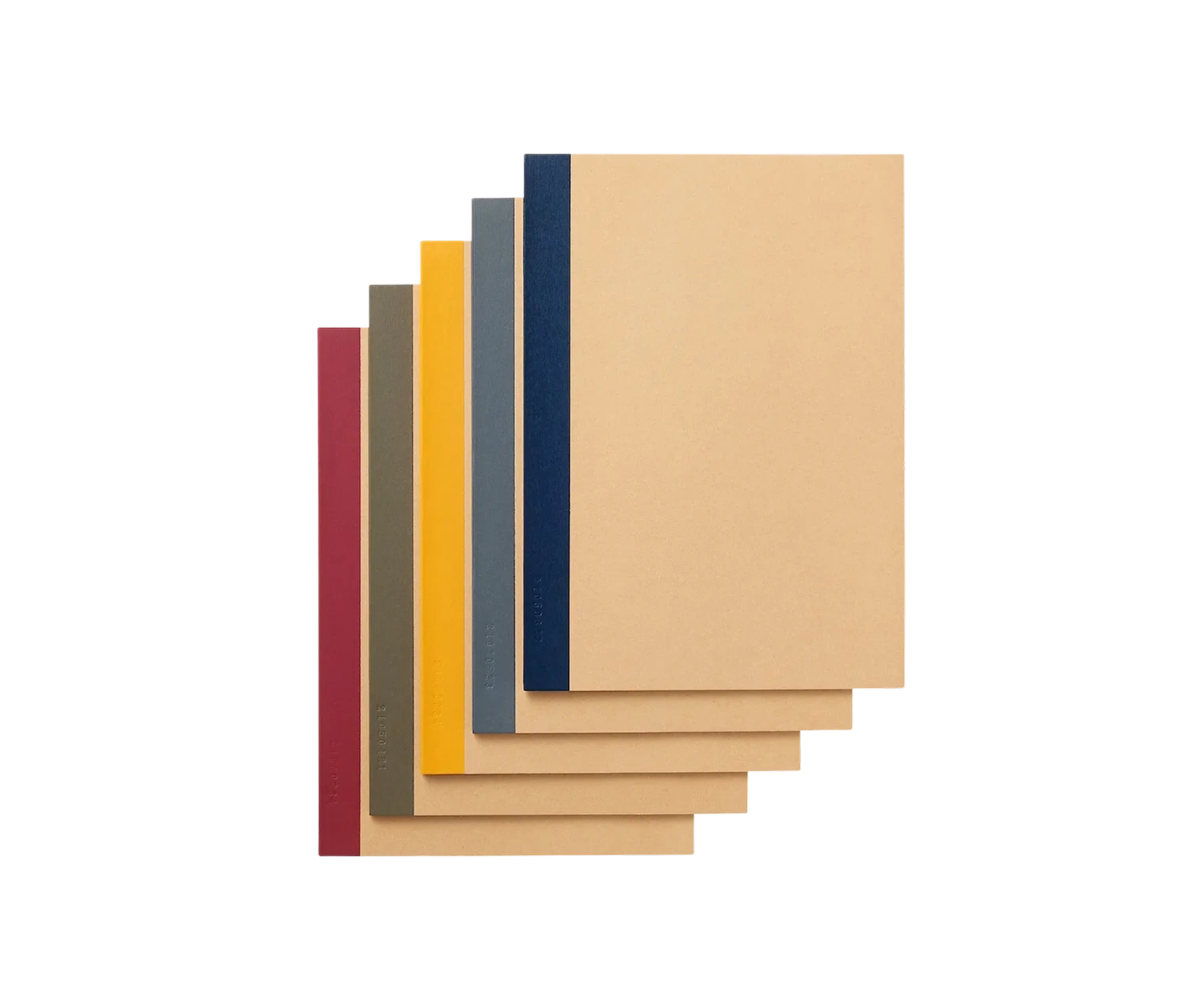
B5 exercise books in a pack of five, each spine a different colour, at about a dollar a book.
Cheap notebooks usually give themselves away on the first page, where a highlighter soaks through and sits on the back of the sheet. MUJI sells these as bleed-proof. The paper is thin, and MUJI rates it to take highlighters and pens without showing through. Each book has 36 sheets, so 72 pages, ruled at 6 mm, which is narrower than most American college rule.
B5 is a Japanese school size, 182 by 257 mm, which gives each page about half as much area again as A5. A pack of five, each with its own spine colour, gives one book per subject or project, told apart on a shelf with no label written on any of them. Nothing is printed on the covers.
The paper comes from MUJI's afforestation programme, in which the communities that grow the trees choose which ones to plant and take the benefit directly. MUJI started in Japan in 1980 under the line "lower priced for a reason", and these books are about as plain a reading of that line as the company makes: no hard cover, no ribbon, no pocket.
They are working notebooks, not keepsakes. They suit study notes, meeting notes and drafts you expect to fill in a month and recycle. MUJI does not publish the paper weight.
- Page size
- B5 (182 × 257 mm)
- Pages
- 36 sheets (72 pages) per book, five books
- Ruling
- Lined, 6 mm
- Binding
- Soft cover, colour-coded spine
Specifications as published by the manufacturer. Source
Choosing one
If the journal is meant to be kept and searched later, the Leuchtturm1917's numbered pages and contents page do that work for you. If you write with a fountain pen, the paper weight is the figure to read: the TJB Daily Notebooks at 157 gsm, then the Midori and Leuchtturm1917 at 80 g/m², then the Moleskine at 70. If the order of the pages should be yours to change, only the Ugmonk allows it. And for notes you will throw away, the MUJI five-pack costs less than a single book anywhere else on the list. For something to write in them with, see pens worth buying.
All 6 compared
Leuchtturm1917 A5 NotebookNumbered and indexed- Page size
- 145 × 210 mm
- Pages
- 251
- Paper
- 80 g/m²
- Binding
- Hardback
Moleskine Classic NotebookThe original format- Page size
- 13 × 21 cm
- Pages
- 240
- Paper
- 70 g/m²
- Binding
- Hardback
Midori MD Notebook A5Sewn, no hard cover- Page size
- 148 × 210 mm
- Pages
- 176
- Paper
- 80 g/m²
- Binding
- Sewn, paper cover
Ugmonk Discbound Heirloom JournalPages that move- Page size
- 6 × 8.5 in
- Pages
- 120
- Paper
- 70 lb
- Binding
- Brass discs
The James Brand TJB Daily NotebooksHeaviest paper, pocket size- Page size
- 3.5 × 5.5 in
- Pages
- 48 × 3
- Paper
- 157 gsm
- Binding
- Thread-stitched
Muji Planted Tree Paper NotebooksFive subjects, one pack- Page size
- 182 × 257 mm
- Pages
- 72 × 5
- Paper
- –
- Binding
- Softcover
MUJI does not publish a paper weight. Ugmonk quotes its paper in US pounds, which is a different scale from g/m² and cannot be compared directly.
How we chose
We looked for notebooks that differ on something a writer can check before buying: paper weight, how the pages are bound, and what happens to the book once it is full. That gave three A5 hardbacks that part ways on paper and on archiving, a pocket book, a five-pack of exercise books and one refillable journal, from $6 to $129. Every figure comes from the maker's own page and was checked against an independent retailer or review; Moleskine does not print a page count on its product page, so the 240 comes from two retailers who agree. Where a maker publishes nothing, as MUJI does not for paper weight, the figure is left out rather than estimated.
Common questions
It depends on whether you want to find entries again. The Leuchtturm1917 A5 numbers all 251 pages and leaves a blank contents page, so a finished journal can be indexed. The Ugmonk Discbound Heirloom Journal lets you move or remove pages. The Midori MD Notebook A5 has the same 80 g/m² paper weight as the Leuchtturm1917 for a quarter of the price.
Grams per square metre, the weight of one square metre of the paper, also written g/m². Heavier paper is thicker and lets less ink show through. In this list the TJB Daily Notebooks are 157 gsm, the Leuchtturm1917 and Midori are 80 g/m², and the Moleskine Classic is 70 g/m².
The Leuchtturm1917 A5 is 145 by 210 mm with 251 numbered pages of 80 g/m² paper, a contents page, two ribbons and eight perforated sheets. The Moleskine Classic Large is 13 by 21 cm with 240 pages of 70 g/m² ivory, acid-free paper and one ribbon. The Moleskine is slightly narrower and lighter; the Leuchtturm1917 has heavier paper and is built to be indexed.
Heavier paper shows less through to the back of the page, so the paper weight is the first figure to read. Of these six, the TJB Daily Notebooks are heaviest at 157 gsm, followed by the Midori MD Notebook and Leuchtturm1917 at 80 g/m², then the Moleskine Classic at 70 g/m².
Only to a refillable one. The Ugmonk Discbound Heirloom Journal binds its pages on eight brass discs, so pages come off and press back on anywhere, and Ugmonk sells dot grid, lined and blank refills. A sewn notebook like the Leuchtturm1917 or the Midori has a fixed set of pages.
About the author

Justin Farrugia
Founder & Editor of Curated Supply
Justin Farrugia is the founder and editor of Curated Supply, a design-led directory to things worth owning. He has personally curated over 1,000 products across workspace, carry, coffee, audio, and the home, each judged against one standard: design intent, material quality, and the restraint that lets a thing last.