About
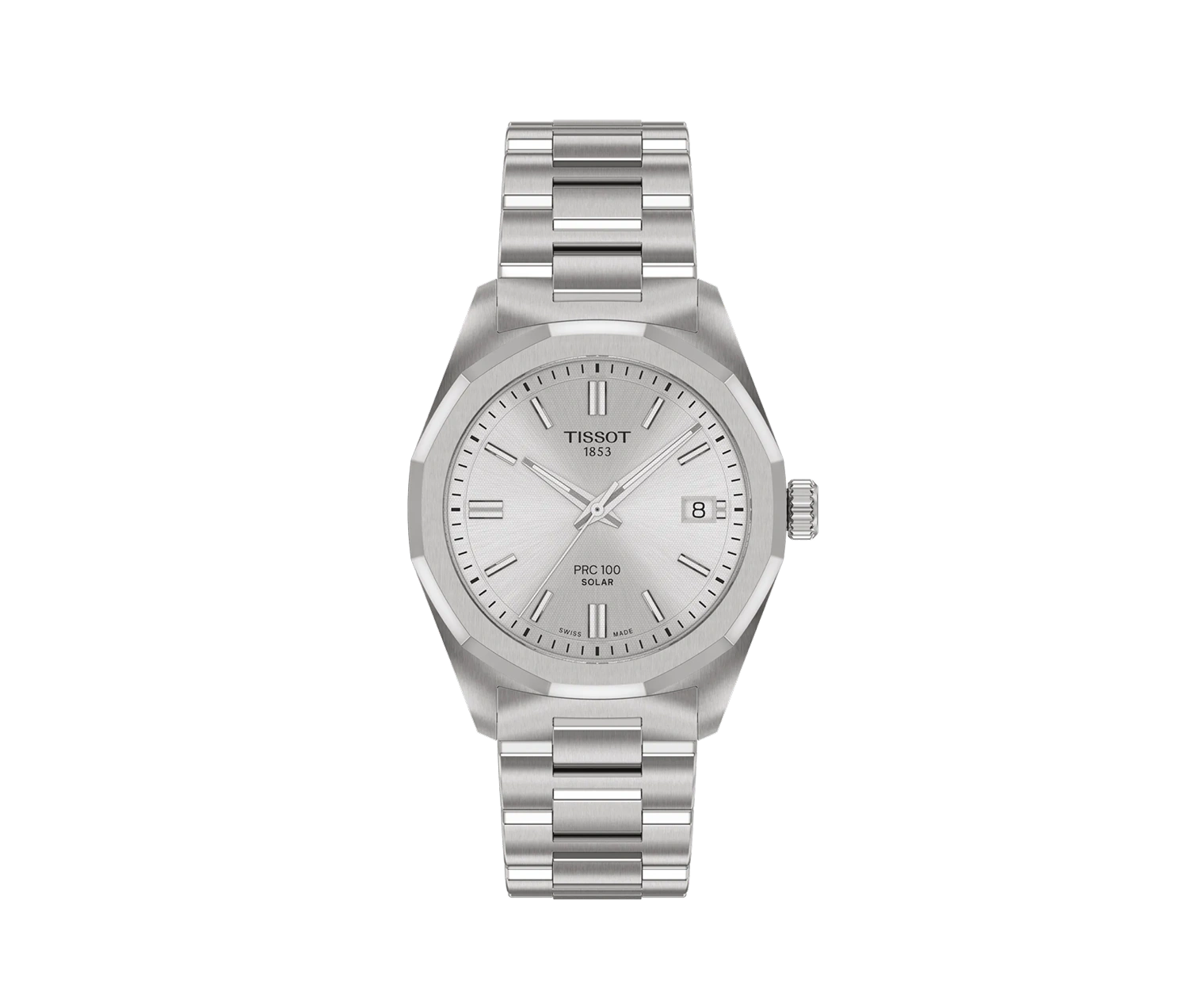
Solar watches usually announce themselves. The dial goes slightly cloudy, or a ring of cells sits under a translucent layer where the numerals should be. Tissot took a different route and put the cells in the glass.
The PRC 100 Solar's photovoltaic cells are a honeycomb pattern set into the sapphire crystal rather than a panel beneath the dial, and at arm's length you cannot see them. Lightmaster is the name Tissot gives the system, and it works on daylight and room light alike, converting both into current for the quartz movement and sending whatever is spare into a rechargeable accumulator. That buffer is what makes the numbers interesting. Ten minutes at 5,000 lux, roughly an overcast afternoon outdoors, banks a day of running in the dark. An hour of light a day for thirty days carries the watch through six months of darkness. From a full charge it keeps time for fourteen months with no light at all, or twenty if you pull the crown out to stop the hands.
When the accumulator does run low, the watch warns you a few hours ahead: the second hand begins jumping in four-second steps, which Tissot calls End of Energy mode, and the time and date stay correct throughout. A windowsill fixes it.
The case wears the design it arrived with. The PRC 100 first appeared in the mid-2000s, and the twelve flat sides of its bezel return here on the solar movement, with 20 millimetre lugs that accept any strap of that width.
- Designed & made in
- Switzerland

- Case
- 316L stainless steel, 39 mm across, 9.22 mm thick
- Crystal
- Sapphire
- Water resistance
- 100 metres (10 bar)
- Movement
- Lightmaster solar quartz
- Power reserve
- 14 months, 20 with hands stopped
Figures as published by the manufacturer. Source