Original
 Staff Pick
$1,199
About
Every other rower opens with a decision you are not qualified to make: pick a number on the damper, one to ten, before you have taken a single stroke. The WaterRower Original has no such number, and no setting at all.
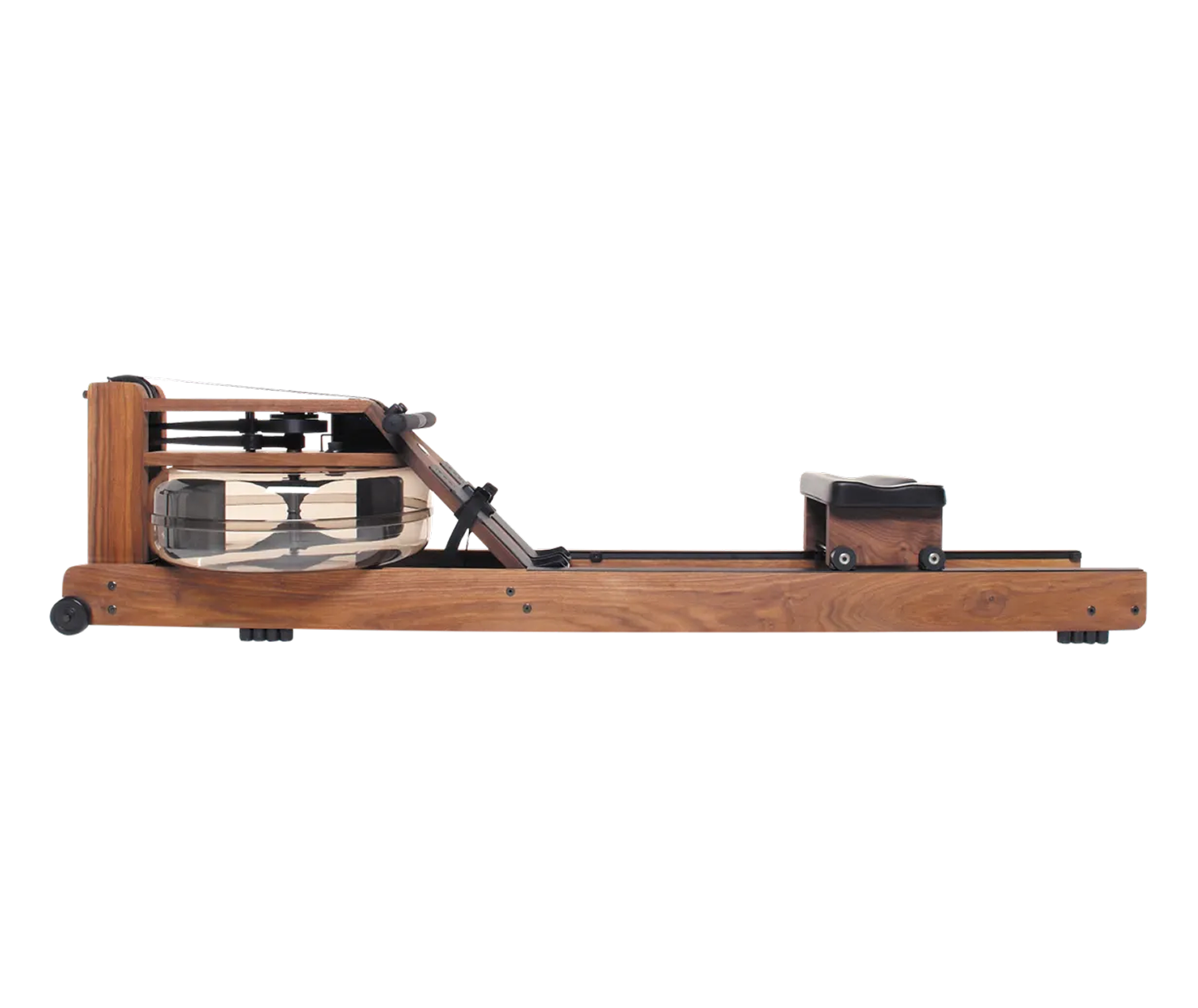
The WaterRower Original sets its resistance by the water itself, using the patented WaterFlywheel: a specially formed paddle cups the moving water to cut slippage, and water answers effort by the rule of cubes, so a small rise in stroke speed costs a large rise in drag. Pull harder and it pushes back harder, in the same instant, no harder and no softer than you asked. The company's way of putting it is that you are the engine. It is also why a gentle warm-up and a flat-out piece feel like two different boats, which is the effect John Duke was chasing when he filed the patent in 1987.
The frame is solid oak finished in Danish oil, and WaterRower's stated reason for the wood is acoustic rather than decorative: oak absorbs sound and vibration. The seat runs along two rails on eight ball-bearing polyurethane rollers, and the footrests adjust for leg length from a single button in the middle of the board. Stand the machine on its end and it stores at 82.25 inches tall on a footprint of 20 by 22.25 inches, which is roughly the floor space of an armchair.
Duke took the look from Shaker furniture, and the machine has since been shown at the Museum of Modern Art in New York and at London's Design Museum, which is unusual company for a piece of gym equipment. It is still handmade in Warren, Rhode Island, where production has sat since it moved back from England in 1997.
- Designed in
- United States

- designer
- John Duke
- Made in
- Warren, Rhode Island
- Material
- Dimensions
- 82.25 in long, 22.25 in wide, 20 in high in use
- Weight
- 63.5 lb without water
Figures as published by the manufacturer. Source