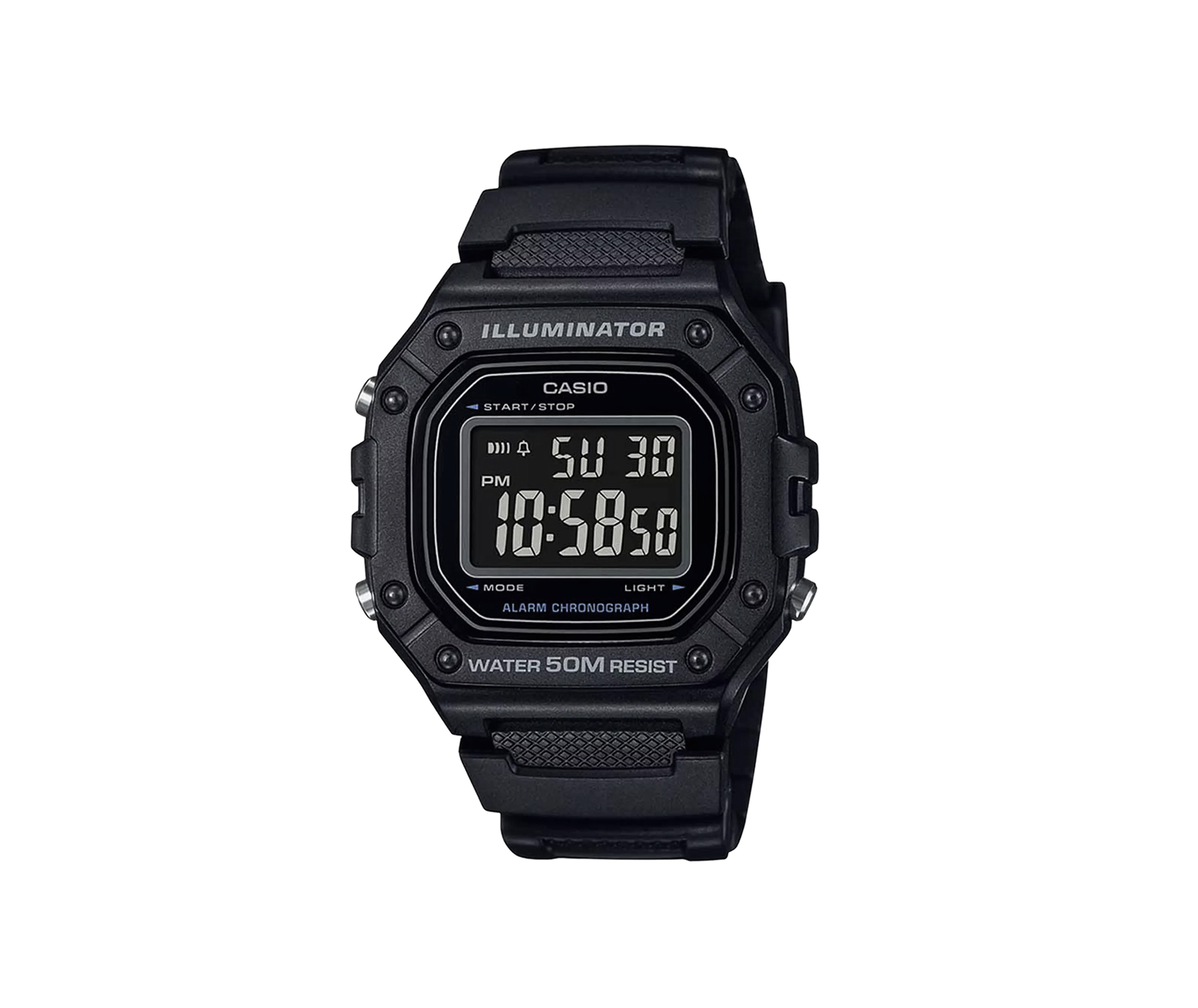
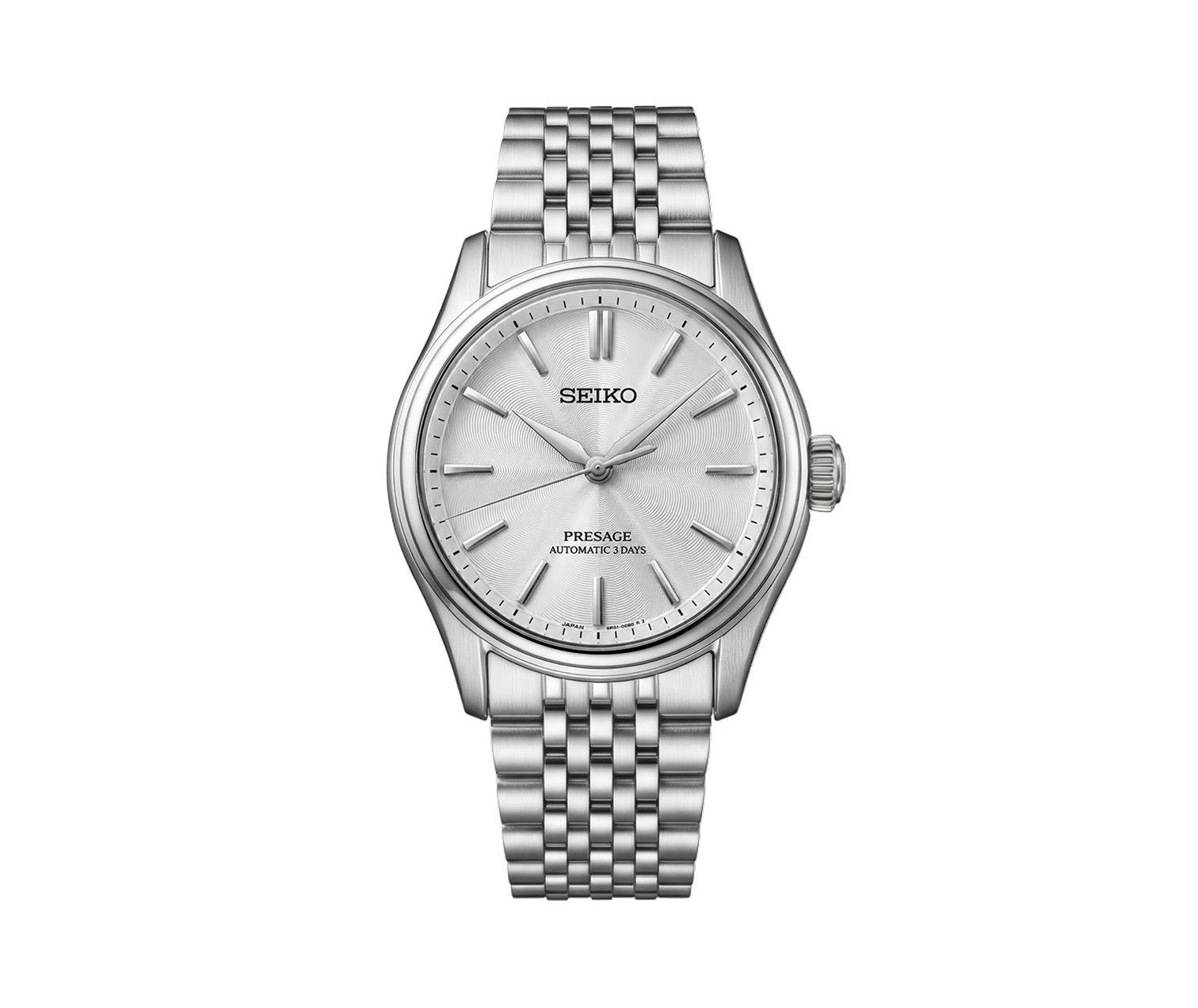
Minimalist watches under $300, from Slow and VOID to Timex
Minimalist watches under $300, from the one-hand Slow Round to the Timex Easy Reader, sorted by what each leaves off the dial, with glass and water ratings.
Minimalist watches under $300 differ less in quality than in what each one decides to leave off the dial. The five below run in order of that decision, from least on the face to most.
The Slow Round has one hand and no minute hand at all. The VOID V01MKII shows the time as digits in a slot of steel. The VOID PKG01 keeps hands and batons on a case 7 mm thick. The TID No.1 moves its crown to the other side. The Timex Easy Reader prints its numerals so large that the day-date window has to sit on top of one.
All five run on quartz, so the battery is the only part that wears out on a schedule, and Slow's is rated for 45 months. Where they differ most is the glass, sapphire on two and mineral on three, and the water rating, which runs from splash-proof to 10 atm. A short guide after the picks covers both.
A wider spread of styles in the same band sits in watches under $500, and the minimal timepieces list carries the same restraint up to five figures.
1.Slow Round

The only watch here with one hand, and it goes round once a day instead of twice.
Slow Watches builds every model on a 24-hour dial. The single hand takes the whole day to complete a turn, so the face shows where you are in the day as a position, the way a sundial does, and noon and midnight sit on opposite sides of it. Slow says the dial can be read to within a minute or two. That is the honest limit of one hand, and the point of it.
The Round arrived in 2017, a development of the brand's earlier round O. It has since overtaken the Jo, Slow's first model, as the best-selling family. The case is 40 mm of steel with a top-loading back, sealed to 10 atm, double the rating of anything else in this post. Inside is a Swiss Ronda 515.24 quartz movement on a Renata 371 cell, rated at 45 months, also the longest here. Ronda's tolerance for the calibre is minus 10 to plus 20 seconds a month, a drift one hand cannot show.
Two things to check before ordering. Each colourway carries a number, and they differ by more than colour: the 01 in the photograph is silver with a silver dial on black calf, while the Round 03, which our link opens, has an anthracite case, a blue dial, rose-gold hands and a dark brown strap. And Slow's current page lists sapphire, while a European retailer still lists one Round colourway with K1 mineral glass and a four-screw back, which reads as older stock.
The strap is two layers of Italian calf, 20 mm at the lugs and tapering to 18. Wearing it means giving up the exact minute. If you need to know it is 9:52 rather than ten to ten, the phone is still in your pocket.
- Display
- One hand, one turn every 24 hours
- Movement
- Ronda 515.24 Swiss quartz, Renata 371 cell, 45 months
- Case
- 40 mm steel, top-loading back
- Crystal
- Sapphire (older stock may be K1 mineral)
- Water resistance
- 10 atm
- Strap
- Italian calf, 20 mm tapering to 18 mm
Specifications as published by the manufacturer. Source
2.VOID V01MKII

The only digital watch here, with sapphire over the display and bare steel everywhere else.
David Ericsson founded VOID in Sweden in 2008, and the V01 was the watch it launched with. The MKII is the current run of that original. The case is a block of matte 316 steel, 36 by 42 mm and 8.4 mm thick, and the sapphire covers only the LCD in its upper half. The rest of the face is steel, so from across a room it reads as a slab with a slot cut in it.
The display shows time and date in 12-hour format, with a backlight for the dark, powered by a CR2016 coin cell. The buttons sit on the side of the case. The set button is recessed, and VOID's manual says to press it with a ballpoint pen or something similarly blunt. Water resistance is 5 atm.
VOID uses the same 36 by 42 mm case for the V02MKII, an analogue watch that reads the time off coloured hands, so the two are the brand's square shape done twice: once in digits, once in needles. The V01MKII came first, by a year.
The strap is black Italian leather, 22 mm at the lugs, sized for wrists from 155 to 200 mm. Unlike the PKG01 below, it uses ordinary spring bars with no quick-release pins, so changing it takes a strap tool.
Of the five, this is the one that answers to the minute without any interpretation: it spells out 9:52. It is also the one most people will not recognise as a watch from a distance.
- Display
- LCD, time and date, 12-hour, backlight
- Case
- 36 × 42 mm, 8.4 mm thick, 316 steel
- Crystal
- Sapphire, over the display only
- Water resistance
- 5 atm
- Battery
- CR2016
- Strap
- Italian leather, 22 mm, standard spring bars
Specifications as published by the manufacturer. Source
3.VOID PKG01

At 7 mm deep, the thinnest case in this post and in VOID's own collection.
Every other VOID is a rectangle. The PKG01 is round, 38 mm across, and VOID lists it as the thinnest watch it makes. Patrick Kim-Gustafson drew it, and the name is his initials. The dial carries batons, three hands and a date, and nothing else. On the version our link points at, the only colour that is not gold or white is the red tip of the seconds hand.
The case is 316 steel finished in IP gold, ion plating that bonds the colour to the steel as a thin coat. VOID brushes the flat surfaces and polishes the edges, so the side of the case reads as a line, and tapers the crown so it does not stand proud of it. The glass is mineral, where the V01MKII above has sapphire.
Inside is a Miyota GM10, a Japanese quartz calibre with a date. VOID's manual carries a warning worth knowing before you set it: change the date between about 9 pm and 1 am and it may fail to move on the next day. Set it in daylight.
Every PKG01 carries a code that names its case, strap and dial. GO/OL/WH is gold on olive leather with a white dial. VOID sells more than a dozen combinations, from $199 on leather to $219 on a steel bracelet. The strap is 18 mm on quick-release pins, so any other 18 mm strap goes straight on without tools. Water resistance is 5 atm.
It is the dress watch of the five. At 7 mm it fits under a shirt cuff, and with nothing on the dial to explain it reads as jewellery as much as an instrument.
- Display
- Three hands and date
- Movement
- Miyota GM10 quartz
- Case
- 38 mm, 7 mm thick, IP gold 316 steel
- Crystal
- Mineral
- Water resistance
- 5 atm
- Strap
- Italian leather, 18 mm, quick release
Specifications as published by the manufacturer. Source
4.TID No.1

The only watch here with its crown on the left, moved there so a bent wrist cannot press into it.
TID Watches started in Stockholm in 2012, co-founded by the design studio Form Us With Love, and the No.1 was its first watch. TID is Swedish for time. The design questions one convention most watches never do: the crown sits at 9 o'clock instead of 3, which TID says is to reduce contact with the wrist. Bend your hand back and a crown at 3 meets the back of it. At 9 it points the other way, up the arm.
Moving it changes the look as much as the comfort. The right side of the case is a clean edge, and that blank side is what identifies a No.1. The seconds hand ends in a small round tip, drawn to sit over the scale like a magnifying glass as it passes.
This version is 316L steel with a black ion coating, under mineral glass, on a Japanese quartz movement, rated to 5 atm. TID makes it in three sizes, 33, 36 and 40 mm, and lists the same 21 mm strap for all three, so a strap bought for one fits the others. Straps change without tools, and the leather is vegetable-tanned.
Choose the size at the shop. TID sells the No.1 Black as a separate listing for each strap, each with a choice of the three diameters, so the name alone does not tell you which watch you are getting.
On the right wrist the layout reverses. The crown points toward the hand, the way a conventional crown does on the left, so a left-hander who wears a watch on the right gets an ordinary watch, and everyone else gets a crown that never meets the back of the hand.
- Display
- Three hands, crown at 9 o'clock
- Movement
- Japanese quartz
- Case
- 33, 36 or 40 mm, black ion-coated 316L steel
- Crystal
- Mineral
- Water resistance
- 5 atm
- Strap
- Vegetable-tanned leather, 21 mm, tool-free
Specifications as published by the manufacturer. Source
5.Timex Easy Reader Watch
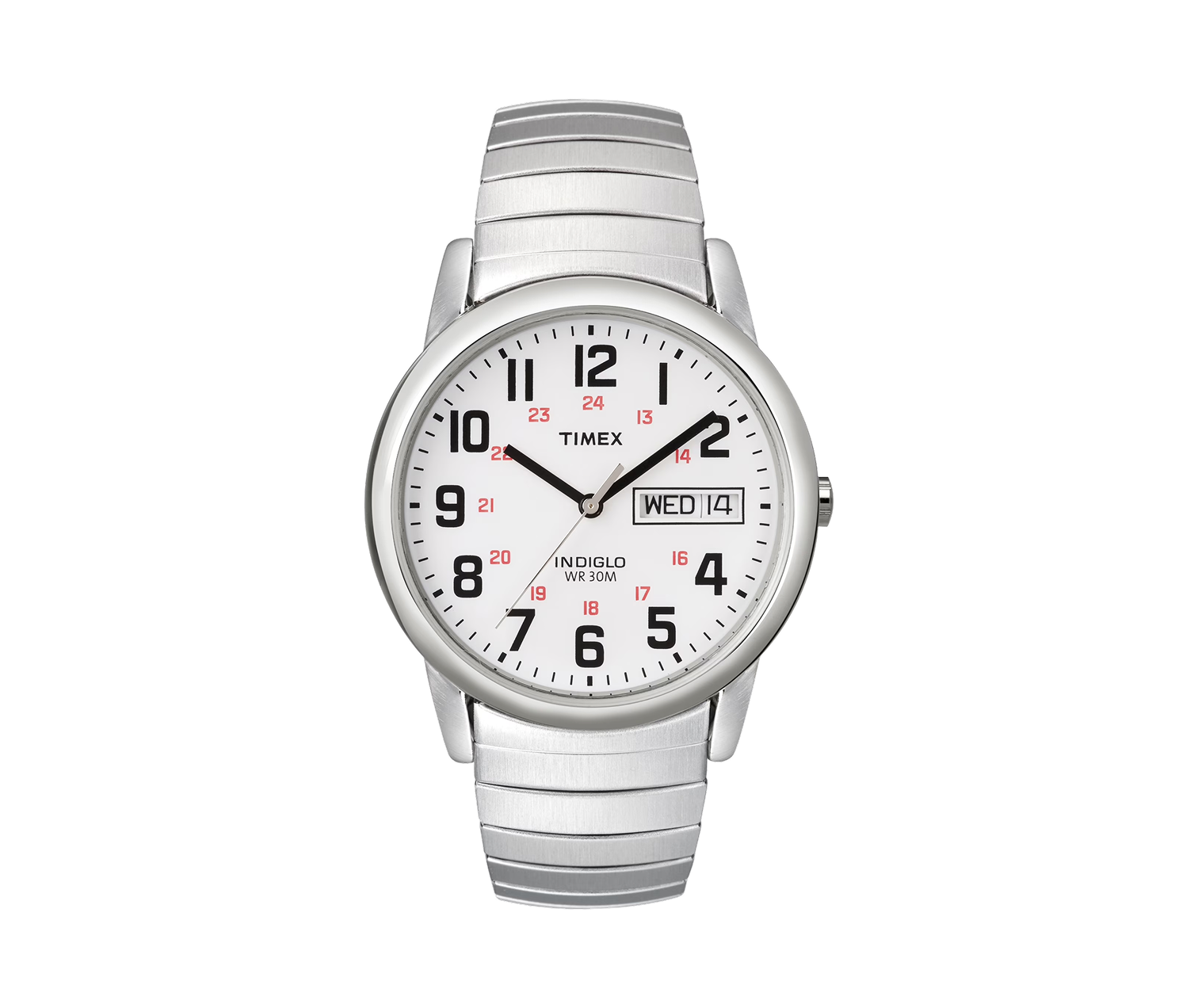
The most on any dial here, and the only one built to be read at a glance by anyone, at any distance.
Timex has sold the Easy Reader since 1977 on one idea: black Arabic numerals on a white dial, large enough to read without a second look, with hands scaled to match. Timex has called it a best-seller since launch. The reference our link opens, T20461, adds a day and date window and a small red 24-hour scale inside the hours, which makes it the busiest dial in this post. The window sits where the 3 would be, so this Easy Reader shows eleven numerals.
The case is 35 mm, which Timex lists as brass and low-lead brass in a polished silver tone. Some sellers call it stainless steel, but Timex's own page says brass. The crystal is mineral, the lugs are 18 mm, and the movement is quartz on a CR2016 cell. INDIGLO, the electroluminescent backlight Timex developed in the early 1990s, lights the whole dial at the push of a button, so the numerals read in the dark the way they read in daylight. Water resistance is 30 m, which Timex limits to hand-washing and splashes, with no showering or swimming.
The band is a stainless steel expansion bracelet with removable links and no clasp. It stretches over the hand and closes on its own.
The same watch is sold under four codes: T20461, T204619J at Timex US, T20461JT and T20461PF. The leather-strap Easy Reader, T2H281, is a different watch with a date only and a buckle, and weighs 37 g to this one's 59 g, so check the reference against the dial you want.
It is the only watch here a reader of any age can use without explanation, and the one place in this post to find the day of the week.
- Reference
- T20461, day-date, expansion band
- Display
- Three hands, Arabic numerals, day-date, INDIGLO
- Case
- 35 mm, brass and low-lead brass
- Crystal
- Mineral
- Water resistance
- 30 m, hand-washing and splashes only
- Battery
- CR2016
Specifications as published by the manufacturer. Source
How to choose a minimalist watch under $300
One hand, two hands, or digits
The Slow Round gives up the minute to show the whole day as one sweep, and reads to a minute or two. The VOID V01MKII gives you the exact minute as numbers. The PKG01, the TID and the Timex use hands in the usual way. Decide whether you want to read a watch or look at one before choosing anything else.
Sapphire or mineral glass
Two of these have sapphire: the Slow Round and the VOID V01MKII. Sapphire is hard enough that keys, desks and grit rarely mark it. The PKG01, the TID and the Timex use mineral glass, which is tougher against a knock but scratches more easily. On a watch worn daily, that difference is the one you see first.
What the water rating actually allows
The ratings here run from 30 m to 10 atm, and the numbers do not mean diving depths. The Timex's 30 m covers hand-washing and splashes only. The watches rated at 5 atm, both VOIDs and the TID, are fine for rain and hand-washing, and TID tells owners to avoid hot water and not to work the crown when wet. The Slow Round's 10 atm is the only one here you could take swimming without thinking about it.
The battery, and who changes it
Every watch here is quartz. The Slow Round runs a Renata 371 that Ronda rates at 45 months, the longest here. The V01MKII and the Timex both take a CR2016 coin cell, the same one sold for car keys. A screwed or top-loading back, like the Slow's, is a job for a watch shop, so that it stays sealed to its rating.
All 5 compared
Slow Watches Slow RoundOne hand, 24 hours- Display
- One hand, 24 h
- Case
- 40 mm
- Crystal
- Sapphire
- Water
- 10 atm
Void Watches V01MKIIDigital, half-glazed- Display
- LCD digital
- Case
- 36 × 42 mm
- Crystal
- Sapphire
- Water
- 5 atm
Void Watches PKG01Thinnest here- Display
- 3 hands, date
- Case
- 38 mm
- Crystal
- Mineral
- Water
- 5 atm
TID Watches No1BlackCrown on the left- Display
- 3 hands
- Case
- 33–40 mm
- Crystal
- Mineral
- Water
- 5 atm
Timex Easy Reader WatchMost on the dial- Display
- Day-date
- Case
- 35 mm
- Crystal
- Mineral
- Water
- 30 m
Slow figures are for the Round 03 our link opens, which shares its case, crystal and movement with the Round 01 shown. TID makes the No.1 in 33, 36 and 40 mm.
How we chose
We chose five quartz watches under $300 from the minimal timepieces list and ordered them by how much each puts on its dial, from one hand to a day-date window, because that is the decision a minimalist watch actually asks you to make. Every figure is quoted from the maker's page or manual for the reference our link opens and checked against an authorised retailer or the watch press. Two watches we had lined up were dropped because their links led to a different reference from the one we would have described. Where a maker and a retailer disagreed, as on the Timex's case metal and older Slow stock's glass, the maker's current page wins and the disagreement is named in the post.
Common questions
A dial with nothing on it that is not needed to read the time: no sub-dials, few or no numerals, and a plain case. The five here show how far that goes, from the Slow Round's single hand with no minute hand at all to the Timex Easy Reader, whose large numerals are the whole design.
The Slow Round's single hand turns once every 24 hours, so its position on the dial shows the time of day, the way a sundial does. Slow says it can be read to within a minute or two. It is not a watch for timing anything to the second.
It decides how the watch looks after a few years of daily wear. Sapphire resists the fine scratches keys and desks leave; mineral glass does not. Under $300 here, the Slow Round and the VOID V01MKII have sapphire, and the VOID PKG01, the TID No.1 and the Timex Easy Reader have mineral glass.
The rating is a pressure test, not a depth. Of the five here, only the Slow Round at 10 atm is rated well above everyday splashes. The Timex Easy Reader's 30 m rating is limited by Timex to hand-washing and splashes, with no showering or swimming.
TID puts the crown at 9 o'clock to reduce contact with the wrist: when you bend your hand back, a crown at 3 presses into it. Worn on the right wrist, the layout reverses and the crown points toward the hand, like a conventional watch on the left.
About the author

Justin Farrugia
Founder & Editor of Curated Supply
Justin Farrugia is the founder and editor of Curated Supply, a design-led directory to things worth owning. He has personally curated over 1,000 products across workspace, carry, coffee, audio, and the home, each judged against one standard: design intent, material quality, and the restraint that lets a thing last.