Action cameras that go where a phone won't
Five action cameras, from DJI's $269 Action 2 to the 8K GoPro MAX2, and what a mount and a sealed body do that a phone held in your hand cannot.
Action cameras still sell in the year a phone shoots 4K because a phone is the wrong shape for the moment you most want to keep.
The problem is never resolution. It is that one hand is on the bars, or in the water, or holding a child, and the thing you would film is happening in front of you for about four seconds. A phone needs a hand and a decision. These cameras need a mount and a button, and they survive being hit.
That is a different object from a camera you choose by how it looks and hold in two hands. Five here, running from a $269 magnet the size of a matchbox to a 360 camera shooting true 8K, in descending order of price.
1.DJI Osmo Pocket 4
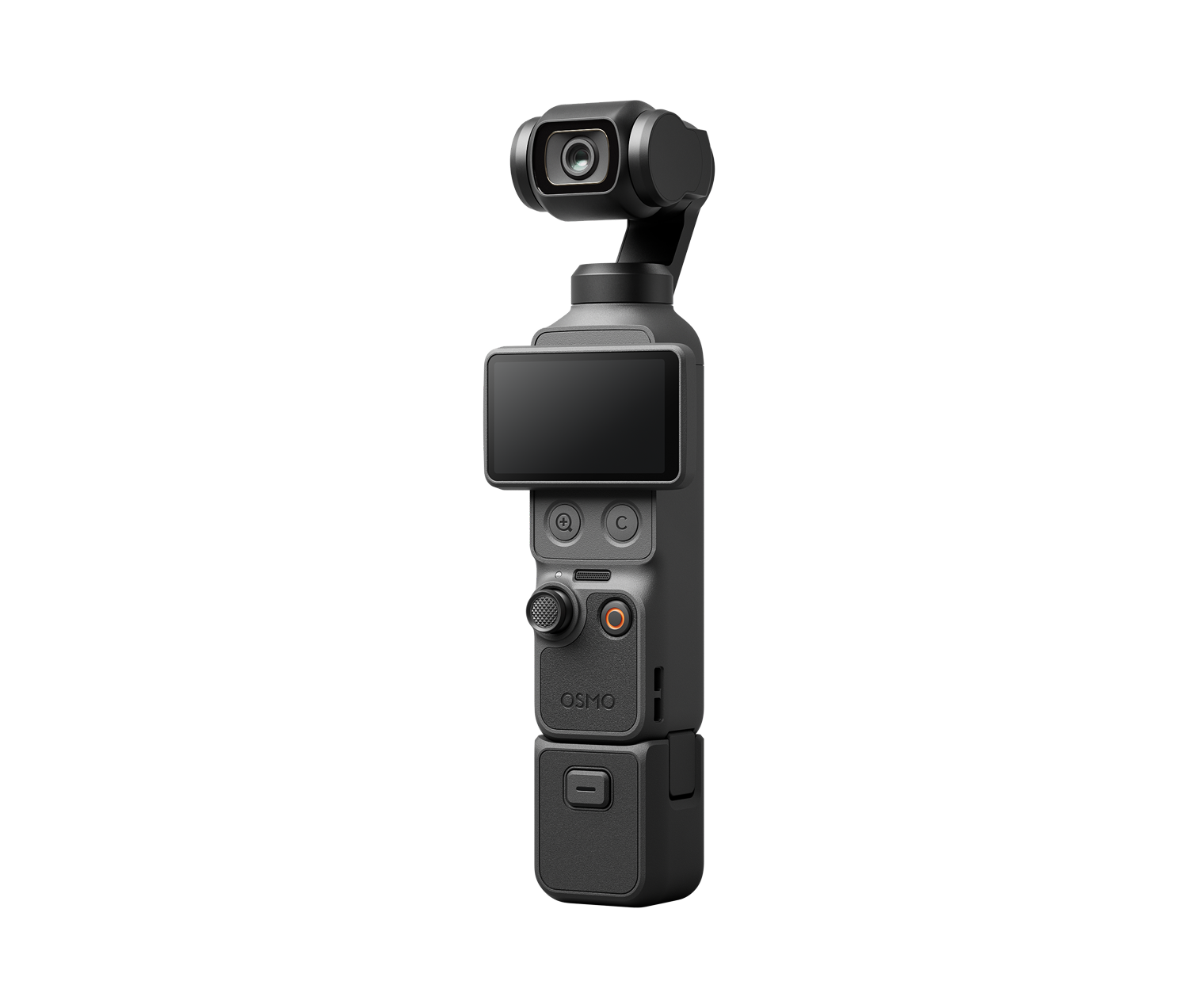
The only one of the five with a motor turning the lens.
Every other camera here stabilises in software. The sensor grabs a wider frame than it shows you, and the processor slides a crop around inside it to cancel out the shake. It works well and it costs you the edges of the picture. The Osmo Pocket 4 hangs its lens on a three axis gimbal instead, and small motors hold the camera level while the handle you are gripping does whatever your arm does. The frame arrives whole, because nothing needed cutting away.
DJI puts a 1 inch sensor behind an f/2.0 lens at 20 mm equivalent, which is the largest sensor in this group by a wide margin. It records 4K at up to 240 frames per second. The 2 inch screen rotates, and turning it to vertical switches the camera to a vertical frame, which is the whole reason people carry these to film themselves talking.
Two things to know before buying. Storage is 107 GB built into the body with no card slot, so a long trip is a decision about when you will next reach a laptop. DJI also publishes no waterproof rating for it, which is why this one belongs on a boardwalk and not on the board. It is 190.5 g and 144 mm long, a pen that films.
- Video
- 4K at up to 240 fps
- Stabilisation
- Three axis mechanical gimbal
- Waterproof
- Not rated
- Sensor
- 1 inch CMOS, f/2.0, 20 mm equivalent
- Storage
- 107 GB built in, no card slot
- Screen
- 2 inch rotatable OLED, 1000 nits
- Battery
- 240 min at 1080p 24 fps
- Weight
- 190.5 g
- Size
- 144.2 mm long, 44.4 mm wide, 33.5 mm deep
Specifications as published by the manufacturer. Source
2.GoPro MAX2
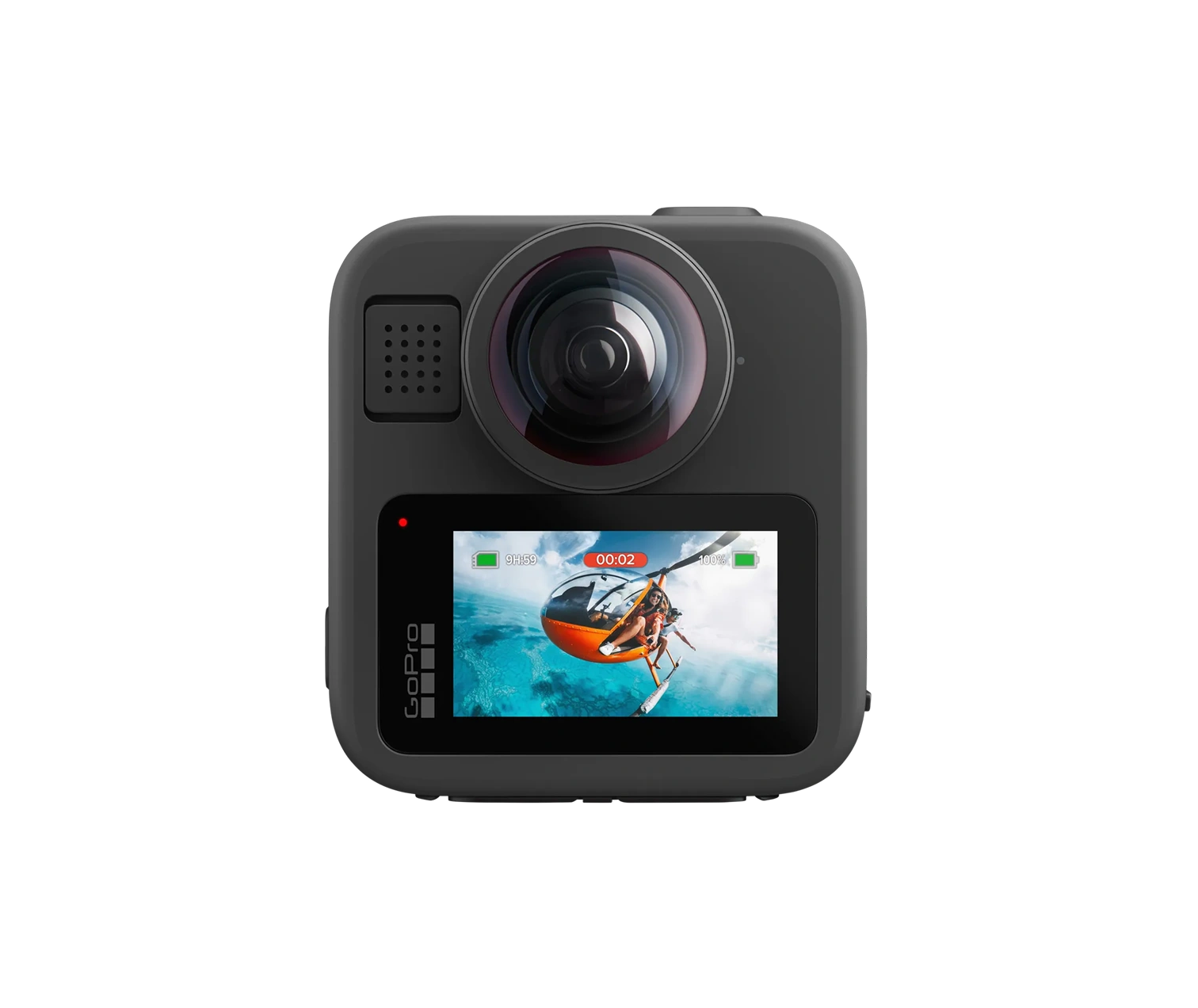
Two lenses pointing opposite ways, so framing becomes an editing decision.
A 360 camera records the whole sphere and lets you choose the shot afterwards. Point it at nothing in particular, ride down the hill, then sit at a laptop and pan around what already happened. MAX2 shoots that sphere in what GoPro calls true 8K, with 10 bit colour and bitrates to 300 Mbps, and pulls 29 megapixel stills out of the same two sensors.
The detail that matters most on a 360 camera is the least glamorous one. The glass sits proud of the body on both sides, because a lens that sees 180 degrees cannot hide behind a flat window, so it is the first thing to meet gravel. On MAX2 both lenses twist off and replace with no tools and no recalibration. A scratch on a 360 lens lands in the seam where the two images join, and that seam runs through the middle of every shot you frame later.
Six microphones handle audio from all sides. GPS sits inside the body, which is rare on a 360 camera and useful if you want speed and altitude burned into the footage. The 1960 mAh battery is GoPro's cold weather Enduro cell.
It is waterproof to 5 m, the shallowest here, so it is a rain and river camera and not a diving one.
- Video
- 8K 360, plus 5.6K60 and 4K100 spherical
- Stabilisation
- Max HyperSmooth with 360 Horizon Lock
- Waterproof
- 5 m (16 ft)
- Photos
- 29 MP 360
- Audio
- Six microphones
- Storage
- microSD, v30 or UHS-3
- Battery
- 1960 mAh cold weather Enduro
- Lenses
- Replaceable glass, twist off, no tools or recalibration
Specifications as published by the manufacturer. Source
3.GoPro HERO13
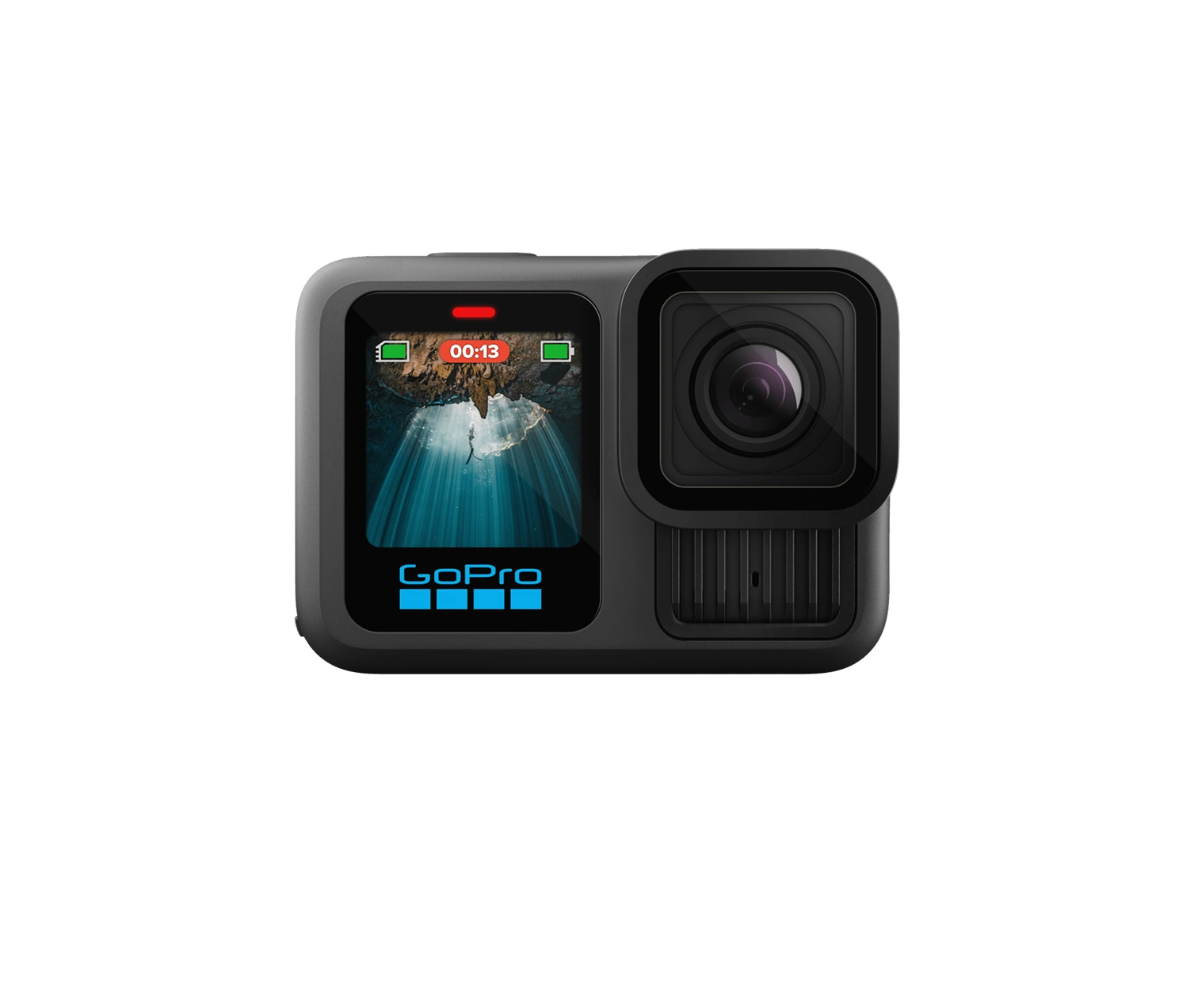
The default, and still the current one.
GoPro never shipped a HERO14. The next generation went into the MISSION 1 line in May 2026, which leaves the HERO13 as the newest camera in the HERO Black shape, two years after launch. That is worth knowing, because buying an action camera in the last month before a replacement is the classic way to lose $150.
It shoots 5.3K at 60 frames, 4K at 120, and 1080p at 240, plus a burst mode that reaches 400 frames per second at 720p for fifteen seconds. Stills are 27 megapixels. It is waterproof to 33 ft, which is 10 m, and the 1900 mAh Enduro battery runs over an hour and a half at 4K30.
Buy it for the system, not the sensor. HERO13 reads which HB series lens you have screwed on and sets itself up for it, so a macro lens, an ultra wide, an anamorphic or a set of neutral density filters each change what the camera is without changing the settings you have to remember. Underneath there are folding mounting fingers, a magnetic latch and a 1/4-20 thread, which between them fit almost every mount made in the last decade.
At 154 g and 72 mm across it is the one you stop thinking about.
- Video
- 5.3K60, 4K120, 1080p240
- Stabilisation
- HyperSmooth 6.0
- Waterproof
- 10 m (33 ft)
- Photos
- 27 MP
- Storage
- microSD, v30 or UHS-3
- Battery
- 1900 mAh Enduro, over 1.5 h at 4K30
- Lens mods
- HB series, recognised automatically by the camera
Specifications as published by the manufacturer. Source
4.Insta360 GO 3S
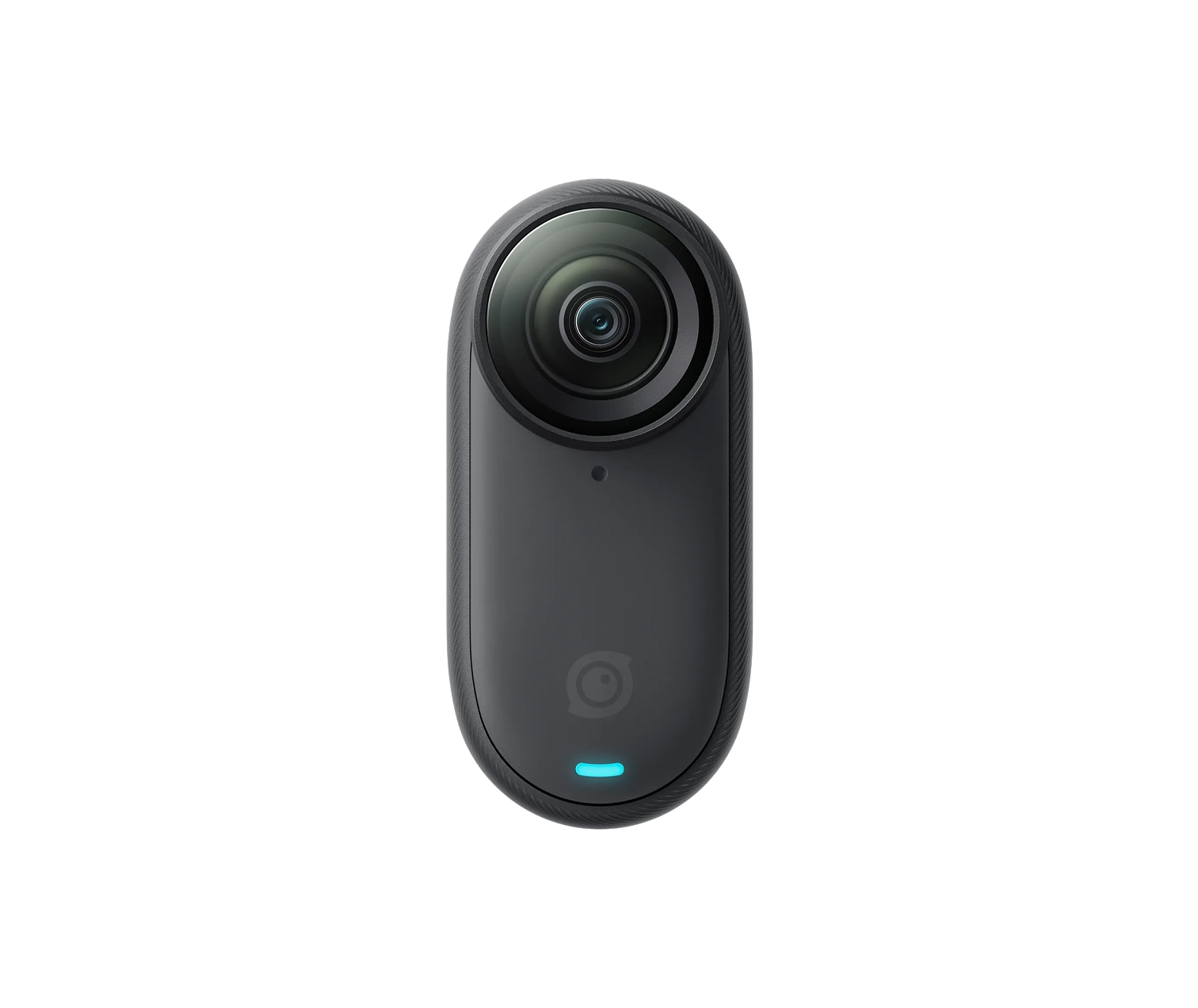
Thirty nine grams, and that number is the entire argument.
The GO 3S camera is a thumb. It weighs 39.1 g, measures 25.6 by 54.4 mm, and clips to a magnetic pendant you wear under a shirt, so the lens sits at your sternum and your hands are free. Nothing else here can be worn that way without you feeling it. It shoots 4K through an F2.8 lens at 16 mm equivalent and goes 10 m underwater on its own.
It ships with a folding case Insta360 calls the Action Pod, which holds a 2.2 inch screen, a 1270 mAh battery and the camera's charger, and works as a remote monitor when the camera is stuck to something across the room. The camera's own 310 mAh cell runs 45 minutes. Dropped into the pod, the pair runs 170. Note that the pod itself is only splash resistant, so the 10 m rating belongs to the thumb and not to the case.
Insta360 fixes storage at 32, 64 or 128 GB with no card slot, the same constraint as the Pocket 4.
Insta360 has since released the GO Ultra, which takes microSD cards and runs longer. It also weighs 52.9 g and moves to a squarer body about the size of a watch face. If you are buying a camera to forget you are wearing, the older, smaller one is the point.
- Video
- 4K at 30 fps
- Stabilisation
- FlowState, with Horizon Lock below 4K30
- Waterproof
- 10 m camera, Action Pod splash resistant only
- Lens
- F2.8, 16 mm equivalent
- Storage
- 32, 64 or 128 GB built in, no card slot
- Battery
- 45 min camera, 170 min with the Action Pod
- Weight
- 39.1 g camera, 96.3 g Action Pod
- Size
- 25.6 mm wide, 54.4 mm high, 24.8 mm deep
Specifications as published by the manufacturer. Source
5.DJI Action 2 Dual-Screen Combo
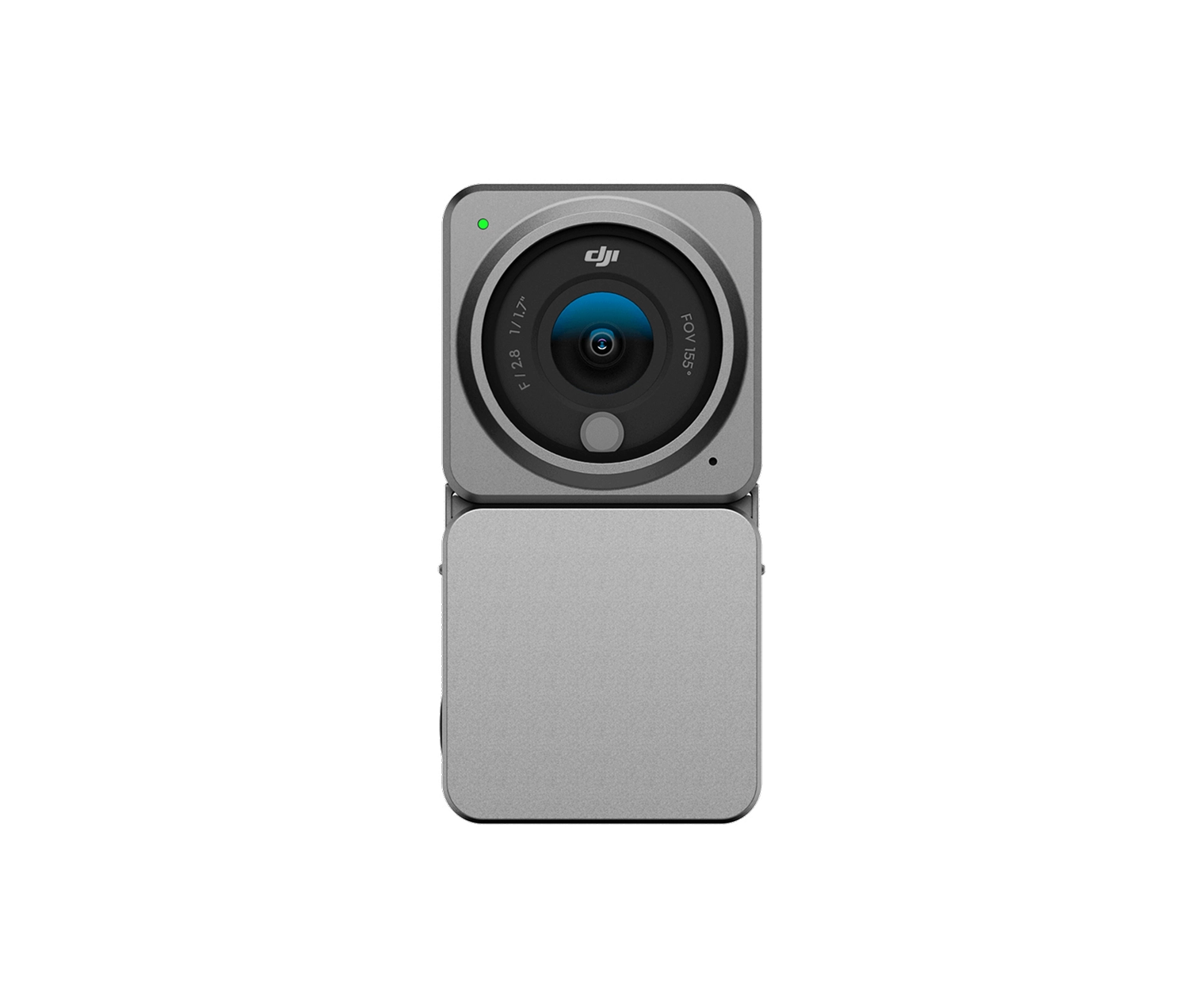
A 56 gram cube that snaps onto things with magnets.
The Action 2 came out in 2021 and DJI has never replaced its idea. The camera is a square of brushed aluminium with a 1.76 inch OLED touchscreen on the back, a 1/1.7 inch sensor behind a 155 degree lens, and 4K at up to 120 frames. DJI rates it IP68 to 10 m bare, and 60 m in the case. There is no mounting arm and no cage. Two magnetic latches on the base hold it to a lanyard, a clip or a helmet mount, and it comes off in one movement.
The dual screen part is a second module that clicks underneath. It adds an OLED screen facing forward, so you can see yourself while filming, and three more microphones for a four mic array. It also nearly doubles the run time, from 70 minutes on the camera alone to 160 with the module attached.
Buy this one clear eyed. Five years is old for a camera and DJI now sells larger Osmo Action models with better low light. What none of them do is weigh 56 g and split into parts. At $269 with the screen module included it is the cheapest way into a body that mounts anywhere, and the modularity is still unusual enough that nobody has copied it well.
- Video
- 4K at up to 120 fps
- Stabilisation
- RockSteady 2.0 with HorizonSteady
- Waterproof
- 10 m IP68, 60 m in the case
- Sensor
- 1/1.7 inch, 155 degree field of view
- Screen
- 1.76 inch OLED, second OLED on the front module
- Audio
- Four mic array once the front module is attached
- Battery
- 70 min alone, 160 min with the front module
- Weight
- 56 g camera unit
Specifications as published by the manufacturer. Source
What actually separates these
Mechanical stabilisation and the software kind
A gimbal moves the lens. Electronic stabilisation moves the crop. The gimbal keeps the whole frame and adds motors, weight and a moving part that a knock can damage. Software keeps the camera solid and sealed and quietly hands back some of the picture. The Pocket 4 is the only mechanical one here, and it is also the only one with no waterproof rating, which is not a coincidence.
The waterproof number is not a swimming depth
A depth rating is a pressure rating, measured static. Moving through water at speed, or hitting it from a height, puts more pressure on a seal than sitting at that depth does. Treat 10 m as a rating that covers rain, surf and a swimming pool, and 5 m as one that covers rain and a river. Both are far beyond what a phone survives.
Where the footage lives
Two of these five have no card slot. The Pocket 4 holds 107 GB and the GO 3S holds up to 128, and when either fills you must offload before you shoot again. The three GoPro and DJI bodies that take microSD cards let you carry spares in a pocket for a few dollars each. On a two week trip this matters more than any spec on the sensor.
The mount is the product
Almost nobody holds these. The HERO13 uses folding fingers, a magnetic latch and a tripod thread. The Action 2 and GO 3S both use magnets, which are faster and hold less firmly. MAX2 mounts low and flat because a tall 360 camera puts your own mount into the shot. Work out where the camera is going to live first, then buy the camera that goes there.
Deciding now against deciding later
Every camera here except MAX2 asks you to point it at something. MAX2 asks you to press record and decide later, at a desk, with the whole sphere in front of you. That is either a relief or an extra hour of editing per outing, and which one it is depends entirely on whether you enjoy the editing.
All 5 compared
DJI Osmo Pocket 4The only real gimbal here- Video
- 4K/240
- Stabilisation
- 3-axis gimbal
- Waterproof
- Not rated
GoPro MAX2Frame it afterwards- Video
- 8K 360
- Stabilisation
- Max HyperSmooth
- Waterproof
- 5 m
GoPro HERO13Still the default- Video
- 5.3K/60
- Stabilisation
- HyperSmooth 6.0
- Waterproof
- 10 m
Insta360 GO 3SWearable at 39 grams- Video
- 4K/30
- Stabilisation
- FlowState
- Waterproof
- 10 m
DJI Action 2 Dual-Screen ComboCheapest way to mount anywhere- Video
- 4K/120
- Stabilisation
- RockSteady 2.0
- Waterproof
- 10 m
Weight is not a column because GoPro publishes no weight for MAX2 anywhere on its product pages. The HERO13 figure quoted in the write-up, 154 g, comes from authorised GoPro dealers rather than from GoPro, for the same reason.
How we chose
We started from the action cameras in the catalogue that no post had covered, and cut the ones a newer model has replaced. That took out the Osmo Pocket 3, which DJI superseded with the Pocket 4 in April 2026, and it is why five cameras are here instead of six. The remaining five sit between $269 and $500, which is a narrow ladder, and that is the truth about this category rather than a gap in the selection: an action camera that costs more than $500 is usually a cinema camera wearing the wrong name. Every figure below comes from the maker's own page or manual except where the note under the table says otherwise.
Common questions
It depends on whether the shot needs a hand. A phone matches these cameras on resolution and beats most of them on sensor size, but it has to be held, unlocked and pointed, and it is the most expensive thing in your pocket to drop in a river. An action camera is bought for the mount and the seal. If what you film is always in front of you while you stand still, a phone is enough. If it happens while you are moving, and both hands are busy, it is not.
A gimbal is motors that physically hold the lens level while the body moves. Electronic stabilisation records a wider frame than it shows you and slides the crop around inside it to cancel the shake. The gimbal keeps the whole picture and adds weight, cost and a moving part. Electronic keeps the camera sealed and solid and takes back some of the edges of your frame. Only the Osmo Pocket 4 here is mechanical, and it is also the only one with no waterproof rating.
It is a different way of working, not a better one. A 360 camera records the whole sphere, so you point it at nothing and choose the shot later at a laptop. That is a relief if you hated missing the moment and an extra hour of editing if you did not. The GoPro MAX2 shoots that sphere in 8K and can also be used as a normal single lens camera at 4K60. Everything else here asks you to decide where to aim before you press record.
There is no HERO14. GoPro put its next generation into the MISSION 1 line, which went on sale in May 2026, which leaves the HERO13 as the newest camera in the familiar HERO Black shape. Buying a camera in the last month of its cycle is how people lose money on this category, and that is not the position the HERO13 is in.
The Insta360 GO 3S, at 39.1 g. It hangs from a magnetic pendant worn under a shirt, with the lens at your sternum and both hands free, and nothing else here is light enough to disappear like that. The trade is run time and storage: 45 minutes on the camera's own battery, and a fixed 32, 64 or 128 GB with no card slot. Insta360's newer GO Ultra fixes both and weighs 52.9 g, which for this particular job is the wrong direction.
About the author

Justin Farrugia
Founder & Editor of Curated Supply
Justin Farrugia is the founder and editor of Curated Supply, a design-led directory to things worth owning. He has personally curated over 1,000 products across workspace, carry, coffee, audio, and the home, each judged against one standard: design intent, material quality, and the restraint that lets a thing last.