Digital watches under $150, and how each one lights up
Digital watches under $150, from the 6 mm Casio A700W to the Armitron Griffy, a steel watch whose red LED digits stay dark until you press the button.
Digital watches under $150 all keep roughly the same time, so the differences that matter sit elsewhere: how deep each one can go, how thin its case runs, and what happens when you press the light button in the dark. The six here run from $30 to $149 and light up in three different ways. Two glow amber from the edge of the display, three light the whole panel evenly, and one has no backlight at all, because its digits are the light.
Casio makes four of the six, and each of the four is here for a different number: the water rating, the thickness of the case, the light, or the calendar. The F-91W and the standard G-Shock square already have their own sections in the best watches under $500, so neither gets one here.
1.W218H – $30
Pros
- 50 m of water resistance, enough for a shower and a swim, at the lowest price here
- Seven years on one CR2016 cell
- 37 grams, light enough to forget until the hourly beep
Cons
- The calendar is set at 28 days for February, so a leap year needs one correction
- Resin crystal, which marks more easily than the A700W's mineral glass
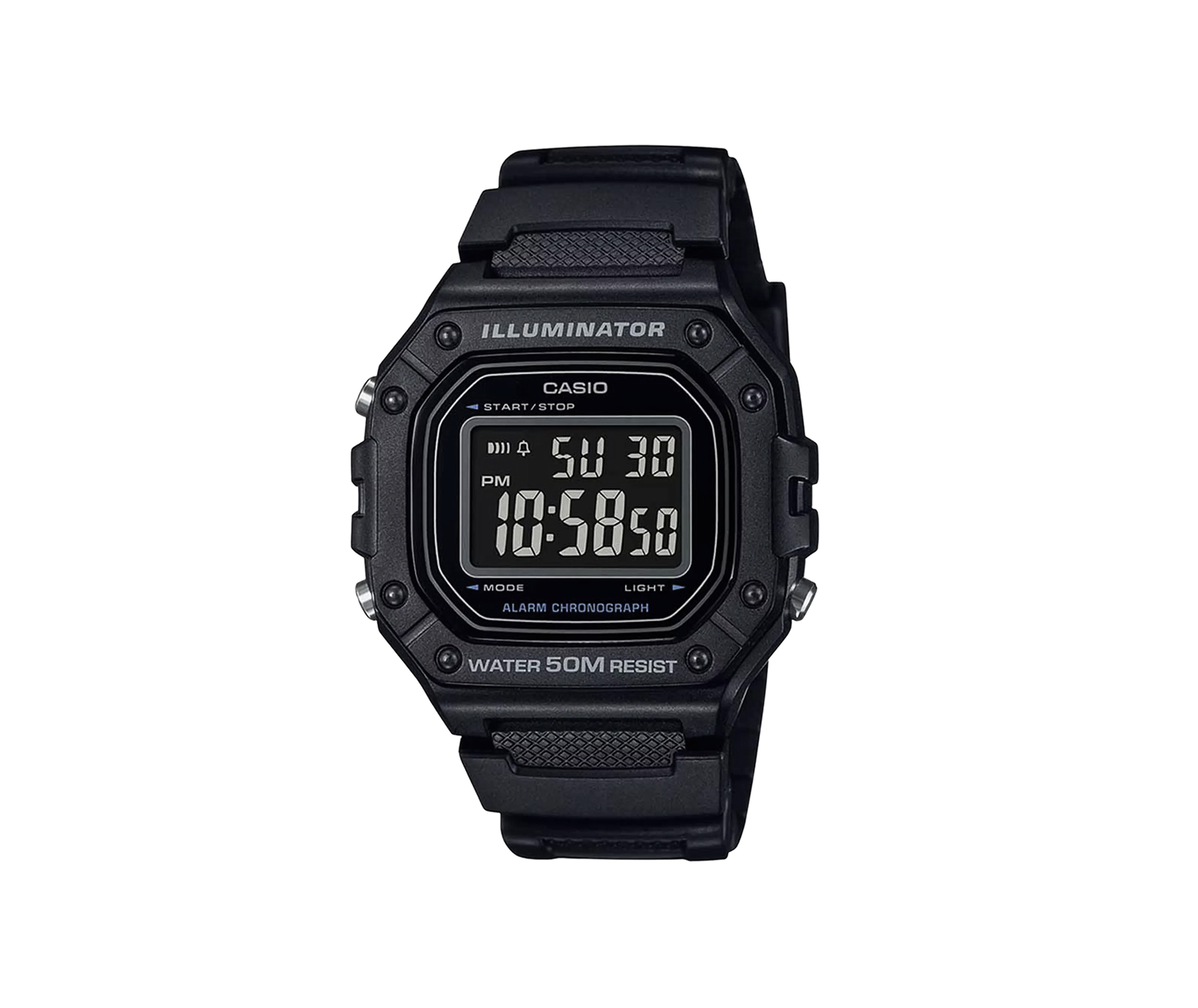
The F-91W's shape scaled up to 43.2 mm and sealed to 50 metres, with an amber light.
Casio gives the W218H a 44.4 by 43.2 by 10.8 mm case and a weight of 37 grams. Casio rates it at 50 metres of water resistance, which covers a shower and a swim, and that rating is the main reason to choose it over the F-91W, rated to 30. The module is the 3224, the case and crystal are resin, and the strap fits wrists from 145 to 215 millimetres.
An amber LED sits at the edge of the display and throws warm light across it. The A700W below uses the same amber lamp, and the A168 and the G-Shock take a different approach entirely.
The battery is a CR2016. Seven years. Casio's figure for drift is 30 seconds a month either way. That adds up to about six minutes a year, so in practice you set it twice a year when the clocks change.
One quirk of the calendar: Casio sets it at 28 days for February. The watch handles 30- and 31-day months on its own, and in a leap year it shows March 1 on the 29th, so the date needs one correction every four years. The stopwatch runs in hundredths of a second up to 59 minutes 59.99 seconds, with split times and first and second place.
At 37 grams it is light enough to forget until it beeps on the hour. Black on black, with an orange glow at night, it suits the gym bag and the beach.
- Case
- 44.4 x 43.2 x 10.8 mm resin
- Weight
- 37 g
- Crystal
- Resin
- Module
- 3224
- Battery
- CR2016, approx. 7 years
- Light
- Amber LED backlight
- Water resistance
- 50 m
Specifications as published by the manufacturer. Source
2.A168W – $30

Pros
- An electroluminescent panel that lights every digit to the same brightness
- A steel bracelet that adjusts without tools
- Seven years on a CR2016, the same as the W218H
Cons
- Rated only "Water Resistant", so rain and handwashing, not a pool
- The chrome-look case is resin, not metal
A steel bracelet on a resin case, with a blue-green glow that covers every corner of the display.
The A168W is the A158 with a backlight added, and that light is the whole difference between them. Casio's own copy says so, and the word Illuminator printed on the face makes the same point. Behind the display is an electroluminescent panel, a thin layer that glows evenly across its whole surface when current runs through it. Every digit lights to the same brightness, corners included.
The chrome case is resin. Casio lists the case and bezel material as resin and the band as stainless steel, which is how a watch that reads as metal weighs 50 grams with the bracelet on. The case is 38.6 by 36.3 by 9.6 millimetres, small enough to sit under a cuff.
Check the water rating before buying it for a swim. Casio rates the A168 "Water Resistant" with no depth given, the lowest tier in its catalogue, and that covers rain and handwashing but not a pool. The W218H above costs the same and goes to 50 metres. Choosing between them comes down to the bracelet against the seal.
The module is the 3298, running on a CR2016 cell rated for about seven years. It drifts by the same 30 seconds a month as the W218H. Like that watch, it gets an alarm, an hourly signal, a 1/100-second stopwatch with split times and a calendar set at 28 days for February.
Casio sells it in silver, gold and black finishes, and the gold costs about twice the silver at Casio's own US store, for the same case and the same module. The bracelet adjusts for wrists from 145 to 205 millimetres with a sliding clasp, no tools needed. On the wrist it reads as a 1980s object because it is one, still made to almost the same drawing.
- Case
- 38.6 x 36.3 x 9.6 mm resin, stainless steel band
- Crystal
- Resin
- Module
- 3298
- Battery
- CR2016, approx. 7 years
- Light
- Electroluminescent, blue-green
- Water resistance
- Water Resistant (no depth rating)
Specifications as published by the manufacturer. Source
3.A700W – $40

Pros
- 6 mm thick, 3.6 mm thinner than the A168 and under any cuff
- Mineral glass, the only Casio here under $100 that has it
Cons
- About three years per battery, against seven on the W218H and A168W
- Rated only "Water Resistant", with no depth given
Six millimetres thick, the thinnest case here by 3.6 mm, and the only Casio under $100 here with mineral glass.
The A700W measures 37.4 by 35.5 by 6 millimetres. The A168 above is 9.6 mm, and the G-Shock below is 13.4. Side by side, the A700W looks like a drawing of a digital watch more than an object, and it slips under a shirt cuff with room to spare.
Getting to 6 mm meant a smaller battery, and the cell's own name says how much smaller. A coin cell's name is its size: CR2016 means 20 mm across and 1.6 mm thick, and CR1616 means 16 mm across at the same thickness. The A700W uses the CR1616, which holds less charge, so Casio rates it at about three years against the seven of the W218H and A168. The case is thinner, the battery is smaller, and the shorter life follows from that.
The glass is the other difference. Casio fits mineral glass here, while the W218H and A168 use resin. Mineral glass is harder and resists the fine scratches that cloud a resin crystal after a year of desks and door frames.
The light is an amber LED, like the W218H. The module is the 3472. Same drift, same daily alarm, same hourly signal and 1/100-second stopwatch as the two above. Water resistance follows the A168: rated "Water Resistant" with no depth, so rain and handwashing only.
It weighs 50 grams, the same as the A168, though it is a third thinner, because the steel bracelet carries most of that weight. Casio's US store lists it at $45.95, and it is also sold in gold as the A700WG-9A.
- Case
- 37.4 x 35.5 x 6 mm resin, stainless steel band
- Weight
- 50 g
- Crystal
- Mineral glass
- Module
- 3472
- Battery
- CR1616, approx. 3 years
- Light
- Amber LED backlight
- Water resistance
- Water Resistant (no depth rating)
Specifications as published by the manufacturer. Source
4.Griffy LED Digital Watch – $60
Pros
- The only stainless steel case in this post
- A true LED display, the format digital watches started with
- 50 m of water resistance
Cons
- Reading the time takes a button press and a second hand
- No alarm and no stopwatch
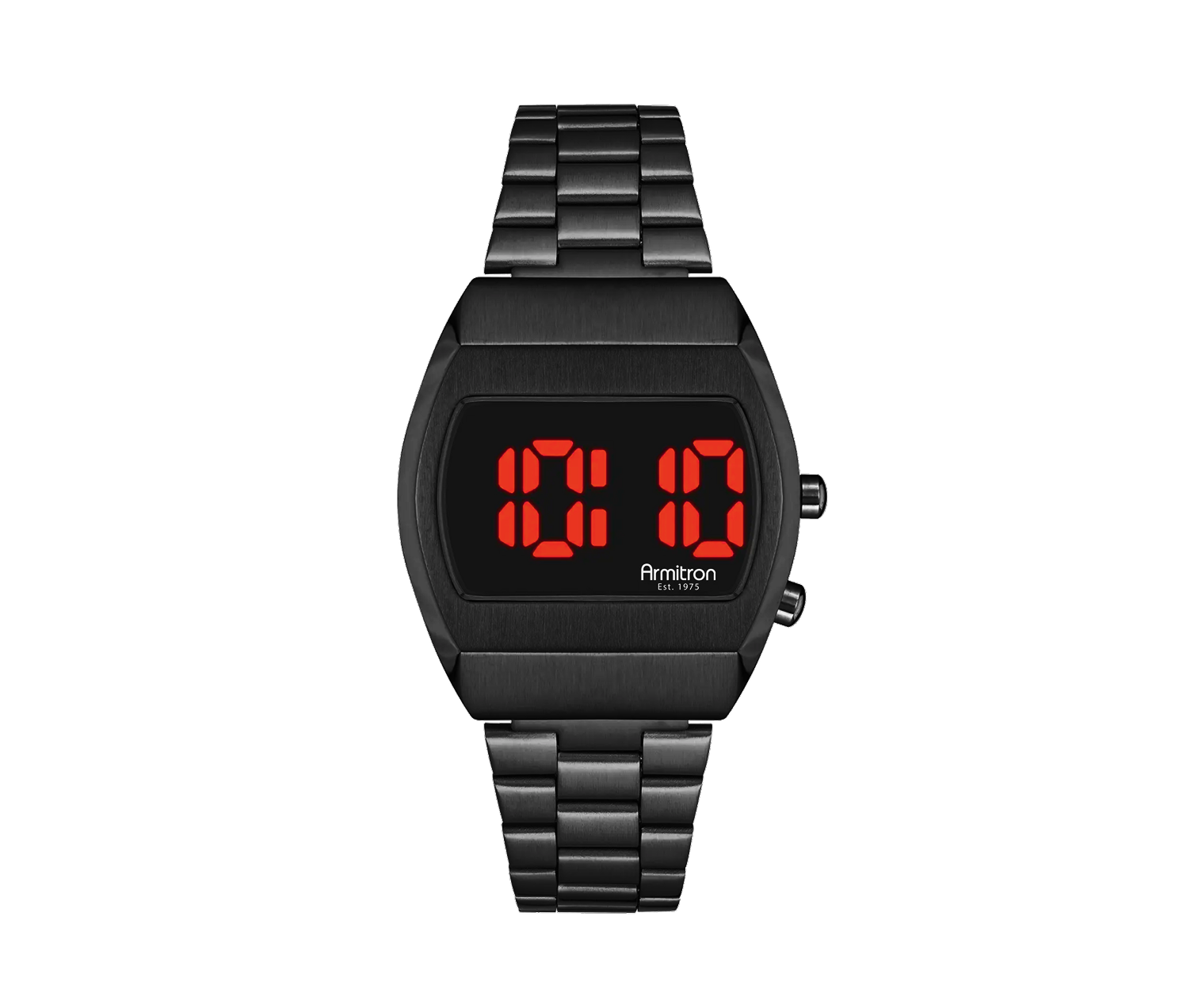
The display is black until you press the button, then shows the time in red LED digits. No other watch here works that way.
The first digital watches used LEDs (light-emitting diodes), and LEDs draw so much current that an always-on display would flatten a coin cell quickly. So the watch stays dark and lights only on request. Liquid crystal displays, the kind every other watch here uses, replaced that design during the 1970s because they show the time all day on almost no power. Armitron made LED watches in that first wave, and the Griffy brings the format back.
In use, the upper right button lights the hour and minutes. Two more presses show the date and then the running seconds. The lower button sets the time and date. There is no alarm and no stopwatch: telling the time on request is the only job the display does.
The case and bracelet are stainless steel, the only steel case in this post. The crystal is acrylic, a plastic that scuffs more easily than glass. A cloth and some polishing paste take the scuffs back out. Armitron rates it to 50 metres of water resistance, and lists the case at 37 mm long. The bracelet uses folded links on a fold-over clasp, close in feel to a Casio A158.
The one in our photo is the black version with red digits, so between presses the face reads as a plain black rectangle. Armitron also sold it in silver, gold and an iridescent finish, with a white-digit option on the black.
Reading the time takes two hands. One wears it, one presses. That makes it a watch to wear for fun and hand round a dinner table, and a poor choice for timing a run, since it has no stopwatch to time one with.
- Case
- 37 mm stainless steel, steel bracelet
- Crystal
- Acrylic
- Display
- Red LED, lit on demand
- Light
- None, the LED digits are the light
- Water resistance
- 50 m
Specifications as published by the manufacturer. Source
5.DW5600BB-1 – $110

Pros
- 200 m of water resistance, four times anything else here
- Full auto-calendar to 2099, so leap years need no correction
- Countdown timer to 24 hours and a flash alert
Cons
- 13.4 mm thick, more than twice the A700W
- About two years per CR2016, the shortest battery life here
- Listed as discontinued by Casio US, replaced by the LED-lit DW5600UBB-1
The original G-Shock square in black on black. Rated to 200 metres, four times anything else in this post.
If you have read about the DW-5600E in the under-$500 post, the DW5600BB-1 is the same watch in a different finish. The case is 48.9 by 42.8 by 13.4 millimetres in the same shock-resistant resin, the module is the same 3229, and the rating is the same 200 metres. Case, bezel and strap are all black. You choose it for the colour.
What the module adds over the cheaper Casios is a set of functions they lack. The countdown timer runs up to 24 hours with an auto-repeat. The alarm and hourly signal can flash the backlight as well as beep, which helps in a loud room. The calendar is fully automatic to 2099, so February and leap years need no correction, and Casio rates it to 15 seconds a month either way, half the figure it gives the other three Casios here.
Its light is a glowing panel with afterglow, so it stays lit for a moment after you let go of the button. The battery is a CR2016 rated for about two years. That is the same cell the W218H runs for seven, and the difference goes on the light and the 200-metre seals.
Casio's US store now lists the DW5600BB-1 as discontinued and points to the DW5600UBB-1 at the same $110, which swaps the electroluminescent panel for an LED backlight. Retailers still list the BB-1. The even glow across the whole panel is what the replacement gives up.
At 13.4 millimetres it is the thickest watch here. More than twice the A700W. No cuff will cover it.
- Case
- 48.9 x 42.8 x 13.4 mm resin, shock resistant
- Crystal
- Mineral glass
- Module
- 3229
- Battery
- CR2016, approx. 2 years
- Light
- Electroluminescent with afterglow
- Water resistance
- 200 m
Specifications as published by the manufacturer. Source
6.Retroware Digital Watch – $149
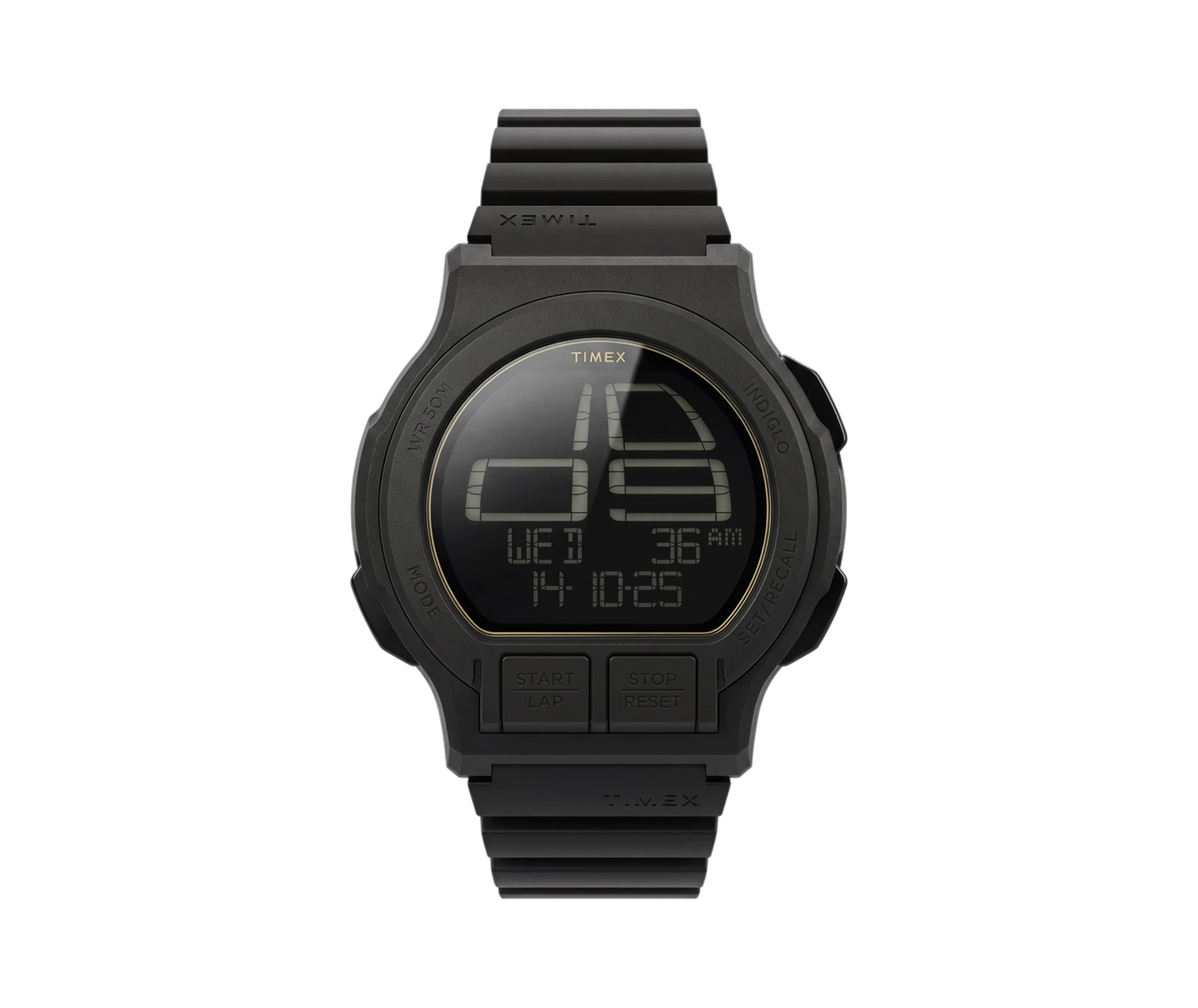
Pros
- The largest display here, with digits running nearly edge to edge
- 11 mm thick, 2.4 mm thinner than the G-Shock despite the width
- Quick-release strap that changes without tools
Cons
- 46 mm across with a 50 mm lug-to-lug span, a lot of watch on a small wrist
- Acrylic crystal scuffs, though the scuffs polish out
The largest display here, in a 46 mm resin case only 11 mm thick, lit by INDIGLO.
The Retroware went on sale in the US in August 2026, a new Timex design that borrows the look of 1980s sport digitals. The case measures 46 millimetres across with a 50 mm lug-to-lug span, and it is 11 millimetres thick. That makes it wider than any other watch here and still 2.4 mm thinner than the G-Shock, so it wears flat for its size.
Timex draws the digits on a curve and run nearly edge to edge, which is why it needs the width: hours and minutes fill most of the face, and they read from further away than any other display here. The 50 mm lug-to-lug matters most on smaller wrists, and Timex says the strap fits wrists of 150 to 205 mm.
INDIGLO is Timex's name for the electroluminescent backlight it introduced in the early 1990s, so it works like the A168 and the G-Shock, lighting the whole panel evenly. The functions are a chronograph, a countdown timer and an alarm.
The crystal is acrylic, like the Griffy's, and Timex picked it for impact resistance. Acrylic scuffs, and a little polish removes them. Water resistance is 50 metres, the same as the W218H. The battery is a CR2025, 20 mm across and 2.5 mm thick, the thickest cell in this post.
The 20 mm resin strap comes off on quick-release spring bars with no tools. Timex lists it in matte blue (TW5M73800) and a grey-green version, each on a matching strap. It costs five times the W218H, and most of the difference is the display.
- Case
- 46 mm resin, 50 mm lug to lug, 11 mm thick
- Crystal
- Acrylic
- Battery
- CR2025
- Light
- INDIGLO electroluminescent
- Strap
- 20 mm resin, quick-release spring bars
- Water resistance
- 50 m
Specifications as published by the manufacturer. Source
What to know before buying a digital watch
"Water resistant" with no number
Three of these six carry a depth: 50 metres on the W218H, the Griffy and the Retroware, 200 on the G-Shock. The A168 and A700W say "Water Resistant" and nothing else. That is Casio's lowest rating, and it covers rain and handwashing but not swimming. On a cheap digital watch the depth printed on the back matters more than the price.
Three kinds of light
An LED backlight sits at the edge of the display and shines across it, as on the W218H and A700W: bright, warm in amber, and a little uneven. A glowing panel behind the display lights its whole area, as on the A168, the G-Shock and Timex's INDIGLO. An LED display, as on the Griffy, uses the digits themselves as the light and stays dark the rest of the time.
The battery code is a size
A coin cell's name gives its dimensions. The first two digits are the diameter in millimetres and the last two the thickness in tenths, so a CR2016 is 20 by 1.6 mm and a CR2025 is 20 by 2.5. A thinner watch takes a smaller cell, which is why the 6 mm A700W gets three years where the 9.6 mm A168 gets seven.
Resin, mineral or acrylic
Resin crystals, on the W218H and A168, scratch most easily. Mineral glass, on the A700W and G-Shock, is harder and resists the fine marks of daily wear. Acrylic, on the Griffy and Retroware, scuffs but a cloth and polish bring it back, which works on neither of the others.
Picking one
The W218H if it is going in the sea. The A168 for a bracelet and the even glow. The A700W for the thinnest case and the only cuff-friendly Casio with glass over the display. The Griffy for a steel watch that shows the time only when asked. The DW5600BB-1 for 200 metres and a calendar that never needs setting. The Retroware for the biggest digits on the page.
All six keep time to within a few minutes a year, and none of them needs a jeweller to change the battery.
All 6 compared
Casio W218HSwimmable for $30- Case
- 43.2 mm resin
- Water
- 50 m
- Crystal
- Resin
- Light
- Amber LED
Casio A168WBracelet and even glow- Case
- 38.6 mm resin
- Water
- No depth
- Crystal
- Resin
- Light
- EL panel
Casio A700WThinnest here- Case
- 6 mm thick
- Water
- No depth
- Crystal
- Mineral
- Light
- Amber LED
Armitron Griffy LED Digital WatchDark until pressed- Case
- 37 mm steel
- Water
- 50 m
- Crystal
- Acrylic
- Light
- LED digits
Casio DW5600BB-1Deepest, and blacked out- Case
- 48.9 mm resin
- Water
- 200 m
- Crystal
- Mineral
- Light
- EL panel
Timex Retroware Digital WatchBiggest digits- Case
- 46 mm resin
- Water
- 50 m
- Crystal
- Acrylic
- Light
- INDIGLO
Casio rates the A168W and A700W only as "Water Resistant" with no depth, its lowest tier: rain and handwashing, not swimming. The Griffy has no backlight because its red LED digits are the light.
How we chose
We looked for digital watches under $150 that each answer a different question: how deep it can go, how thin it can be, how it lights up, how little it needs setting. Every quartz watch here keeps time to within minutes a year, so accuracy decided nothing. Casio and Timex publish full specifications on the pages that sell these references, and each panel quotes them, checked against a second, independent listing; where the two disagreed, as on the G-Shock's weight, the figure is left out. Armitron's own site was offline when we checked, so the Griffy's figures come from an archived copy of Armitron's product page and an owner's review that agree with it.
Common questions
It is Casio's lowest rating. The A168W and A700W carry it, and it covers rain, splashes and handwashing, but not swimming or showering. A watch rated to 50 metres, like the W218H, the Armitron Griffy or the Timex Retroware, handles a shower and a swim. The DW5600BB-1, rated to 200 metres, is the only one here built for real time in the water.
Mostly because of the size of the cell. A coin cell's name gives its dimensions: a CR2016 is 20 mm across and 1.6 mm thick, a CR1616 is 16 mm across. The 6 mm Casio A700W only has room for the smaller CR1616 and Casio rates it at about three years, while the W218H and A168W run about seven on a CR2016. The DW5600BB-1 uses the same CR2016 for about two years, because its light and seals draw more.
An LED backlight sits at the edge of the display and shines across it, as the amber lamps on the Casio W218H and A700W do. An electroluminescent panel sits behind the display and glows evenly across all of it, as on the Casio A168W and the DW5600BB-1. INDIGLO is Timex's name for its own electroluminescent backlight, used on the Retroware. The Armitron Griffy has none of these, because its display is made of red LEDs that are the light.
Casio's US store now lists it as discontinued and points to the DW5600UBB-1 at the same $110, which replaces the electroluminescent panel with an LED backlight. Retailers still list the BB-1. Its case, module 3229 and 200 metre rating are the same as the DW-5600E covered in our post on the best watches under $500.
Not usually. Every watch here with a published cell uses a common coin cell, a CR2016, CR1616 or CR2025, sold in most pharmacies. Opening the back is a small job, but on the 50 and 200 metre watches the gasket needs to seat properly afterwards, which is the part a watch shop does better than a kitchen table.
About the author

Justin Farrugia
Founder & Editor of Curated Supply
Justin Farrugia is the founder and editor of Curated Supply, a design-led directory to things worth owning. He has personally curated over 1,000 products across workspace, carry, coffee, audio, and the home, each judged against one standard: design intent, material quality, and the restraint that lets a thing last.