About
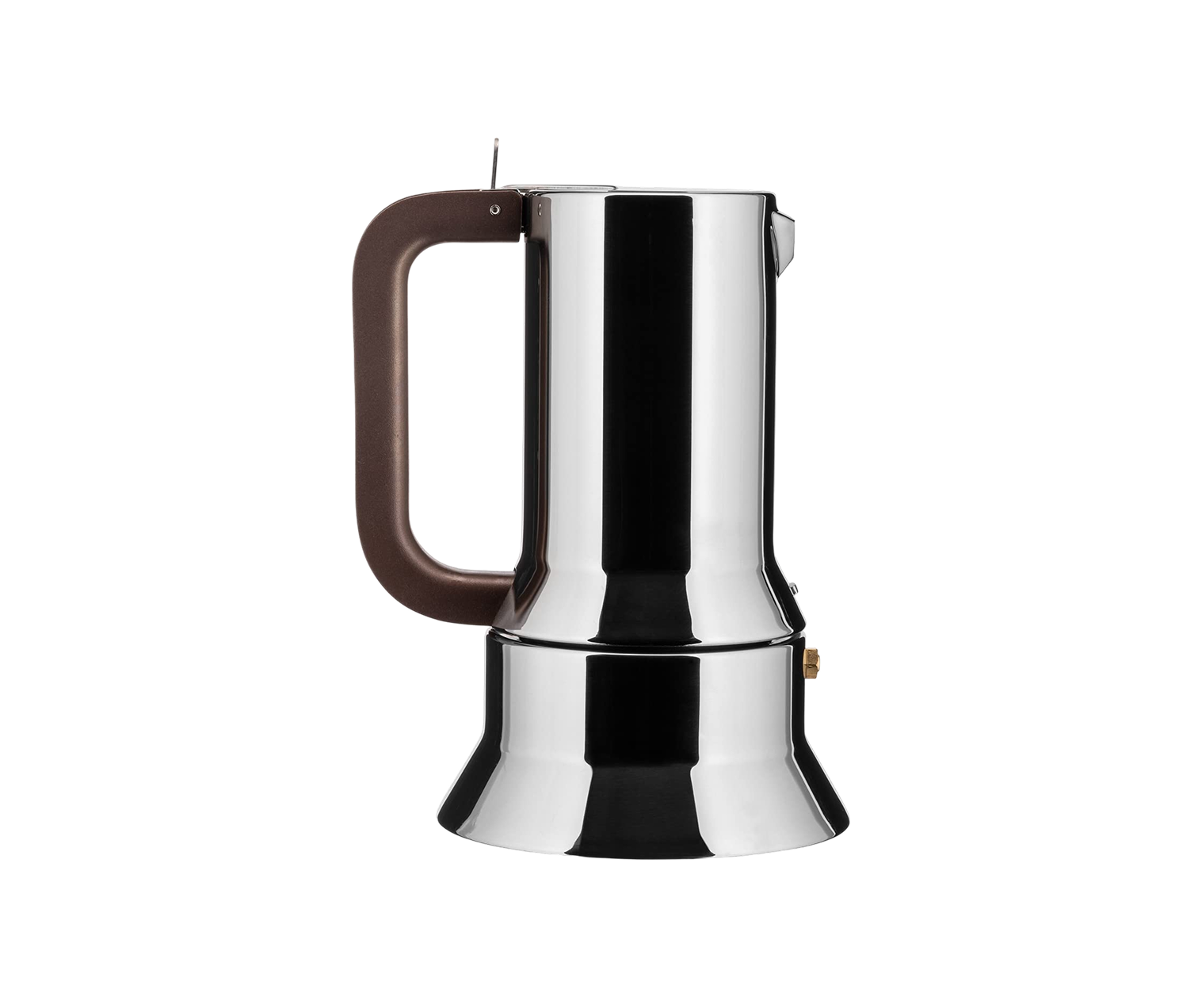
A stovetop espresso pot is usually a thing you inherit rather than choose. This one went the other way: the museums got to it before most kitchens did. Alessi's 9090 was the first espresso maker the company ever made, the first Alessi object to win a Compasso d'Oro, and the first to enter the collection of MoMA in New York.
Richard Sapper set out to give the machine features its rivals lacked, and three of them are still unusual forty years on. The base is broadened, so the pot pulls as much heat as it can off the burner. The spout is shaped to arrest the drip that normally follows a pour. And the lid is held shut by a lever rather than a screw thread. One movement of the hand opens it, which matters most at the moment the pot is hot and full.
The body is 18/10 stainless steel on a magnetic steel bottom, so it sits on an induction ring as happily as on gas. Alessi does ask you to check that your hob will switch on for a pan 90 millimetres across, because the one-cup version measures 95. Four sizes share the identical shape: a single cup at 7 centilitres and 15 centimetres tall, up to ten cups at 50 centilitres and 23 centimetres. None of them goes in the dishwasher.
Alessi lists twenty spare part codes against the 9090, which tells you what kind of object it is meant to be. A worn one gets rebuilt, not replaced. Sapper was honoured eleven times with the Compasso d'Oro over his career, and this pot earned the first one Alessi ever won.
- Designed in
- Italy

- designer
- Richard Sapper
- Material
- 18/10 stainless steel, magnetic steel bottom
- Sizes
- 1, 3, 6 and 10 cups
- Capacity
- 7, 15, 30 or 50 cl
- Dimensions
- 15 to 23 cm tall, 9.5 to 14.5 cm across
Figures as published by the manufacturer. Source