Staff Pick
About
A composite strap on a Patek Philippe sounds like a category error. In 1997 the company did it anyway, putting one of its own movements behind a strap of moulded composite, a material it rates as ultra-resistant to wear, salt water and UV radiation.
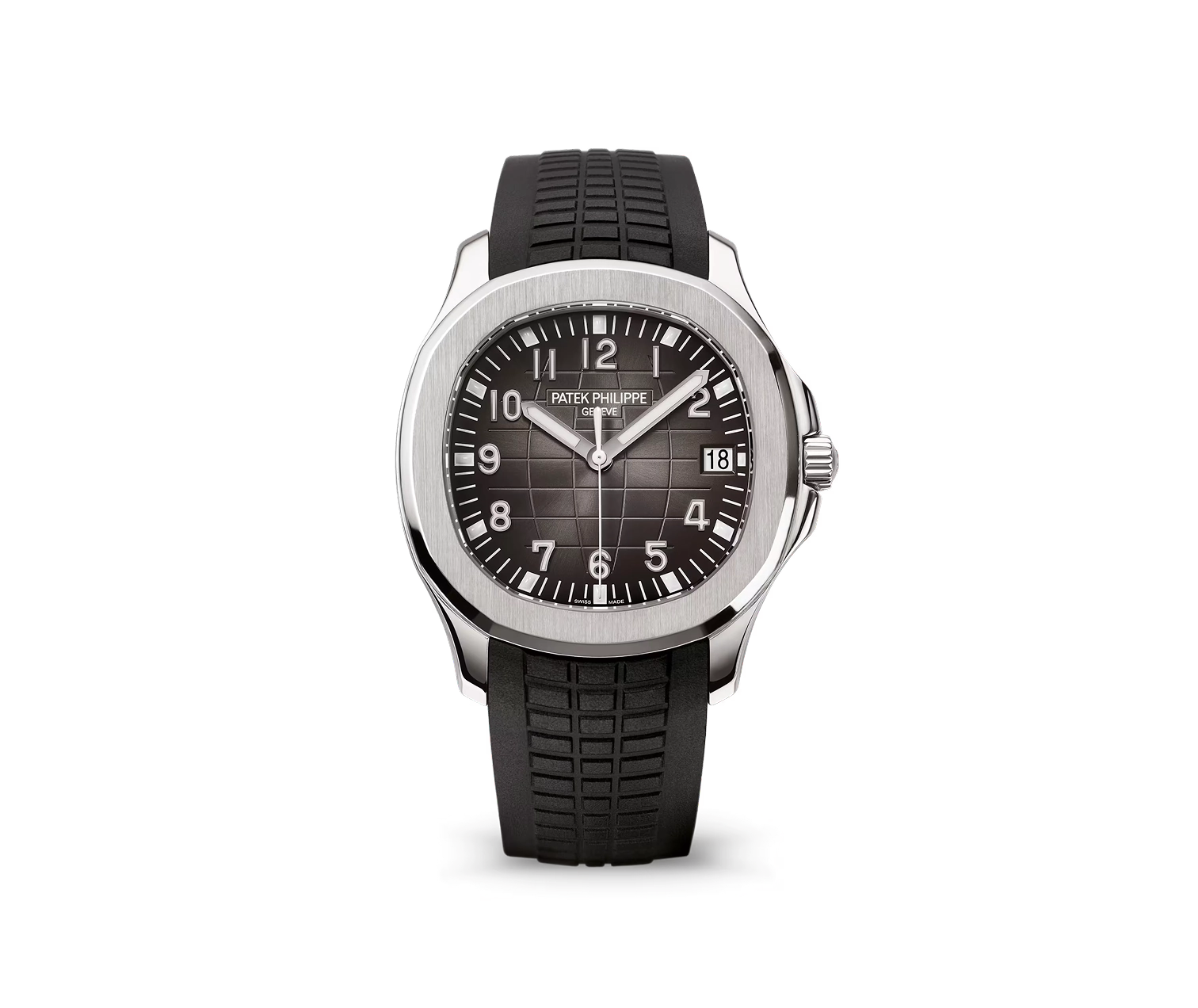
One pattern holds the whole design together. The Aquanaut's dial is embossed with a rounded checkerboard grid and the strap is moulded with the same relief, so the motif runs unbroken from the centre of the watch out past the lugs. Framing it is a rounded octagonal bezel, polished and satin-brushed in turn, which Patek itself describes as reminiscent of the Nautilus. That is an unusually direct thing for a maker to say about its own two collections, and it tells you where the shape came from.
The white gold reference 5168G shows what that shape is carrying. Its sunburst blue dial darkens to black at the rim under applied white gold numerals filled with luminescent coating, and the crown screws down. Behind the sapphire caseback sits calibre 26-330 S C, a self-winding movement of 207 parts wound by a central rotor in 21K gold, beating 28,800 times an hour. The strap closes with Patek's patented fold-over clasp, which is the detail that gives away how much watch is attached to the rubber.
The line has not stayed a single sports watch either. Since 2004 the Luce version has carried the same case with a diamond-set bezel, and the collection has since grown Travel Time, Annual Calendar, chronograph and minute repeater complications, which means the checkerboard grid now fronts some of the most complicated movements the company makes.
- Designed & made in
- Switzerland

- Case
- White gold, 42.2 mm across, 8.25 mm thick
- Crystal
- Sapphire case back
- Movement
- Self-winding calibre 26-330 S C, 30 jewels
- Power reserve
- 35 to 45 hours
- Colour
- Sunburst blue dial, black at the rim
- Material
Figures as published by the manufacturer. Source