About
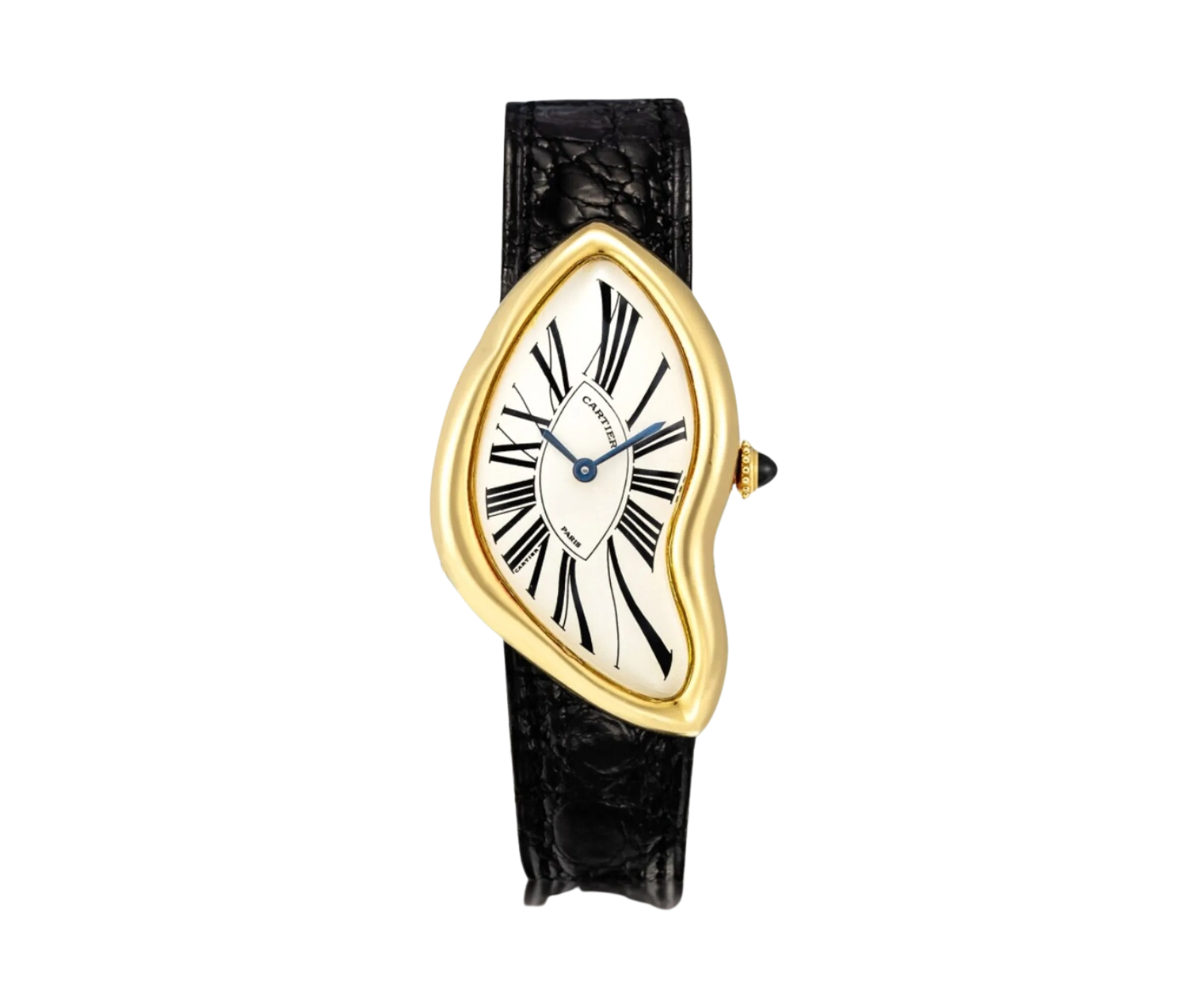
The Cartier Crash looks like a Tank that spent an afternoon somewhere extremely hot. That is more or less the story, depending on which version of it you believe.
It appeared in 1967 at Cartier's London branch under Jean-Jacques Cartier, at the height of everything London was at that moment. The case is asymmetric and elongated, roughly 43 mm long and 25 mm across including the crown, although a warped outline makes conventional measurement a courtesy more than a fact. Roman numerals stretch and lean to follow the distortion. Nothing on the dial is a straight line.
Jaeger-LeCoultre was consulted on what could physically be made to fit inside a shape like that, and the answer was the manual-wind calibre 841, a small tonneau movement. Wright & Davies built the cases by hand from sheets of gold. A conventional case took about thirty-five hours of work and this one took considerably longer, which is the practical reason no more than a few dozen London examples were ever finished.
Cartier has revived it since in small numbered runs, and each one disappears on announcement. The Crash sits at the point where a watch stops being a way of telling the time and turns into an argument about whether a drawing can be worth more than the gold it is cut from.
- Designed in
- France

- Made in
- Switzerland

- Materials
- Case
- Asymmetric, about 43 x 25 mm
- Movement
- Manual-wind Jaeger-LeCoultre 841
- Display
- Stretched Roman numerals
Figures as published by the manufacturer. Source