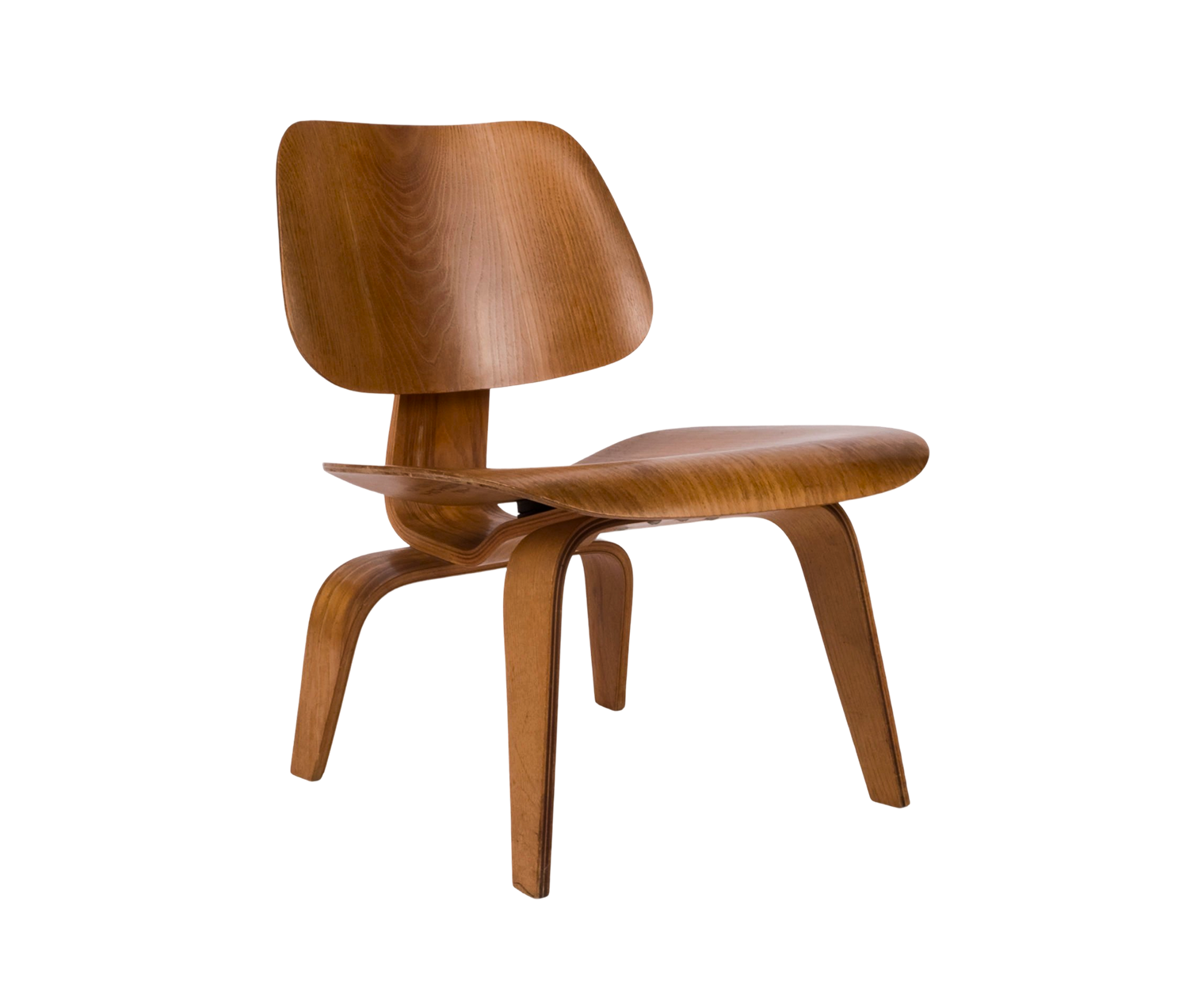
Eames Molded Plywood Chair
$1,195
About
Plywood bends willingly one way and fights you the other. Charles and Ray Eames spent the early 1940s on exactly that argument, in their Los Angeles apartment, with a press they built themselves that moulded veneer using heat and a bicycle pump. The dining chair reached production in 1946.
Herman Miller's Eames Molded Plywood Chair carries its seat and back as two separate shells, each moulded from five plies of veneer and held to the frame on discs of rubber. The split matters: two small curved shells can each follow the body closely, where one large panel would have to compromise between them. Where the load actually goes, the plies double up, so the legs and the back brace are eight rather than five. The rubber shock mounts between shell and frame are springy enough to buffer jarring movement, and the curve of the plywood does the rest of the work of holding you upright.
It comes at two heights. The dining chair, the DCW for dining chair, wood base, stands 28⅞ inches with the seat at 17¾ and is rated to 275 pounds. The lounge version drops to 26⅛ inches with a 15½ inch seat. Both weigh 20 pounds and arrive fully assembled. Veneers run walnut, white ash, white oak, santos palisander, red-stained ash and black-stained ash, and either shell can be ordered upholstered instead. Time magazine named it the best design of the twentieth century, which is a large claim for a chair whose origin story involves a bicycle pump.
- Designed & made in
- United States

- designers
- Charles and Ray Eames
- Materials
- Dimensions
- Dining chair 28⅞ in high, 19½ in wide, 21½ in deep
- Weight
- 20 lb
- Colours
- Walnut, white ash, white oak, santos palisander, red or black stain
- Sizes
- Dining 28⅞ in, lounge 26⅛ in
Figures as published by the manufacturer. Source