About
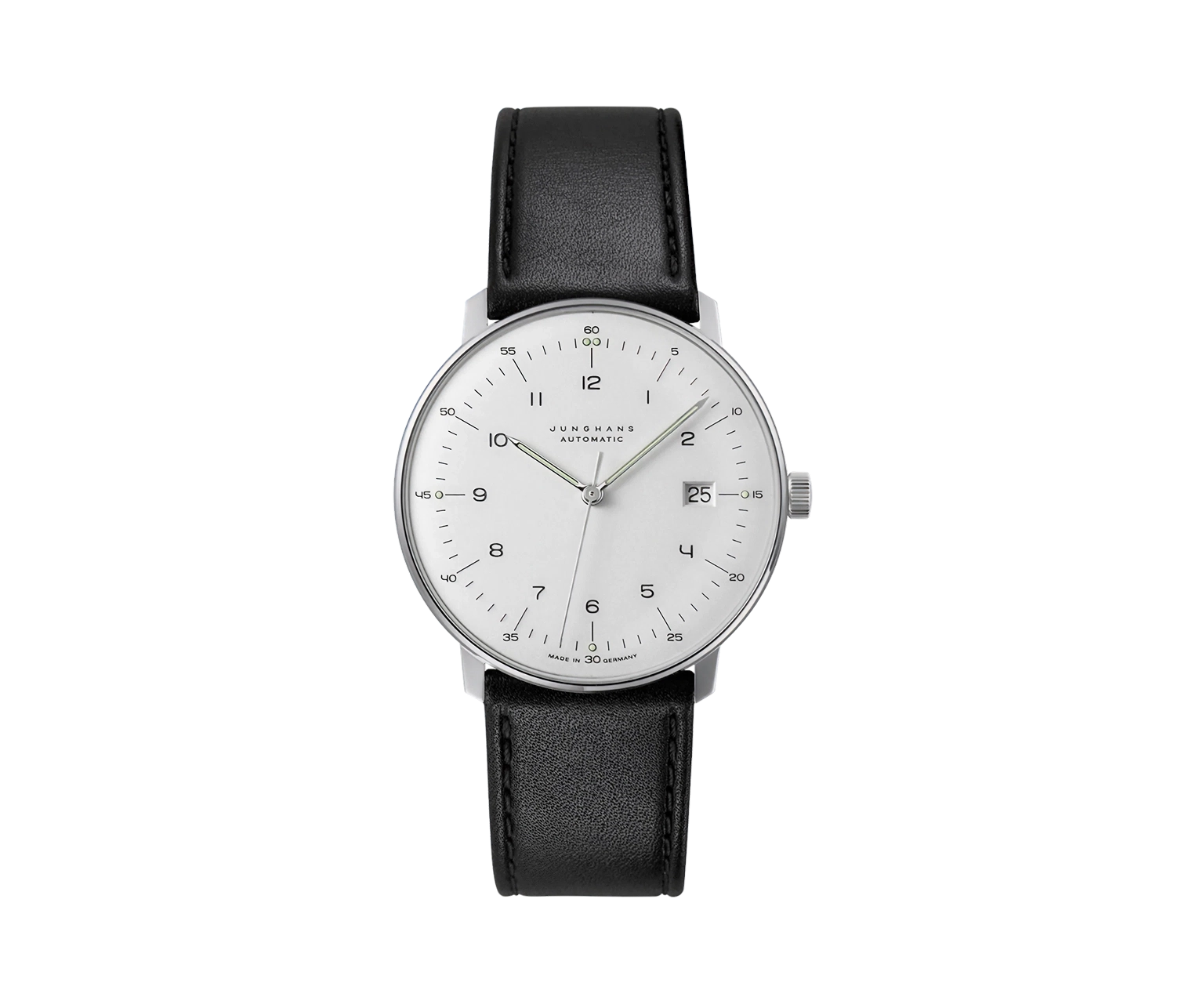
Most watch dials are drawn by watchmakers. This one was drawn by a painter, sculptor and architect who had studied at the Bauhaus in Dessau and went on to help found the Ulm design school, and whose numerals are squared off so hard that the 4 reads like an upturned chair.
At the start of the 1950s Junghans decided that an everyday object should be designed by an artist, and went to Max Bill. The kitchen clock came first. From 1961 he drew the wristwatches, and Junghans has kept that dial layout in production ever since. The Junghans max bill Automatic is a 38 millimetre mechanical watch wearing the dial Bill drew in 1961, running the calibre J800.1 underneath it.
That movement is wound in both directions by the motion of your arm, beats at 28,800 semi-vibrations an hour and holds 38 hours of reserve once full. Starting it from cold by hand takes at least 27 turns of the crown, which is a useful thing to know before you decide the watch is broken. The balance is gold-plated nickel. The movement sits on Incabloc shock protection and is anti-magnetic to the DIN 8309 standard, the German test for keeping time near the magnets you meet in an ordinary day.
A date window and a black leather strap with a stainless steel buckle come as standard. None of the restraint is recent: Junghans has made watches in Schramberg in the Black Forest since 1861, and by 1903 it was the largest watch factory in the world, which is a strange fact to carry into a watch this quiet.
- Designed & made in
- Germany

- designer
- Max Bill
- Award
- Red Dot 2018

- Materials
- Movement
- Self-winding calibre J800.1
- Case
- Polished stainless steel, 38.0 mm across, 10.0 mm high
- Crystal
- Domed, anti-reflective sapphire
- Water resistance
- 5 bar
- Power reserve
- 38 hours
- Leather
- Black strap, stainless steel buckle
Figures as published by the manufacturer. Source