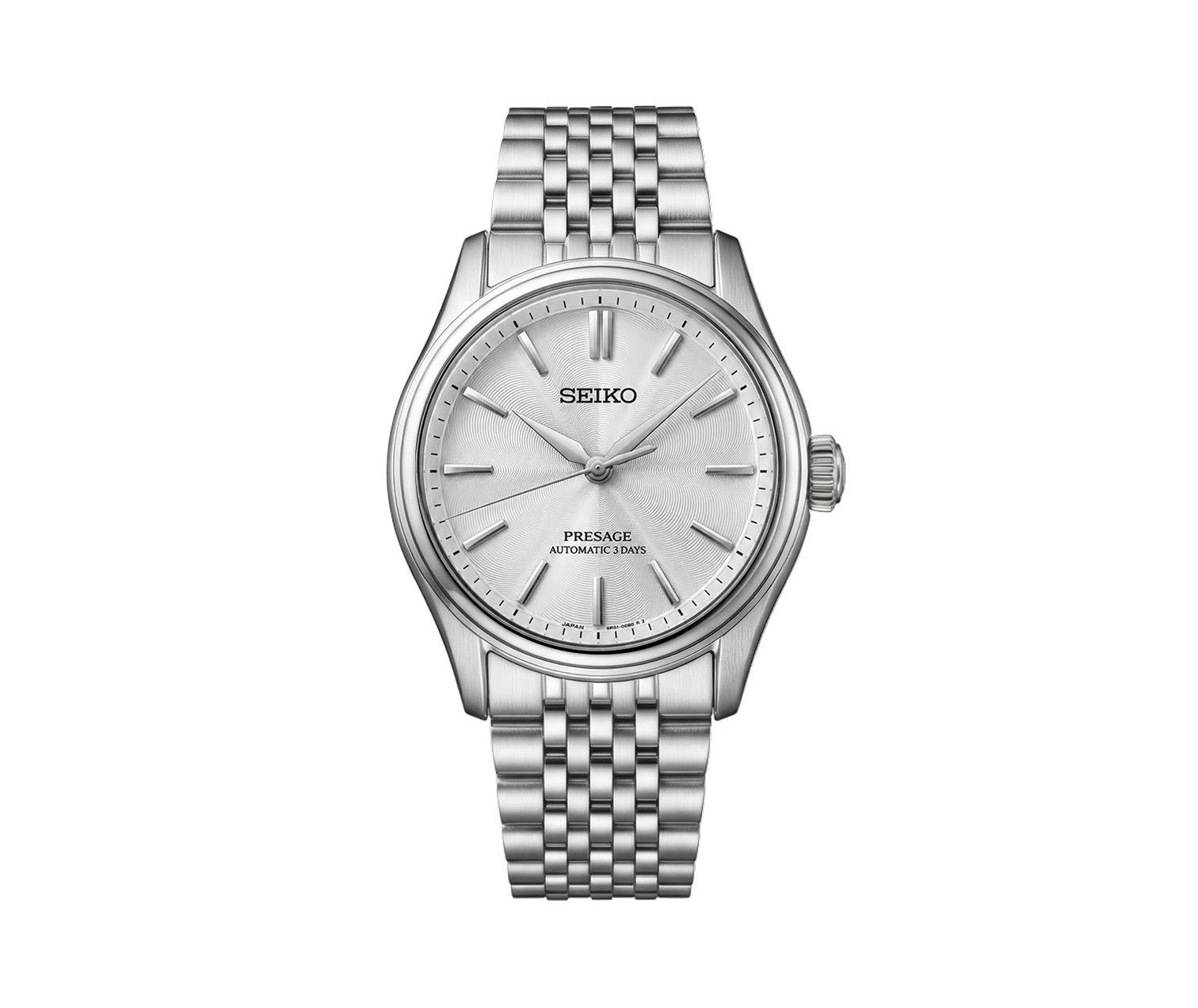
Bauhaus watches, from Junghans max bill to Nomos and Braun
Bauhaus watches from the Junghans max bill to the Nomos Tangente and Metro, compared on case, movement and reserve, plus the calibre switch dealers miss.
Bauhaus watches trace back to one man who actually studied there. Max Bill enrolled at the Bauhaus in Dessau in 1927, and in 1961 he drew a wristwatch dial for Junghans that is still in production. Everything else sold under the word is a descendant: Nomos, founded in Glashütte in 1990 and drawing on the same 1930s German watches, and Braun, whose design department grew up alongside the Ulm school that Bill helped found.
The five below run in the order their designers drew them, from Bill's 1961 dial to a Braun chronograph that took an iF Design Award in 2019. Four are mechanical and one runs on a battery. Three come from Nomos, because no other maker has built as much of its catalogue on the idea. After the picks, a short guide covers what the label actually means and the one specification that changes under the same reference number.
More of the same restraint, at every price, sits in the minimal timepieces list.
1.Junghans max bill Automatic

Pros
- The dial Max Bill drew in 1961, still in production
- Domed sapphire crystal with an anti-reflective coating
Cons
- 38 hours of reserve, the shortest of the four mechanical watches here
- Junghans and its dealers disagree on the water rating, 5 bar against 3
The only watch here drawn by someone who studied at the Bauhaus, and the only black dial in this post.
Junghans went to Max Bill at the start of the 1950s with the idea that an artist should design an everyday object. The first result was a kitchen clock in 1956, drawn with his students at the Ulm School of Design, where Bill was the first rector. The wristwatches followed from 1961, and the dial has stayed in production since.
Bill's numerals are the part to look at closely. Bill squared them off so hard that Junghans itself describes the 4 as a chair turned upside down. The minute track runs right to the edge, the hands are long and thin, and on this reference, 27/4701.02, the dial is matt black with luminous hands. The same dial is also sold on quartz and hand-wound movements. This one is the automatic.
The case is 38 mm across and 10 mm tall in polished steel, under a domed sapphire crystal with an anti-reflective coating. Inside runs the self-winding calibre J800.1 with up to 38 hours of reserve, which means a watch left on the dresser from Friday night will usually have stopped by Sunday afternoon.
The dome is what gives it away from across a room. It curves high over the dial and catches light at the edges. On a 38 mm case it reads larger than it is, and the black leather strap with a plain steel buckle keeps it a watch you can wear with a T-shirt.
- Reference
- 27/4701.02, black dial, leather strap
- Movement
- Automatic, calibre J800.1
- Power reserve
- Up to 38 hours
- Case
- 38 mm, 10 mm thick, polished steel
- Crystal
- Domed sapphire, anti-reflective
Specifications as published by the manufacturer. Source
2.Nomos Tangente

Pros
- 6.2 mm thick, the slimmest case in this post
- Hands heat-blued at 290 °C, with no paint or coating
Cons
- The same reference sells with two movements, 53 hours against 43
- Hand-wound, so it needs winding every day or two
At 6.2 mm thick it is the slimmest watch here, and the one whose movement has changed under the same reference number.
Roland Schwertner registered Nomos in Glashütte in January 1990, two months after the Berlin Wall fell, and its first four watches arrived in 1992. The Tangente was one of them. Its designer, Susanne Günther, drew on the Bauhaus-era German watches of the 1930s, and the result has barely moved in three decades: five Arabic numerals in a narrow typeface, a small seconds dial above six, and thin lugs that run straight off a flat case.
The hands are steel heated to 290 degrees Celsius until the surface oxidises cornflower blue. Nomos paints nothing on, so the colour shifts from navy to bright blue as the light changes.
Reference 101 measures 35 mm in diameter and 6.2 mm from crystal to caseback, stretching to 45 mm between the lug tips, with a sapphire crystal, a solid steel back and 5 atm of water resistance. Nomos now lists it with the DUW 4001, a hand-wound calibre 2.6 mm tall that runs up to 53 hours. Older stock carries the Alpha, the calibre the Tangente used for most of its life, which runs up to 43. Nomos makes both, and authorised dealers still list either one.
The 35 mm size is the original and Nomos sells it as unisex. On a larger wrist it sits like a 1930s watch should, small and flat enough to slide under any cuff. You wind it by hand every day or two.
- Reference
- 101, white silver-plated dial
- Movement
- Hand-wound, DUW 4001 (older stock: Alpha)
- Power reserve
- Up to 53 hours (Alpha: up to 43)
- Case
- 35 mm, 6.2 mm thick, 45 mm lug to lug, steel
- Water resistance
- 5 atm, splash-proof
Specifications as published by the manufacturer. Source
3.Nomos Orion

Pros
- Gold indices, the only warm colour on any dial here
- Domed sapphire crystal that carries the case's curve over the dial
Cons
- Older stock carries the Alpha, rated to 43 hours
- Hand-wound, like the Tangente
The only watch here with no hour numerals, just gold batons under a domed crystal.
The Orion was another of Nomos's first four watches in 1992. Where the Tangente is all angles, the Orion is all curves: the lugs flow out of the case instead of sitting on it, and the domed sapphire crystal carries that curve across the top. The dial drops hour numerals entirely. Gold-coloured indices mark the hours, set slightly in from the minute track, with the same heat-blued hands as the Tangente.
It shares the Tangente's movement. Reference 301 runs the hand-wound DUW 4001 with up to 53 hours of reserve, in a 35 mm steel case that measures 45 mm lug to lug, on an 18 mm strap of Horween Shell Cordovan. Water resistance is 5 atm. The 301 has a solid steel back. Reference 309 is the same watch with a sapphire back that shows the movement.
As with the Tangente, older stock of the Orion carries the Alpha. A French dealer still lists the 301 with it, so ask before buying.
Of the three Nomos picks, this is the dress watch. The gold on the indices is the only warm colour on any dial in this post, and the domed crystal makes the dial look deeper than it is. Beside a Tangente on the same wrist, the Orion reads softer, all curve where the Tangente is all edge.
- Reference
- 301, solid steel back
- Movement
- Hand-wound, DUW 4001 (older stock: Alpha)
- Power reserve
- Up to 53 hours (Alpha: up to 43)
- Case
- 35 mm, 45 mm lug to lug, steel
- Water resistance
- 5 atm, splash-proof
Specifications as published by the manufacturer. Source
4.Nomos Metro Neomatik 41

Pros
- The date reads off a ring around the dial, with no window cut into it
- Self-winding, the only automatic among the three Nomos picks
Cons
- 40.5 mm across, the largest case here
- 42 hours of reserve, eleven fewer than the hand-wound Nomos pair
The only watch here with no date window at all: the date runs as a ring around the edge of the dial.
Nomos asked an outside designer to draw the Metro. Mark Braun, a Berlin product designer known for furniture and lighting, delivered the first one in 2014, and it introduced the Nomos swing system, the escapement the company makes for itself. The neomatik 41 Update followed in 2021, with the date moved out of a window and onto a printed ring around the dial. Two neon orange markers frame today's number, and the date sets quickly in either direction.
The trick is in where the date mechanism sits. In the DUW 6101, Nomos's automatic calibre with a date, the date ring sits around the outside of the movement, which makes it wide, 35.2 mm, and thin, 3.6 mm. The finished case is 40.5 mm across and 9.1 mm tall, with wire lugs that stretch it to 47.5 mm from end to end. Reserve is up to 42 hours, the back is sapphire, and water resistance is 5 atm.
The dial carries indexes at three, nine and twelve only, with oxidised black hands. The Update design won a Good Design Award from the Chicago jury.
It is the biggest watch in this post and the only automatic from Nomos here, so it never needs winding if you wear it daily. The wire lugs make it wear shorter than 47.5 mm suggests. The dark grey woven strap is waterproof and swaps out on quick-release spring bars.
- Reference
- 1165, Metro neomatik 41 Update
- Movement
- Automatic, DUW 6101 with ring date
- Power reserve
- Up to 42 hours
- Case
- 40.5 mm, 9.1 mm thick, 47.5 mm lug to lug, steel
- Water resistance
- 5 atm, splash-proof
Specifications as published by the manufacturer. Source
5.Braun BN0265

Pros
- A chronograph, the only one in this post
- Runs on a battery, so it is always set when you pick it up
Cons
- Mineral glass, where the other four have sapphire
- 3 ATM, not rated for swimming
The only quartz watch here, and the only chronograph.
Braun did not make a wristwatch until 1989, when it launched the AW 10, drawn by Dietrich Lubs and Dieter Rams. Braun's design language was older than that: in the 1950s the company worked with teachers from the Ulm School of Design, the school Max Bill had helped found, and its radios, shavers and clocks came out of that collaboration. Today Zeon, a British company, makes Braun watches under licence, and Braun's own design team approves each new model.
The BN0265 is a 40 mm quartz chronograph in matte stainless steel, with two sub-dials and a date at six o'clock. Its only colours are the two Braun has used on clocks for decades: a yellow chronograph hand and a red marker. The crystal is mineral glass, which scratches more easily than the sapphire on the other four picks, and water resistance is 3 ATM, enough for rain and hand-washing but not for swimming. The strap is 22 mm. The watch took an iF Design Award in 2019.
Our link goes to the version on black leather. The same case also comes on a steel bracelet.
A battery means it is always running when you pick it up, and a chronograph means it can time a pour-over or a parking meter without your phone. With two sub-dials it carries the busiest face here, though not by much. A smaller three-hand Braun, the BN0021, appears in our watches under $500.
- Reference
- BN0265, silver dial, black leather strap
- Movement
- Quartz chronograph
- Power reserve
- None: quartz, on a battery
- Case
- 40 mm, matte stainless steel
- Water resistance
- 3 ATM
Specifications as published by the manufacturer. Source
Where the style comes from
The Bauhaus was a German art school that ran from 1919 to 1933 and taught that an object's form should follow from its use. It never made watches. What the term describes in watches is a look: a plain dial, a thin case, numerals in a simple sans-serif typeface or none at all, and nothing on the face that is not needed to read the time.
Two routes lead to it. Junghans's max bill line is the direct one, drawn by a former student. Nomos's watches take their cue from the German watches of the 1930s that shared the same ideas. Braun's comes through Ulm, which carried the Bauhaus's teaching into the 1950s. All five here sit on one of those lines.
The calibre that changes under one reference
Nomos has been fitting the DUW 4001 to its small hand-wound watches in place of the Alpha. The reference number stays the same, so a Tangente 101 or an Orion 301 can carry either movement.
The difference matters on the wrist. The DUW 4001 runs up to 53 hours, the Alpha up to 43. Ten hours is the gap between a watch that survives a weekend off the wrist and one that stops on Sunday. Ask the dealer which calibre is inside, or look for the calibre name on the warranty card.
Mineral glass, sapphire and the dome
Four of these have sapphire crystals, which is hard enough that everyday wear rarely marks it. The Braun has mineral glass, which keys and grit can mark. The Junghans and the Orion have domed crystals, which catch light at the edges and make the dial look deeper. The Tangente has a flat one, which keeps it thin.
All 5 compared
Junghans MaxbillDrawn by a Bauhaus student- Movement
- Automatic
- Reserve
- 38 h
- Case
- 38 mm
- Water
- –
Nomos TangenteThinnest here- Movement
- Hand-wound
- Reserve
- 53 h
- Case
- 35 mm
- Water
- 5 atm
Nomos OrionNo hour numerals- Movement
- Hand-wound
- Reserve
- 53 h
- Case
- 35 mm
- Water
- 5 atm
Nomos Metro Neomatik 41Date round the rim- Movement
- Automatic
- Reserve
- 42 h
- Case
- 40.5 mm
- Water
- 5 atm
Braun BN0265Only quartz chronograph- Movement
- Quartz
- Reserve
- Battery
- Case
- 40 mm
- Water
- 3 ATM
Water resistance for the Junghans is left blank: Junghans lists 5 bar for reference 27/4701.02, while two authorised dealers list 3 bar. Nomos reserves are for the current DUW 4001; older Tangente and Orion stock carries the Alpha, rated to 43 hours.
How we chose
We chose five watches that descend from the Bauhaus by a line you can trace: one drawn by a former student, three from the Glashütte maker that built its catalogue on 1930s German watches, and one from the company whose design came out of the Ulm school Max Bill helped found. They run in the order they were designed. Every figure is quoted from the maker's page for the exact reference our link goes to and checked against an authorised dealer or the watch press. Where the two disagreed, as on the Junghans's water resistance and the Orion's thickness, the figure is left out.
Common questions
A watch drawn on the principles of the Bauhaus, the German art school that ran from 1919 to 1933: a plain dial, a thin case, simple sans-serif numerals or none, and nothing on the face that is not needed to read the time. The school itself never made watches. The best known are Junghans's max bill line, drawn from 1961 by Max Bill, who studied at the Bauhaus in Dessau, and the Nomos Tangente.
Nomos's first four watches, released in 1992, were designed by Susanne Günther with the German watches of the 1930s as a starting point, and Nomos itself describes the Tangente's numerals as reminiscent of the Bauhaus era. No Nomos designer studied at the Bauhaus, so the link is one of style, not lineage.
Nomos now lists reference 101 with the hand-wound DUW 4001, which runs up to 53 hours. Earlier watches under the same reference carry the Alpha, rated to 43 hours, and authorised dealers still list both. Check the calibre on the warranty card or ask the dealer.
The max bill line comes with automatic, hand-wound and quartz movements. Reference 27/4701.02, the one linked here, is the automatic, running calibre J800.1 with up to 38 hours of reserve in a 38 mm case.
Not directly. Braun's postwar design grew out of work with teachers from the Ulm School of Design, which Max Bill helped found to carry on the Bauhaus's ideas. Braun made its first wristwatch, the AW 10, in 1989, and its watches are now made under licence by Zeon.
About the author

Justin Farrugia
Founder & Editor of Curated Supply
Justin Farrugia is the founder and editor of Curated Supply, a design-led directory to things worth owning. He has personally curated over 1,000 products across workspace, carry, coffee, audio, and the home, each judged against one standard: design intent, material quality, and the restraint that lets a thing last.