About
Every other sleep tracker asks you to wear something to bed. Withings' answer is a thin strip that slides under the mattress and never touches you at all.
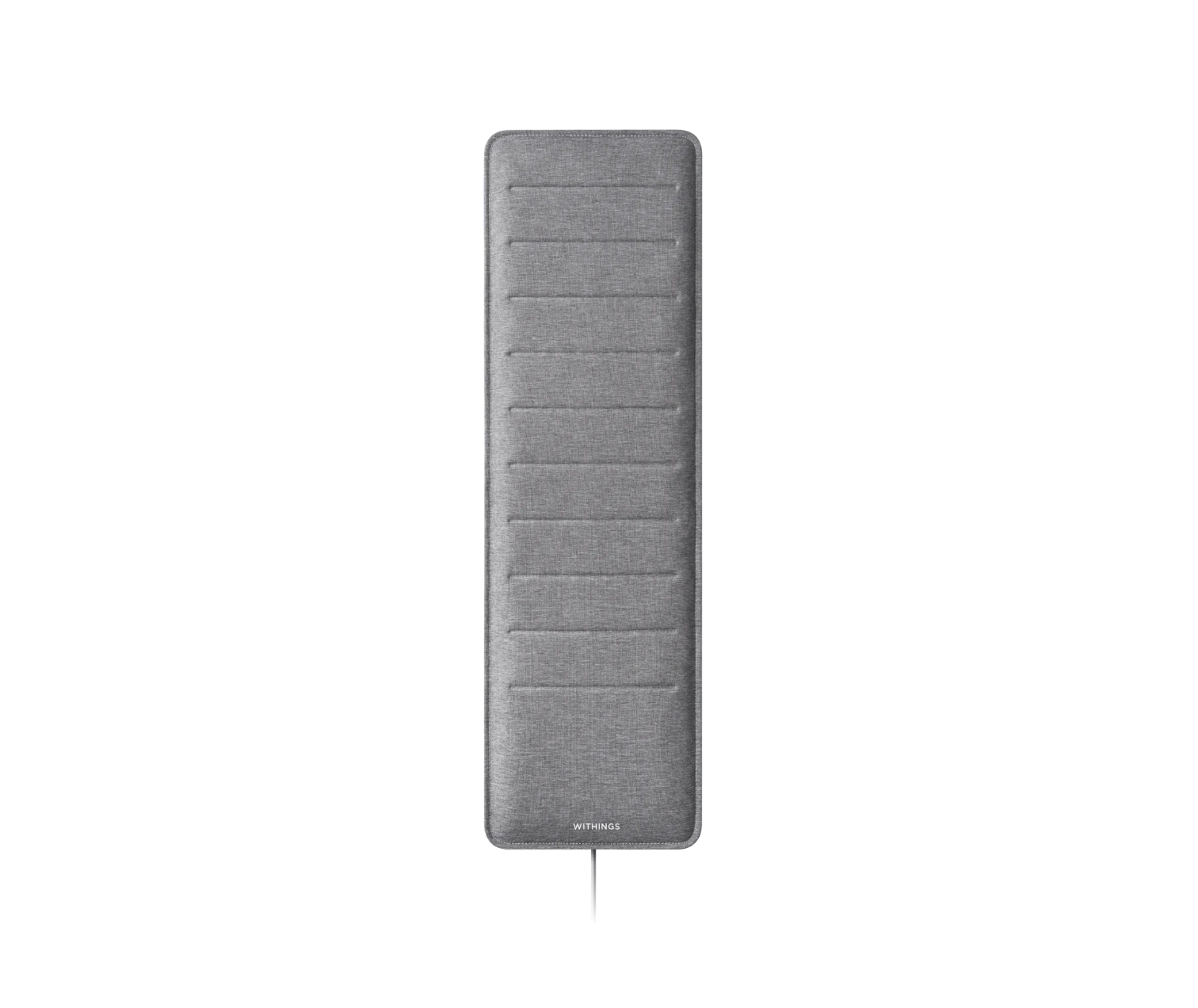
Most trackers sit on the wrist and infer sleep stage from movement and pulse read at the skin. The Withings Sleep mat instead lies flat beneath the fitted sheet and reads the mattress's own vibrations: a pneumatic sensor picks up the faint pressure changes that each heartbeat and each breath sends through the foam or springs, a method called ballistography, while a separate microphone listens for snoring. Withings developed the approach with sleep physicians at Hôpital Béclère in Paris and tested it against polysomnography, the wired overnight study hospitals treat as their own gold standard. It works under spring, foam or latex mattresses. Withings does not recommend a waterbed or an air mattress, since neither carries those pressure changes cleanly through to the sensor.
Setup pairs over Bluetooth, after which the mat syncs by itself over Wi-Fi. The data that matters, sleep cycles, duration and snore count, is free in the Withings app on iOS or Android with no subscription attached; an optional Withings+ plan layers a Readiness score and coaching on top of the same nightly readings, but the tracking underneath is not paywalled. One caveat worth knowing before you buy two: the mat reads only the person lying directly above it, and a partner on the other side of the bed is invisible to it.
- Designed in
- France

- Dimensions
- 637 x 190 x 5 mm (25 x 7.5 x 0.2 in)
- Weight
- 350 g (1.13 oz)
- Charging
- USB, 5V/1A adapter included
Figures as published by the manufacturer. Source