Best minimalist alarm clocks, from Braun to Balmuda
Minimalist alarm clocks that wake you without a phone, from the $40 Braun BC03 and its silent sweep to the Balmuda Clock that tells the time in light.
The best minimalist alarm clocks do one job a phone does badly: they wake you without putting a screen within reach of the bed. What separates the six here is how they do it. A beep that gets louder, light that brightens, a soft alarm with a firmer one behind it, a piece of music, or birdsong that starts three minutes early.
They run from a $40 Braun on one AA battery to a $500 Balmuda carved from aluminium. Two need no app, no account and no Wi-Fi, ever. Three need an app once, to set them up. Whether a clock ticks, whether it needs a socket, and whether its best sounds sit behind a subscription are the facts that decide which one suits a bedroom, and each section says which.
1.Braun Classic Analogue Alarm Clock – $40
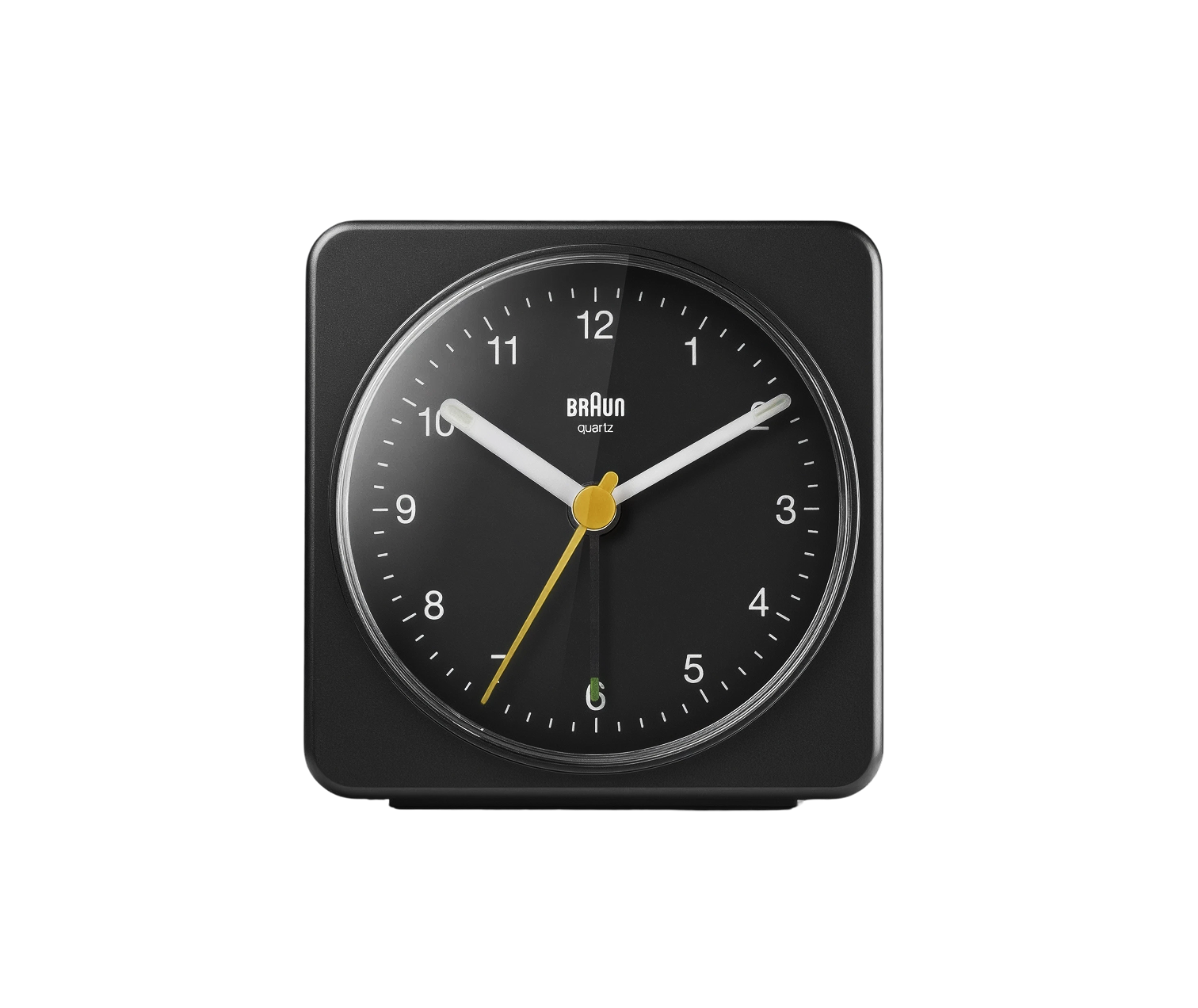
Its second hand sweeps without stepping, so there is no tick to hear in a quiet room.
The BC03 descends from the AB 1, the alarm clock Dietrich Lubs designed for Braun in 1987, and the clock keeps the rules of that era: a black face, white hands with luminous tips, and a yellow second hand that Braun still uses as a signature. It is the larger version of the BC02 travel clock, 78 mm square and 32 mm deep, which is about the size of a coaster.
A cheap quartz clock ticks because its motor jumps the second hand forward once a second, and each jump is a small click. A sweep movement drives the hand in many tiny steps instead, so it glides and makes almost no sound. That one difference is what makes an analogue clock tolerable on a bedside table for a light sleeper.
The alarm is a crescendo beep: it starts quietly and gets louder the longer it is left. It has a snooze and a backlight. It runs on one AA battery, sold separately, and Braun covers it for two years.
There is no app and nothing to pair. Retailers sell it as Braun's large travel clock, and at 32 mm deep it packs as easily as it sits on a nightstand.
2.Muji Railway Station Alarm Clock – $60

The only clock here that Muji designed to mount on a wall as well as stand on a desk.
Muji sells it as the Station Alarm Clock in the US, and it is named for the clocks on railway platforms. The dial carries four numerals, 12, 3, 6 and 9, with plain strokes between them and a thin second hand. Nothing on it is there except to be read from across a room. It measures 12.6 by 9 by 4 cm and weighs 193 g with its single AA battery, which Muji includes.
The landscape shape is the useful part. Most small alarm clocks are square or round and only stand up. This one is wider than it is tall, so it sits low beside a lamp, and the same body goes on a wall in a kitchen or a hallway.
Muji makes it in China, and it costs less than any other clock here except the Braun. Like the Braun, it needs no app, no setup and no power socket.
It is a battery clock in the plainest sense: an hour hand, a minute hand, an alarm. Anyone who wants light, sound libraries or a way to keep a phone out of reach should read on.
3.Hatch Restore 3 Sunrise Alarm Clock – $170

It wakes you with light first and sound second, and since this version it can be run from buttons on the clock with the phone in another room.
The Restore 3, released in January 2025 at $169.99, added physical controls to a line that had leaned on its app. One large button on top snoozes, stops the alarm and sets the volume, and smaller buttons switch routines, pause them and turn on a bedside light.
A sunrise alarm brightens the room slowly before the alarm time, so you surface from sleep in light before any sound plays. The sound, if you set one, arrives at the end of the sunrise.
The app is still needed to set the clock up and build routines. Hatch includes 30 days of its Hatch+ subscription, and after that it costs $4.99 a month or $49.99 a year. The clock works without it. The subscription adds a larger library of sounds, stories and extra routine steps.
It comes in three colours, Cocoa, Greige and Putty, and plugs into the wall. The Blueair Mini Restful in small air purifiers for small rooms is another sunrise clock, with a purifier inside.
4.Loftie Clock – $169

Two alarms in sequence: a soft one that fades after 30 seconds, then a second one three, six or nine minutes later.
The two-phase alarm is the reason the Loftie exists. The first phase plays a quiet sound for half a minute and stops on its own, which is often enough to wake you without startling you. The second phase is a calm melody that keeps going until you switch it off. The gap between them is yours to choose, and it behaves like a built-in snooze you never have to press.
The clock needs Wi-Fi once, to set up and fetch updates. After that a No Wi-Fi Mode keeps every alarm and sound working with the router out of the picture. It holds more than 100 sounds, from white and brown noise to sound baths and breathing exercises, and Loftie's page now states plainly that there is no subscription and no paywall. Earlier versions of Loftie's help pages listed a paid tier, so the change is recent.
It measures 6.5 by 2.75 by 2.75 inches and needs a socket. A backup battery keeps it going for five to seven hours if the power drops. The display dims down to nothing, a nightlight helps at 3am, and it can pair with a Bluetooth speaker.
Of the six, it does the most to keep a phone out of the bedroom, including an app-blocking mode that locks chosen apps while you are in the room.
5.OneClock Analog Alarm Clock – $230

It wakes you with music written for it by Jon Natchez of The War on Drugs, and has no screen, no Wi-Fi, no Bluetooth and no app.
Jamie Kripke started OneClock in Boulder, Colorado, and launched on Kickstarter in February 2021. The idea was narrow: an analogue clock with a good speaker. Natchez wrote a set of waking compositions for it, and the clock picks one at random each morning, so you do not wake to the same few bars every day.
The case is machined aluminium with wood and glass, and OneClock says its proportions follow the golden ratio. Inside is a Swiss-designed 12-hour analogue movement. Like any analogue alarm, it cannot tell morning from evening: set it at 11pm for 7, and it rings at the next 7 the hands reach. There is no snooze button, by design.
It runs from a USB-C cable and a wall adapter, and it keeps its time and alarm setting through a power cut. A touch on the clock turns on a night light for five seconds.
Nothing on it updates over the air, and nothing breaks when a company retires an app. It is the analogue clock the Braun is, at bedside-speaker scale and with a different idea of what an alarm should sound like.
6.Balmuda The Clock – $500
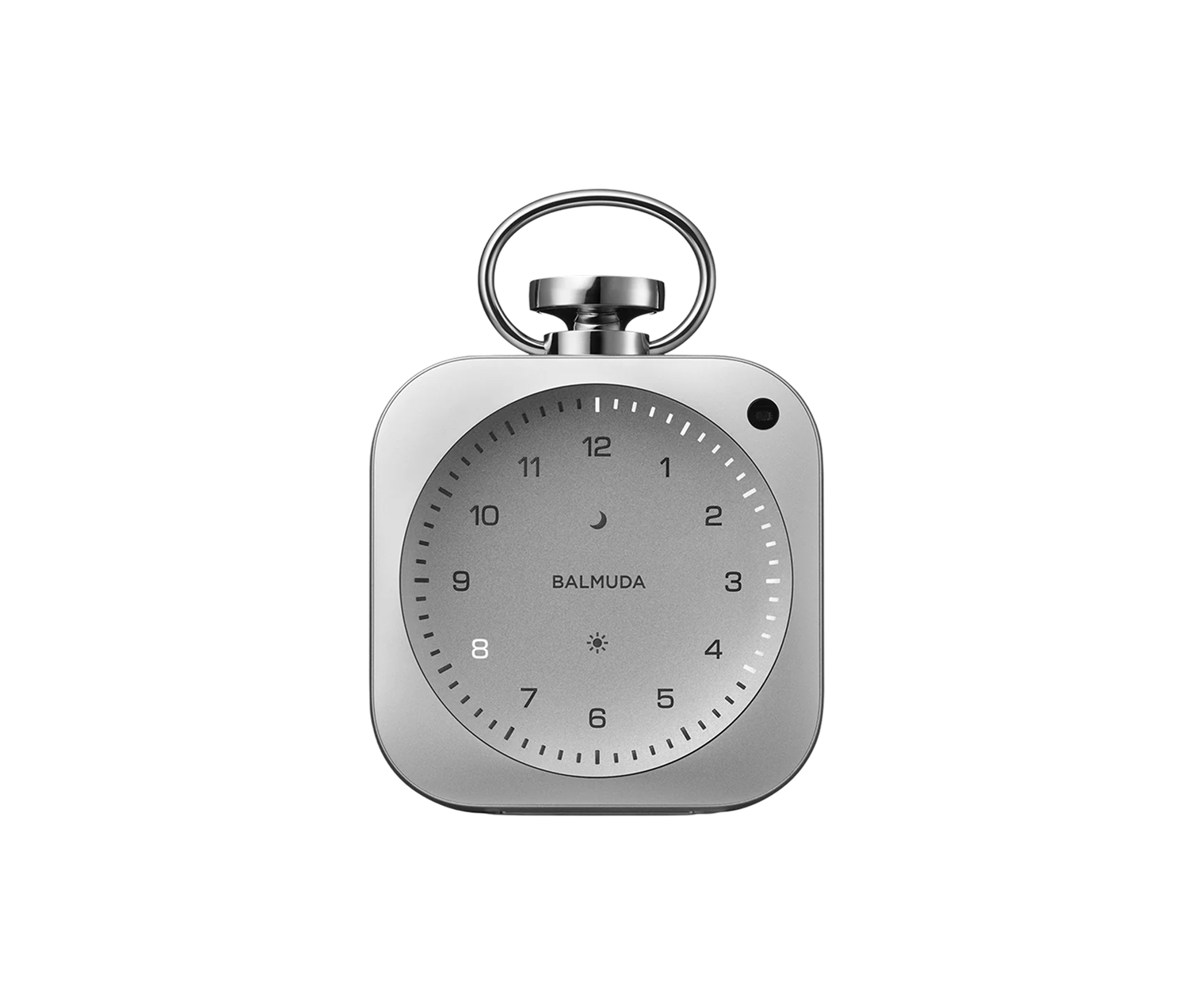
There are no hands: the hour glows as a numeral and a ring of light marks the minutes and seconds.
Balmuda calls this the Light Hour system. Seventy-five LEDs sit behind the face, the hour shows as a lit numeral in the middle, and the minutes and seconds travel around the ring. On the hour a chime sounds and the light swings across the dial like a pendulum. The body borrows from a pocket watch, crown included, and Balmuda says more than 200 parts go into it, the aluminium case among them.
The alarm starts three minutes early. Ambient sound, birds or a distant train, fades in before the set time, through stereo speakers. A Relax Time mode plays recorded soundscapes, rain on leaves or a fireplace, and a focus timer runs white noise for 1 to 60 minutes.
It is the only clock here with a rechargeable battery. Balmuda rates it at about 24 hours of normal use and 2.5 hours to charge over USB-C, so in practice it lives on its cable and comes off for an evening in another room. It stands 4.1 inches tall with the crown, weighs 259 g and connects over Wi-Fi and Bluetooth 5.0 to Balmuda's app.
It went on sale in Japan in March 2026, which makes it the newest clock here, and the only one that tells the time in a way you have to learn.
How we chose
We chose these by how each one wakes you, because that is the real difference between six clocks that all keep good time: a rising beep, light, a two-step alarm, composed music, or sound that starts early. Every clock had to work with the phone out of the bedroom once it was set up, and we left out anything that needs an app to switch the alarm off. Figures come from each maker's own page, checked against a second source: Braun, Muji, Loftie, OneClock and Balmuda all limit automated readers, so their pages were read in a browser. Where two sources disagreed, as with the Hatch's free sound count, the figure is left out. These are bought for how they look and how they wake you, so there is no comparison table.
Common questions
Look for a sweep movement, where the second hand glides instead of jumping once a second. The Braun BC03 uses one and is close to silent. Clocks with no hands, like the Balmuda The Clock, or with a display, like the Loftie and the Hatch Restore 3, have nothing to tick.
Yes. The Braun BC03, the Muji Station Alarm Clock and the OneClock have no wireless connection at all. The Loftie needs Wi-Fi once for setup, then runs in a No Wi-Fi Mode. The Hatch Restore 3 and Balmuda The Clock use an app for setup and settings.
Not to work. The Hatch Restore 3 includes 30 days of Hatch+, then charges $4.99 a month or $49.99 a year for a larger sound library and extra routine steps; the alarm and sunrise work without it. Loftie says its clock has no subscription and no paywall.
The Braun BC03 and the Muji Station Alarm Clock each take one AA. The Balmuda The Clock has a rechargeable battery rated at about 24 hours. The Loftie, the Hatch Restore 3 and the OneClock plug into the wall; the Loftie's backup battery lasts five to seven hours, and the OneClock keeps its settings through a power cut.
Two alarms in sequence. On the Loftie Clock, a soft sound plays for 30 seconds and fades on its own, then a second, continuous melody starts three, six or nine minutes later and plays until you turn it off.
About the author

Justin Farrugia
Founder & Editor of Curated Supply
Justin Farrugia is the founder and editor of Curated Supply, a design-led directory to things worth owning. He has personally curated over 1,000 products across workspace, carry, coffee, audio, and the home, each judged against one standard: design intent, material quality, and the restraint that lets a thing last.


