Kitchen tools and appliances worth leaving on the counter
Seven kitchen tools worth leaving on the counter, from an $85 grinder set to a $450 stand mixer, each judged on how it looks between uses, not just in use.
Updated
Eighteen inches is the gap between the counter and the underside of the kitchen cabinets above it. That is the National Kitchen and Bath Association's recommended figure, and it is the constraint every countertop appliance has to work under, which is why so many of them turn out to be seventeen and a bit inches tall.
Fitting is the easy half. The kitchen tools worth leaving on the counter have to pass a second test, which is how they look on the days nobody uses them. Most of these run for twenty minutes and sit in view for the other twenty three hours, so the ratio that decides the purchase is not how well a thing works but how many hours of not working it has to stay tolerable for.
Seven that pass, from an $85 grinder set to a $450 mixer. The hob counts as counter here, because two of them live on it.
1.KitchenAid Artisan Series 5 Quart Tilt-Head Stand Mixer

Twenty two point eight pounds, which is the whole argument.
A machine at that weight is not lifted in and out of a low cupboard twice a week. Owning one is a decision about what occupies the open corner of a counter for the next decade, taken once and rarely revisited.
It stands 13.9 inches closed and 17.75 inches with the head tilted back, a quarter of an inch under the standard clearance. KitchenAid sized it to open where it already stands. Pull a mixer forward every time the bowl needs filling and it stops getting filled, which is the first step towards the cupboard.
The silhouette is not a retro reference. Egmont Arens drew it in 1937, and the shape sold today is that drawing with a current motor inside, which makes it one of the longest continuously produced industrial designs in an American kitchen.
Underneath, the Artisan runs 325 watts through a planetary action: the beater turns one way while the shaft carrying it turns the other, so the tool sweeps the whole bowl instead of cutting a single circular track through the middle of it. Ten speeds put real distance between folding and whipping, which a three setting dial only approximates.
The hub on the front is the part that changes what the object is. It drives more than ten attachments off the same motor, so a pasta roller, a meat grinder and a spiralizer arrive as heads, not as three more machines wanting three more sockets.
More than thirty colours, and since the body is enamel over metal, the colour is the finish itself, not a coat sprayed over a plastic shell.
2.Le Creuset Signature Round Dutch Oven

Cast in a sand mould the foundry breaks to get it out, so no two are quite identical.
Le Creuset has been pouring iron at Fresnoy-le-Grand in northern France since 1925, and each piece is still cast individually rather than stamped out of a permanent die. The mould is broken to get the pot out, which means the object leaving the foundry is the only one that mould will ever produce. Hand finishing follows, and that is where the casting seams go.
The Signature line is the current generation, and every difference from the older Classic is about handling. The side handles are 45 per cent larger, which is the gap between gripping a full pot in oven gloves and shuffling it across the hob. The knob is a composite rated to 500°F, so the lid goes into the oven at bread temperatures without swapping to a metal one first.
Inside, the enamel is sand coloured. Dark interiors hide the two things a cook is looking into a pan to read: how far a fond has caught, and whether a braise has reduced. A pale floor shows both. It also means the Signature Round Dutch Oven never needs seasoning, because there is no bare iron anywhere to protect.
Cast iron holds heat long after the flame is off, which is what a slow braise wants and what a thin pan cannot imitate. The lid seals tightly enough to trap steam and send it back down, so the liquid stays in the pot instead of on the hob.
Le Creuset picks the exterior colours for a room, not for a cupboard. It lives on the hob because it is too heavy to keep moving, and it survives being on show there because that is where it was always going to end up.
3.Aarke Carbonator 3

Stainless steel over the whole body, no cord, and no batteries anywhere in it.
Every other sparkling water machine on a counter announces itself with a plastic shell, a power lead and an indicator light, for a job that amounts to one squeeze of gas. Aarke builds the Carbonator 3 around a lever instead. Pulling it down releases CO2 from the cylinder, and how fizzy the water gets depends on how long you hold the lever down, so there are no electronics to fail and no setting that can be wrong.
The shell is SUS304 stainless, the grade used for sinks and commercial worktops. It shows a fingerprint and loses it to a cloth, and it will not yellow the way a white plastic housing does after a few summers by a window.
It stands 16.3 inches and weighs 3.7 pounds, so it clears a standard cabinet with room to lift the bottle out, and one hand moves it when the counter needs wiping. Anything that needs two hands gets wiped around instead of under.
A standard 60 litre cylinder carbonates about sixty bottles, and the supplied bottle holds a litre with a fill line at 800 millilitres. For a household drinking two litres of sparkling water a day, that is one cylinder a month against roughly sixty plastic bottles carried home, which is the practical case for owning one at all.
Finishes run from bare steel to matte black, sand and copper. The steel reflects whatever the kitchen already is, which is the version that dates slowest.
4.Smeg 2-Slice Toaster

Six browning levels and a rack that centres the bread, which between them fix the thing toasters get wrong.
Most toasters brown unevenly at level three, where nearly everyone leaves the dial, because the slice leans against one wall of the slot and cooks harder on that face. The 2-Slice Toaster holds each slice upright between sprung racks, so both faces sit the same distance from the element and the 950 watts lands evenly on each.
The slots are wider than standard, which is a decision about bread, not about toast. A cut off a sourdough loaf is thicker than a supermarket slice and will not go into most toasters at all.
Three functions sit alongside the dial: defrost, reheat, and bagel, the last of which runs the inner elements only, so a cut face toasts while the crust stays soft. The crumb tray is stainless and pulls straight out of the base.
The shape is not a survivor from the fifties. Matteo Bazzicalupo and Raffaella Mangiarotti of Deepdesign drew Smeg's 50's Style line as new work, taking the curves, chrome trims, spherical knobs and small feet of the period and building them around current internals. It is a designed impression of an era, not a reissue of any particular machine.
Which is also why it arrives in pastel blue, cream and red as readily as steel. A toaster is one of the few things on a counter that can carry a strong colour without fighting the food, because it is small, low, and always in the same place.
5.Field Company No. 8 Cast Iron Skillet
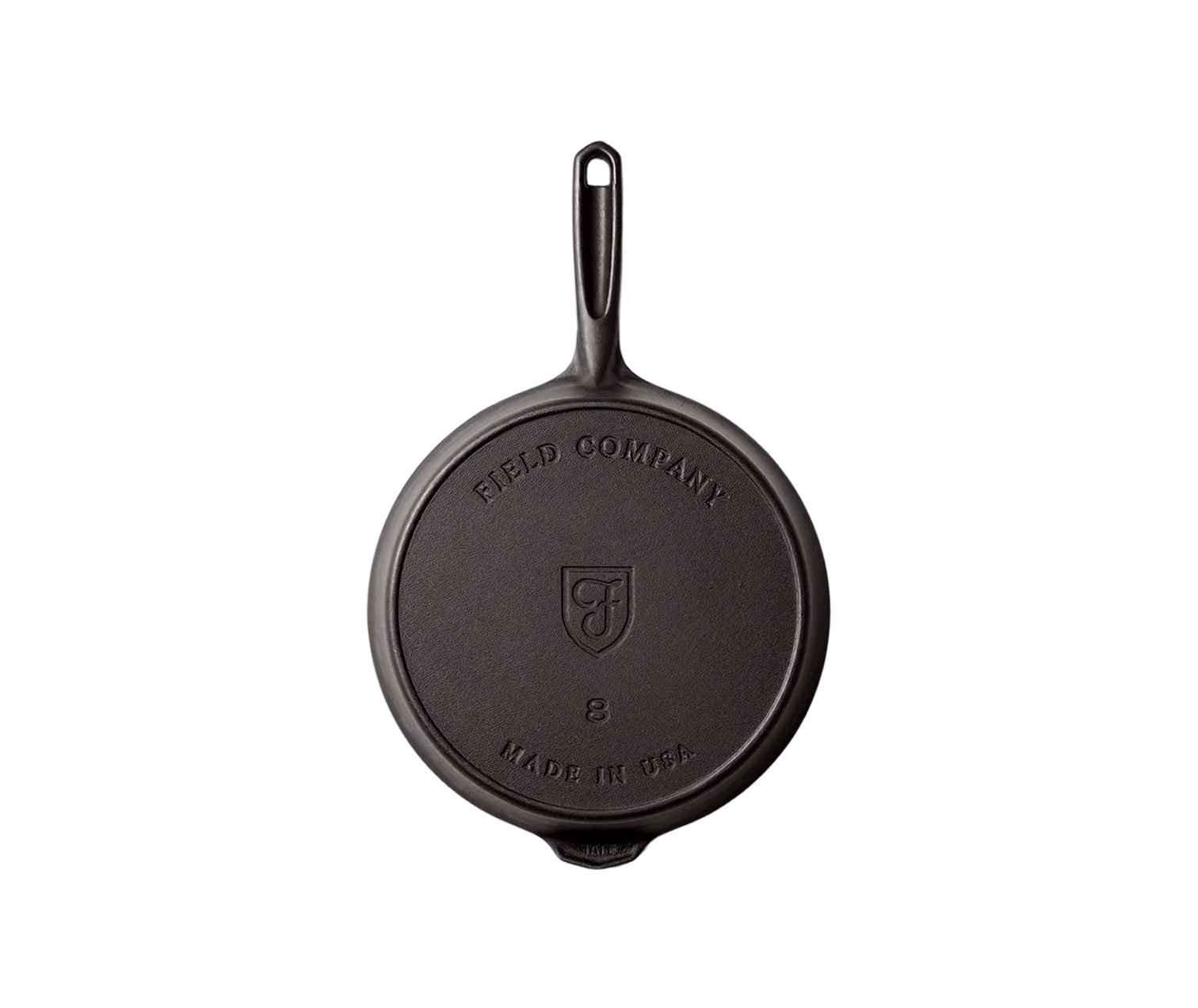
Four and a half pounds, where the equivalent Lodge is 5.35, and the difference is all in the wall thickness.
Cast iron got heavy after the war because thick walls are easier to pour. Field Company casts thinner ones, which is harder to do and rejects more of the run, and a 10.25 inch pan comes out of it that tips and lifts one handed. Anyone who has carried a full traditional skillet from hob to oven knows what that pound is worth.
The cooking surface is then machined smooth. American foundries finished skillets that way as standard until about 1960, and modern budget cast iron keeps the pebbled texture of the sand mould, which is why it takes years of use before eggs stop sticking to it. Machining skips the years. The No. 8 arrives with layers of grapeseed oil polymerised onto that face, so the first meal cooks on seasoning instead of building it.
There is a genuine trade going the other way. Thinner iron stores less heat, so a cold steak dropped in pulls the temperature down further than it would in a heavier pan, and the sear wants a hotter start to compensate. Field publish the trade themselves instead of leaving buyers to find it.
It hangs or sits on the hob because it earns a turn most days, and because a machined iron face reads as a tool, not as cookware. Nothing about it is decorative, which on a counter of coloured enamel is the contrast that makes the rest of it work.
6.Alessi Bird Whistling Kettle
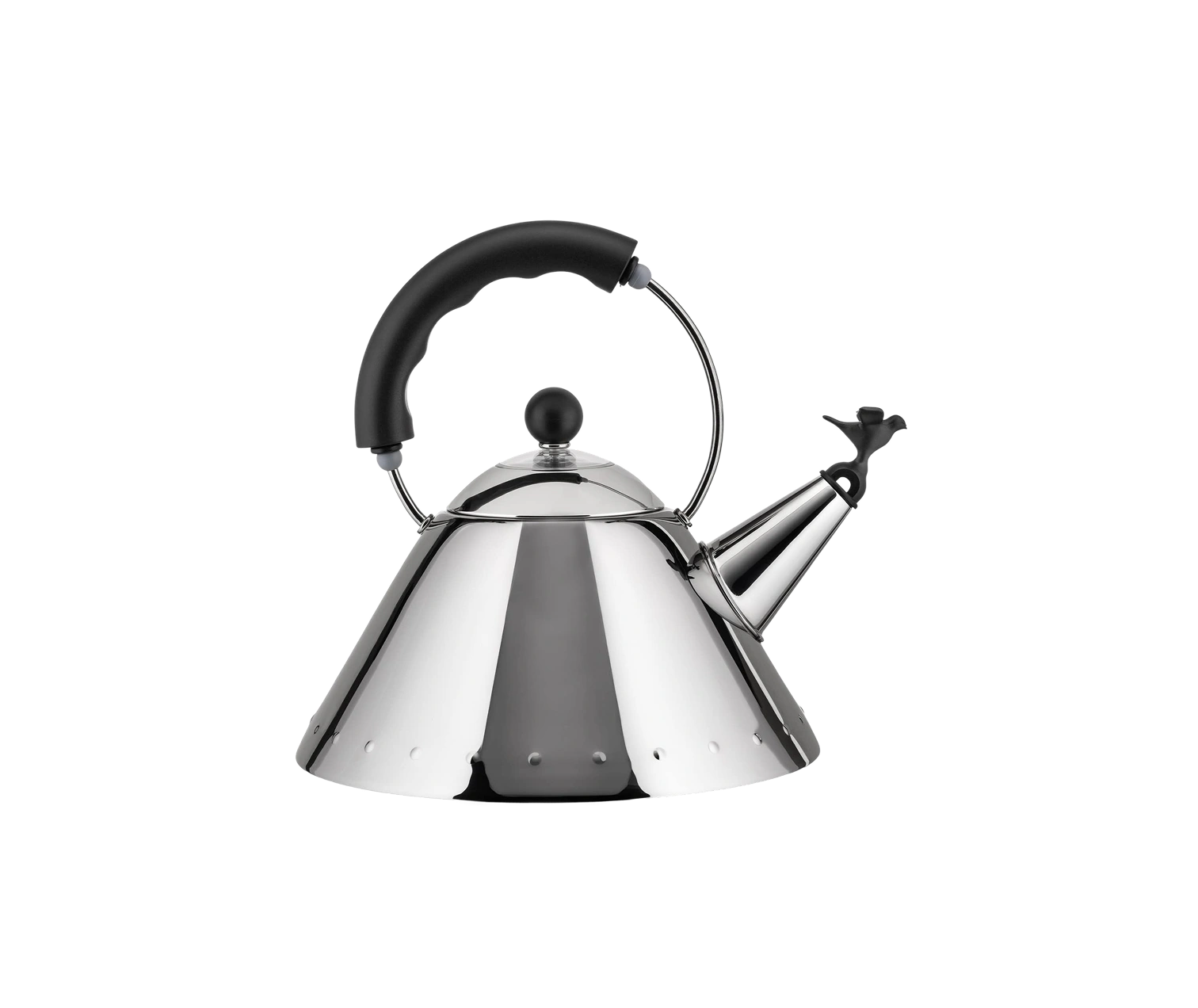
The best selling object in Alessi's history, past a million and a half units since 1985.
Michael Graves was an architect first, and the 9093 reads like a small building: a truncated cone, a wide base that puts the most water surface over the flame, and a handle arcing clear of the heat coming up the sides. It went on sale in 1985 and has not been out of production since, which at this price is the only durability claim worth making.
The whistle is a brass bird seated in the spout. Steam passes through it and the bird sings, two notes where an ordinary kettle manages one flat tone, loud enough to carry into the next room without working as an alarm. Nothing about a kettle requires this. That is precisely the case for buying one.
The body comes in polished 18/10 stainless, with a pale blue polyamide handle that stays cool in the hand. The Bird Whistling Kettle holds two quarts, enough for a full teapot and a cup after it.
An electric kettle boils faster, and this one does not compete on speed. It answers the only remaining reason to keep a stovetop kettle: nothing else on a counter makes a sound on purpose, and a kitchen without one is quieter in a way people notice.
Alessi sells the bird on its own as a spare part, because it is the piece that goes missing.
7.Audo Bottle Grinder

The grinding mechanism sits at the top instead of the bottom, and that inversion is the entire design.
A conventional mill grinds downward from a burr in its base, so setting it back down leaves a small ring of pepper on the table. Norm Architects turned it over for Audo: the burr is under the lid, the body beneath it is the reservoir, and what comes off the grind falls into the food, not onto the surface. A table that stays clean is not a styling choice, it is the reason the pair can live in the open next to a bowl of fruit.
The burr is ceramic, which does not corrode against salt the way steel does, so either mill in the set takes either seasoning. Most sets quietly assign the salt to a mill that will rust and the pepper to the one that will not.
The form is a bottle, wide at the base and narrowing at the neck, sized to sit in a closed hand and to tip and twist in one movement. There is no cap to take off and no knob on top to find.
The Bottle Grinder is sold as a two piece set, in matte finishes carrying small deliberate irregularities, with a wooden lid closing each one. Buy two colours and the salt and the pepper tell themselves apart, with no label to read.
What the counter is actually for
A kitchen runs two storage systems. Cupboards are for hiding things, and the counter is for reaching them, and the rent on a counter place is years of standing in full view.
That inverts what a specification means. Twenty two point eight pounds is not a drawback of the KitchenAid, it is the reason the decision is permanent. The sand interior of the Le Creuset and the machined face of the Field skillet solve one problem in opposite materials, which is letting a cook read a surface. The Aarke has no display because a display is the only part of it that could ever look dated.
None of this is the cheapest way to do the job. A $20 kettle boils water, a plastic carbonator makes bubbles, and any skillet will fry an egg. The argument for these versions is the hours between uses, the part nobody costs and everybody sees.
The single heavy mill, and the rest of the ordinary objects worth spending on, are in everyday objects that look better than they need to.
How we chose
We took every kitchen product in the catalogue that carries an affiliate link and appears in no post, then kept only the ones that live in the open, on the counter or on the hob. Seven objects doing seven different jobs, none repeated, from $85 to $450. Figures in the prose come from the makers' own pages and spec sheets, with the Field and Lodge weights taken from Field's own published comparison and the 18-inch clearance from the National Kitchen and Bath Association. No pick carries a spec panel and there is no comparison table, because a mixer, a kettle and a skillet share no measurement worth putting in a column.
About the author

Justin Farrugia
Founder & Editor of Curated Supply
Justin Farrugia is the founder and editor of Curated Supply, a design-led directory to things worth owning. He has personally curated over 1,000 products across workspace, carry, coffee, audio, and the home, each judged against one standard: design intent, material quality, and the restraint that lets a thing last.