Classic sunglasses, from the Ray-Ban Aviator to the Persol 649
Five classic sunglasses still made new, from the 1937 Ray-Ban Aviator and the Wayfarer to the Persol 649, with the sizes that decide whether a pair fits.
Classic sunglasses are the few shapes that have outlived every trend around them, and four of the five here date from before 1960: the Ray-Ban Aviator in 1937, the Wayfarer in 1952, the Persol 649 in 1957. The Oakley Holbrook borrows that era's lines for a modern frame, and the Ray-Ban Meta puts a camera inside the Wayfarer.
One thing the shop windows do not say: all five come from the same company. Luxottica bought Persol in 1995, Ray-Ban from Bausch & Lomb in 1999 and Oakley in 2007, and since 2018 it has been part of EssilorLuxottica. The smart Wayfarer is its joint product with Meta. The choice between them is real, but it is a choice of shape, material and lens, not of maker.
Three numbers printed inside the temple size every frame: lens width, bridge and temple length, in millimetres. Each section gives them, because they decide fit more than any photograph does. More things to wear are in Made to Wear.
1.Ray-Ban Aviator Classic
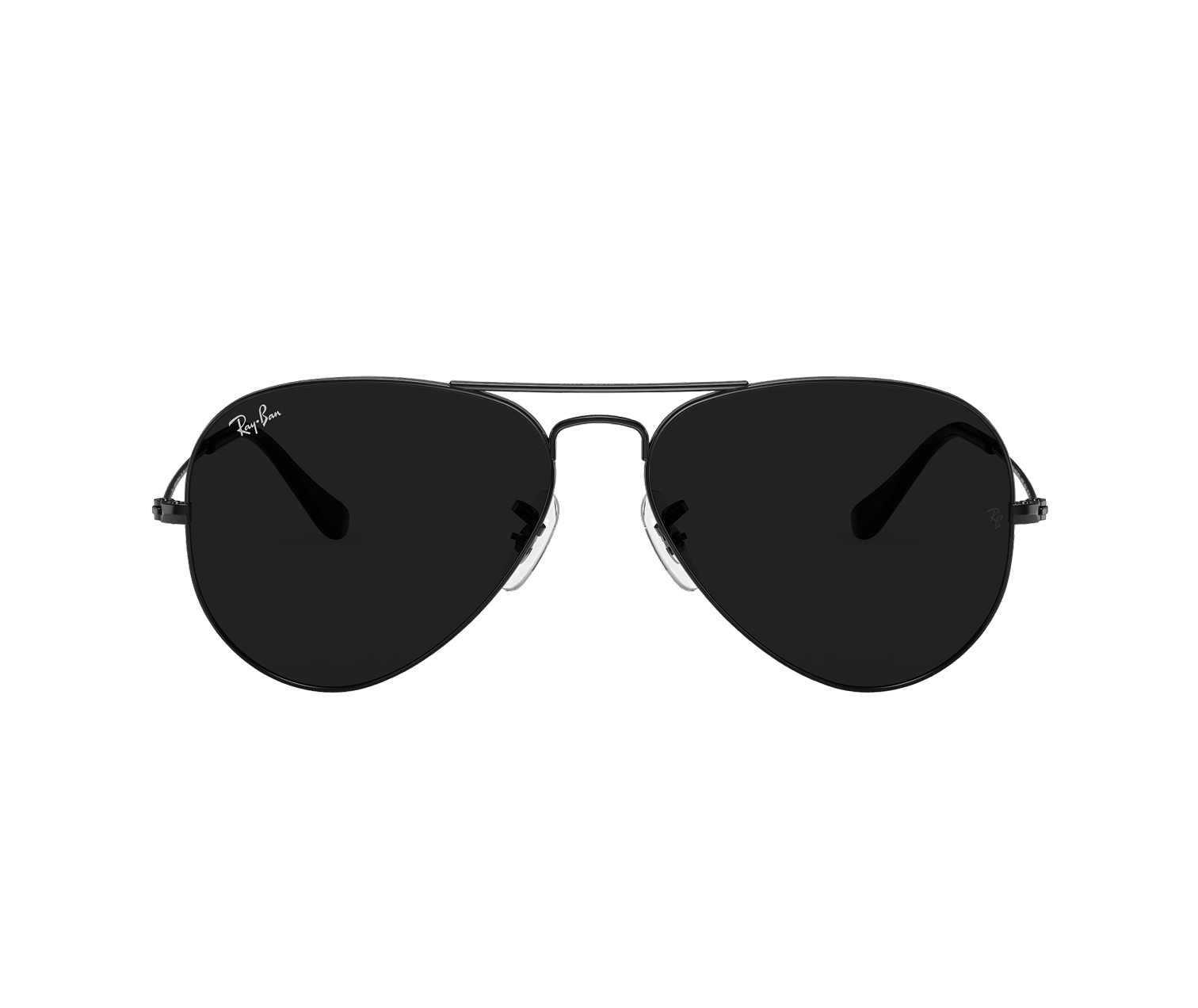
The oldest shape here, made for pilots in 1937, and the only one sold in three sizes of the same teardrop.
The model number is RB3025. A pilot's view runs down as much as forward, toward the instruments, and the deep teardrop lens covers that downward glance; it is why the shape still sits lower on the cheek than any other frame in this post. The aim was a pair that cut the glare at altitude without blocking the view, and Bausch & Lomb, the American optics company that created Ray-Ban, sold it to the public under that name.
The three sizes are 55, 58 and 62 mm lens widths, and all three share one 14 mm bridge and 135 mm temples. That is unusual. On most frames a bigger lens comes with a different bridge, so a size change moves where the glasses sit on the nose. Here only the width grows, and the fit at the nose stays the same. The 58 has a lens about 50 mm tall.
The frame is thin metal with adjustable nose pads, so it rests on two small pads instead of across the bridge of the nose. An optician can bend them to fit. The gold frame with green lenses is the version in most old photographs, and Ray-Ban sells polarised and gradient lenses on the same frame.
A metal frame weighs little and folds flat in a shirt pocket. The trade is that wire bends where acetate would not, so these want a hard case more than any other pair here.
2.Ray-Ban Original Wayfarer Classic Sunglasses
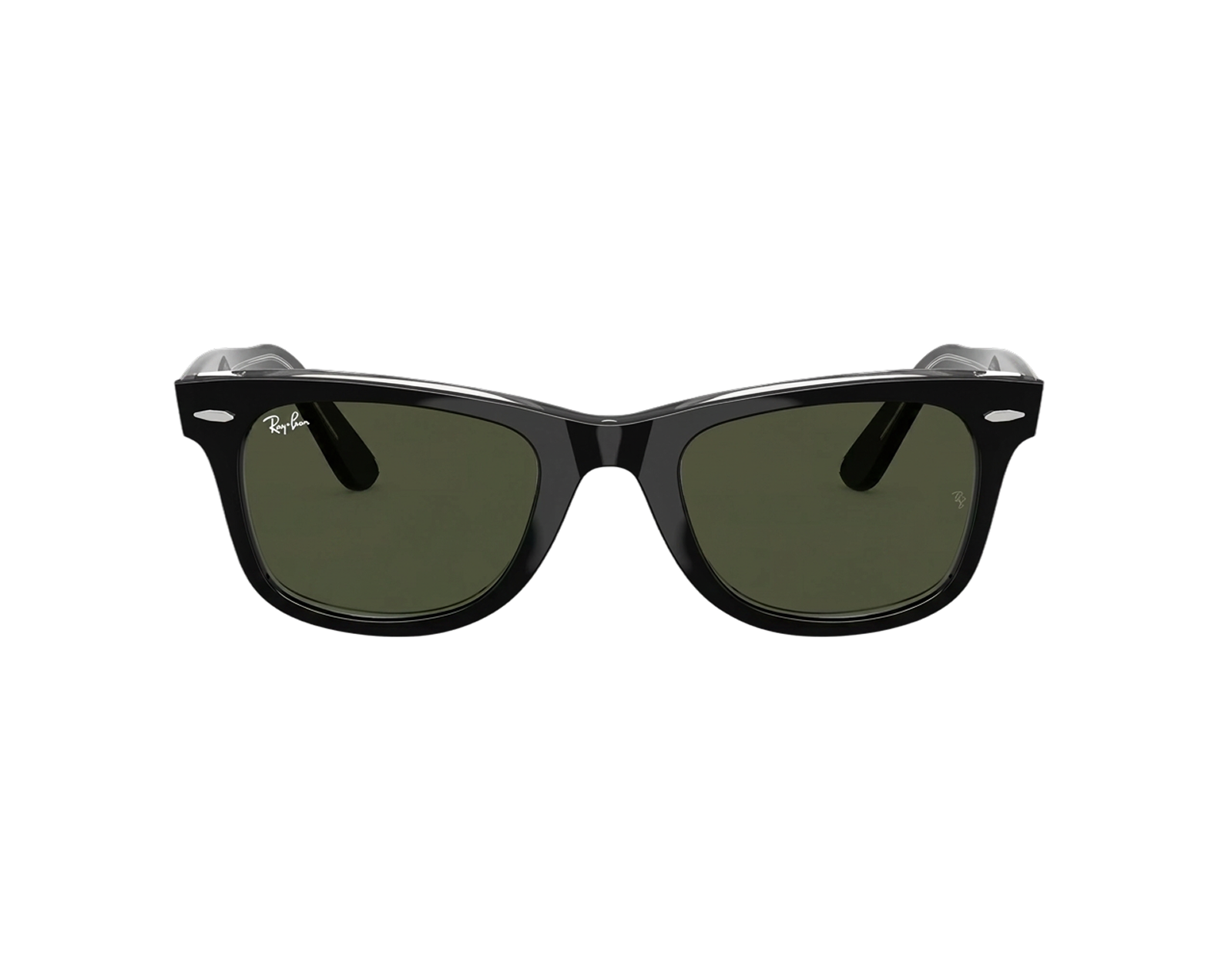
The acetate answer to the Aviator, introduced in 1952 as Ray-Ban's first frame in moulded plastic instead of metal.
Acetate is a plant-based plastic cut from thick sheets, which is why a Wayfarer feels dense in the hand where an Aviator feels like wire. The RB2140 tilts forward at the top, a trapezoid that leans out from the brow, and that tilt is what made it read as new in the 1950s, when most frames were still thin metal.
It comes in two sizes, and the numbers are worth reading closely. The smaller has a 50 mm lens on a 22 mm bridge; the larger has a 54 mm lens on an 18 mm bridge. Both run 150 mm temples. So the bigger Wayfarer sits on a narrower bridge, which means it suits a wide face with a slim nose, and the 50 is the better choice for a wider nose even on a larger face.
The version in the photographs is code 901: black acetate with green G-15 lenses, a grey-green tint that keeps colours close to true.
A Wayfarer sits on the nose with no pads, the whole weight across the bridge. On the right size that is comfortable all day. On the wrong one it slides, which is why the two sizes matter more here than on the Aviator.
3.Persol 649
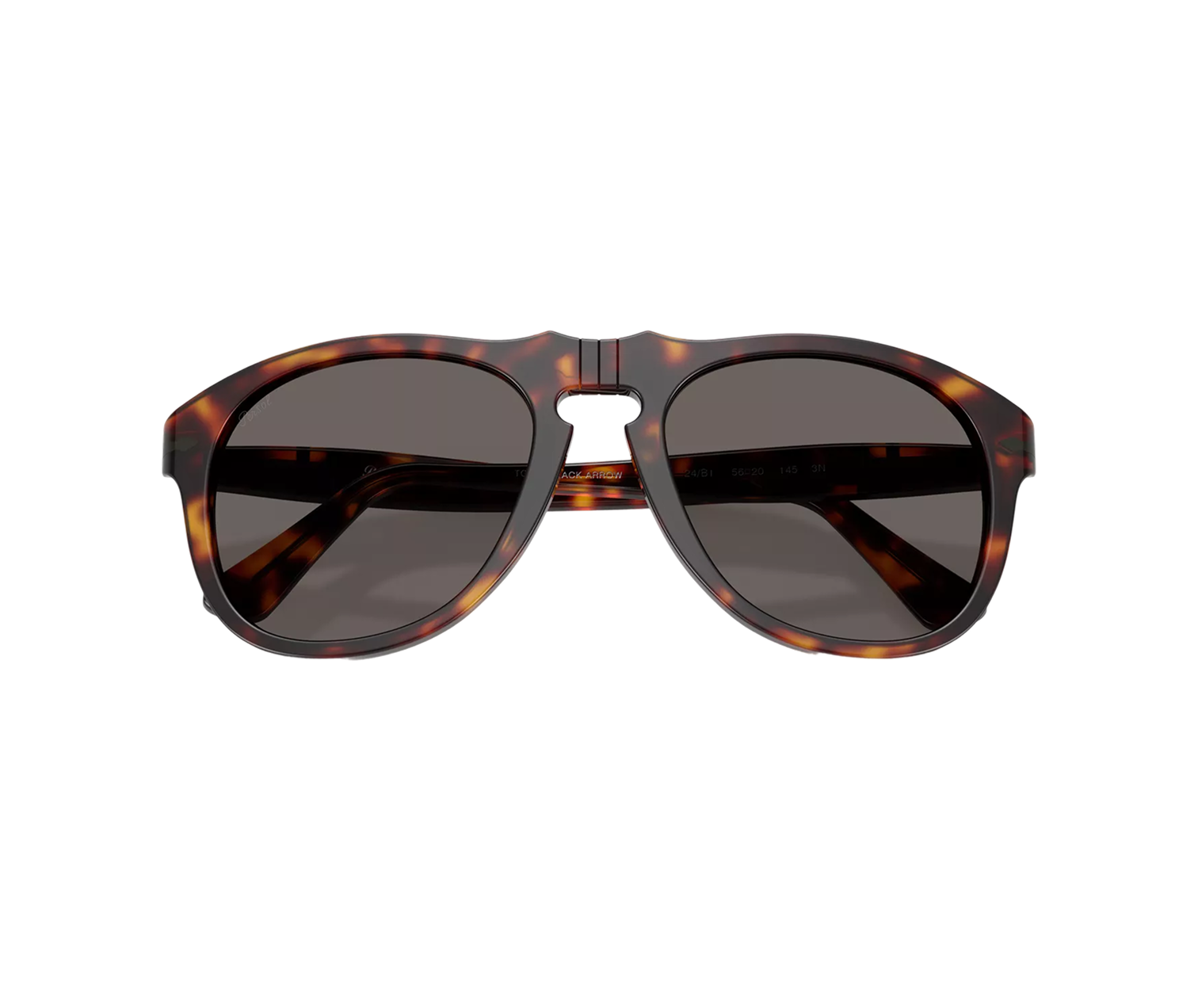
Made in 1957 for the tram drivers of Turin, to keep dust and glare out of their eyes through a whole shift, and still made by hand in Italy.
The 649 is a large acetate frame with a keyhole bridge, the arched cut-out between the lenses that spreads the weight onto the sides of the nose. Inside each temple is Meflecto, the flexible stem system Persol introduced in the late 1930s. The core of the arm flexes as the glasses go on, so the temples settle to the width of the head and stop pressing on it. Behind the hinge sits the Supreme Arrow, the silver arrow that is the easiest way to spot a Persol across a room.
The lenses are what Persol calls crystal, its word for glass, sold from plain tints to polarised. Glass resists scratches better than the plastic lenses most sunglasses use, and it is heavier. The acetate is Persol's own, made from cotton and powdered pigment.
The standard size is 54-20-140: a 54 mm lens, a 20 mm bridge and a 140 mm temple. The 649 became the brand's first icon after Marcello Mastroianni wore a pair in the 1961 film Divorce Italian Style.
Persol lists the 649 at $363 on its own site, and up to $427 with polarised lenses. The figure in the buy row below is the retailer we link to. Glass lenses and thick acetate make it a pair you notice on the face, the way a good watch sits on the wrist.
4.Oakley Holbrook
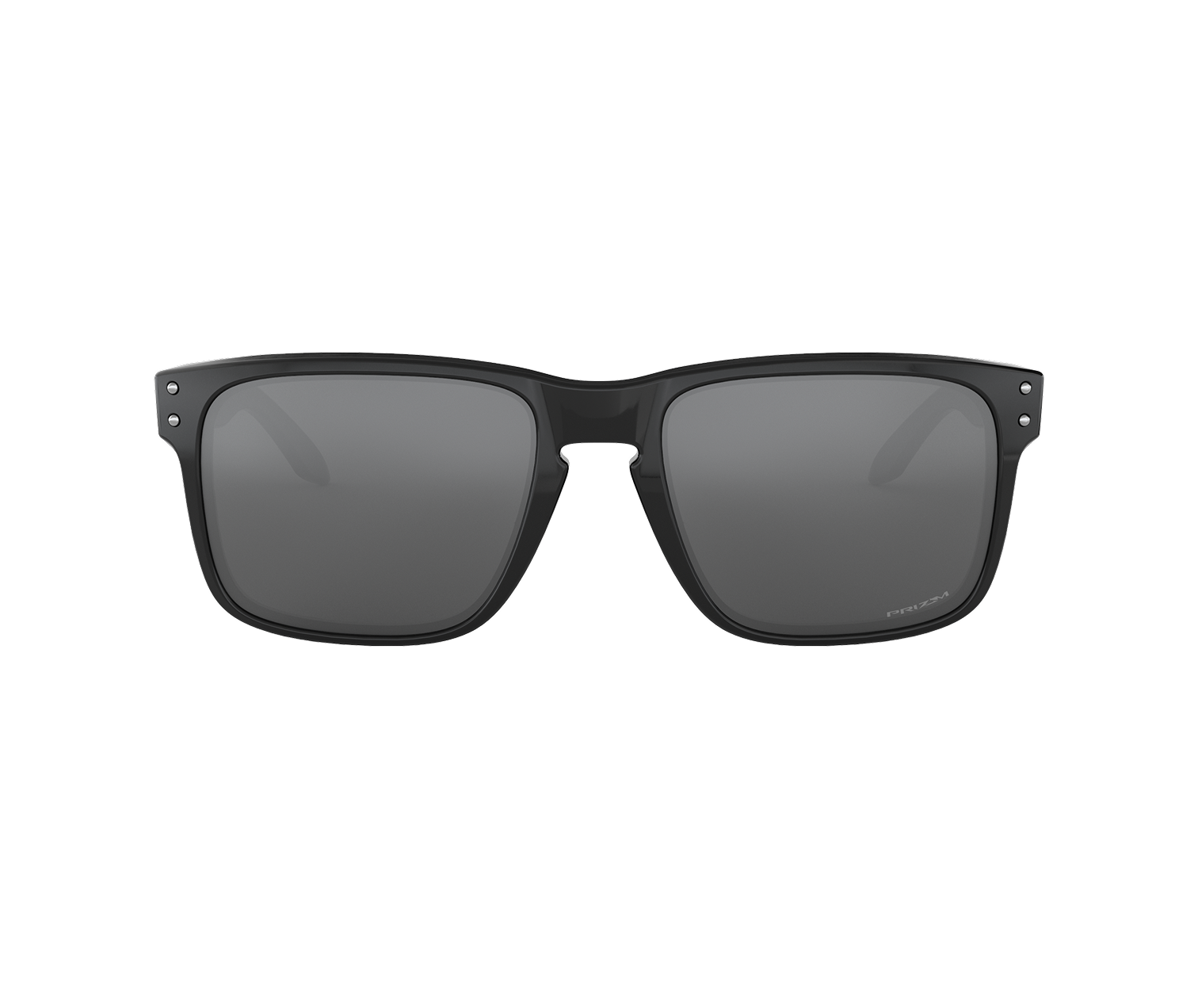
The one modern frame here: a square shape borrowed from mid-century films, built from Oakley's sports materials.
The frame is O Matter, a nylon-based material that flexes under stress and returns to shape, which is why a Holbrook survives being sat on more often than an acetate frame does. It holds its weight at three points only, the bridge and the two temple tips, so nothing presses on the sides of the head.
The lenses are Plutonite, a polycarbonate that blocks UV as a property of the material itself, not as a coating that can wear off. Most are sold with Prizm, Oakley's tint that filters specific wavelengths where colours blur together, so contrast rises instead of everything simply going darker. It is the opposite idea to the G-15 on the Ray-Bans, which aims to keep colours as they are.
The standard Holbrook is one size, 57-18-137, with a 43 mm lens height. The lenses sit on a gentle curve that wraps a little round the eye without becoming a sports wrap.
Of the five, it is the one to keep in a car door or take on a boat, because a nylon frame and a polycarbonate lens forgive a drop.
5.Ray-Ban Meta Wayfarer (Gen 2)
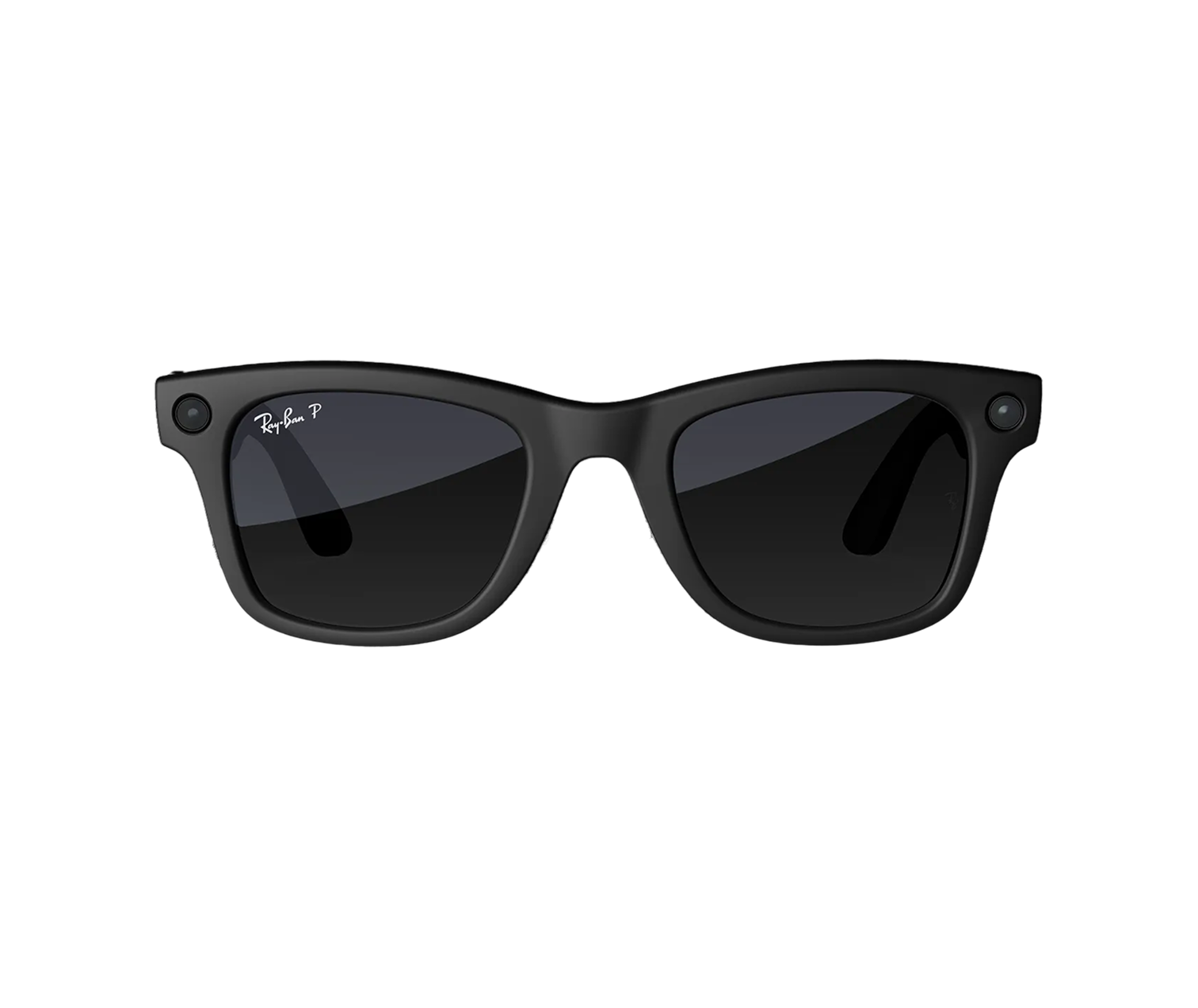
The Wayfarer shape with a 12 megapixel camera at the hinge, open-ear speakers in the arms and a microphone array, launched in September 2025.
From a few feet away it looks like the second pick in this post. The temples are thicker, because they hold the battery, and a small LED next to the camera lights when it is recording, so the people around you know. Video records at up to 3K. Meta rates the battery for eight hours of typical use, nearly double the first generation's, and the charging case holds another 48 hours. Twenty minutes in the case gets the glasses to half.
The speakers point down toward the ears and leave them open, so street noise still comes through. That is a safety choice on a pavement and a limit on a train. Setup, photos and the voice assistant run through the Meta AI app on the phone, and a capture button on the temple takes a photo without reaching for it.
Prices start at $379 with clear or sun lenses. Polarised lenses add $30, and Transitions lenses, which darken in sunlight, add $80. The figure in the buy row is the polarised version.
It is the only pair here that needs charging, and the only one a newer model will make out of date. The other four have kept their shape for decades.
How to choose classic sunglasses
Read the three numbers
Inside the left temple of almost every frame are three numbers, like 54-20-140. The first is the lens width, the second the bridge between the lenses, the third the temple length, all in millimetres. If a pair you own fits, read its numbers and match them. Two or three millimetres on the bridge decide whether glasses sit still or slide.
Glass or plastic lenses
The Persol uses glass lenses, and the Ray-Ban classics have long been sold with them too. Glass resists scratches and gives very clear optics, and it is heavier and can crack if dropped. Polycarbonate, like Oakley's Plutonite, is lighter and far harder to break, and scratches more easily.
Polarised or not
A polarised lens cuts glare reflected off flat surfaces like water, wet roads and car bonnets. On these frames it adds $30 on the Meta to $64 on the Persol, and it can make phone and car screens hard to read at some angles. For driving and water it is worth having. For city walking it matters less.
Acetate or metal
Acetate frames like the Wayfarer and the 649 are thicker, warmer to the touch and rest across the nose. Metal frames like the Aviator are lighter, sit on adjustable pads and fold flatter. An optician can adjust both, acetate with gentle heat and metal by bending the pads.
How we chose
We started from shapes that have stayed in production for decades and are still made new by the company that first sold them, so no vintage, no reissues from a different maker and no copies. That gave three frames from before 1960, and we added the Holbrook as the modern frame built on that era's lines, and the Ray-Ban Meta as the classic shape with a camera in it. Every one of the five is made by EssilorLuxottica, and we say so in the post because no shop window does. The frame sizes come from two places each: the maker's own page where it would load, and an authorised optical retailer. Ray-Ban and Oakley block automated readers, so their sizes come from two retailers that agree. Where the sources disagreed, as on the Persol 649's lens height, the figure is left out. These are bought for shape and feel, so there is no comparison table.
Common questions
The Ray-Ban Aviator, first sold in 1937, and the Ray-Ban Wayfarer, introduced in 1952, are the two shapes most often called classic. The Persol 649 from 1957 is the third, best known from Marcello Mastroianni in the 1961 film Divorce Italian Style. All three are still made new.
The three numbers inside the temple, like 54-20-140, are the lens width, the bridge between the lenses and the temple length, in millimetres. Matching them to a pair that already fits is the most reliable way to buy online. The Ray-Ban Wayfarer comes in 50-22-150 and 54-18-150, so the larger size sits on a narrower bridge.
The Aviator is a thin metal frame on adjustable nose pads, with a deep teardrop lens that sits low on the cheek. The Wayfarer is a thick acetate frame with no pads, resting its weight across the bridge of the nose. The Aviator comes in 55, 58 and 62 mm lens widths on one 14 mm bridge; the Wayfarer in 50 mm on a 22 mm bridge and 54 mm on an 18 mm bridge.
EssilorLuxottica. Luxottica bought Persol in 1995, Ray-Ban from Bausch & Lomb in 1999 and Oakley in 2007, and merged with the lens maker Essilor in 2018. The Ray-Ban Meta glasses are a joint product with Meta.
Glass, which Persol calls crystal, resists scratches and gives very clear optics, but it is heavier and can crack if dropped. Polycarbonate, like Oakley's Plutonite, is lighter and much harder to break, and scratches more easily. The Persol 649 uses glass; the Oakley Holbrook uses Plutonite.
About the author

Justin Farrugia
Founder & Editor of Curated Supply
Justin Farrugia is the founder and editor of Curated Supply, a design-led directory to things worth owning. He has personally curated over 1,000 products across workspace, carry, coffee, audio, and the home, each judged against one standard: design intent, material quality, and the restraint that lets a thing last.