Home espresso machines worth the counter space
Home espresso machines from the $700 Breville Barista Express to the La Marzocco Linea Mini, and what each step up the price ladder adds to the cup.
Home espresso machines improve in a fixed order as the price climbs: first steady water temperature, then steam while a shot is still running, then control over how fast water moves through the coffee, and last, enough hot metal that the tenth shot of a morning tastes like the first.
Six machines here, from $700 to $6,600, and each one adds a step to that list. Only the cheapest has a grinder built in. The other five expect one beside them, and that grinder will shape the cup more than anything below, which is the whole argument of coffee grinders worth more than the machine.
1.Barista Express – $700

Pros
- Grinder, pump and steam wand in one body, on one plug
- Low-pressure pre-infusion before the 9 bar shot
Cons
- 16 grind settings leave gaps a dose change has to cover
- One thermocoil, so milk waits until the shot is done
- 54 mm basket takes its own tools, not the 58 mm standard
The only machine here that grinds its own beans, with a conical burr grinder sitting in the same steel body as the pump.
Breville sells it as model BES870, and its grinder has 16 settings feeding an 18 g dose into a 54 mm portafilter. Sixteen settings is coarse by espresso standards. When a shot runs too fast at one step and too slow at the next, only the dose can split the difference, and the other five machines here hand that job to a separate grinder.
The water heats in a thermocoil, a steel tube coiled through a heated block, so water warms as it passes instead of waiting in a tank. A PID controller holds the coil at 200°F. One heater has two jobs, though, so a shot and a jug of steamed milk come one after the other, with a pause while the coil climbs from brewing temperature to steam.
The box says 15 bar. The machine pulls the shot at 9, after a short low-pressure pre-infusion that wets the coffee before full pressure arrives. Fellow's machine below makes the same split between what a pump can do and what a shot needs, and nine is the figure that matters on both.
The 54 mm basket is the size to know before buying accessories. Every other machine in this post uses 58 mm, so tampers, distribution tools and bottomless portafilters bought for this one will not carry over to a later machine, and Breville sells its own 54 mm range for that reason.
Owning one means one plug, one footprint and no second appliance to justify. Upgrade the grinder later and the built-in one stays where it is, taking up its share of the counter.
- Heating
- Thermocoil with PID control
- Grinder
- Integrated conical burr, 16 settings
- Portafilter
- 54 mm stainless, 18 g dose
- Pump
- 15 bar pump, 9 bar extraction after low-pressure pre-infusion
- Water tank
- 2 L, from authorised retailers
Specifications as published by the manufacturer. Source
2.Espresso Series 1 – $1,500

Pros
- Ready in two minutes or less from cold
- Pressure profiles change the shot as it runs
- Bottomless 58 mm portafilter shows channelling as it happens
Cons
- One boiler system, so brewing and steaming happen in sequence
The first espresso machine from Fellow, the company that made the Stagg kettle and the Ode grinder, and it heats with three elements instead of one.
Fellow calls the arrangement a Boosted Boiler. A flow-through heater, a stainless boiler and a separately heated grouphead each warm the water in turn, so the metal the coffee touches is already hot when the shot starts. Retailers report that Fellow classes it as a single-boiler machine, which is accurate: there is one boiler. The other two elements are what let it brew in two minutes or less from cold, against the quarter of an hour a full boiler machine needs.
The pressure changes during the shot. A program can start low, rise to 9 bar, and fall away as the puck thins out, which mirrors what a cafe barista does by hand on a manual lever machine. The pump can reach 15 bar and Fellow calibrates it to stop at 9.
It ships with a 58 mm bottomless portafilter. With no spouts beneath the basket, the shot runs straight off the bottom of the coffee, and any channel, a crack in the puck where water finds an easy path, shows up as a jet spraying sideways. It is a teaching tool as much as a part.
The 2 litre tank lifts out of the top and carries a sensor that warns before it runs dry. At 21.7 lb (9.8 kg) it moves easily for cleaning, and it runs on 1500 W from a standard socket.
It brews and steams from the same system, so milk drinks still come in sequence. The machine assumes a grinder is already on the counter, and Fellow's own lineup is where it expects you to find one.
- Heating
- Boosted Boiler: boiler, flow-through heater and heated grouphead
- Portafilter
- 58 mm bottomless
- Pump
- 15 bar, calibrated to 9 bar extraction
- Water tank
- 2.0 L, lift-out, with low-water sensor
- Warm-up
- Two minutes or less
- Weight
- 21.7 lb (9.8 kg)
Specifications as published by the manufacturer. Source
3.Steel Duo – $1,895

Pros
- Ready in one minute, with steam available during the shot
- 270 mm wide, the narrowest machine here
- Brew pressure adjusts from outside the case
Cons
- Vibratory pump is louder than the rotary pumps above it
- Thermoblocks hold little heat in reserve compared with a boiler
Two thermoblocks, one for the shot and one for steam, so this is the first machine on the ladder that can do both at once.
A thermoblock is a block of metal with a water channel cut through it, heated on demand. It holds little water and very little mass, which is why Ascaso can quote one minute from switch-on to ready. Giving steam its own block means milk can be texturing while a shot pulls, and that is the step that changes a morning with two flat whites in it.
A PID controller holds brewing water within 1.5°C of the target. Brew temperature sets anywhere from 80°C to 110°C in one degree steps, and steam from 110°C to 165°C. Ascaso also makes the Steel Uno, a single-thermoblock version in the same body, and from the front the two are hard to tell apart.
The pump is vibratory: an electromagnet drives a small piston back and forth many times a second. It costs less and fits in a smaller body than a rotary pump, at the price of more noise. An overpressure valve on the outside of the machine sets the ceiling, so you can adjust brew pressure without opening the case.
The steel body measures 270 mm wide, 360 mm tall and 315 mm deep, the narrowest here, and weighs 15 kg. The 2 litre tank sits on the side where you can see the level through the panel. Handles are walnut, and the 10 mm steam wand stays cool to the touch.
It has the look of a cafe machine at a size that fits beside a toaster.
- Heating
- Two thermoblocks, one for brewing and one for steam
- Portafilter
- 58 mm, from authorised retailers
- Temperature
- PID, ±1.5°C, brew 80 to 110°C in 1°C steps
- Pump
- Vibratory, external overpressure valve
- Water tank
- 2 L, side-mounted and visible
- Weight
- 15 kg
- Size
- 270 mm wide, 360 mm high, 315 mm deep
Specifications as published by the manufacturer. Source
4.Bianca – $3,000

Pros
- Paddle shapes the flow through every shot
- Rotary pump, with pump and steam pressure gauges
- Tank moves to either side or the back, or plumbs in
Cons
- Two boilers take far longer to heat than a thermoblock
- Every shot asks for a decision about flow
A wooden paddle on top of the group controls how fast water flows through the coffee while the shot is running.
The paddle turns a valve. Open it fully and water arrives at the pump's full rate. Close it partway and the flow slows, so the shot can start with a gentle soak, build, and taper as it finishes. Pressure follows the flow, which is how Lelit lets one machine pull a light-roast shot slow and long and a dark roast fast and short. A Low Flow mode does the same thing electronically, at the start of the shot, the end or both, with the paddle left alone.
It has two boilers: 0.8 litres for coffee and 1.5 litres for steam. A boiler stores heat as well as water, and that stored heat is what keeps a run of shots consistent. It also takes much longer to bring to temperature than the thermoblocks above, so the Bianca is a machine that gets switched on before the kettle and left on.
The pump is rotary, quieter than the Ascaso's vibratory pump, and two gauges on the front show pump and steam pressure side by side. The 2.5 litre tank can sit on either side or at the back, and the machine can also take water straight from a supply line and empty into a drain.
The group is Lelit's L58E, sized for 58 mm baskets and tampers. The stainless version carries walnut on its knobs, lever, paddle and feet. Black and white bodies get maple.
The Bianca rewards a bag of coffee you mean to dial in over a week, and the paddle gives every one of those shots something to adjust.
- Heating
- Dual boiler, 0.8 L coffee and 1.5 L steam
- Portafilter
- 58 mm, L58E group
- Flow control
- Manual paddle plus electronic Low Flow mode
- Water tank
- 2.5 L, fits on either side or the back; plumb-in option
Specifications as published by the manufacturer. Source
5.Linea Micra – $4,500

Pros
- Saturated group puts boiler temperature right at the coffee
- Runs from the La Marzocco Home app
- Two thirds of the Linea Mini's weight
Cons
- 1.6 L steam boiler, about half of the Mini's
The first machine La Marzocco designed for homes alone, launched in 2022, with a saturated group taken from its cafe machines.
In a saturated group the group head is part of the coffee boiler, so water fills the metal right up to the coffee. The temperature of the brass touching the puck is the temperature of the boiler. On most other designs, water travels through a pipe to a separate group with its own heater, and that pipe is where heat goes missing between shots.
It weighs 19 kg and is 29 cm wide, a few centimetres wider than the Ascaso, with a 1.6 litre steam boiler. The pump is rotary, and the 2 litre tank sits inside the body, out of sight. Baskets and tampers are standard 58 mm, so tools carry over from the Bianca or the Fellow. Measure the counter against the right number: La Marzocco's launch brochure gave the depth as 39 cm, and its current product page gives 47.2 cm.
It connects to the La Marzocco Home app, so a phone can run it. That matters more than it sounds on a boiler machine, where the wait is in heating up, and the app lets that wait start from bed.
It comes in several body colours, red, blue, crème and yellow among them, against stainless steel at the front.
The Micra pulls the same kind of shot as the Linea Mini beside it at two thirds of the price and two thirds of the weight. What it gives up is steam: its 1.6 litre boiler holds a little over half of what the Mini carries.
- Heating
- Dual boiler, 1.6 L steam, saturated group
- Portafilter
- 58 mm, standard tampers
- Water tank
- 2 L, internal
- Weight
- 19 kg
- Width
- 29 cm
Specifications as published by the manufacturer. Source
6.Linea Mini – $6,600
Pros
- 3 L steam boiler, nearly double the Micra's
- Paddle start and stop taken from the cafe Linea
Cons
- 30 kg, the heaviest here by 11 kg
- Draws 14 A, so it wants a circuit to itself in the US
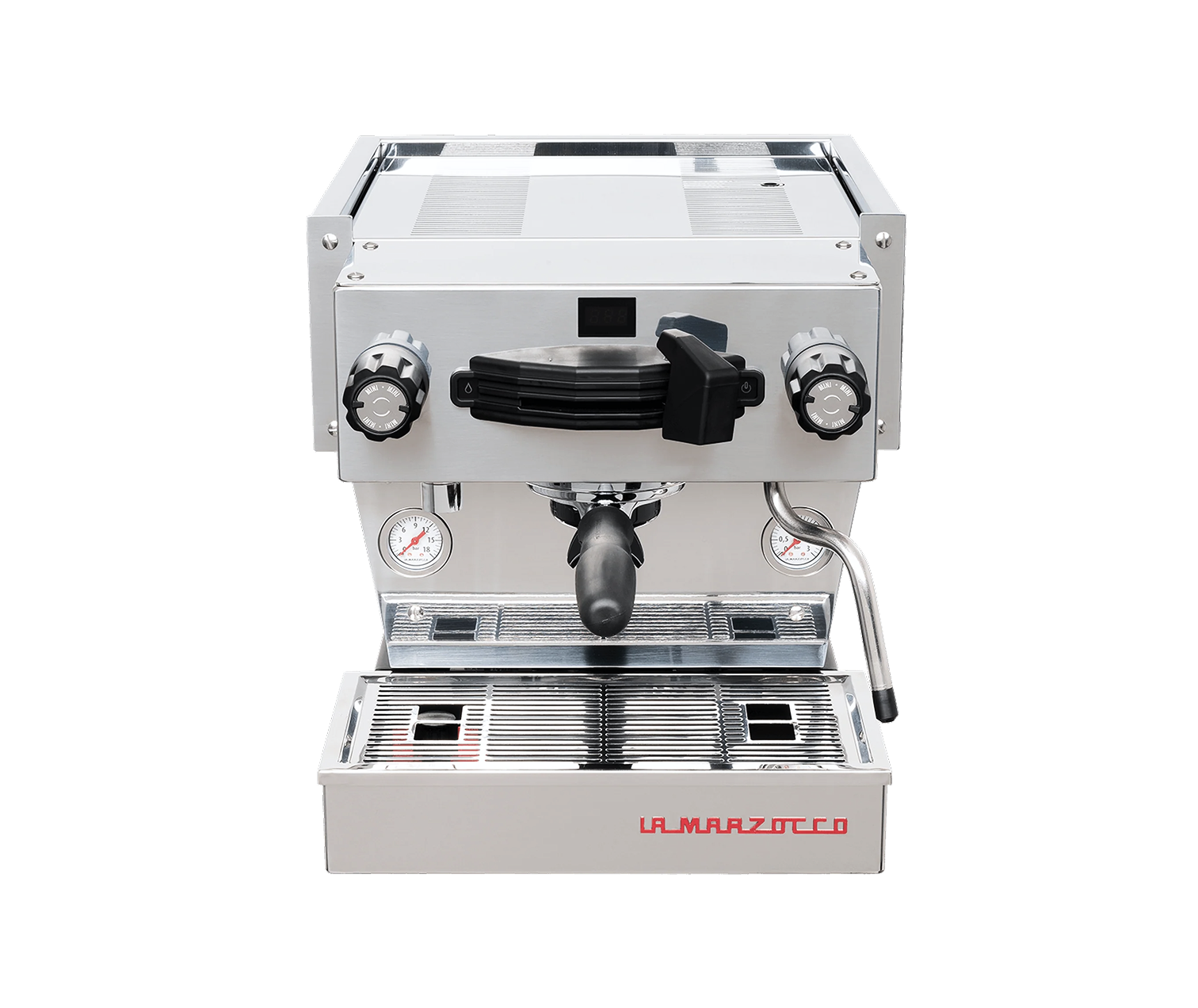
The cafe Linea Classic, made small for a kitchen in 2015, with the paddle, the boilers and the badge of the machine behind a cafe counter.
It won Best New Product and the People's Choice award at the Specialty Coffee Association of America show in April 2015, its launch year. The shape comes straight from the Linea, the machine behind the counter of a generation of specialty cafes, down to the paddle on top of the group that starts and stops the shot. On the Bianca the paddle shapes the flow. Here it is an on and off switch, and it falls under the thumb.
The two boilers are wildly unequal. Coffee gets 0.17 litres, because water only needs to arrive at the group hot and fast. Steam gets 3 litres, nearly double the Micra's, for milk drink after milk drink. That ratio is the part of a cafe machine that survived the shrinking.
It weighs 30 kg (66 lb), the heaviest here by 11 kg. The body is 35.6 cm wide, 38.1 cm tall and 45.7 cm deep, with a 2.5 litre reservoir.
On a US 115 V supply it draws 14 amps. A standard kitchen circuit carries 15, so the Linea Mini wants an outlet with nothing else on it, and that is worth checking before it arrives.
It is the one machine here built to make drinks for a room full of people, and it looks like a cafe machine because it is one with less of the bar around it.
- Heating
- Dual boiler, 0.17 L coffee and 3 L steam
- Portafilter
- 58 mm
- Water tank
- 2.5 L
- Weight
- 30 kg (66 lb)
- Size
- 35.6 cm wide, 38.1 cm high, 45.7 cm deep
- Power
- 14 A at 115 V
Specifications as published by the manufacturer. Source
What decides an espresso machine
Thermocoil, thermoblock and boiler
A thermocoil and a thermoblock heat water as it passes through, so they are ready in a minute or two and hold almost no hot water in reserve. A boiler keeps litres at temperature all day and takes far longer to get there. The Breville uses one thermocoil, the Ascaso two thermoblocks, the Fellow a hybrid of both ideas, and the Lelit and both La Marzoccos run two boilers.
One heater or two
One heater means brew, then steam. Two heaters, whether blocks or boilers, means both at once. If most of what you make has milk in it, this is the line on the ladder that changes your morning, and it falls between the Fellow and the Ascaso.
Vibratory and rotary pumps
A vibratory pump pushes water with a small piston driven by an electromagnet. It is compact, cheap to replace and loud. A rotary pump spins a set of vanes, runs quietly and holds pressure steady, and it is the kind that can draw from a mains water line. The Ascaso uses vibratory, the Lelit and both La Marzoccos rotary.
54 mm and 58 mm
Portafilter diameter decides every accessory you buy afterwards. 58 mm is the cafe standard, and five of these six use it. The Breville's 54 mm basket takes its own tools, a detail that matters when you start building the kit in coffee accessories for cafe-quality drinks at home.
Pressure and flow control
The Fellow programs pressure through the shot. The Lelit hands you a paddle that changes flow, and pressure follows. Both exist because a single fixed pressure suits some coffees and not others. A machine without either still makes excellent espresso. What it cannot do is change shape halfway through a shot.
Who each one is wrong for
The Barista Express is the wrong buy beside a good grinder you already own, because its own will sit unused inside it. The Espresso Series 1 is the wrong shape for a household making several milk drinks at once. The Steel Duo's pump is loud enough to matter in a quiet kitchen at six in the morning. The Bianca asks for decisions on every shot, which suits a tinkerer and wears on someone who just wants coffee. The Linea Micra runs short of steam for a crowd, and the Linea Mini needs a deep counter, a strong shelf and a kitchen circuit with no kettle on it.
If none of these is the right shape and the appeal is a machine that does everything from bean to cup, the bean-to-cup options in coffee gear that actually looks good work the other way, trading every one of these controls for a single button.
All 6 compared
Breville Barista ExpressGrinder built in- Heating
- Thermocoil
- Portafilter
- 54 mm
- Tank
- 2 L
Fellow Espresso Series 1Programmable pressure- Heating
- Hybrid boiler
- Portafilter
- 58 mm
- Tank
- 2 L
Ascaso Steel DuoSteams while it brews- Heating
- Dual thermoblock
- Portafilter
- 58 mm
- Tank
- 2 L
Lelit BiancaFlow control paddle- Heating
- Dual boiler
- Portafilter
- 58 mm
- Tank
- 2.5 L
La Marzocco Linea MicraSaturated group, home size- Heating
- Dual boiler
- Portafilter
- 58 mm
- Tank
- 2 L
La Marzocco Linea MiniCafe machine, scaled down- Heating
- Dual boiler
- Portafilter
- 58 mm
- Tank
- 2.5 L
Breville's own page gives no tank size for the Barista Express, and Ascaso's gives no basket size for the Steel Duo. The 2 L tank and the 58 mm portafilter come from authorised retailers, where two agreed.
How we chose
We built this as a ladder: six machines from the catalogue at six clearly different prices, each one adding something the machine below it cannot do, from steady temperature to simultaneous steam, flow control and boiler mass. We left out bean-to-cup machines, which make the opposite trade and already have a home in another post, and we kept only one machine with a built-in grinder, because at the higher rungs the grinder is a separate purchase. Every figure in the panels comes from the maker's own page and was checked against a second source. Where two sources disagreed, as on the Lelit's weight and the Micra's coffee boiler, we left the number out.
Common questions
A thermoblock or thermocoil heats water as it passes through a heated metal channel, so it is ready in a minute or two and stores almost no hot water. A boiler keeps litres of water at temperature all day, which takes longer to heat but holds the temperature steadier across a run of shots. The Breville and the Ascaso heat on demand, the Lelit and both La Marzoccos use boilers, and the Fellow combines a small boiler with a flow-through heater and a heated group.
Only if it has two heat sources. The Barista Express and the Fellow Espresso Series 1 brew and steam in sequence. The Ascaso Steel Duo has a second thermoblock for steam, and the Lelit Bianca, Linea Micra and Linea Mini each have a separate steam boiler, so all four can texture milk while a shot runs.
No. Espresso is pulled at around 9 bar, and the 15 bar on a box is what the pump can reach, not what reaches the coffee. Breville and Fellow both rate their pumps at 15 bar and extract at 9.
58 mm is the cafe standard and has the widest range of baskets, tampers and distribution tools. Five of the six machines here use it. The Breville Barista Express uses 54 mm, which works well but takes its own accessories, so tools bought for it will not move to a later 58 mm machine.
It changes how fast water moves through the coffee during the shot. On the Lelit Bianca a paddle on the group opens and closes a valve, so a shot can start with a slow soak, build, then taper. Pressure follows the flow. It lets one machine suit coffees that want different treatment, from light roasts pulled long to dark roasts pulled short.
About the author

Justin Farrugia
Founder & Editor of Curated Supply
Justin Farrugia is the founder and editor of Curated Supply, a design-led directory to things worth owning. He has personally curated over 1,000 products across workspace, carry, coffee, audio, and the home, each judged against one standard: design intent, material quality, and the restraint that lets a thing last.