Coffee grinders worth more than the machine
Six coffee grinders, from Fellow's $200 Opus to Weber's 80 mm EG-1, and why the burr set decides more about the cup than the brewer beside it.
Good coffee grinders cost more than the brewers they feed, and the reason is that a brewer can only work with the particles it gets.
Extraction happens at the surface of a ground particle, and it happens at a rate set by how far water has to travel into it. Grind a dose that is half dust and half gravel and both extract at once, in the same bed, for the same ninety seconds. The dust gives up everything it has and turns bitter. The gravel gives up almost nothing and stays sour. Both flow into the same cup. No brewer has a setting that separates them out again.
So the grinder is the first thing to spend on. Six of them here, five electric and one hand cranked, running from a 740 gram Comandante to 13.5 kilograms of aluminium out of Weber Workshops.
1.Weber Workshops The EG-1
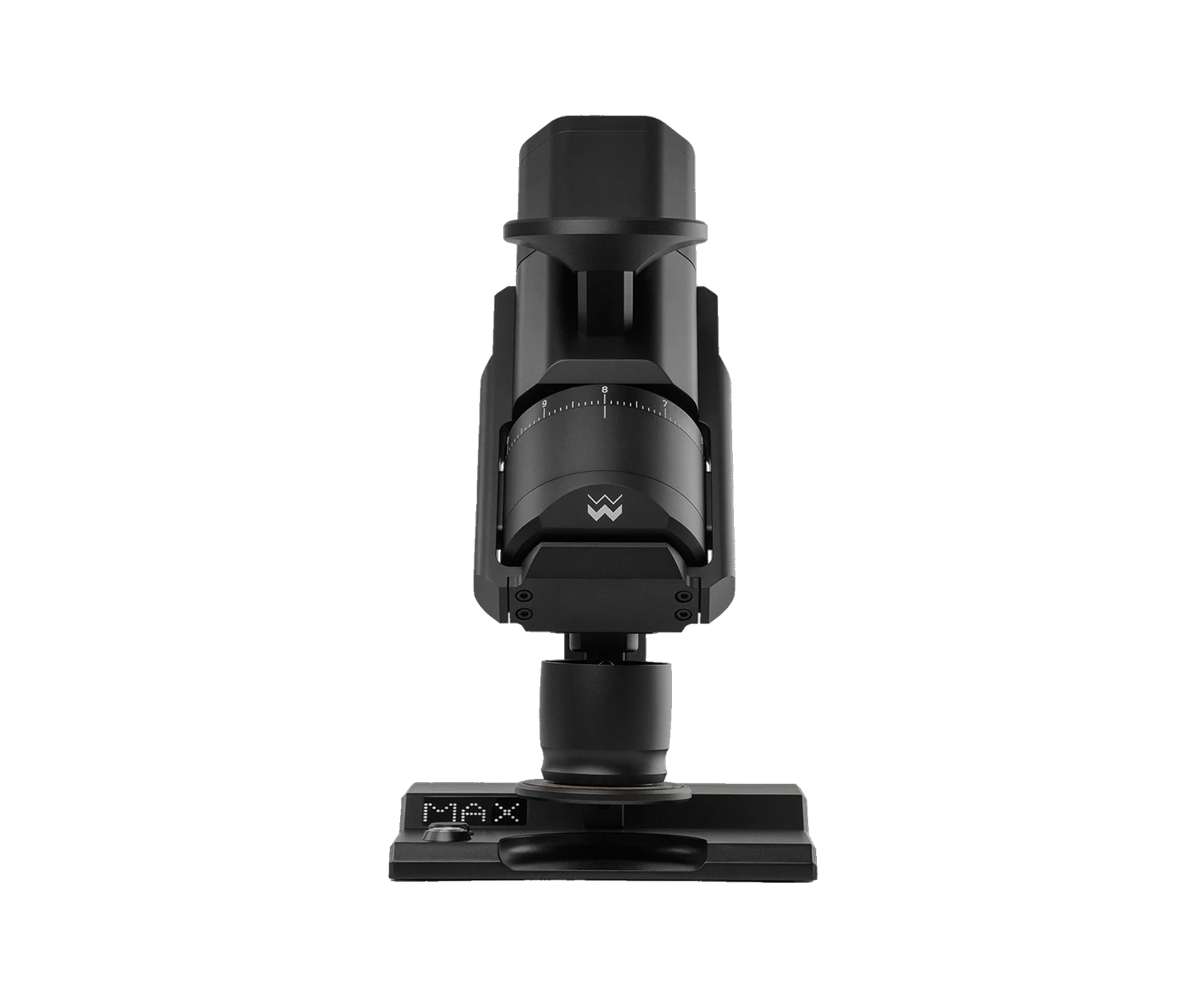
Eighty millimetres of flat burr, adjusted in steps of five microns.
Flat burrs sit as two parallel discs with a gap between them. Coffee enters at the centre, travels outward as the discs turn, and every particle leaves through the same gap at the rim. Conical burrs work as a cone inside a cone, and gravity pulls the coffee down a path that varies with where a bean happened to land. The flat geometry is the more repeatable of the two, which is why the EG-1 is the shape a cafe chasing clarity tends to end up with.
Five microns is the size of the step on the adjustment ring. A human hair runs about 70 microns across, so one click moves the burrs a fourteenth of a hair. Espresso lives inside a band roughly 200 microns wide, from a shot that chokes to one that gushes, which puts something like forty usable positions inside the only range that matters.
The motor runs at variable speed under a controller that reads how hard the beans are and holds the burrs steady against them. Slower burrs mean less friction, less heat carried into the grounds, and fewer of the fines that friction produces.
Retention sits below 0.1 g. Magnets hold the burrs in, so they lift out for cleaning without a tool.
At 13.5 kg it weighs more than the four cheapest grinders here put together. Nothing about it expects to move. At 456 mm tall it will not fit under a wall cabinet either, so buying one is really a decision about a stretch of open counter and what else will never stand there.
- Burrs
- 80 mm flat, magnetically mounted
- Adjustment
- Stepped, 5 microns per step
- Capacity
- Single dose, no hopper
- Retention
- Below 0.1 g
- Weight
- 13.5 kg
- Size
- 245 mm wide, 235 mm deep, 456 mm high
Specifications as published by the manufacturer. Source
2.Weber Workshops The Key
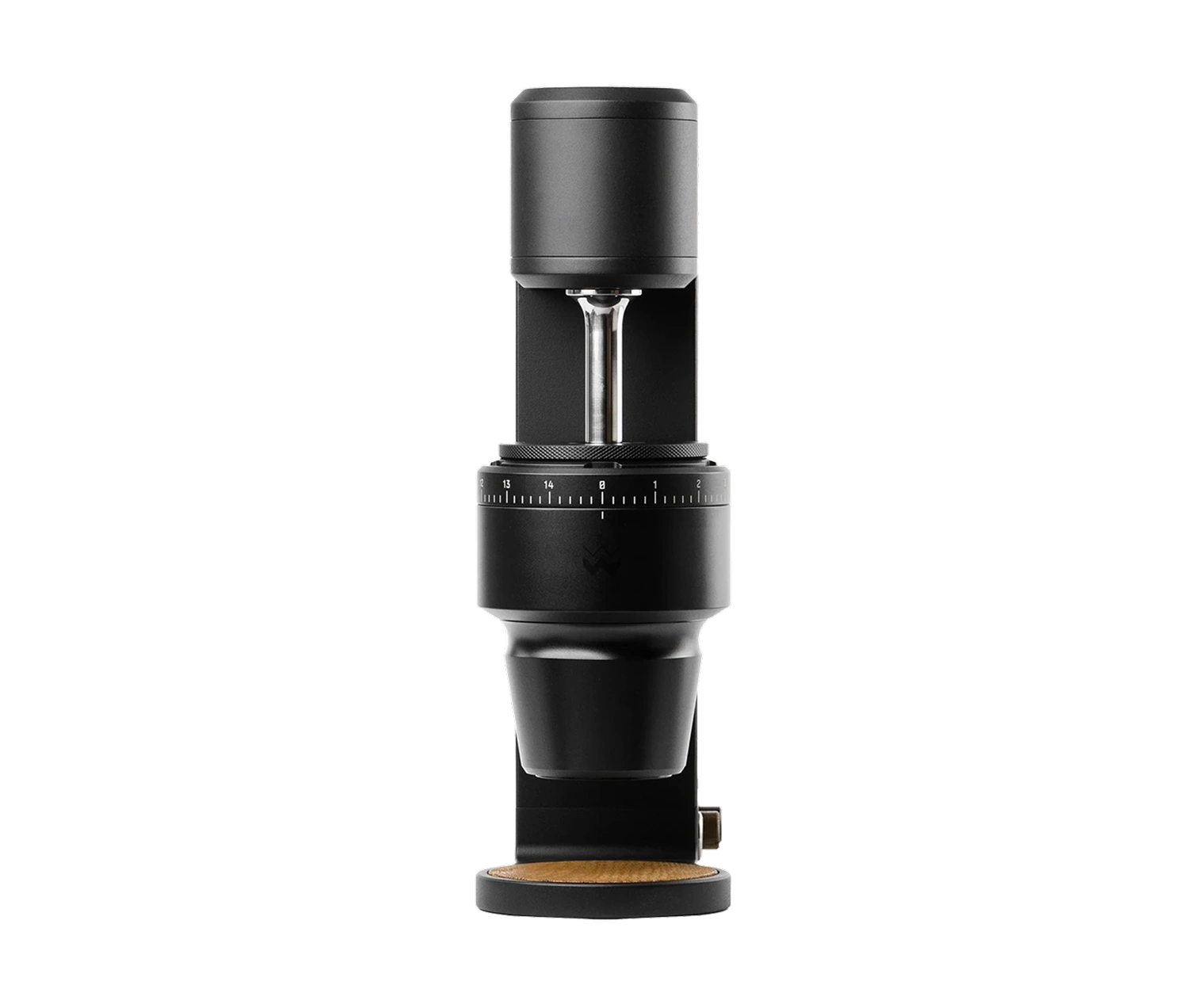
Weber puts the 83 mm Mazzer set in it, which the company describes as the largest conical burr made.
Burr diameter is not about capacity. A larger cone passes more burr across a given bean per rotation, so the bean gets cut fewer times on its way through. Every extra pass is another chance to re-cut a particle that was already the right size, and re-cutting is where fines come from. The 83 mm set inside The Key is doing the same job as the flat discs in the EG-1, by the opposite route.
The Mk.2 carries about half again the torque of the version before it, and it will turn as slowly as 30 rpm. Torque and low speed together are the hard combination to build, because light roasts are dense and a weak motor stalls in them at exactly the speed you want.
The burrs come coated in titanium nitride, the same gold coloured surface used on cutting tools, and Weber rates them at 5,000 kg of coffee. Retention measures below 0.1 g in the company's own testing, so a dose of one coffee does not arrive carrying the last of another.
It is 109 mm wide and 350 mm tall, the footprint of a paperback stood on its end, and 9 kg of it. Weber Workshops sells the wooden platen and the brush handle as parts you choose, so the two pieces you touch every morning are the two you pick.
- Burrs
- 83 mm Mazzer conical, titanium nitride coated
- Adjustment
- Stepped, 5 microns per step, variable speed to 30 rpm
- Capacity
- Single dose, no hopper
- Retention
- Below 0.1 g in Weber's testing
- Weight
- 9 kg
- Size
- 109 mm wide, 248 mm deep, 350 mm high
Specifications as published by the manufacturer. Source
3.Fellow Ode Brew Grinder Gen 2
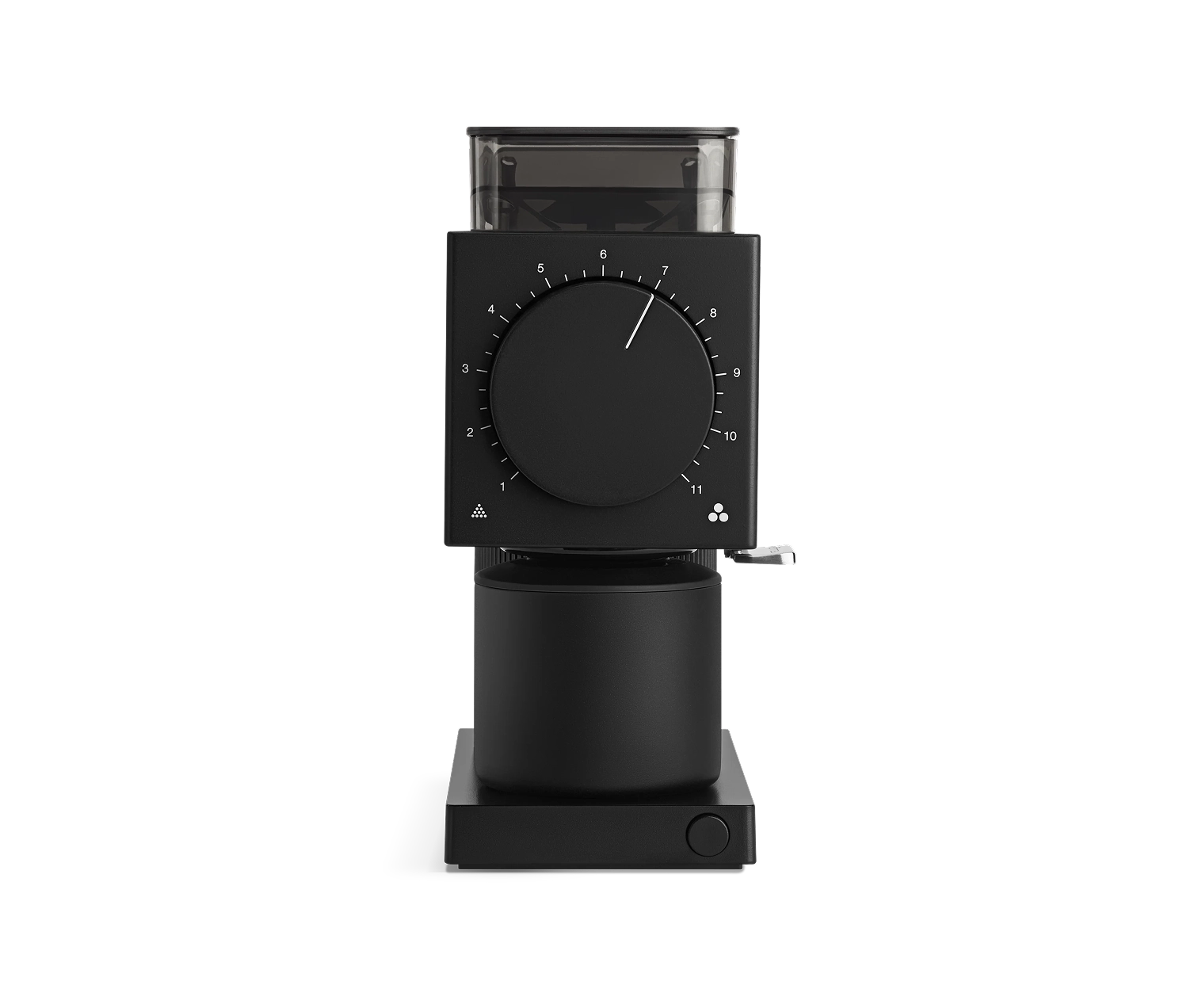
The only grinder here that will not do espresso, and Fellow says so on the page.
A grinder that spans espresso to cold brew has to spread its adjustment across the entire range, which makes every step a large move in the part of the range you actually use. The Ode spends all 31 of its steps between pour over and French press. One click is a small change where a filter brewer needs a small change, and there is nothing below it to travel through.
Its 64 mm flat burrs are large for a domestic grinder, where 38 to 50 mm is the usual range, and the second generation motor turns them slowly to keep heat out of filter grinds.
It loads a dose instead of holding a hopper, up to 100 g at a time. Anti static plates line the grind chamber so the chaff drops instead of clinging, and a sprung knocker raps the chute at the end of the cycle to clear what is left, which holds retention under a gram.
The body is 105 mm wide and 248 mm tall, 4.6 kg of aluminium panel, and it sits low enough to live under a cabinet. Beans go in for the brew in front of you. Nothing waits inside it until tomorrow.
- Burrs
- 64 mm flat, stainless steel
- Adjustment
- 31 steps across 11 numbered settings
- Capacity
- 100 g single dose
- Brews
- Pour over, AeroPress, drip, French press and cold brew. Not espresso.
- Weight
- 4.6 kg
- Size
- 105 mm wide, 239 mm deep, 248 mm high
Specifications as published by the manufacturer. Source
4.Comandante C40 MK4 Hand Grinder
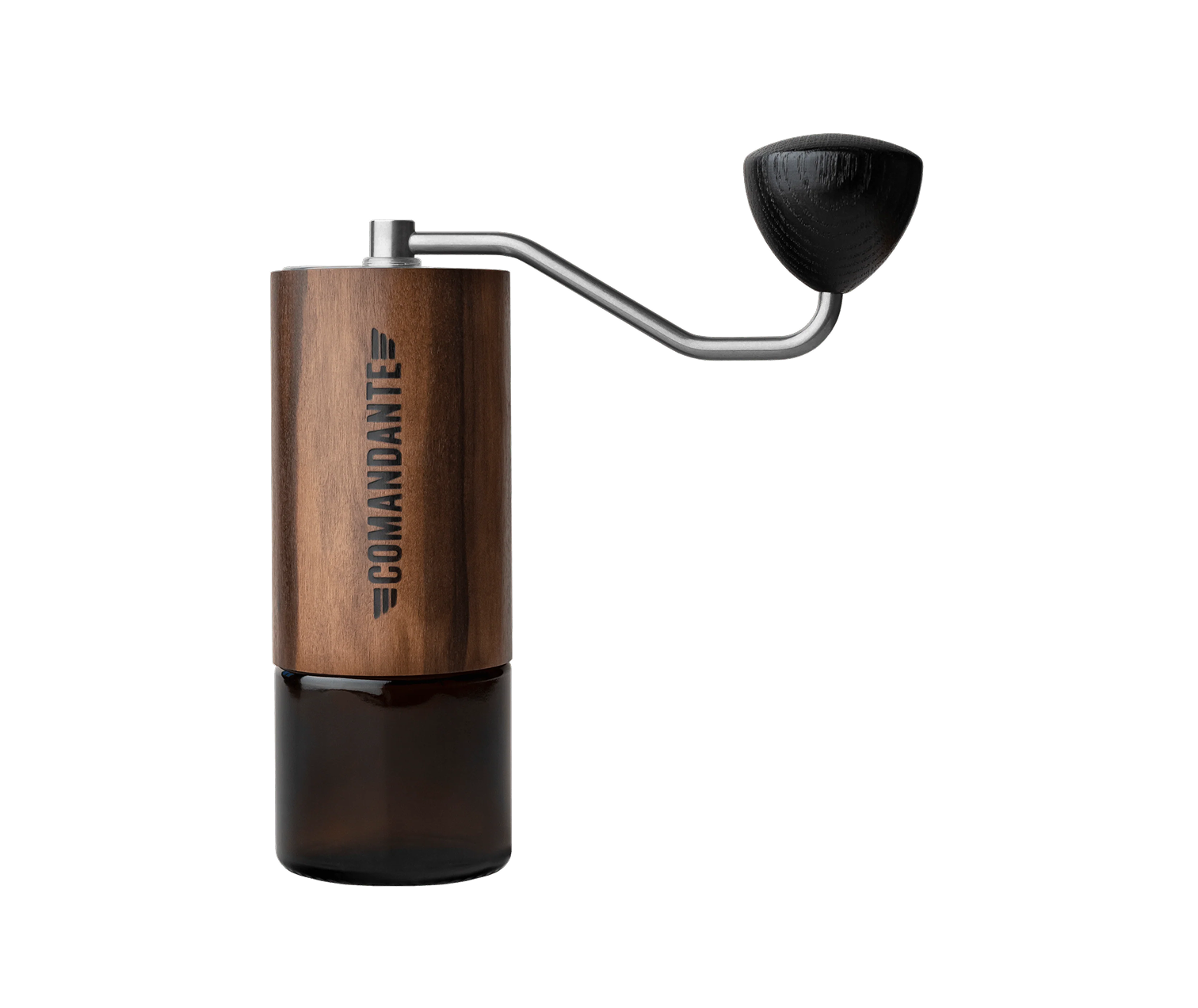
At 740 grams it is the only one here that goes in a bag.
The burrs are the reason the C40 costs what it does. Comandante cuts them from a high nitrogen stainless it calls Nitro Blade, an alloy where nitrogen held in solid solution lets the steel take a very fine martensitic grain. A finer grain holds a sharper edge for longer and corrodes less, and in a hand grinder you feel a dulling burr the same week it starts, because the crank tells you.
The axle matters as much as the steel. One hand turning a lever loads the inner burr from one side, and an inner burr that wobbles opens and closes its own gap several times a second. Perfect burrs will still produce a wide spread of particles if the shaft carrying them moves. The C40 runs its stainless axle on ball bearings top and bottom, which is what keeps the gap the size the click says it is.
Each click moves about 30 microns. The two bean jars hold 40 g each, roughly two filter doses, one in dark glass and one in clear polymer. Comandante builds the grinder in Germany and turns the crank knob from oak.
At 6.3 inches tall and 2.4 across it packs beside a kettle. The sealed jar means you can weigh a dose the night before and cap it.
- Burrs
- Conical Nitro Blade, high nitrogen martensitic stainless, 39 mm outer
- Adjustment
- Stepped, about 30 microns per click
- Capacity
- 40 g bean jar, two jars supplied
- Weight
- 740 g
- Size
- 6.3 inches tall, 2.4 inches across
- Made in
- Germany
Specifications as published by the manufacturer. Source
5.Graef CM800 Coffee Grinder
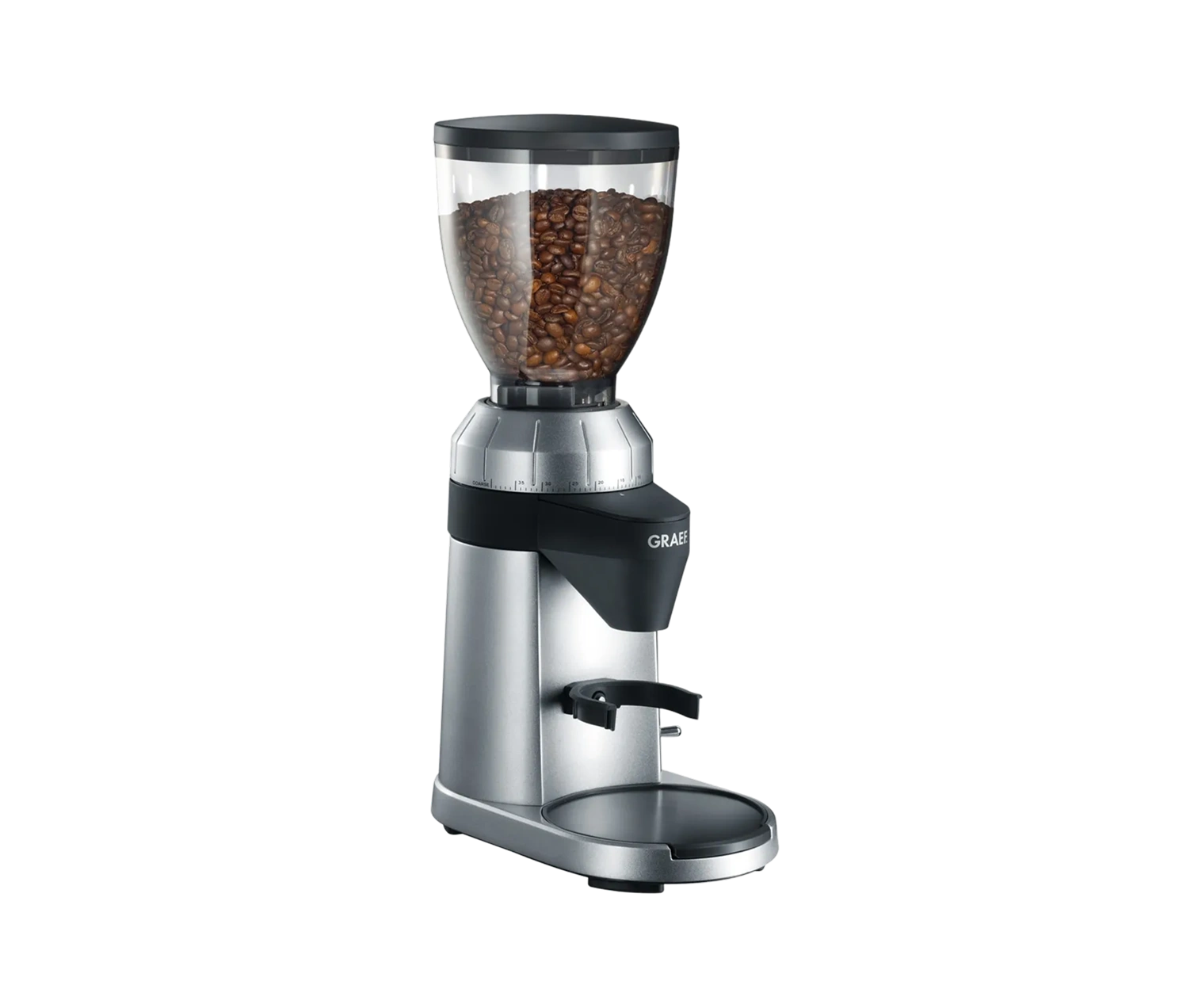
The 350 g hopper makes it the only grinder here that stores beans instead of taking a dose.
That is a genuine choice, not a shortfall. A single dose grinder is empty between uses, so nothing stales inside it, and every morning starts by weighing beans. A hopper trades that for the mornings: 350 g is about eleven days of two cups a day, and the beans sit in a sealed column with a lid on. Graef builds the CM800 for the second habit.
The motor turns the stainless conical burrs at 800 to 900 rpm, which is slow for a domestic grinder, and slow is the point. Less speed means less friction, so less heat reaches the grounds and less static builds in the chute. An ioniser and an anti static insert handle what is left.
Forty numbered settings cover espresso to French press, and the upper burr lifts out to reseat one notch over. That second adjustment moves where setting one sits, so the whole forty step range slides to wherever a particular bean wants it. Two adjustments stacked is how a grinder at this price reaches espresso fineness at all.
It stands 397 mm tall, which clears the eighteen inch gap most wall cabinets leave and not much else, so it belongs in the same conversation as the rest of what stays out on the counter. 128 W, 2.6 kg, built in Germany.
- Burrs
- Stainless conical, diameter not published
- Adjustment
- 40 settings, plus a removable upper burr for fine adjustment
- Capacity
- 350 g hopper
- Motor
- 128 W, 800 to 900 rpm
- Weight
- 2.6 kg
- Size
- 230 mm wide, 135 mm deep, 397 mm high
- Made in
- Germany
Specifications as published by the manufacturer. Source
6.Fellow Opus 2
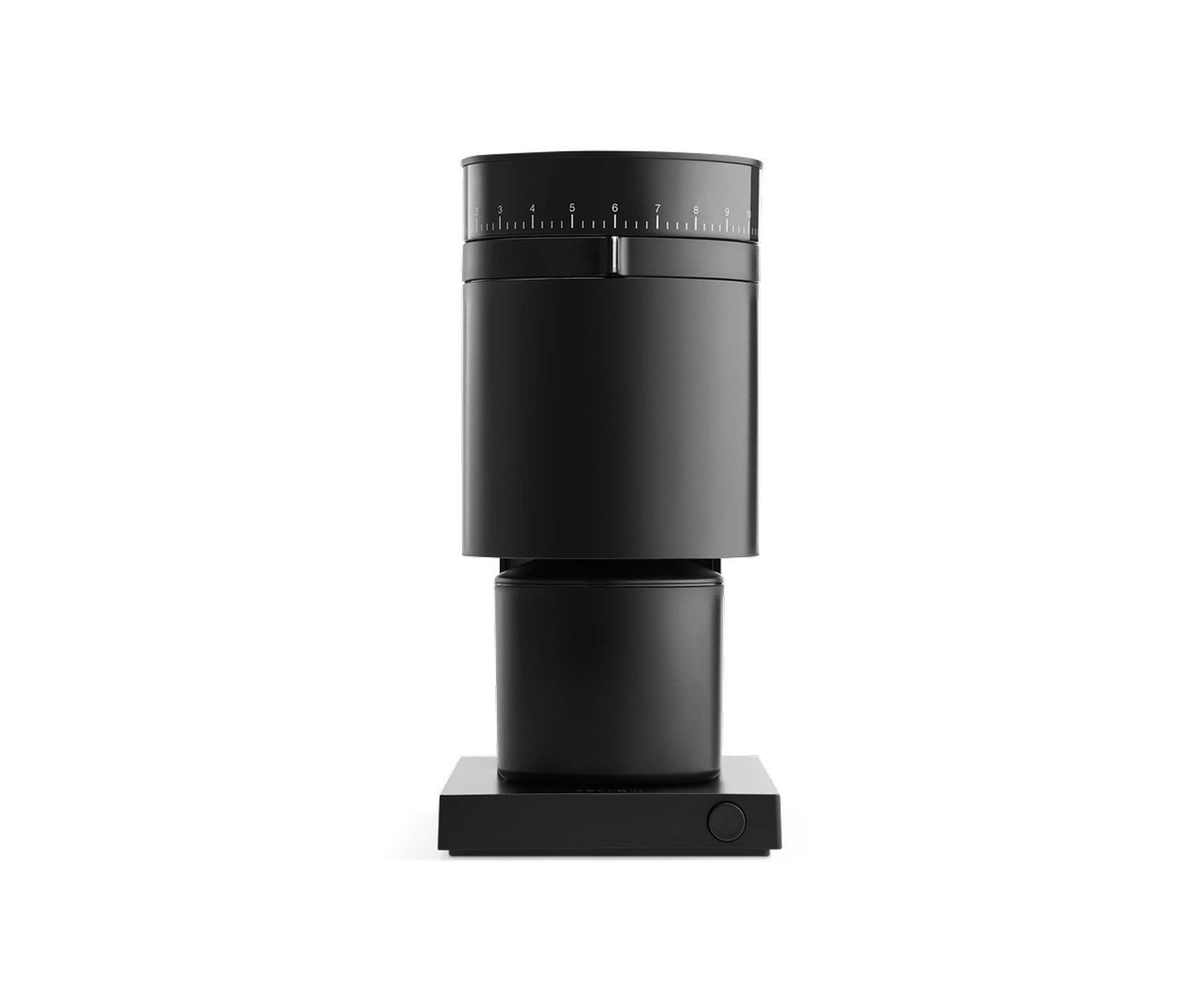
Forty eight millimetre conical burrs and a stepless dial, at the price the 40 mm version sold for.
Fellow replaced the original Opus in 2026. The burrs went from 40 mm to 48 mm, the stepped ring became a stepless collar, and the price stayed at just under $200. Anyone comparing listings will still find both, so the burr diameter is the number that tells you which one is in the box.
Stepless is the part that earns the upgrade. A stepped dial parks the burrs at fixed positions and nothing exists between them. A stepless collar turns continuously and stops anywhere. At filter grind that hardly matters, because thirty microns either way disappears in a two minute brew. At espresso it is the whole game: 250 microns and 280 microns are a shot that runs in 22 seconds and a shot that runs in 35, out of the same dose of the same coffee.
What you give up is a number to return to. Tell a stepped grinder to go back to 14 and it goes. A stepless one remembers nothing, so people mark their own.
The load bin takes 100 g, and two catch cups ship with it, one for brewed coffee and one sized as an espresso dose that drops into 54 mm and 58 mm portafilters. That covers most home machines, and it says plainly what Fellow expects the grinder to do.
- Burrs
- 48 mm conical, stainless steel
- Adjustment
- Stepless collar
- Capacity
- 100 g load bin
- Brews
- Espresso, pour over, drip, French press, AeroPress and cold brew
- Weight
- 2.3 kg
- Size
- 130 mm wide, 206 mm deep, 267 mm high
Specifications as published by the manufacturer. Source
What decides a grinder
Flat burrs and conical burrs
Flat burrs are two parallel discs and the coffee is thrown outward between them, so every particle exits through the same gap. Conical burrs are a cone inside a cone and gravity pulls the coffee down through them, which is quieter, cooler and cheaper to build well. Flats are the more repeatable geometry and conicals the more forgiving one. Both appear at both ends of this list, which is the honest answer about which is better.
Burr size
A larger burr passes more of itself across each bean per rotation, so the bean gets cut fewer times before it exits. Fewer passes means fewer particles that were already the right size getting cut again into dust. That is why 64 mm on the Ode and 83 mm on The Key change the cup, and why burr diameter is worth more attention than motor wattage.
Stepped and stepless
Stepped adjustment moves the burrs in fixed jumps and gives you a number to write down. Stepless moves them continuously and gives you every position in between, at the cost of any way to record where you were. Filter brewing barely notices the difference. Espresso lives inside a band narrow enough that it decides whether a grinder can make espresso at all.
Retention
Retention is how much ground coffee stays inside the grinder after a dose. It matters because what stays behind comes out tomorrow, so a grinder holding two grams serves yesterday's coffee at the start of every shot. Below 0.1 g, which is where the two Webers sit, the question stops existing. Beans swap between doses without a purge.
Hand or electric
A hand grinder puts the burrs, the axle and the bearings in your hand and removes the motor, the heat and the noise. It also removes the option of not being awake. Twenty grams is a minute of turning, every morning, and the people who keep one for a decade are the ones who found they liked that minute.
All 6 compared
Weber Workshops The EG-1Endgame flat burr- Burrs
- 80 mm flat
- Adjustment
- 5 µm steps
- Capacity
- Single dose
- Weight
- 13.5 kg
Weber Workshops The KeyLargest conical made- Burrs
- 83 mm conical
- Adjustment
- 5 µm steps
- Capacity
- Single dose
- Weight
- 9 kg
Fellow Ode Brew Grinder Gen 2Filter only, on purpose- Burrs
- 64 mm flat
- Adjustment
- 31 steps
- Capacity
- 100 g
- Weight
- 4.6 kg
Comandante C40 MK4 Hand GrinderThe one that travels- Burrs
- 39 mm conical
- Adjustment
- 30 µm clicks
- Capacity
- 40 g
- Weight
- 0.74 kg
Graef CM800 Coffee GrinderHolds a week of beans- Burrs
- Conical
- Adjustment
- 40 settings
- Capacity
- 350 g
- Weight
- 2.6 kg
Fellow Opus 2 Conical Burr GrinderStepless at $200- Burrs
- 48 mm conical
- Adjustment
- Stepless
- Capacity
- 100 g
- Weight
- 2.3 kg
Comandante and Graef publish the burr material but not the burr diameter. The 39 mm figure for the C40 comes from Prima Coffee, an authorised Comandante dealer, and Graef publishes no diameter at all.
How we chose
We started from the grinders in the catalogue that no post had covered, then cut anything the maker publishes no burr specification for, because a grinder that will not say what is inside it cannot be compared with one that does. What survived had to span real prices rather than cluster at one end, and it had to include a hand grinder, since the burrs, the axle and the bearings are the same argument whether a motor turns them or a person does. We left out the Weber HG-2 for that reason and not the other way around: at $2,050 it is a second hand-cranked grinder in a list that only needed one. Every figure below comes from the maker's own page except where the note under the table says otherwise.
Common questions
The grinder, if you are choosing. A brewer controls water temperature, pressure and time, and all three act on whatever particles it is given. A wide spread of particle sizes extracts unevenly no matter how good the machine is, because the dust and the gravel in the same bed are extracting at different rates for the same ninety seconds. Fixing the grind is the only step that changes what the machine has to work with.
Neither is better across the board. Flat burrs throw coffee outward between two parallel discs, so every particle exits through the same gap, which makes the geometry more repeatable. Conical burrs let gravity pull coffee down through a cone inside a cone, which runs cooler and quieter and costs less to build well. The most expensive grinder here is flat and the second most expensive is conical.
Yes, and not for the reason people assume. A larger burr is not about how much coffee it can grind at once. It passes more of itself across each bean per rotation, so the bean gets cut fewer times before it leaves. Every extra pass is a chance to re-cut a particle that was already the right size into dust, so bigger burrs produce fewer fines. Most home grinders use 38 to 50 mm burrs. The Fellow Ode uses 64 mm and Weber's Key uses 83 mm.
Retention is the ground coffee left inside the grinder after a dose. It matters because it does not stay there. It comes out at the front of tomorrow's dose, so a grinder holding two grams starts every brew with yesterday's coffee. Both Weber grinders measure below 0.1 g and the Fellow Ode holds under a gram, which is the difference between swapping between two coffees freely and having to purge the grinder first.
It can if the adjustment is fine enough. Espresso sits inside a band of roughly 200 microns, between a shot that chokes and one that gushes, so a grinder whose steps are coarse simply cannot land inside it. The Fellow Opus 2 uses a stepless collar that stops anywhere, and the Graef CM800 stacks a removable upper burr on top of its 40 numbered settings to reach the same place. Both do espresso. The Fellow Ode, at nearly twice the price of either, does not, because Fellow spent its whole adjustment range on filter.
About the author

Justin Farrugia
Founder & Editor of Curated Supply
Justin Farrugia is the founder and editor of Curated Supply, a design-led directory to things worth owning. He has personally curated over 1,000 products across workspace, carry, coffee, audio, and the home, each judged against one standard: design intent, material quality, and the restraint that lets a thing last.