Lofree Flow 2 vs NuPhy Air75 V3: travel, battery and the case
Lofree Flow 2 vs NuPhy Air75 V3: an all-aluminium case and 2.8 mm switches, or 3.5 mm of travel and a battery rated for ten times as many hours.
The Lofree Flow 2 and the NuPhy Air75 V3 are both 84-key, low-profile wireless mechanical keyboards, and they split on three things: how far the keys move, how long the battery lasts and how much of the case is metal. Get the Flow 2 if you want a keyboard milled from one block of aluminium, with short 2.8 mm switches and a touch strip on the side. Get the Air75 V3 if you want keys that travel as far as a full-height board, a battery NuPhy rates at 1,200 hours and a kit that packs for a trip.
Both use the same 75% layout, with a function row and arrow keys and nothing to the right of them. Both connect three ways, over Bluetooth, a 2.4 GHz receiver and a USB-C cable, and both poll at 1,000 Hz on the receiver and the cable. Both sit on a gasket, both take double-shot keycaps and both let you pull a switch out without solder. What is left after all that is what each maker chose to spend the thickness on.
Lofree Flow 2
Pros
- Whole case milled from one block of aluminium
- Bluetooth 5.3, the newer version of the two
- Remaps in VIA, an open tool that runs in a browser
Cons
- 2.8 mm of travel, the shorter stroke of the two
- 120 hours of battery with the lights off, a tenth of the NuPhy's rating
- No slot for the receiver and no key puller in the box
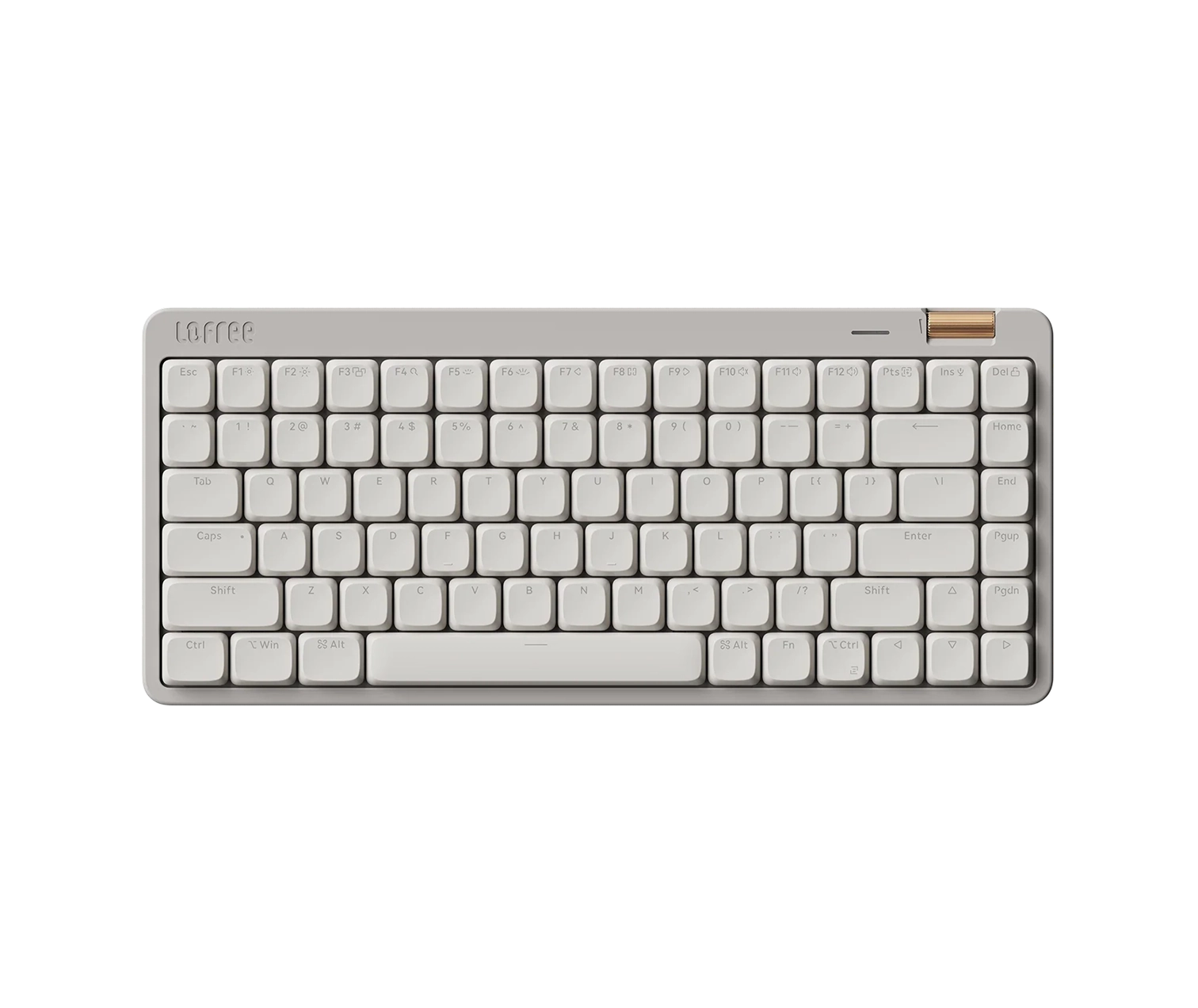
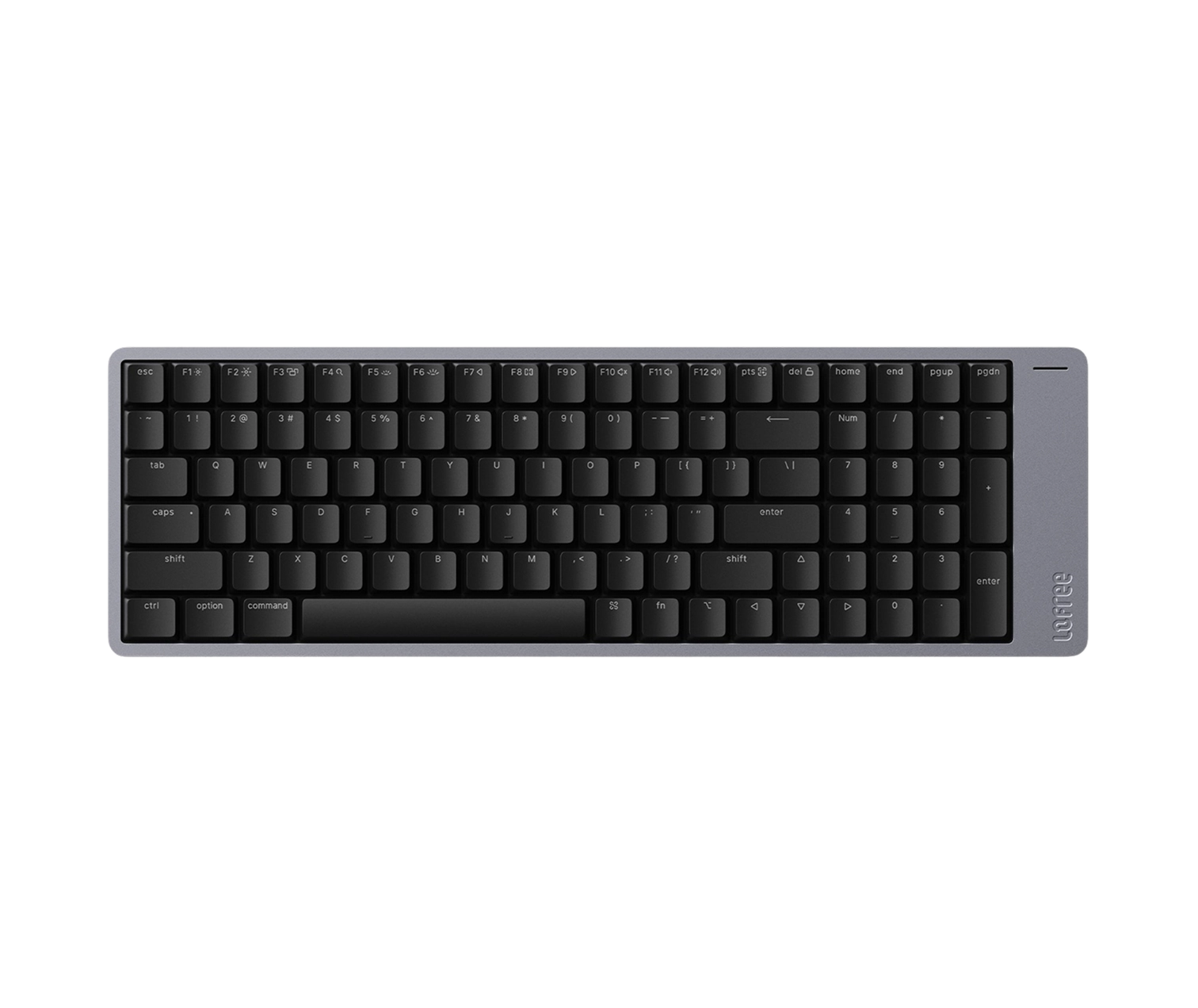
The whole case is aluminium, CNC-milled from a single block, where the NuPhy puts aluminium on top and plastic underneath.
Lofree anodises the outside to a 205-grit finish, a fine texture that reads as satin and holds fewer fingerprints than a polished shell. Inside, the plate rests on a gasket with five layers of dampening, which keeps a thin metal case from ringing on each press. Reviewers who tested it separately heard no metallic resonance, and PCWorld found that even heavy strokes on the silent version made little noise.
The switches are new for this board, a Cloud Series made with Kailh. All three take 40 grams to press and travel 2.8 mm in total. Surfer is linear and Void is the silent linear; both register at 1.3 mm. Pulse is the tactile one, with a bump that waits until 1.6 mm. Lofree says it tightened the gap between stem and housing from 0.05 to 0.04 mm and added 12 small dots inside each housing to stop the stem rocking, which is the usual weakness of a short switch.
The keycaps are double-shot PBT over a translucent PC layer, so the white backlight shows through the legends. Lofree cut the chamfer on each cap from 0.45 to 0.23 mm, which grew the flat you actually press from 194 to 217 square millimetres. A capacitive strip on the right edge changes volume and screen brightness with a swipe. Keys remap in VIA, an open tool that runs in a browser.
The battery is 3,000 mAh, rated up to 120 hours with the backlight off and 17 hours with it on. Lofree publishes the 84-key board at 341.2 by 126 mm and 21.5 mm high.
It suits a desk where it stays put. The touch strip sits where a hand rests, and Digital Trends found it still triggered by accident after weeks of use. There is nowhere on the board to keep the receiver, and no key puller in the box.
- Key travel
- 2.8 mm, 40 g, Cloud Series (Surfer, Pulse, Void)
- Battery
- 3,000 mAh, up to 120 hours backlight off, 17 hours on
- Case
- Aluminium, CNC-milled from one block, 205-grit anodised
- Bluetooth
- 5.3, plus 2.4 GHz receiver and USB-C
- Size
- 341.2 × 126 × 21.5 mm, 84 keys
- Controls
- Capacitive touch strip for volume and brightness, VIA remapping
Specifications as published by the manufacturer. Source
NuPhy Air75 V3
Pros
- Red and Brown switches travel 3.5 mm, most of a full-height stroke
- Battery rated up to 1,200 hours with the lights off
- Two knobs, a receiver, a screwdriver and a puller in the box
Cons
- Aluminium on top only, over an ABS base
- Polling drops to 125 Hz over Bluetooth
- NuPhy's own pages disagree on the Blush switch's travel and the Bluetooth version
The switches travel 3.5 mm, most of the 4 mm a full-height switch moves, in a case NuPhy measures at 13.2 mm at the front.
NuPhy uses Gateron's Low-profile 3.0 switches in three versions: Red, a linear, Brown, a tactile, and Blush, a silent linear that NuPhy marks as its best seller. Red and Brown travel 3.5 mm. Blush is the one to check. NuPhy's launch material gives 3.5 mm for the whole range, while its own switch sheet lists Blush at 3.2 mm, and either figure still moves further than the Flow 2's 2.8 mm. RTINGS, which tested a Blush unit, found it very quiet and a little soft at the bottom of the stroke, so the Red or the Brown is the choice for a firmer landing.
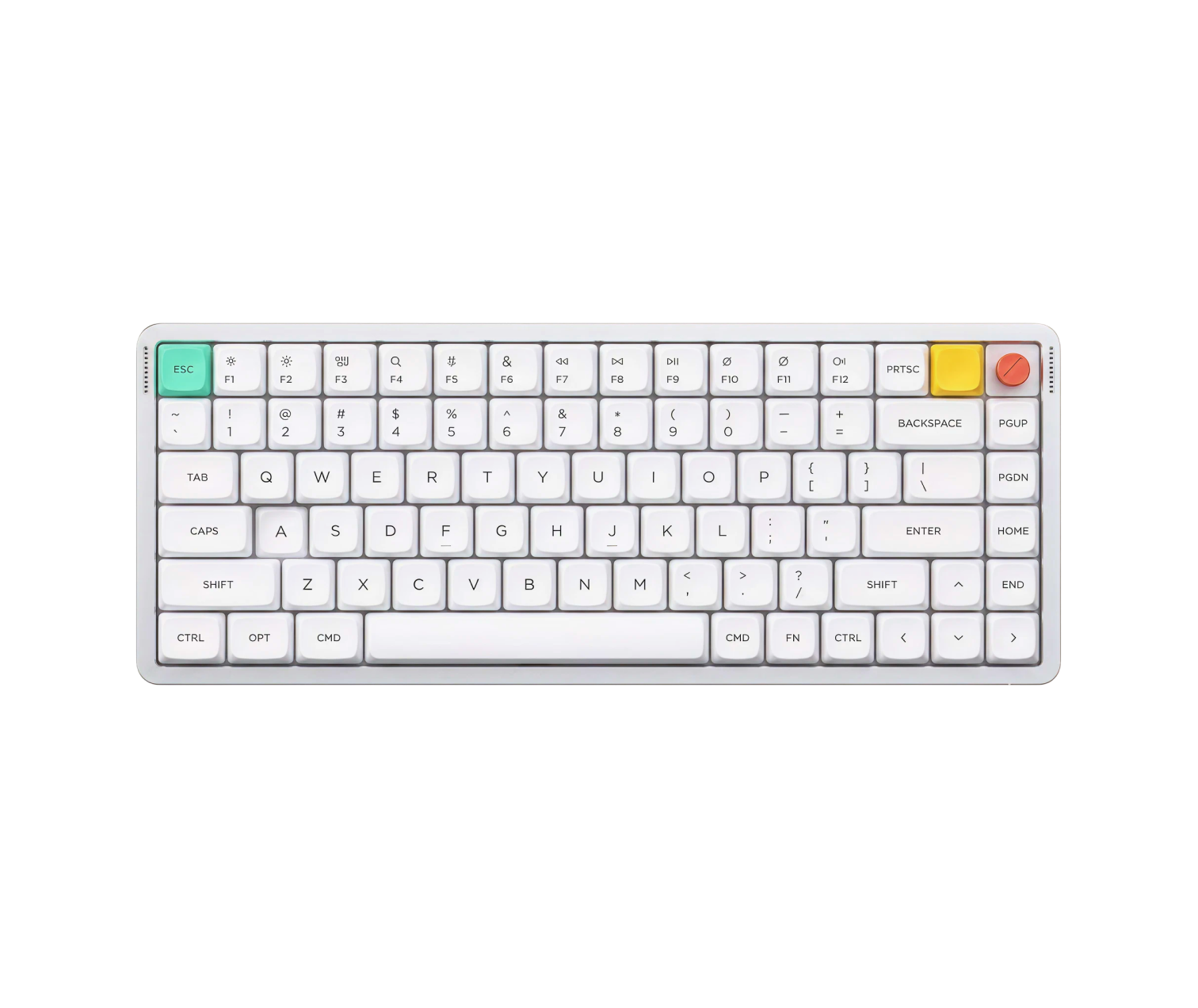
The top case is aluminium with a 220-grit anodised finish, over an ABS base and a polycarbonate plate on a gasket. The keycaps are NuPhy's own nSA profile, low and nearly flat, in double-shot PBT, and the RGB backlight faces north, toward the legends. Remapping, layers and macros run in NuPhy IO, in a browser or an offline app.
The battery decides it for a lot of people. NuPhy fits 4,000 mAh and rates it at up to 1,200 hours with the lights off and 60 to 100 hours with every key lit, ten times the Flow 2's figure with the lights off. Polling stays at 1,000 Hz on the receiver and the cable and drops to 125 Hz on Bluetooth. NuPhy's own spec sheet gives Bluetooth 5.0, while launch coverage reported 5.1. It weighs 724 grams on a 318.9 by 128.9 mm footprint, 22 mm narrower than the Flow 2.
The top right key lifts out for a knob module. Two come in the box, one tall and one flush, along with the receiver, a screwdriver, a keycap and switch puller and six spare keycaps for the US layout. A stepped kickstand under the back sets the angle. It suits someone who carries a keyboard: fit the flush knob and it slides into a bag with the rest of the kit.
- Key travel
- 3.5 mm Red and Brown; Blush listed at 3.2 mm on NuPhy's switch page
- Battery
- 4,000 mAh, up to 1,200 hours backlight off, 60 to 100 hours on
- Case
- Aluminium top case, 220-grit anodised, ABS bottom
- Bluetooth
- 5.0 per NuPhy, plus 2.4 GHz receiver and USB-C; 125 Hz over Bluetooth
- Size
- 318.9 × 128.9 × 13.2 mm at the front, 724 g, 84 keys
- Controls
- Swappable knob module, tall and flush knobs included, NuPhy IO remapping
Specifications as published by the manufacturer. Source
How they differ in hand
Travel is the first thing a hand notices. The 0.7 mm between the Flow 2's switches and NuPhy's Red or Brown sounds small. On a 2.8 mm switch it adds a quarter again. The Flow 2 feels close to a well-made laptop with a mechanical click at the bottom. The Air75 V3 feels closer to a full-size keyboard pressed flat. Digital Trends found the Flow 2's keys had enough travel to feel deliberate, and still noted a learning curve for anyone coming from a full-height board.
The case is the second. The Flow 2 is one piece of metal from the top to the underside, so it feels cold and dense on a desk. The Air75 V3 is aluminium where your hands are and plastic where the desk is, which Tom's Guide still described as fuller and more planted than the earlier Air boards.
The controls are the third. A swipe strip is invisible until you use it and easy to brush. A knob is always visible and never fires by accident.
The two makers do not say where they measure height, and NuPhy's 13.2 mm is a front-edge figure, so read the gap against the Flow 2's 21.5 mm as a direction and not a number. Both boards come in other sizes, and review figures often belong to the wrong one: the Flow 2 100 weighs 870 grams in PCWorld's test, and NuPhy's own page lists the Air65 V3's 635 grams beside the Air75's 724.
All 2 compared
Lofree Flow 2All-aluminium, shorter travel- Key travel
- 2.8 mm
- Battery
- 120 h
- Case
- All aluminium
- Bluetooth
- 5.3
NuPhy Air75 V3 Wireless Mechanical KeyboardDeeper travel, bigger battery- Key travel
- 3.2–3.5 mm
- Battery
- 1,200 h
- Case
- Aluminium top, ABS
- Bluetooth
- 5.0
Battery hours are each maker's laboratory figure with the backlight off. NuPhy's spec sheet gives Bluetooth 5.0; launch coverage reported 5.1.
How we chose
We compared the 84-key Flow 2 with the Air75 V3 because they share a layout, so the differences are the ones a buyer actually chooses between: switch travel, battery, case material and controls. Every figure comes from the maker's own product and switch pages, checked against a second, independent source, mostly launch coverage and published reviews. Both makers block automated readers, so their pages were read in a browser. Review figures that belong to another size of the same board, such as the 870 g that PCWorld measured on the Flow 2 100, were left out, and where NuPhy's own pages disagree with each other, on Bluetooth and on the Blush switch's travel, both figures are given. Neither board was typed on for this comparison; what each is like in use comes from the reviews named in the text.
Common questions
They are built for different hands. The Flow 2 has an all-aluminium case milled from one block and 2.8 mm Cloud Series switches at 40 g. The Air75 V3 has an aluminium top over an ABS base, Gateron switches that travel up to 3.5 mm, and a 4,000 mAh battery NuPhy rates at 1,200 hours with the lights off, against 120 hours for the Flow 2.
The Air75 V3. Its Red and Brown switches travel 3.5 mm, and NuPhy lists the silent Blush at 3.2 mm on its switch page. All three Flow 2 switches, Surfer, Pulse and Void, travel 2.8 mm.
Each has a silent linear option: Void on the Flow 2 and Blush on the Air75 V3. RTINGS found the Blush-equipped Air75 V3 very quiet, and PCWorld found heavy strokes on the silent Flow 2 made little noise. RTINGS notes that the Flow 2's tactile Pulse switch can be on the louder side.
Both makers list macOS and Windows support. NuPhy gives the Air75 V3 a Mac media-key layout, with shortcuts for Mission Control, Focus, dictation and screenshots. Lofree sells a separate Flow 2 for Mac, the version Digital Trends reviewed.
The Air75 V3. It comes with a flush knob for packing, it is 22 mm narrower at 318.9 mm, and its battery is rated for ten times the hours. The Flow 2 has no slot to store its receiver, which Digital Trends listed among its downsides.
About the author

Justin Farrugia
Founder & Editor of Curated Supply
Justin Farrugia is the founder and editor of Curated Supply, a design-led directory to things worth owning. He has personally curated over 1,000 products across workspace, carry, coffee, audio, and the home, each judged against one standard: design intent, material quality, and the restraint that lets a thing last.