Slim wallets that aren't leather, from aluminium to carbon fibre
Slim wallets that aren't leather, from the Ridge's two aluminium plates to Ekster's push-button cardholder, plus a Secrid wrapped in plant-based Mirum.
Slim wallets that aren't leather hold their shape for as long as you own them, because aluminium, carbon fibre and polyurethane do not stretch to fit the busiest week of the year and then stay that size. Six of them here, from a $20 phone stand to a $125 case that takes 25 cards.
Two need a caveat up front. Secrid and PROOF both build on an aluminium core, and the versions in our catalogue wrap that core in leather. Each maker sells a version with no leather on it at the same price, and those two sections say which one to order. Anyone who wants the leather after all will find six stitched wallets in our minimalist leather wallets roundup.
1.Magnetic Flip Wallet & Stand – $20

Pros
- Friction hinge holds any angle from 15 to 160 degrees, portrait or landscape
- Clear window shows an ID or photo when flipped open
Cons
- Three cards is the ceiling and there is no place for cash
- Will not seat on an iPhone 14 Pro wearing a case
A hinge that stops wherever you let go of it, anywhere from 15 to 160 degrees.
Aulumu calls this one the G02, and of the six it alone rides on a phone and folds. The frame is high-strength TPU, a rubbery plastic that flexes before it cracks. The outside is PU leather, a polyurethane coating that Aulumu sells as vegan leather, over a microfibre lining. So it looks like leather from across a table and contains none.
The hinge is the reason to buy it. Most fold-out stands click into two or three fixed angles. This one holds by friction, so a phone can sit almost flat for typing at 15 degrees, near upright for a video call at 160, and anywhere in between, in portrait or landscape. Shut, it measures 100 by 65 by 10 mm and weighs 73 g.
Three cards is the ceiling, and Aulumu says so on its own page, pointing anyone who carries more toward its metal G03. A slot cut in the bottom edge lets a thumb push the stack out, and a clear window inside shows an ID or a photo when you flip the wallet open. There is no place for cash.
Aulumu builds the magnets into the body. They hold it to an iPhone 12 or anything newer, and they are also why it has to come off before the phone goes on a wireless charger. One fit warning sits in the small print: it will not seat on an iPhone 14 Pro wearing a case, because that camera bump leaves too little flat back. Aulumu publishes no pull-force figure for the magnets.
On a phone it disappears into the hand, and Aulumu drew it around the hand. Three cards and a stand you stop noticing until a train table needs one.
- Material
- High-strength TPU frame, PU leather, microfibre lining
- Card capacity
- 3 cards
- Dimensions
- 100 x 65 x 10 mm
- Thickness
- 10 mm
- Weight
- 73 g
- Hinge range
- 15 to 160 degrees
Specifications as published by the manufacturer. Source
2.G03 Multi-Tool Magnetic Wallet – $70

Pros
- 8.2 mm thick for 12 cards or more, slimmer than the three-card G02
- Kickstand, AirTag holder, bottle opener and ruler built in
Cons
- RFID blocking comes from two cards in the box, not from the case
An aluminium case where the G02 has a plastic frame, so the same magnetic idea takes twelve cards or more.
The G03 is an aluminium alloy box with a carbon fibre lid, 8.2 mm thick and 72 g, which makes it slimmer than the G02 for four times the cards. Aulumu rates it for 12 cards and up, plus folded notes and coins. The cards leave through the side, so a thumb pushes one out and the lid stays shut. A stainless steel leaf swings out of the back as a kickstand, working against the same magnets that hold the wallet on.
Then there is the list of small things. A woven elastic strap crosses the outside as a finger grip, and a spare comes in the box. A removable holder takes an AirTag. A ruler runs along one edge, a bottle opener is cut into the metal, and there are lanyard holes at one end.
Read the RFID claim closely. Aulumu does not say the case blocks anything. It ships two RFID-blocking cards to slide in beside the real ones, and those cards are the claim. A frosted-lid version trims the case to 7.9 mm and 69 g, without the carbon weave.
Fit matches the G02: iPhone 12 through the iPhone 17 range, including the Air, and an iPhone 14 Pro only without a case. Aulumu also warns against pairing it with a Galaxy S25 Ultra case, whose camera ring the wallet partly covers. As with the G02, there is no published magnet strength, and the wallet comes off for wireless charging.
Twelve cards is a lot of weight to hang on magnets, so the strap matters more than it looks. It is the part your fingers hold, and it takes the strain off the magnets when the phone is in your hand.
- Material
- Aluminium alloy case, carbon fibre cover, stainless steel kickstand
- Card capacity
- 12 cards and up, plus notes and coins
- Thickness
- 8.2 mm
- Weight
- 72 g
Specifications as published by the manufacturer. Source
3.Aluminum Cardholder Wallet – $90
Pros
- A button fans the cards up in steps, so the one you want stands clear
- Tracker Card add-on puts it on Apple's Find My network
Cons
- Two-year warranty on the standard model, against lifetime on the Pro
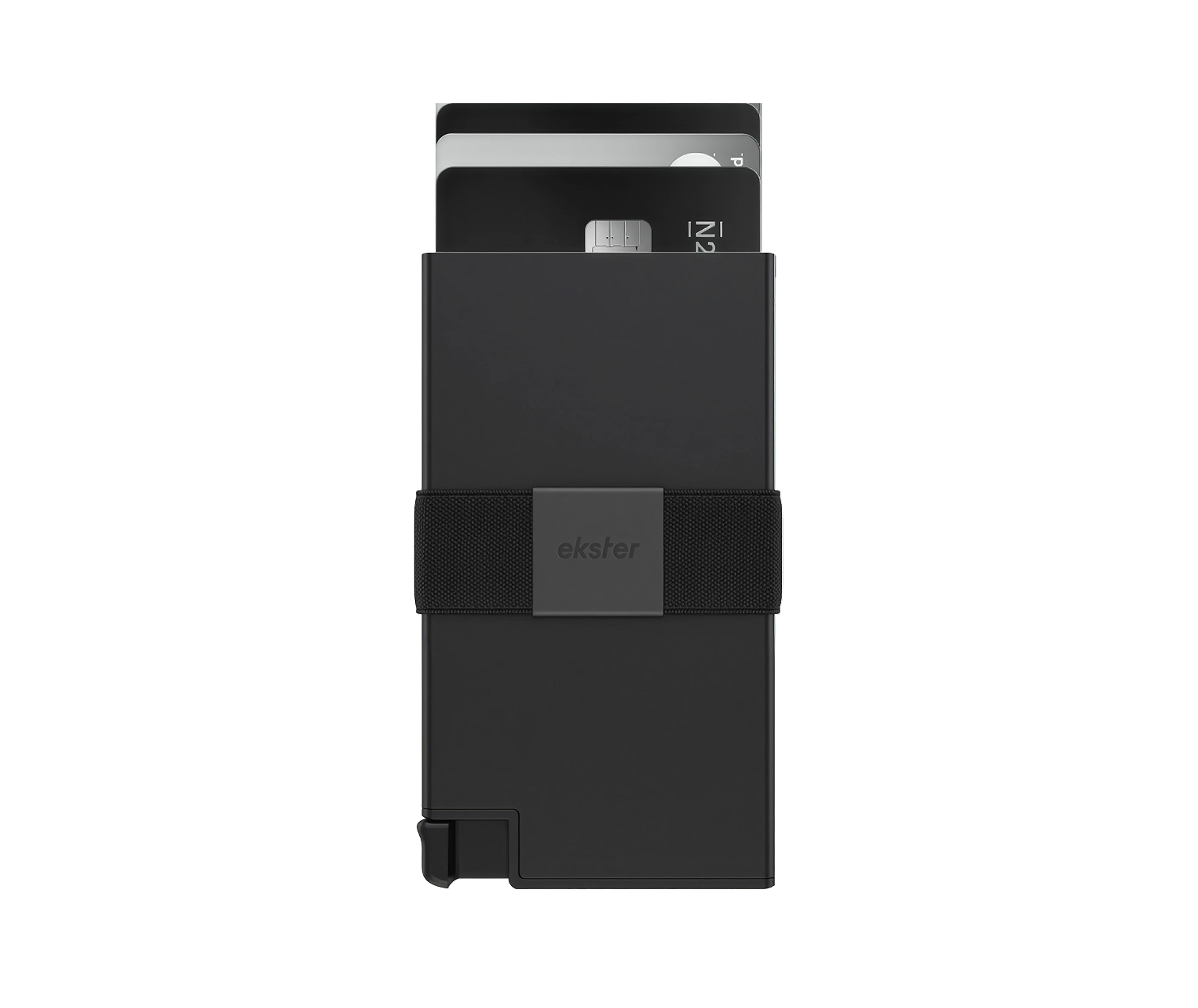
A button on the edge that fans the cards up in steps, so the one you want stands clear of the rest.
Ekster machines the case from 6061-T6 aluminium, the alloy most of the metal wallets here use, and also sells it in 3K carbon fibre. Press the button and the mechanism lifts the stack out of the top, each card sitting a little higher than the one behind it. No fanning through a stack at a counter, no sliding the whole lot out to find one.
Capacity depends on your cards. The mechanism takes up to six flat-printed cards, or four to six once embossed cards with raised numbers join them, since the raised digits eat into the space. An expandable backplate on the rear holds six to eight more, or folded notes under its strap, for a total of twelve. Ekster sells a separate cash clip backplate for a thicker fold of notes.
One number on Ekster's own page does not agree with itself. The spec table gives 10.5 by 6 by 0.75 cm, so 7.5 mm thick, and another section on the same page says 0.6 inches, which is about 15 mm. Ekster does not say which is right, and it publishes no weight.
Ekster's Tracker Card, a $39 add-on, puts the wallet on Apple's Find My network, the same one that locates AirTags. The case is RFID-blocking, and the standard model carries a two-year warranty. The Pro version gets a lifetime one.
The button is the whole experience. Cards stay hidden until you ask for them, then come up in order. Ekster lists it at $99 on its own site against $90 here, so check before ordering.
- Material
- 6061-T6 aluminium (also sold in 3K carbon fibre)
- Card capacity
- Up to 6 in the mechanism, 12 with the backplate
Specifications as published by the manufacturer. Source
4.Gunmetal Aluminum Wallet – $95

Pros
- 86 by 54 mm, less than half a millimetre longer than a bank card
- Cash strap and money clip swap on the same screws
Cons
- Twelve cards add about 9 mm of plastic to the 6 mm of plates
Two plates the size of a bank card, so the wallet is never wider than what it holds.
The Ridge measures 86 by 54 by 6 mm. A standard bank card is 85.6 by 54 mm, which leaves the plates less than half a millimetre to spare in length. Nothing in a pocket gives away that a wallet is there, because the outline is the outline of a card.
The plates are 6061-T6 aluminium, anodised gunmetal. Between them runs an elastic band on what Ridge calls a dual-track design, so the cards ride against the elastic and the plates close down around one card or open for twelve. A card is 0.76 mm thick, so a full load adds about 9 mm of plastic to those 6 mm of metal. A notch in one plate lets a thumb push the stack out from below and fan it.
Screws hold everything together. Ridge sells a cash strap and a money clip that swap on the same fixings, so a wallet bought with one can take the other a year later. The elastic and the screws are replaceable parts, which matters for a design whose main failure is a stretched band.
The 2.0 revision came in 10 per cent lighter and set the logo into an oil-filled recess. Ridge covers it with its Built for Life lifetime warranty and a 99-day trial, and it sells the same shape in more than 26 finishes, from powder-coated colours to a $150 carbon fibre version.
The Ridge is a metal wallet in the plainest sense: a stack of cards with a plate either side. It is the one most people picture when they hear the phrase, and the reason the category exists.
- Material
- 6061-T6 aluminium, anodised gunmetal
- Card capacity
- 1 to 12 cards
- Dimensions
- 86 x 54 x 6 mm
- Thickness
- 6 mm
Specifications as published by the manufacturer. Source
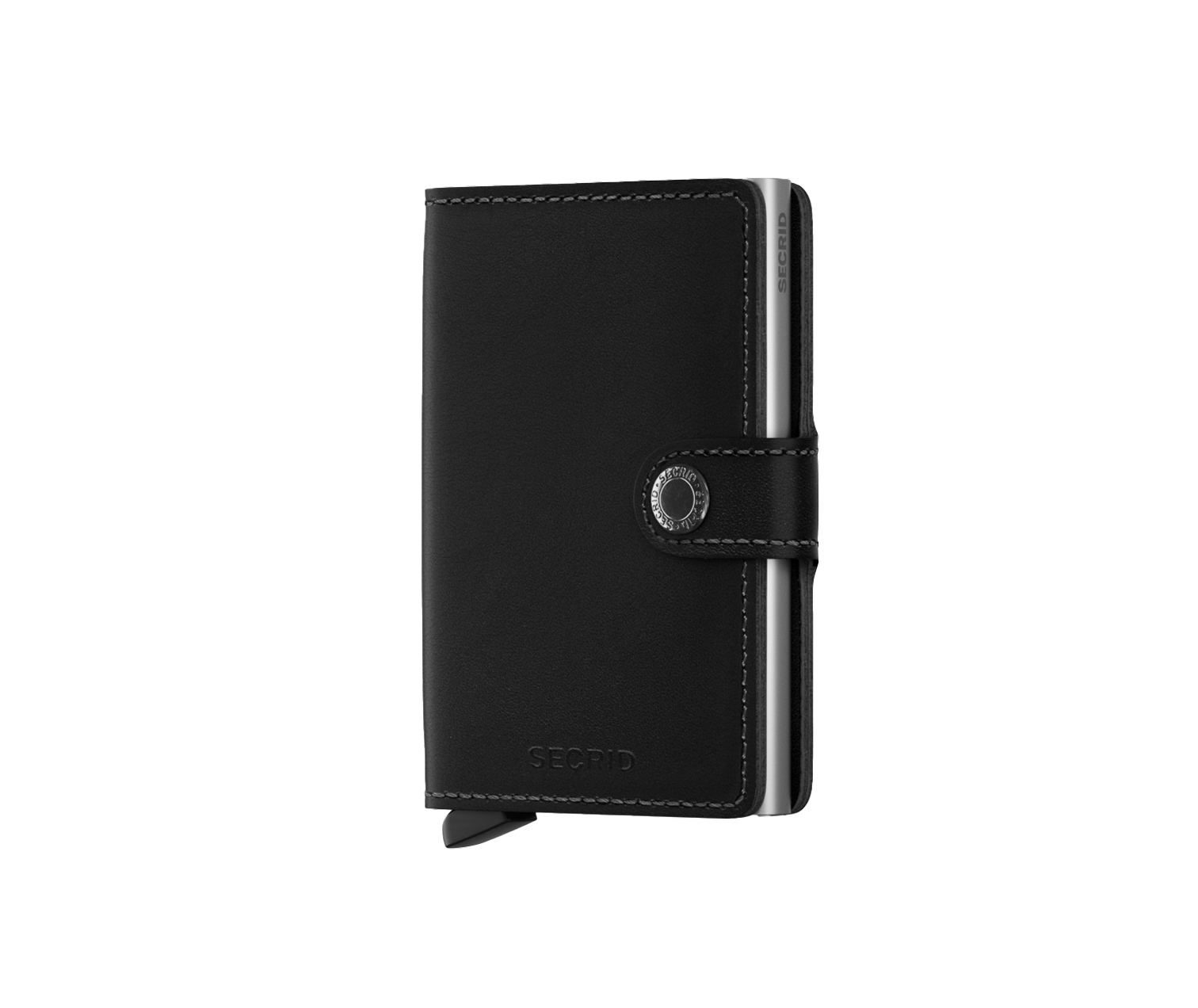
5.Miniwallet – $100
Pros
- One lever slides up to six cards out in a staggered fan
- Wrap holds notes, receipts and four more cards outside the metal
Cons
- The catalogue version is leather; order the Mirum for none
- 21 mm, the thickest pick here
An aluminium case that slides all its cards out at once, and the one pick that comes in a plant-based wrap.
Secrid launched the Cardprotector, the aluminium case at the centre of this wallet, in 2009, and it won a Red Dot design award in 2010. Push the lever at the bottom and up to six flat cards, or four embossed ones, slide out together in a staggered fan. The metal walls keep them from bending or snapping and, Secrid says, from unwanted RFID reads.
The Miniwallet adds a wrap around that core. It holds four more cards on the outside, plus notes, business cards and receipts, ten cards in all, and a press stud keeps it shut. The wrap is where the leather question comes in. The Original in our catalogue is semi-aniline European cowhide. The Miniwallet Mirum is the same wallet at the same $99 on Secrid's site, with the wrap in Mirum: a plant-based material Secrid describes as natural rubber, farm waste and minerals pressed onto a woven cotton backing, with no glue. Secrid cuts and stitches it in the Netherlands.
The Miniwallet runs about 102 by 65 by 21 mm and 72 g in the Original. That makes it the thickest pick here by some way, because notes travel folded inside the wrap.
Secrid is a certified B Corp, gives a two-year warranty that registration extends, and runs its own repair service for wallets that come back worn.
The slide-out is the habit it builds. Cash and receipts live in the wrap, the cards you reach for live in the metal, and one thumb movement at a till brings them up.
- Material
- Aluminium Cardprotector in a leather wrap, or Mirum plant-based wrap
- Card capacity
- Up to 10 cards: 4 embossed or 6 flat in the core, 4 in the wrap
- Dimensions
- 102 x 65 x 21 mm
- Thickness
- 21 mm
- Weight
- 72 g (Original leather)
Specifications as published by the manufacturer. Source
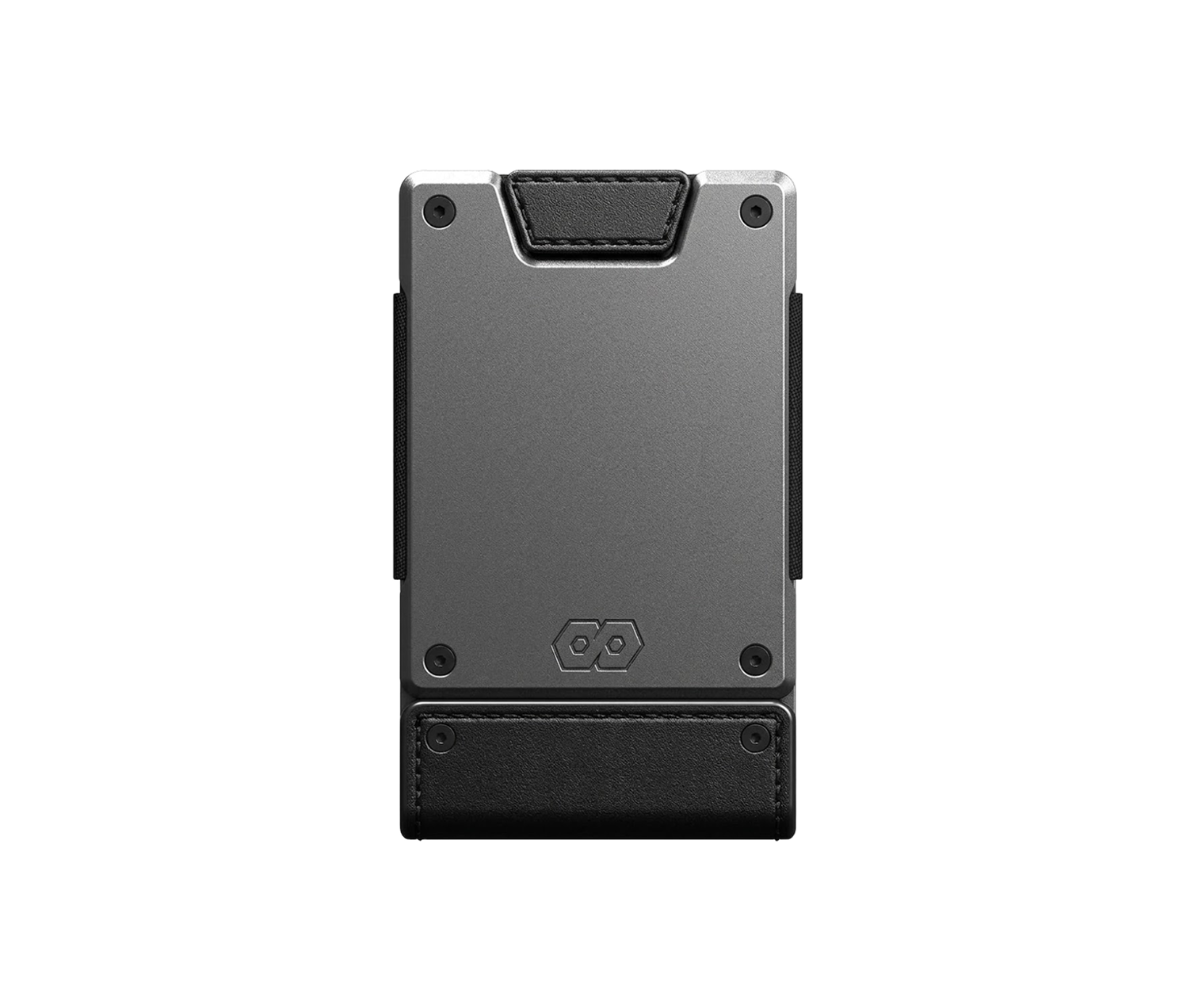
6.Wallet – $125
Pros
- 25 cards and 20 bills behind one pull tab
- 49.5 g, the lowest of the four published weights here
Cons
- The catalogue version is faced in leather; order the Oracle for none
- Close to an inch thick with all 25 cards in
Room for 25 cards and 20 bills, the most of anything here, behind one pull tab.
PROOF builds its Wallet on an aerospace-grade aluminium plate. A strap runs behind the cards, and a tug on the front tab lifts the whole stack clear, then lets it drop back. A US utility patent and two design patents cover that mechanism. A second strap on the back holds cash flat against the plate.
The version in our catalogue is The Founder, which faces the plate in top-grain bomber leather, so this pick is part leather as listed. The Oracle is the same wallet, same plate, same $125, with woven carbon fibre where the Founder has leather, and that is the one to order for a wallet with no leather on it. Both weigh 49.5 g, the lowest of the four weights published here.
PROOF gives the size as 2.25 by 3.75 inches and about half an inch thick, based on card load, and that qualifier carries a lot. Twenty-five cards at 0.76 mm each come to 19 mm of plastic alone. Yanko Design describes the wallet growing from a few millimetres to about an inch as the cards go in, which squares with the arithmetic.
The plate does part of the RFID blocking, with a blocking layer built inside the case. PROOF backs it with a lifetime warranty and will replace a wallet that is lost or damaged. A team of US military veterans and engineers designed it.
It is the one pick here sized for a full stack: loyalty cards, a transit card, the ID that rarely comes out. Carried with all 25 it is close to an inch-thick block, and still one pull to get at.
- Material
- Aerospace-grade aluminium plate, top-grain leather (The Founder) or carbon fibre (The Oracle)
- Card capacity
- Up to 25 cards and 20 bills
- Thickness
- About 13 mm, depending on card load
- Weight
- 49.5 g
Specifications as published by the manufacturer. Source
What to look for once leather is off the list
Aluminium, carbon fibre or plastic
Four of the six put aluminium at the core, and three of them name 6061-T6, the common machining alloy, heat-treated for stiffness. It is light, takes an anodised colour, and will not bend in a back pocket. Carbon fibre is lighter and stiffer again, which is why Ridge charges $150 for it against $95 for aluminium. The Aulumu G02 is the odd one out: a TPU frame under PU leather, which is plastic all the way through and the only pick that looks soft.
What RFID blocking actually does
Contactless cards talk at 13.56 MHz over a few centimetres. A metal case that surrounds the card stops that signal, which blocks a skimmer and also means you take a card out to tap it at a terminal. The Ridge, Ekster, Secrid and PROOF all claim it from the case. Aulumu claims it for the G03 only through the two blocking cards in the box.
Card capacity against thickness
A bank card is 0.76 mm thick, so every four cards add about 3 mm. That makes published thickness a starting figure. The Ridge's 6 mm is the plates, PROOF's half inch rises toward an inch at 25 cards, and Ekster's page gives two different figures. Count the cards you actually carry, multiply, and add the wallet.
MagSafe wallets and the phone they ride on
The two Aulumu wallets attach to iPhone 12 and later, and both have to come off for wireless charging. Neither has a published magnet strength, and neither seats on an iPhone 14 Pro in a case. The G02 suits three cards, and the G03 suits a full load with the strap doing the holding.
Which of the six fits you
Three cards and a phone stand: the G02. Twelve cards stuck to a phone: the G03. Cards that present themselves at the press of a button: the Ekster. The thinnest outline and the most finishes: the Ridge. Cash and receipts as well as cards: the Secrid, in Mirum. Everything you own in one block: the PROOF, as the Oracle.
All 6 compared
Aulumu Magnetic Flip Wallet & StandStand at any angle- Cards
- 3
- Material
- TPU, PU leather
Aulumu G03 Multi-Tool Magnetic WalletTwelve cards on MagSafe- Cards
- 12+
- Material
- Aluminium, carbon
Ekster Aluminum Cardholder WalletPush-button cards- Cards
- Up to 12
- Material
- Aluminium
Ridge Gunmetal Aluminum WalletCard-sized footprint- Cards
- 1–12
- Material
- Aluminium
Secrid MiniwalletPlant-based wrap option- Cards
- Up to 10
- Material
- Aluminium, leather or Mirum
Proof WalletMost cards here- Cards
- 25 + 20 bills
- Material
- Aluminium, leather or carbon
Two columns, because these are the only two facts all six makers publish without contradicting themselves. Ekster's page gives two different thicknesses and no weight, and Ridge's current page gives no weight, so thickness and weight live in the spec panels instead.
How we chose
We started from material: every wallet here holds its cards in aluminium, carbon fibre or plastic. Two of the versions in our catalogue are faced in leather, and for both the section names the version the maker sells without it, at the same price. Beyond that, each pick gets a card out a different way, from a friction hinge to a push button to a pull tab, across a spread from $20 to $125. Every figure in the spec panels comes from the maker's own page and was checked against a second listing. Where the two disagreed, or the maker published nothing, we left the figure out.
Common questions
A metal case that surrounds a contactless card stops the 13.56 MHz signal it uses, so a skimmer cannot read it and a terminal cannot either until the card comes out. Ridge, Ekster, Secrid and PROOF claim blocking from the case itself. Aulumu's G03 makes the claim through two RFID-blocking cards that ship in the box.
Between three and twenty-five among these six. A bank card is 0.76 mm thick, so every four cards add about 3 mm, and a wallet rated for 25 cards grows from a few millimetres to close to an inch as it fills. Count the cards you actually carry before buying for capacity.
No. PU leather is a polyurethane coating on a fabric or plastic backing, made to look like leather. Aulumu uses it over a TPU frame on the G02 and sells it as vegan leather.
In five of these six. Ridge swaps between a cash strap and a money clip, PROOF holds up to 20 bills under a rear strap, Secrid folds notes inside its wrap, Ekster takes them under the backplate strap, and the Aulumu G03 takes folded notes and coins. The three-card Aulumu G02 has no place for cash.
Both Aulumu wallets here have to come off the phone before it goes on a wireless charger. They attach to iPhone 12 and later, and neither seats on an iPhone 14 Pro wearing a case.
About the author

Justin Farrugia
Founder & Editor of Curated Supply
Justin Farrugia is the founder and editor of Curated Supply, a design-led directory to things worth owning. He has personally curated over 1,000 products across workspace, carry, coffee, audio, and the home, each judged against one standard: design intent, material quality, and the restraint that lets a thing last.