EDC pocket knives and titanium tools, from CRKT to Benchmade
EDC pocket knives and titanium tools, from the 52 g Benchmade Bugout to Big Idea Design's TPT Slide, with blade lengths, locks and steels compared.
Two numbers decide EDC pocket knives before anything else: how long the blade is and how it locks, because those two settle how the knife cuts and where you can lawfully carry it. This set runs from a 2.16 inch frame lock at $27 to a 3.24 inch AXIS lock at $200.
Between the knives sit two titanium tools from Big Idea Design for the jobs a blade should never do, prying and turning screws, and one full-size Leatherman for the jobs a pocket cannot hold. Every length and weight below appears on the maker's page and on at least one knife dealer's.
1.Squid Folding Pocket Knife – $27

Pros
- 3.48 inches closed, the shortest of the three knives
- 8Cr13MoV comes back sharp on an ordinary whetstone
Cons
- At 99 g it outweighs the Bugout, whose blade is more than an inch longer
- 8Cr13MoV dulls sooner than the S30V on the Bugout
The shortest blade in the set, 2.16 inches, held open by the handle itself.
The Squid is a frame lock. Its handle is stainless steel, and one side of it is cut and bent inward so that, once the blade swings open, that strip of the handle springs across behind the blade's tang and braces it. To close it, the thumb pushes the strip back out to the side. There is no separate liner and no extra spring, which is why frame locks are the usual choice on small, cheap knives that still need to feel solid. The blade opens with a thumb stud, one-handed.
CRKT commissioned the design from Lucas Burnley, a maker in Bend, Oregon, and kept it squat: 3.48 inches (88 mm) closed, with a drop point blade 2.8 mm thick. The steel is 8Cr13MoV in a black stonewash, the tumbled finish that hides the small scratches daily carry leaves. 8Cr13MoV is a Chinese stainless that sits at the budget end of knife steels. It dulls sooner than the S30V on the Bugout further down, and it comes back on an ordinary whetstone in a few minutes, without diamond plates.
The one number that surprises is the weight. At 3.5 oz (99 g), the Squid is heavier than the Bugout, which carries a blade more than an inch longer. Steel handles weigh more than polymer ones, and the Squid is mostly handle.
In the pocket it is a dense little block that rides low on its clip. It suits boxes, string, tape and fruit, the cuts of an ordinary week. A short blade does not settle where you may carry it, though: several places that allow small folding knives exclude locking blades from that allowance, whatever their length. A non-locking alternative is the Swiss Army 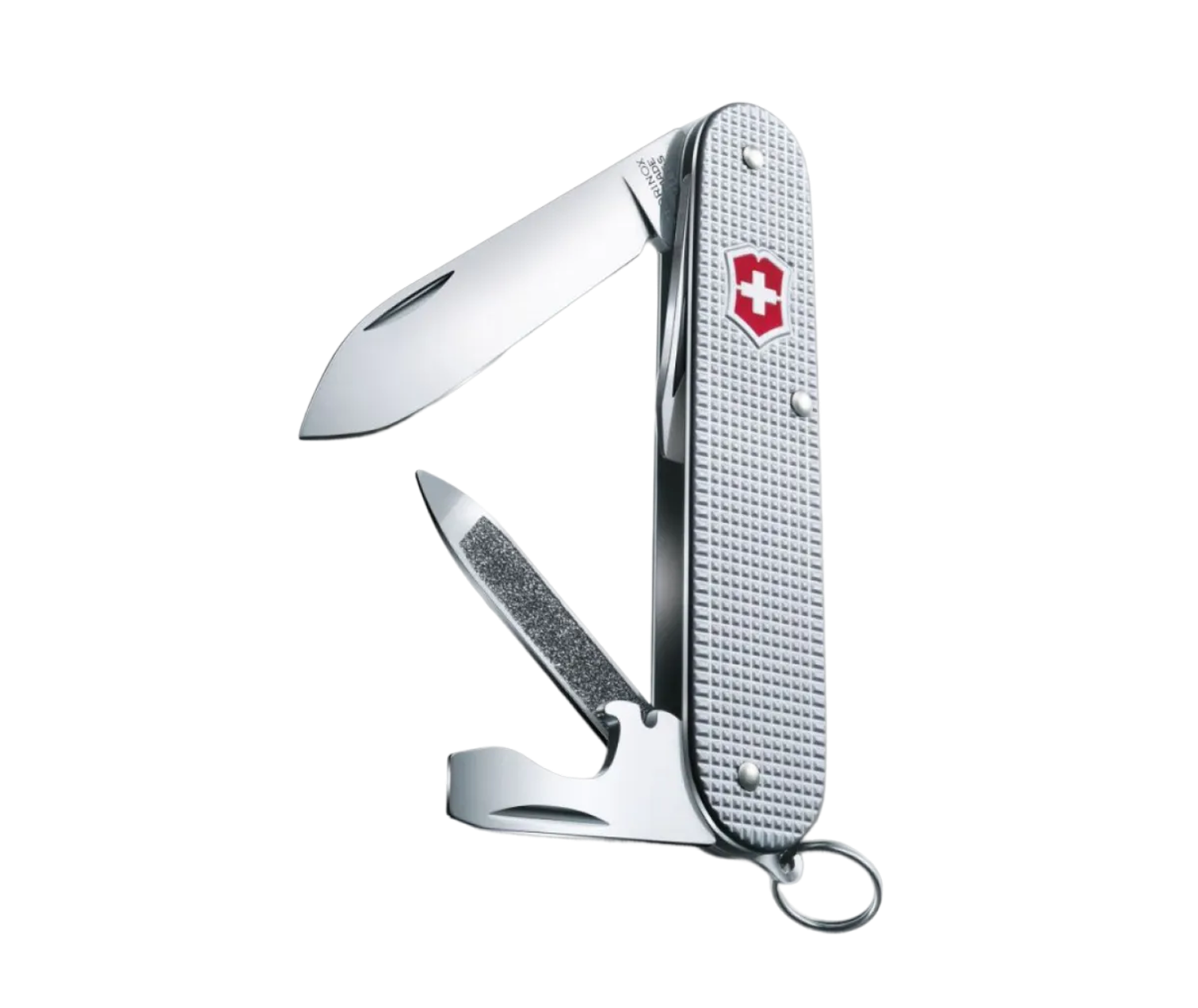 Cadet Alox in our pocket-sized carry roundup.
- Blade
- 2.16 in (55 mm), 8Cr13MoV, black stonewash
- Steel
- 8Cr13MoV
- Closed length
- 3.48 in (88 mm)
- Weight
- 3.5 oz (99 g)
- Lock
- Frame lock, thumb stud opening
- Handle
- Stainless steel
Specifications as published by the manufacturer. Source
2.Elementum II Button Lock Folding Knife – $65
Pros
- The button releases the blade without the fingers crossing its path
- Lighter than the Squid with a blade almost an inch longer
Cons
- Looks like an automatic knife at a glance, though it opens manually
- 3 mm blade stock is the thickest here, so it slices less cleanly than the Bugout
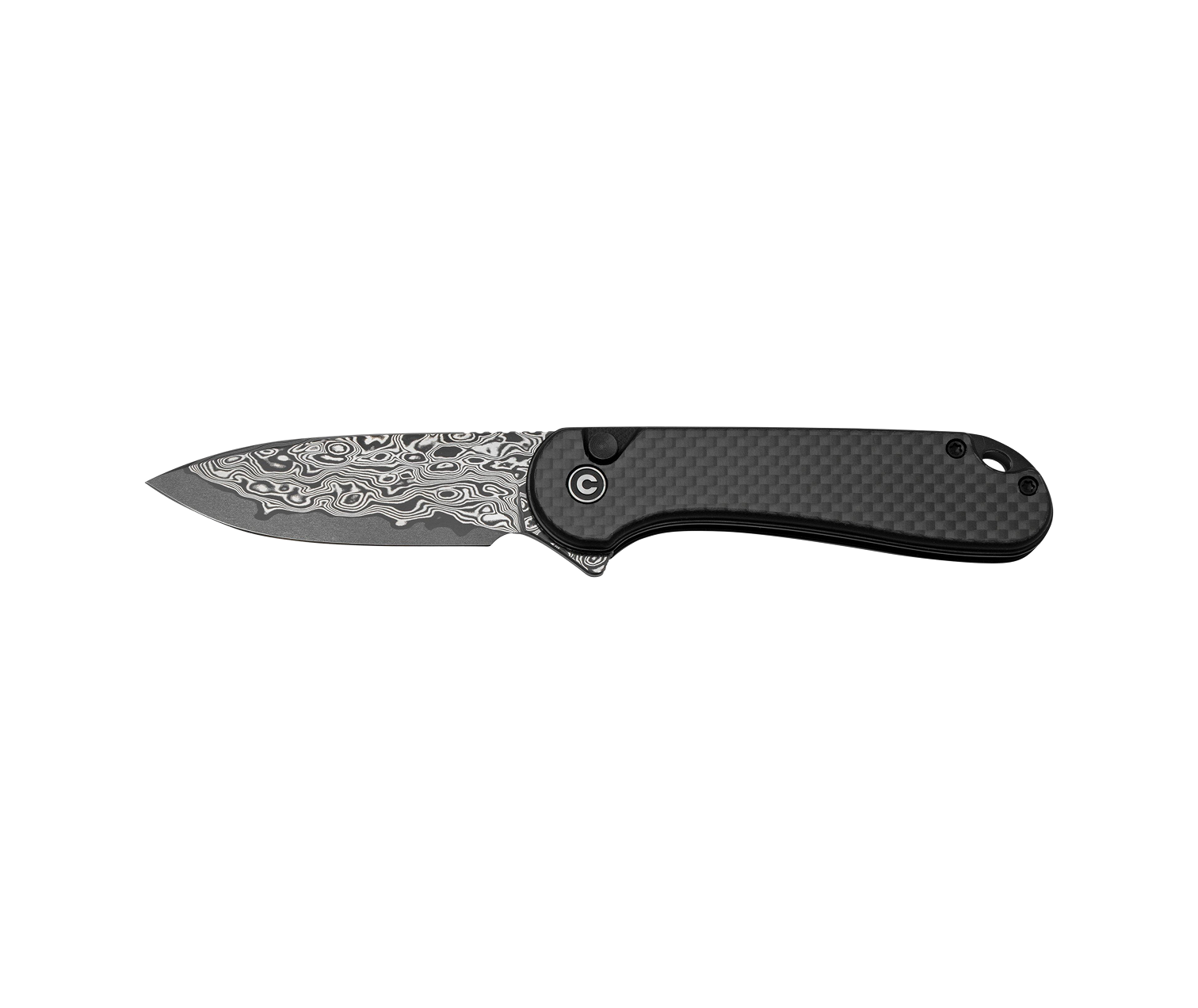
A button lock and a caged ceramic ball bearing pivot, two parts usually found on knives at twice the price.
A button lock works like a plunger. A spring-loaded pin sits in the handle beside the pivot, and when the blade opens, the pin drops into a notch in the blade's tang and holds it. Press the button and the pin lifts out, so the blade can be let down shut with a flick of the wrist. The fingers never cross the edge's path, which is the problem with a liner or frame lock, where the thumb pushes the lock bar out from directly under the blade.
The button does not open the knife. The Elementum II opens manually, with a flipper tab on the spine, and the spring sits under the button, not behind the blade. That matters, because many places restrict automatic knives, and a button lock looks similar to one at a glance.
The blade is 2.96 inches (75.1 mm) of Nitro-V, 3 mm thick and hardened to 58 to 60 on the Rockwell C scale, the standard measure of how hard a blade steel is. Higher holds an edge longer and takes longer to sharpen; 58 to 60 is the middle of the range for a pocket knife. The pivot rides on ceramic balls held in a cage, so they roll evenly where loose bearings can bunch together. Closed, it is 4.11 inches (104.3 mm) long, with G10 scales over black stainless liners. G10 is fibreglass cloth set in resin, grippy when wet and close to indestructible.
CIVIVI is the line WE Knife Co. started in 2018 for lower-priced everyday carry. At 3.12 oz (88.5 g), this is a lighter knife than the Squid with a blade almost an inch longer, and it sits on a deep tip-up clip.
- Blade
- 2.96 in (75.1 mm), Nitro-V at 58 to 60 HRC
- Steel
- Nitro-V
- Closed length
- 4.11 in (104.3 mm)
- Weight
- 3.12 oz (88.5 g)
- Lock
- Button lock, flipper opening, caged ceramic ball bearing pivot
- Handle
- G10 over black stainless steel liners
Specifications as published by the manufacturer. Source
3.Ti Pry Bar – $80
Pros
- Takes the prying that snaps knife tips
- At 4.5 inches it sits well inside TSA's seven inch limit for tools
Cons
- Titanium scratches more readily than hardened steel
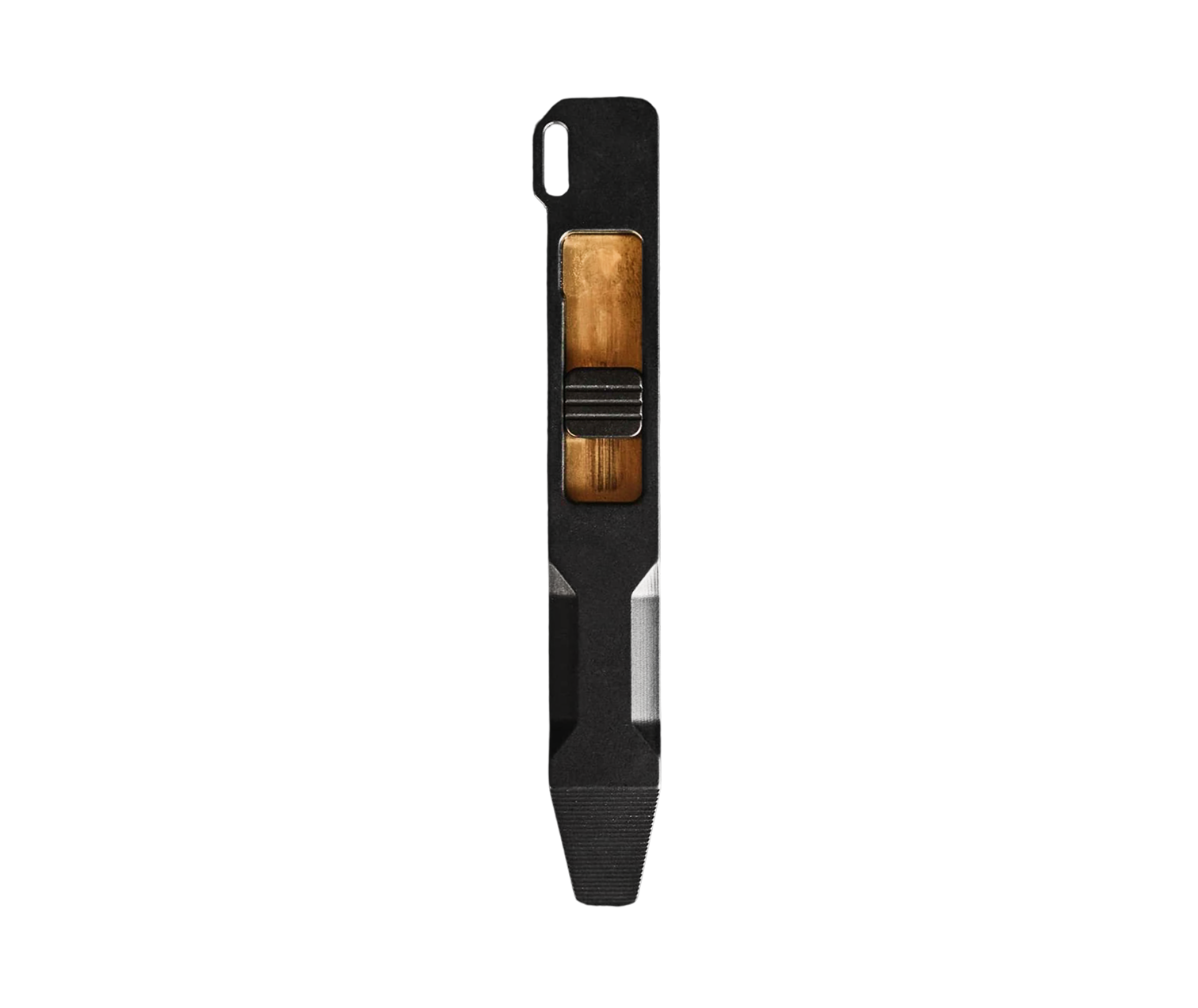
No edge at all: 11.5 cm of solid grade 5 titanium for the jobs that snap knife tips.
Knife makers harden a blade to keep an edge, and hard steel turns brittle under a twist. Use the tip to lever a lid or a staple and it chips or snaps. A pry bar exists so the knife never has to do that work. Big Idea Design lists five plain jobs for this one: prying, opening taped boxes, scoring materials, turning a flathead screw and lifting bottle caps.
Grade 5 is the titanium alloy also written Ti-6Al-4V, six percent aluminium and four percent vanadium, considerably stronger than the commercially pure grades used for things like titanium cookware. Titanium is about 45 percent lighter than steel for the same size and does not rust, which suits something that lives against a damp pocket lining. It is softer than hardened tool steel, so the faces scratch and the edges pick up marks with use. Big Idea Design mills the bar from a single block, so it has no joins, pins or screws to work loose.
Set into the face are magnetic buttons that slide back and forth with a smooth action, something for the thumb to do, with no tool function at all. The deep-carry clip seats the bar low in the pocket. It comes in Stonewashed or the DLC Black shown here, DLC meaning a diamond-like carbon coating that resists wear better than paint. Big Idea Design works out of Chattanooga, Tennessee; Knivesandtools lists China as this bar's country of origin.
The maker calls it a TSA friendly, non-threatening carry. TSA rules allow tools seven inches or shorter in carry-on bags, and at about 4.5 inches the bar is well inside that, though the officer at the checkpoint has the final say. Retailers disagree on its weight, so this post leaves it out.
- Edge
- None, pry tip and flathead end
- Length
- 11.5 cm (4.5 in)
- Material
- Grade 5 titanium, milled from solid
- Finish
- Stonewashed or DLC Black
Specifications as published by the manufacturer. Source
4.TPT Slide Titanium Pocket Tool – $89
Pros
- A dull edge is swapped for a fresh blade through the EZ Swap door
- Wrench fits 15 socket sizes, eight SAE and seven metric
Cons
- Blades are not included
- With a razor blade fitted it is not allowed in a US carry-on bag
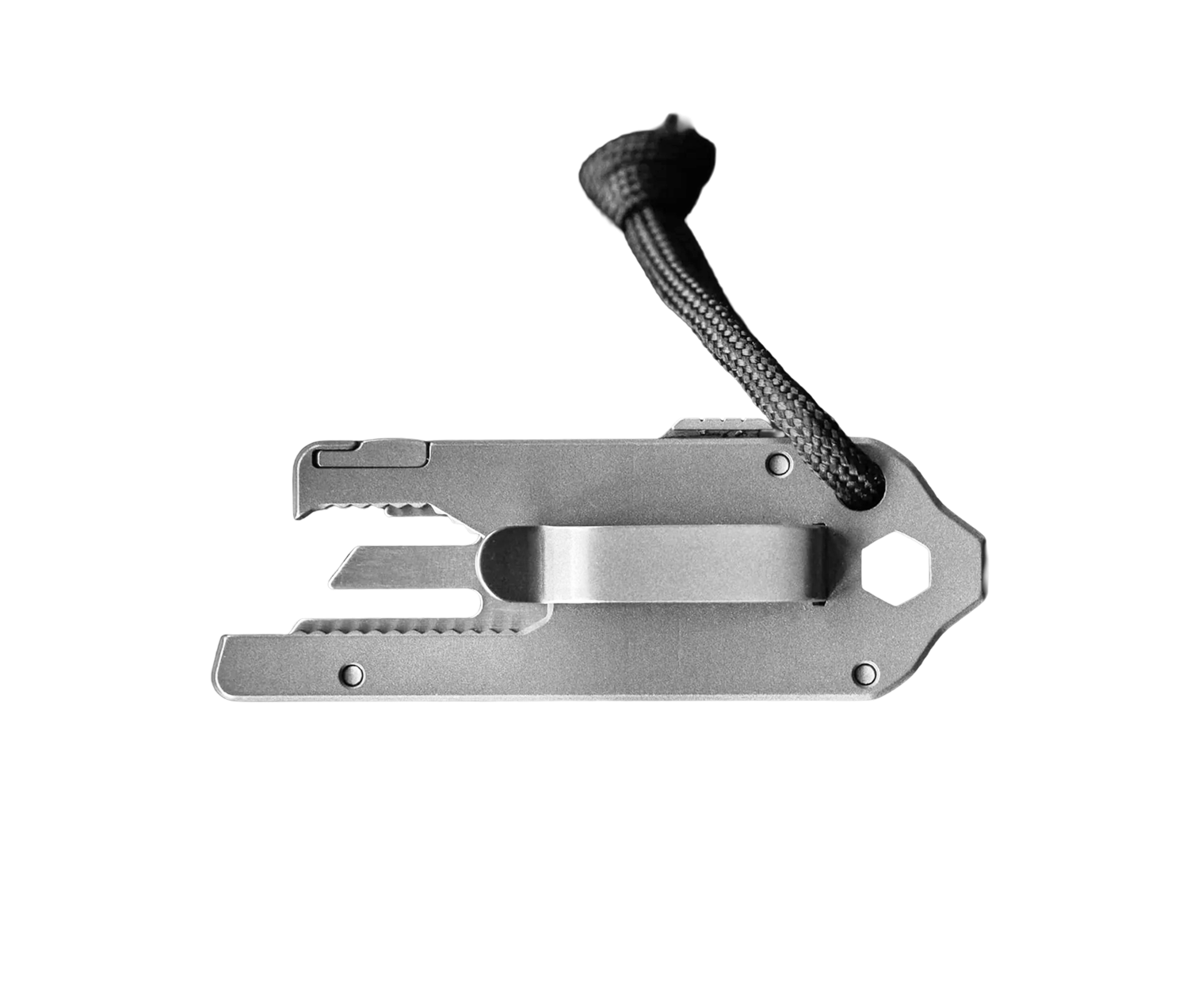
The edge is a standard utility razor blade, so it gets replaced when it dulls, never sharpened.
The TPT Slide is 7.5 cm long, 2.5 cm tall and 5 mm thick, 9 mm with the clip on, and weighs about an ounce. That makes it the smallest and lightest pick here. The body is grade 5 titanium, made 25 percent thicker than the original TPT it replaces, and a slide lever on top pushes the blade holder out under the thumb. An EZ Swap door on the back opens for blade changes. Two stainless steel inserts come in the box, one natural and one black anodised. Blades do not.
Around the edge the titanium does everything else. There is a bottle opener, two widths of flathead screwdriver, a mini pry bar, a scraper edge and measurement cues. The wrench cut-out fits 15 socket sizes, eight SAE from 15/64 to 7/16 inch and seven metric from 6 to 12 mm. A 1/4 inch hex opening holds a standard driver bit on an internal magnet. The screws are #304 stainless Torx.
Carry is left open. The clip comes off, the tail takes the included 550 paracord lanyard or a key ring, and a leather sheath is in the box as well.
One thing to know before flying: Big Idea Design calls the Slide TSA friendly, but TSA lists loose razor blades and box cutters as prohibited in carry-on bags. Take the blade out first, or fit one of the maker's Safe-Carry inserts. The same company makes the 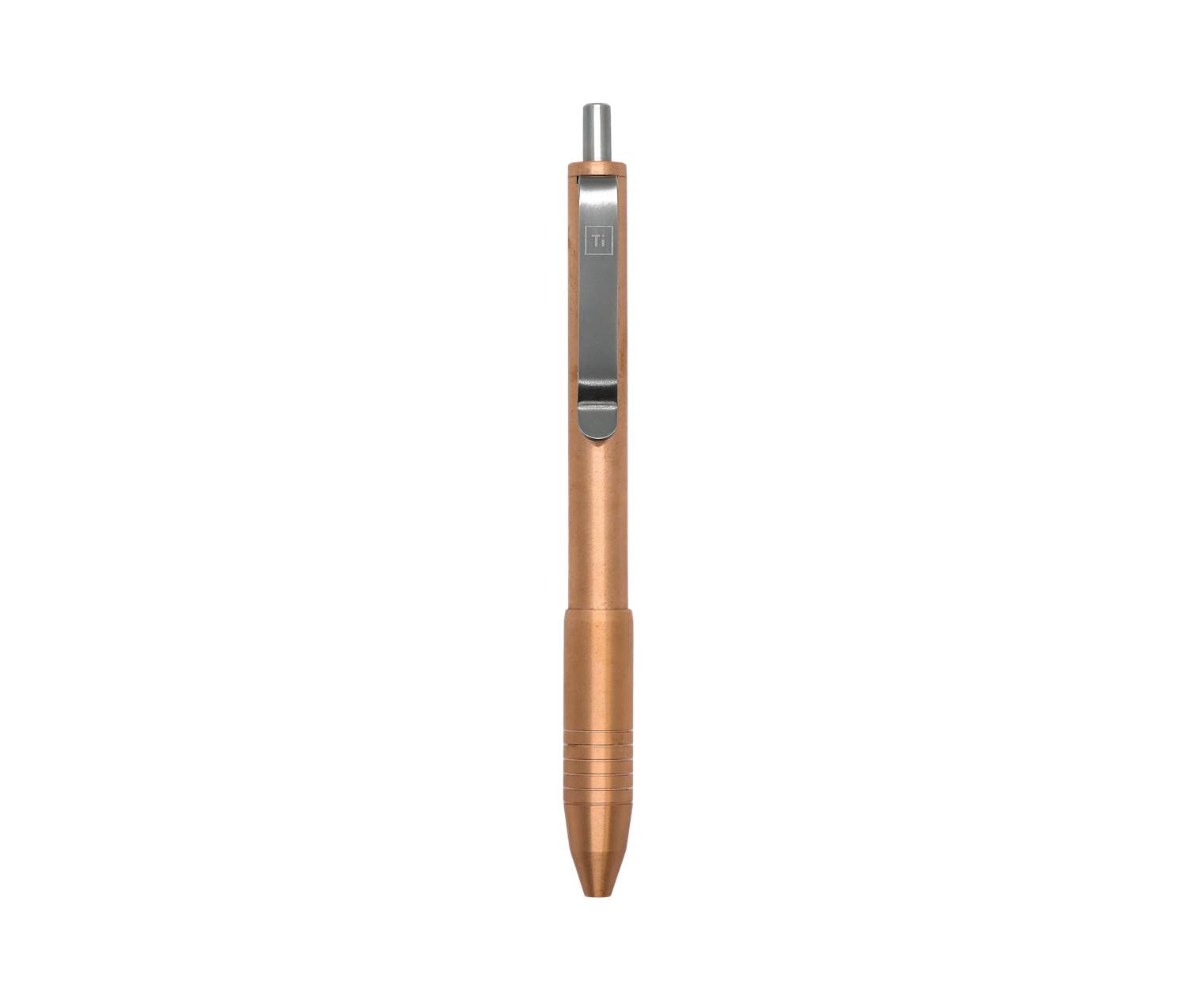 Copper Click EDC Pen, whose clip is titanium and whose collet takes over 100 refills, a second Big Idea Design object built around a replaceable part.
- Edge
- Standard utility razor blade, not included
- Length
- 7.5 cm long, 2.5 cm tall
- Weight
- About 1 oz (28 g)
- Thickness
- 5 mm, 9 mm with clip
- Material
- Grade 5 titanium (6Al4V), stainless steel inserts
Specifications as published by the manufacturer. Source
5.Surge Multi-Tool – $160

Pros
- Wire cutters and hard-wire cutters are replaceable parts
- Saw and diamond-coated file swap on one blade exchanger
Cons
- 12.5 oz, more than the rest of the set combined
- No carry-on bag allows it while it has blades
The only pick with pliers, and the only one whose wire cutters come off and get replaced when they wear.
The Surge carries 21 tools in a frame 4.5 inches (11.4 cm) long when closed, and it weighs 12.5 oz (354 g). That is more than everything else in this post put together. It is a belt-and-bag tool more than a pocket tool, and it is in this set for the jobs that need grip and force.
On most multi-tools the wire cutters are ground into the plier jaws, so once they blunt, the whole plier head goes with them. Leatherman makes them separate parts on the Surge: a set of wire cutters and a set of hard-wire cutters, each replaceable, plus a third cutter for stranded wire. A blade exchanger takes either a saw or a diamond-coated file, so neither sits in the handle full time. There is also an electrical crimper, a wire stripper, spring-action scissors that reopen by themselves, an awl, a can opener, a bottle opener, a large bit driver and two screwdrivers.
Two 3.1 inch blades in 420HC stainless, one straight and one serrated, open from the outside without unfolding the handles, as do two more tools. 420HC is a tough, low-carbon stainless that takes a working edge easily and shrugs off rust; it gives up edge life against Nitro-V or S30V, and on a tool that also cuts wire and cardboard that trade suits it.
Leatherman has built tools in Portland, Oregon, since 1983 and covers the Surge for 25 years. It is the only pick here that will never pass airport security in a carry-on, because TSA allows no multi-tool with a blade. At home it lives in a drawer or on a belt, ready for the bike, the car and the flat-pack.
- Blade
- Two 3.1 in 420HC blades, straight and serrated
- Steel
- 420HC
- Closed length
- 4.5 in (11.4 cm)
- Weight
- 12.5 oz (354 g)
- Tools
- 21, both blades reachable with the handles closed
- Warranty
- 25 years
Specifications as published by the manufacturer. Source
6.Bugout Folding Knife – $200

Pros
- 52 g with the longest blade of the three knives
- AXIS lock and reversible clip work the same in either hand
Cons
- 0.09 inch blade stock is the wrong tool for prying
The longest blade of the three knives, 3.24 inches, at the lowest weight: 1.85 oz, or about 52 g.
The weight comes off the handle. Where the Squid's handle is steel, the Bugout's is Grivory, a glass-fibre reinforced nylon with thin steel liners inside, stiff enough to carry the pivot and the lock. The blade is thin too, 0.09 inches (2.3 mm), against the Squid's 2.8 mm and the Elementum II's 3 mm, so it slices more like a kitchen knife and pries less well. That is the job the Ti Pry Bar is for.
The steel is CPM S30V, a powder steel that Crucible developed with knifemaker Chris Reeve, hardened here to 58 to 60 HRC. It holds an edge noticeably longer than 8Cr13MoV, and Benchmade will resharpen it for life through its LifeSharp service. The grey blade coating cuts the glare.
The lock is the AXIS, a spring-loaded steel bar that runs across the handle and drops in behind the blade. Pull the small studs on either side back and the blade swings free, so it opens and closes the same way in a left or right hand. Bill McHenry and Jason Williams designed it, and Benchmade launched it on the 710 at the 1999 SHOT Show. Once the patent ran out, crossbar locks spread across the industry. The clip is reversible, tip-up on either side.
Closed, the Bugout is 4.22 inches (107 mm), open 7.46 inches, and made in the USA. In the pocket it registers less than the much shorter Squid. For a knife that does not fold at all, the Victorinox 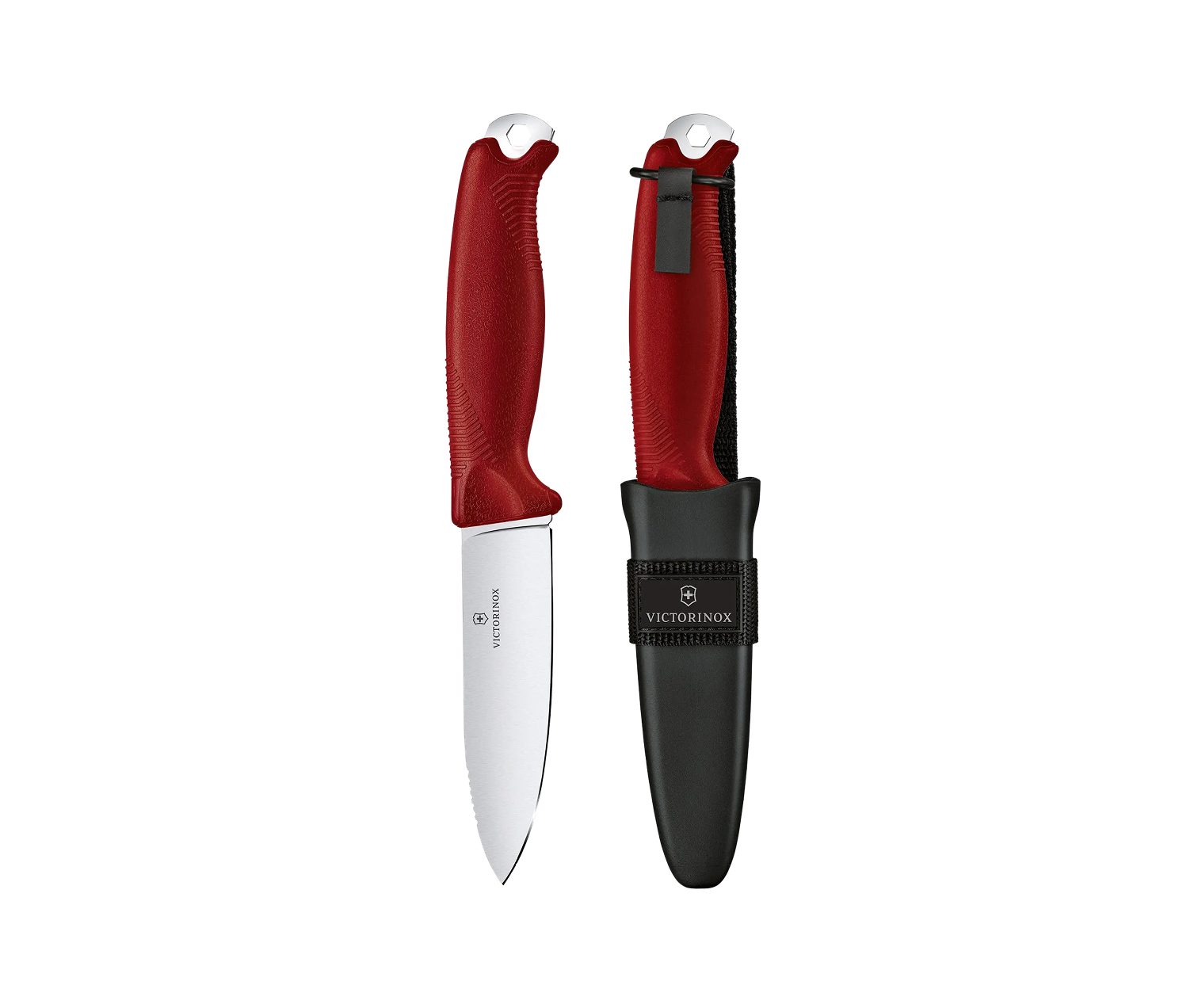 Venture is a fixed blade with a 10.5 cm drop point, built for carving and fire lighting and carried on the belt.
- Blade
- 3.24 in (82 mm), CPM S30V at 58 to 60 HRC, 0.09 in thick
- Steel
- CPM S30V
- Closed length
- 4.22 in (107 mm), 7.46 in open
- Weight
- 1.85 oz (52 g)
- Lock
- AXIS crossbar lock, reversible tip-up clip
- Handle
- Grivory with steel liners
Specifications as published by the manufacturer. Source
Choosing between a knife and a tool
Most carry ends up as one cutting thing and one levering thing. A knife alone gets used for prying, and a tool alone leaves nothing for a clean cut. The Bugout and the TPT Slide together weigh about 80 g, under a quarter of the Surge, and between them they cover a clean cut, a screw, a bottle and a lid. Add a small light, such as one of Nitecore's flat EDC torches, and the pocket holds everything a normal day asks for.
All 6 compared
CRKT Squid Folding Pocket KnifeShortest blade here- Blade
- 2.16 in
- Closed
- 3.48 in
- Weight
- 99 g
- Material
- 8Cr13MoV
CIVIVI Elementum II Button Lock Folding KnifeButton lock- Blade
- 2.96 in
- Closed
- 4.11 in
- Weight
- 88.5 g
- Material
- Nitro-V
Big Idea Design Ti Pry BarNo edge at all- Blade
- None
- Closed
- 11.5 cm
- Weight
- –
- Material
- Grade 5 titanium
Big Idea Design TPT Slide Titanium Pocket ToolReplaceable razor edge- Blade
- Utility blade
- Closed
- 7.5 cm
- Weight
- 28 g
- Material
- Grade 5 titanium
Leatherman Surge Multi-ToolPliers and 21 tools- Blade
- 3.1 in
- Closed
- 4.5 in
- Weight
- 354 g
- Material
- 420HC
Benchmade Bugout Folding KnifeLightest knife here- Blade
- 3.24 in
- Closed
- 4.22 in
- Weight
- 52 g
- Material
- CPM S30V
Big Idea Design publishes no weight or length for the Ti Pry Bar. Its length is the figure two knife dealers agree on; their weights disagree, so none is shown.
How we chose
We looked for objects that each do a different job in the same pocket, so the set holds three folding knives with three different locks, two titanium tools for the prying and turning a blade should never do, and one full-size multi-tool for the work that needs pliers. Every pick had to publish its blade length and weight, or have them stated by two independent knife dealers, because those two figures decide how a knife carries and, in many places, whether it can be carried at all. Prices run from $27 to $200 so the steel, lock and handle material can be seen changing as the price climbs.
Common questions
It depends entirely on where you are. Knife laws differ between countries, and often between states, cities and venues within them. The things they most often turn on are blade length, whether the blade locks, how it opens (automatic and assisted knives are commonly restricted) and whether you have a reason to carry it. Check the law where you live and where you are going before carrying any knife; this post is not legal advice.
Most everyday cutting, such as boxes, tape, string and food, needs between 2 and 3.5 inches of blade. The knives here run from the Squid's 2.16 inches to the Bugout's 3.24 inches. Shorter blades disappear in a pocket and are allowed in more places; longer ones slice faster and reach through thicker material.
A frame lock uses a sprung strip of the steel handle itself to brace the open blade, as on the CRKT Squid. A button lock drops a spring-loaded pin into a notch in the blade, released by pressing a button, as on the CIVIVI Elementum II. Benchmade's AXIS lock runs a sprung bar across the handle behind the blade, pulled back from either side, so it works the same in either hand.
In the United States, TSA does not allow knives, multi-tools with blades, box cutters or loose razor blades in carry-on bags; they can go in checked luggage. Tools seven inches or shorter, such as a small pry bar, are generally allowed in carry-on, though the officer at the checkpoint has the final say. Other countries set their own rules, so check with the airline and the airport authority before flying.
For a tool body, titanium is about 45 percent lighter than steel for the same size and does not rust, which suits something carried every day. It is softer than hardened steel, so it scratches, and it makes a poor knife edge, which is why titanium knives use steel blades and titanium only for the handle or frame.
About the author

Justin Farrugia
Founder & Editor of Curated Supply
Justin Farrugia is the founder and editor of Curated Supply, a design-led directory to things worth owning. He has personally curated over 1,000 products across workspace, carry, coffee, audio, and the home, each judged against one standard: design intent, material quality, and the restraint that lets a thing last.