Keyring trackers, cables and key organisers worth clipping on
Keyring trackers, cables and key organisers, from the Chipolo Loop that works with iPhone or Android to Nomad's ChargeKey 2 and a folding Ridge Keycase.
Trackers, cables and key organisers belong on the keyring for one reason: keys are the object nobody leaves the house without, so whatever hangs from them goes everywhere by default. The six here start with the ring itself and end with a case that replaces it. In between sit a tracker for either kind of phone, a screw-shut housing for an AirTag, a short cable that charges a laptop and a carabiner that keeps the keys on when it opens.
Each one does a single job. Two of them, the cable and the tracker, also work together, since the Chipolo charges over USB-C and ships without a lead.
1.Ring V2 Quick Release Keyring – $17
Pros
- A 3.6 mm opening clears a house key, a fob loop or another ring
- 2 mm flat section sits lower than a doubled split ring
Cons
- On keys that never come off the set, the quick release adds nothing a split ring lacks
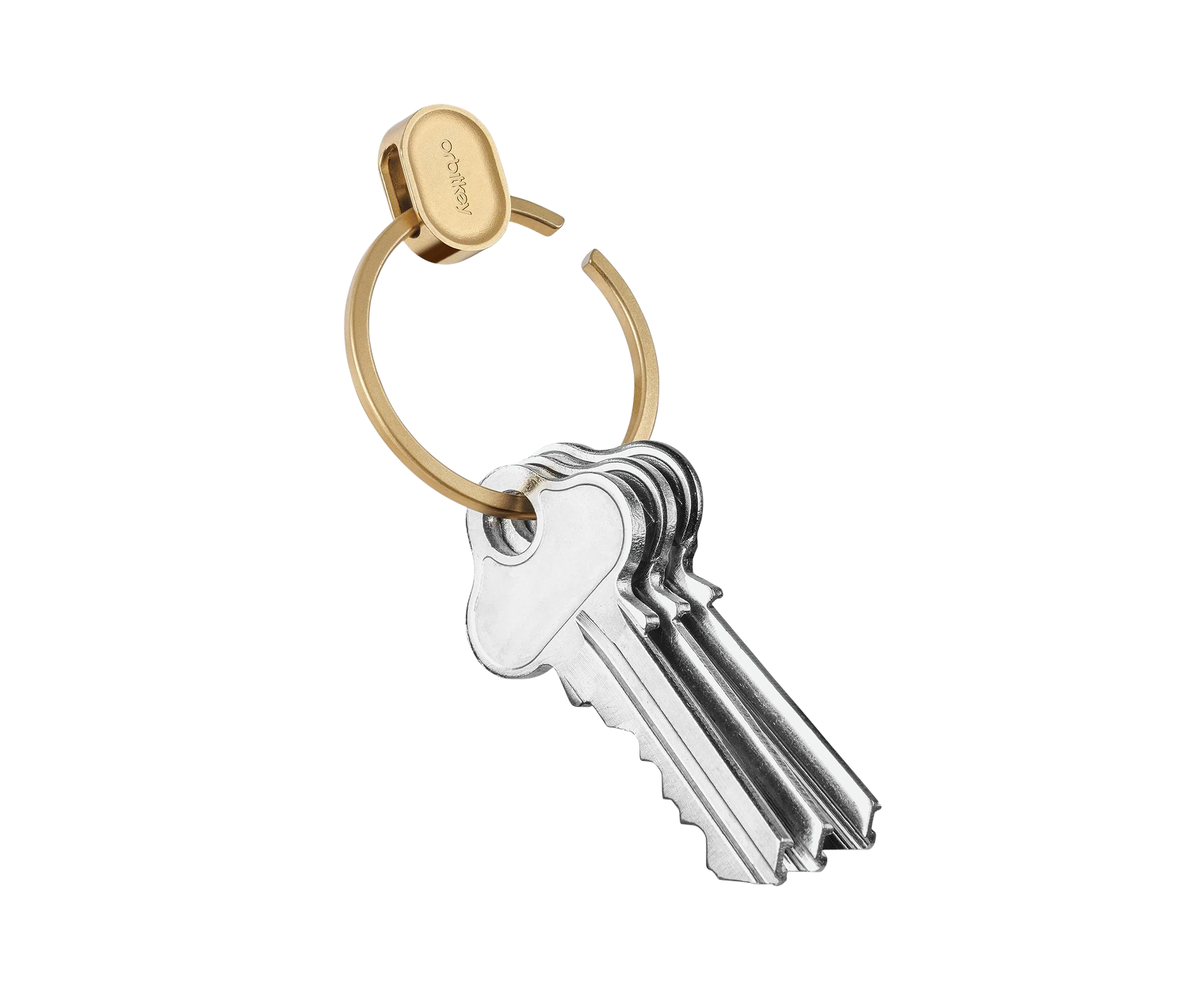
A stainless steel keyring with a sliding lock over its gap, so a key goes on with a pull and a twist and nothing gets prised apart.
Orbitkey released the Ring V2 in September 2022. The ring is open, with a short sleeve covering the break. Pull the sleeve along the ring and rotate it to uncover the gap, slide the key on, turn the sleeve back, and it locks. Retailers list the ring at 2 mm thick and about 32 mm across, with an opening of 3.6 mm, which clears the hole in a house key, the loop on a car fob or another ring. Orbitkey rates it for up to ten keys.
The flat 2 mm section is the other difference from a split ring, which is two coils of wire stacked and twice as tall where it meets the keys. On a full set that is the bulge in a pocket.
Nobody agrees on the steel grade. Some retailers say 316L, Orbitkey's entry for its Good Design Award says 304, and Orbitkey's own product page says only stainless steel. Both resist rust in a pocket. 316L carries added molybdenum for salt water, which counts on a boat and hardly anywhere else.
Orbitkey designed it to sit alongside its Key Organisers, carrying whatever does not fit the stack: a fob, a locker key, a spare handed over for a week. That is where a quick-release ring earns its place on any set. A key that never leaves gains little from an opening that takes two seconds, and a key that comes and goes gains a lot. It comes in black, silver, yellow gold and rose gold, and Orbitkey sells it in packs of three and six, which is how one ends up on every set in a house.
- Capacity
- Up to 10 keys
- Material
- Stainless steel, all-metal construction
- Lock
- Pull-and-rotate quick-release sleeve
Specifications as published by the manufacturer. Source
2.ChargeKey 2 – $29
Pros
- 240 W covers any laptop that charges over USB-C, including the 140 W 16-inch MacBook Pro
- Magnetic zinc plugs close the cable into a loop through the keyring
Cons
- The 10 Gbps data speed only applies on USB 3 devices, which on an iPhone means a Pro model from the 15 onwards
- 12 cm reaches a laptop on the same table, not a wall socket
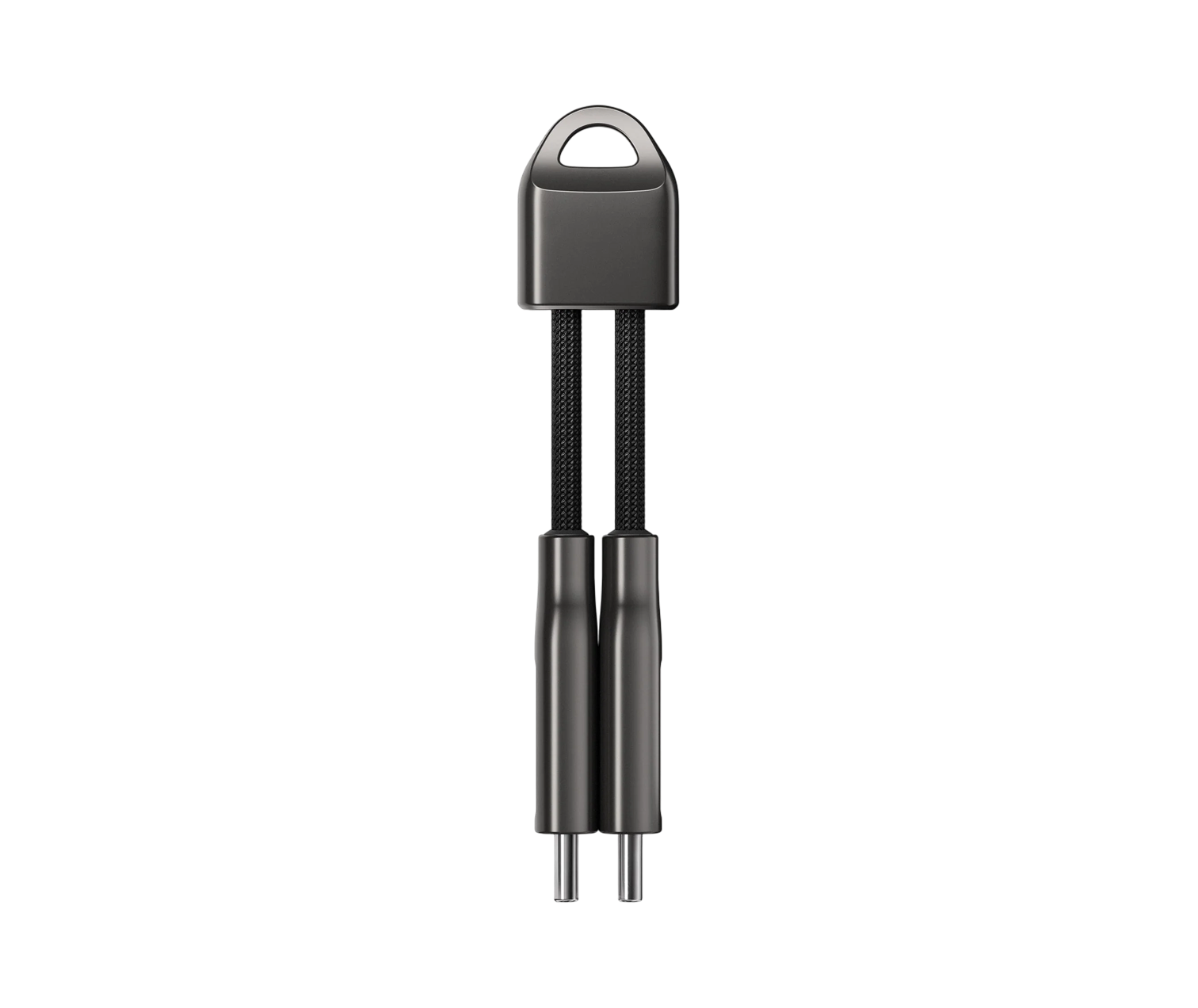
A 12 cm USB-C cable rated for 240 W of charging and 10 Gbps of data, with magnets in the plugs so it closes into a loop.
The version matters. Nomad's first USB-C to USB-C ChargeKey, from 2023, stopped at 60 W and moved data at USB 2.0's 480 Mbps. The ChargeKey 2, launched in February 2025, raised both limits without changing the size. The two look alike in photographs, so check for V2 in the listing before ordering.
Both new numbers have ceilings worth knowing. 240 W is the top of the USB Power Delivery standard, and few devices ask for it; Apple's most demanding laptop, the 16-inch MacBook Pro, takes 140 W. The data speed pays off on an iPhone 15 Pro or a later Pro model, which runs USB 3 at 10 Gbps and can record video straight to an external SSD. The standard iPhones are USB 2, so on those the cable charges at full speed and copies files at the old rate.
The plug housings are zinc, electroplated, with magnets inside. Clipped on, the two ends meet through the keyring and hold each other; pulled apart, it is an ordinary cable with a braided nylon sheath. The usable length is 12 cm, enough to join a laptop and a phone lying next to it on a table and too short to reach a socket from a sofa.
It comes in silver, carbide grey and a limited Stellar Orange, with a two-year warranty. On a set of keys it is the one thing that solves a problem away from home in under a minute, whether that is a flat phone at a friend's desk or a file that needs to move from a phone to a drive. It also charges the tracker in the next section.
- Connectors
- USB-C to USB-C
- Charging
- Up to 240 W
- Data
- Up to 10 Gbps (USB 3.1)
- Usable length
- 12 cm
Specifications as published by the manufacturer. Source
3.Loop – $39
Pros
- Works with either phone system, chosen at setup
- Built-in silicone loop needs no separate holder
Cons
- Switching from Find My to Find Hub means resetting the tag
- No charging cable in the box
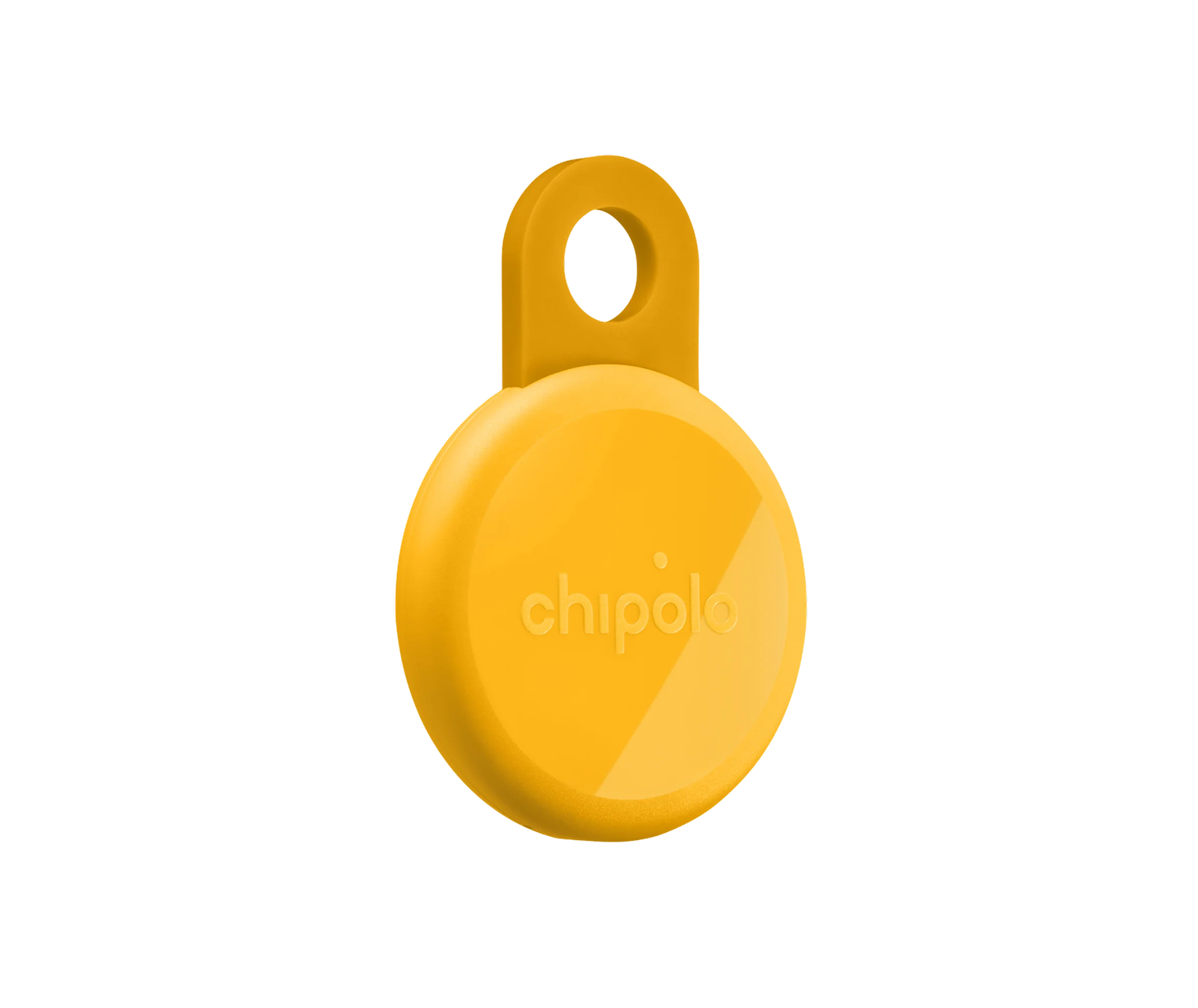
A rechargeable tracker that joins Apple Find My on an iPhone or Google Find Hub on Android, so the same tag suits either phone.
Chipolo makes and assembles the Loop at its headquarters in Slovenia. The network is chosen once, during setup, and the tag uses one at a time. Moving it from an iPhone to an Android phone means resetting it and removing it from the first account, so in a house with both kinds of phone each person needs their own.
The battery charges over USB-C, and its rating has already changed once. At launch in August 2025 Chipolo quoted six months per charge. In April 2026 it raised that to a year, after using the tags for more than a year and finding its lab simulations had been conservative. The announcement credits real-world testing for the new figure and names no hardware change. An AirTag takes a CR2032 coin cell instead, bought and swapped when it runs down. The Loop's level shows in Find My or Find Hub, so the yearly charge does not have to come as a surprise.
Chipolo rates the speaker at about 125 dB; the flat Chipolo Card stops at 110. Bluetooth reaches 120 m on Chipolo's figure, for ringing it from the app when it is close, and beyond that the network of other people's phones does the finding. Its IP67 rating covers 30 minutes in a metre of water. The loop itself is part of the tag, in silicone made without fluorinated chemicals, and it won a Red Dot award in 2025.
On keys it hangs like a soft fob. The silicone stretches over a bag strap or a zip pull as easily as a ring, so there is no holder to buy, and it comes in six colours.
- Network
- Apple Find My or Google Find Hub, one at a time
- Battery
- Rechargeable over USB-C, rated up to 1 year per charge
- Loudness
- About 125 dB
- Water and dust
- IP67, 30 minutes in 1 m of water
- Bluetooth range
- Up to 120 m
Specifications as published by the manufacturer. Source
4.Monarch AirTag Case – $45
Pros
- Four screws keep the AirTag in the case on a thrown bag
- A twist-lock gate cannot be pushed open by a strap rubbing across it
Cons
- Changing the AirTag's coin cell means finding the tool and undoing four screws
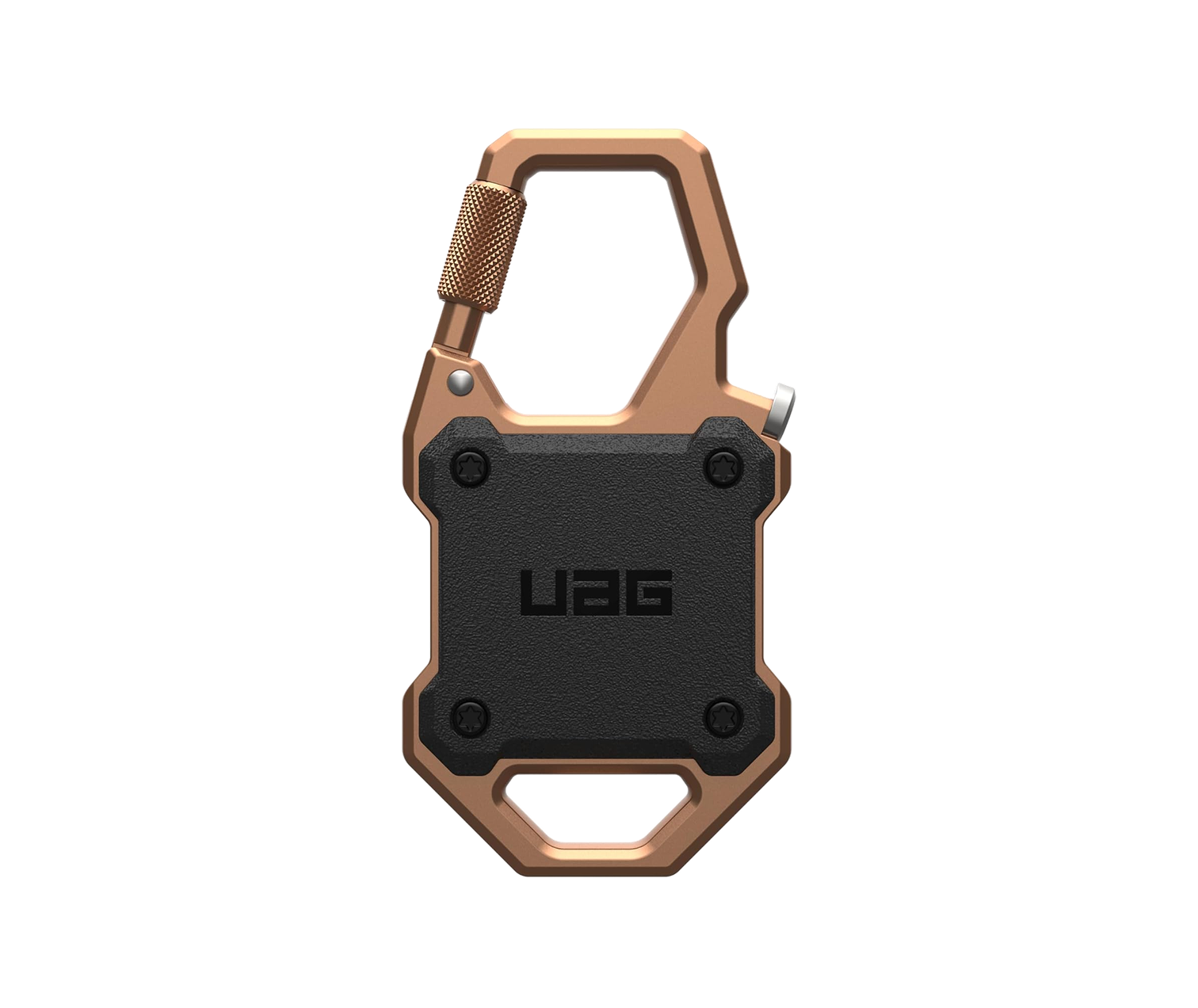
A polycarbonate and aluminium housing for an Apple AirTag, closed with four screws, with a twist-lock carabiner and a bottle opener built in.
An AirTag has no hole of its own, so it always needs a holder, and most are a sleeve of leather or silicone that grips it by the rim. Urban Armor Gear, better known for rugged phone cases, built the Monarch as a sealed enclosure. The AirTag sits in a fitted interior, the halves close over it, and four screws hold them shut. The tool comes in the box; the AirTag does not. UAG describes the closed case as protected against scratches, dust and water.
The screws are the trade. Changing the AirTag's coin cell means finding the tool and opening four of them, where a sleeve stretches off in a second. In return, nothing short of a screwdriver gets the tracker out, which matters on a suitcase handle more than on a keyring.
There are two ways to attach it. A heavy-duty twist-lock carabiner clips it to luggage, backpack loops and outdoor gear. A twist lock needs a turn before the gate will open, so a strap rubbing across it cannot push it free, which is how a plain spring gate lets go of a bag. At the bottom of the case, a key ring attachment takes a set of keys. The bottle opener is steel-reinforced, the only steel in a case otherwise built of plastic and aluminium.
It suits a checked bag, a duffel or a bike pannier as much as a set of house keys, and it takes the throwing around those get. Pocket-sized everyday carry explains how every passing iPhone finds the AirTag inside.
- Fits
- Apple AirTag, not included
- Materials
- Polycarbonate and aluminium
- Closure
- Four screws, tool included
- Attachments
- Twist-lock carabiner and key ring attachment
Specifications as published by the manufacturer. Source
5.The Hardin – $39

Pros
- Keys sit in a gateless lower compartment, so unclipping never frees them
- Takes a large set of keys out of the pocket and onto a belt loop
Cons
- Not made for climbing, and The James Brand publishes no strength rating
A drop-forged aluminium carabiner split into two compartments, so the keys stay put when the gate opens.
Most key carabiners have one space inside. Open the gate to unclip it from a belt loop and the keys can slide out through the same gap. The James Brand divides the Hardin in two. The upper compartment sits behind a spring-loaded gate and goes over the belt loop or bag strap. The lower one holds the keys and has no gate at all, so clipping and unclipping never touches them. Its tapered shape keeps the bunch centred under the clip.
It is drop-forged from 6063 aluminium and anodised. Forging presses hot metal into a die, so the grain of the metal follows the curve of the part; a carabiner cut from flat plate keeps the plate's straight grain across its bends. The anodising is a hard oxide grown on the surface, which is how the colour stays on through years of keys rubbing against it. A titanium keyring comes with it for threading the keys.
The James Brand pitches it as the replacement for "that overbuilt climbing carabiner on your hip". It carries keys and everyday kit, and it is not made for climbing or for any load beyond that; The James Brand publishes no strength rating.
The belt loop decides it. A large set of keys hung outside the trousers stops pulling a pocket out of shape, and the keys are in reach without a hand going into a pocket. The maker lists nine colourways, from plain black and silver to two-tone pairings such as Sea Wave with Cerulean.
- Material
- Drop-forged 6063 aluminium, anodised
- Design
- Two compartments, spring-loaded gate
- Included
- Titanium keyring
Specifications as published by the manufacturer. Source
6.Keycase – $75

Pros
- Keys pressed between plates have no room to rattle
- A tension plate holds two keys as firmly as six
Cons
- Car keys with plastic heads and fobs do not fold in and hang on an outside ring
- Six keys is the ceiling
A folding case that holds two to six keys between metal plates, opening one at a time like a pocket knife.
Ridge, best known for its metal wallets, makes the Keycase from the same 6061-T6 aluminium. The keys stack on a post between two side plates, and a tension plate lets the stack grow from two keys to six while holding each one with the same grip. Swing one out to use it, fold it back, and the rest stay closed. Pressed together between plates, the keys have no room to rattle against each other.
It ships with a bolt tool for loading keys and two key rings, and the pocket clip is manganese spring steel, the kind used for flat springs that have to return to shape. Ridge covers the whole case with a lifetime warranty.
Fitting the keys is the part to plan for. A key folds in only if its head is flat enough to sit between the plates, so a car key with a plastic head or a remote fob goes on one of the rings outside the case. Ridge also sells a hanging AirTag holder as an add-on, which goes on the same ring.
Six keys is the ceiling. A bigger bunch splits between the case and one of its rings, or moves to the Orbitkey at the top of this page, which takes up to ten. Kept to six, it closes to a single bar of metal just under 3 inches long.
- Capacity
- 2 to 6 keys
- Material
- 6061-T6 aluminium
- Included
- Bolt tool and 2 key rings
- Warranty
- Lifetime
Specifications as published by the manufacturer. Source
What to weigh up before buying
Find My or Find Hub
Trackers find things through other people's phones. An AirTag uses only Apple's Find My network, so it works with an iPhone and no Android phone. The Chipolo Loop works with either, but one at a time, chosen at setup. The question to ask is whose phone is doing the finding, and whether it might change in the life of the tag.
A coin cell or a charging port
A coin cell needs no cable and gets replaced; a rechargeable tag needs a cable and never needs buying again. The AirTag in the Monarch takes a CR2032 behind four screws. The Loop charges over USB-C once a year on Chipolo's current rating. Neither is the free option: one costs a small battery, the other a reminder.
What a keyring cable can carry
Two numbers decide a short cable. Wattage sets how fast a laptop charges, and the USB data standard sets how fast files move. Most keyring cables are USB 2.0, at 480 Mbps, which is fine for a phone backup and slow for video. The ChargeKey 2 runs at 10 Gbps, but only when both ends support USB 3, which on an iPhone means a Pro model from the 15 onwards.
How many keys, and what shape
Count the keys first. The Ring V2 takes up to ten, the Keycase two to six, and the Hardin as many as its titanium ring will hold. Then look at the heads: flat metal keys fold into a case, and car keys and fobs do not, which is why every organiser here also carries a ring on the outside.
The short version
The ring and the carabiner change how keys go on and come off. The case changes how they sit in a pocket. The tracker and the AirTag housing are for finding them, on whichever phone is doing the looking. The cable is the one thing here that does a job away from the keys entirely. Most sets need two of the six, and the right two depend on whether the keys live in a pocket or on a belt.
How we chose
We chose six things that live on a keyring and each do a different job there: hold the keys, organise them, clip them on, find them, protect a tracker, and charge something. Every figure on this page was checked against the maker's page and one other independent source, a review, a launch report or an authorised retailer. Where the two disagreed, we left the number out: Ridge lists the Keycase at two different sizes on two of its own regional sites, and The James Brand publishes no dimensions for the Hardin. There is no comparison table, because a cable's wattage and a key case's capacity measure different things and a table would line up numbers that do not compare.
Common questions
Yes, but with one at a time. During setup it joins Apple Find My on an iPhone or Google Find Hub on Android. Moving it to the other system means resetting the tag and removing it from the first account.
Chipolo rates it at up to a year per charge. At launch in August 2025 the rating was six months; in April 2026 Chipolo doubled it after more than a year of real-world use. It charges over USB-C, and no cable comes in the box.
It is rated for up to 240 W, the top of the USB Power Delivery standard and more than the 140 W the 16-inch MacBook Pro draws. It also moves data at up to 10 Gbps, which an iPhone 15 Pro or later Pro model can use. The earlier USB-C ChargeKey stopped at 60 W and 480 Mbps.
Two to six. Keys need flat heads to fold between the plates, so a car key with a plastic head or a fob goes on one of the two included rings outside the case.
No. It is a case for an Apple AirTag bought separately. The case closes with four screws and includes the tool to open them, which is needed whenever the AirTag's coin cell is changed.
About the author

Justin Farrugia
Founder & Editor of Curated Supply
Justin Farrugia is the founder and editor of Curated Supply, a design-led directory to things worth owning. He has personally curated over 1,000 products across workspace, carry, coffee, audio, and the home, each judged against one standard: design intent, material quality, and the restraint that lets a thing last.


