About
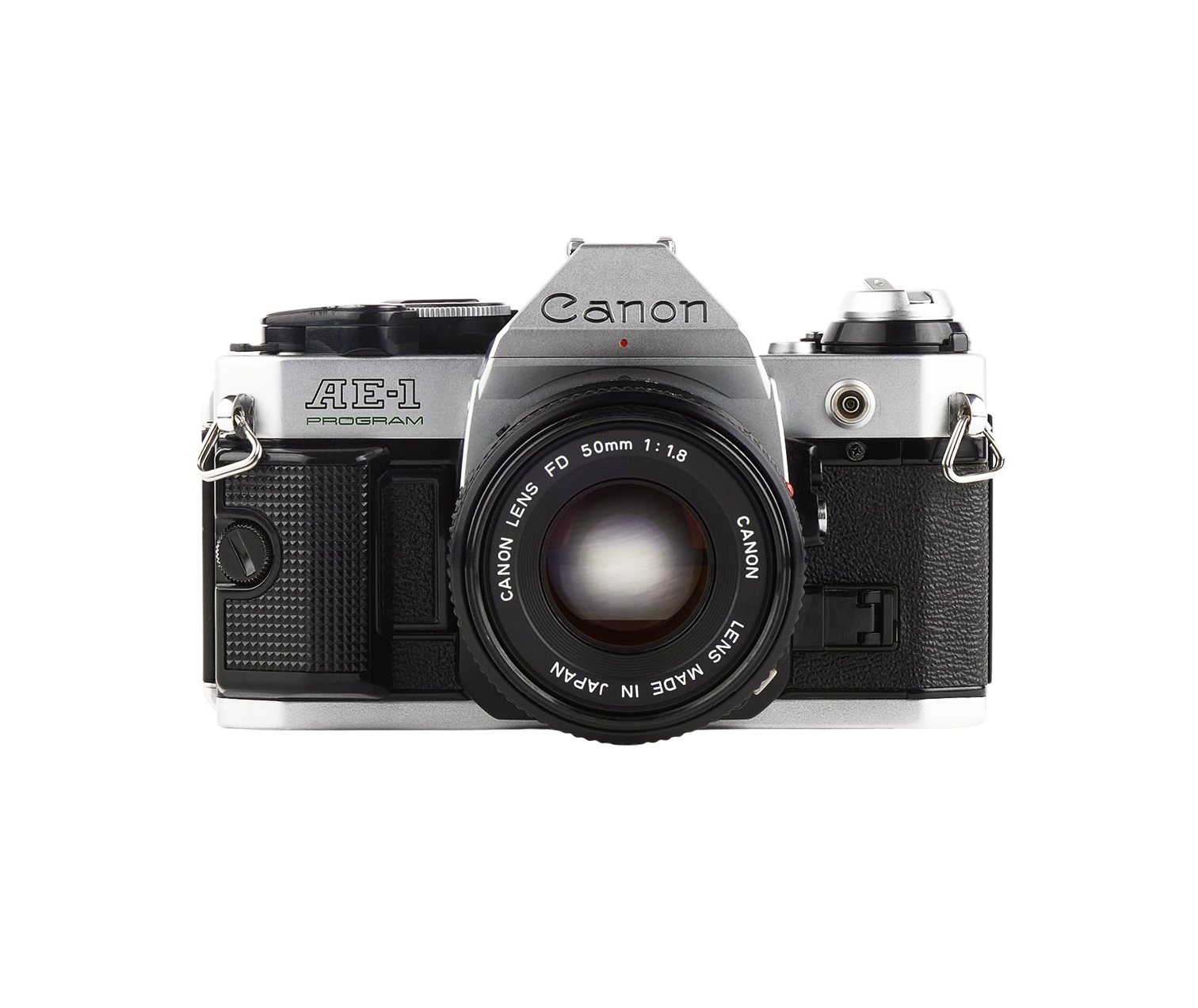
The Canon AE-1 has 300 fewer parts than it would have done without electronics. Canon introduced the 35mm SLR in April 1976 and designed it from the ground up as five major units and twenty-five minor units, all centrally controlled by a microcomputer. Manufacturing was also highly automated.
The ordinary mechanical SLR of the period timed its shutter with springs and gears. The AE-1 keeps cloth curtains, in a four-axis, horizontal-travel focal-plane shutter, but every speed is controlled electronically. The range runs from 1/1000 sec down to 2 sec, with B, X and a built-in self-timer. That is why the camera needs a battery to fire at all: either one 4G-13 6 V mercury oxide cell or a 4LR44 alkaline.
The same electronics do the metering. Through the FD lens mount, the AE-1 reads light TTL at full aperture, centre-weighted and averaged. In shutter speed-priority AE, the photographer sets the speed and the camera chooses the aperture. Stopped-down match-needle manual metering is the alternative. At ISO 100 and f/1.4 the meter works from EV 1 to EV 18, film speeds run from ISO 25 to 3200, and exposure compensation reaches +1.5 EV.
The Canon AE-1 is a 35mm SLR that pairs a cloth-curtain shutter with fully electronic speed control and shutter speed-priority auto exposure.
Everything else stays hands-on. The fixed eye-level pentaprism shows 0.86x magnification, a camera-top lever advances the film through a 120° stroke, and a camera-top crank rewinds it. A computer sits in the body, yet the film still moves by thumb.