About
The Bauhaus ran for fourteen years and then closed. That is shorter than most art schools take to settle on a timetable, and yet it turns up in the history of painting, sculpture, design, architecture, film, photography, textiles, ceramics, theatre and installation alike.
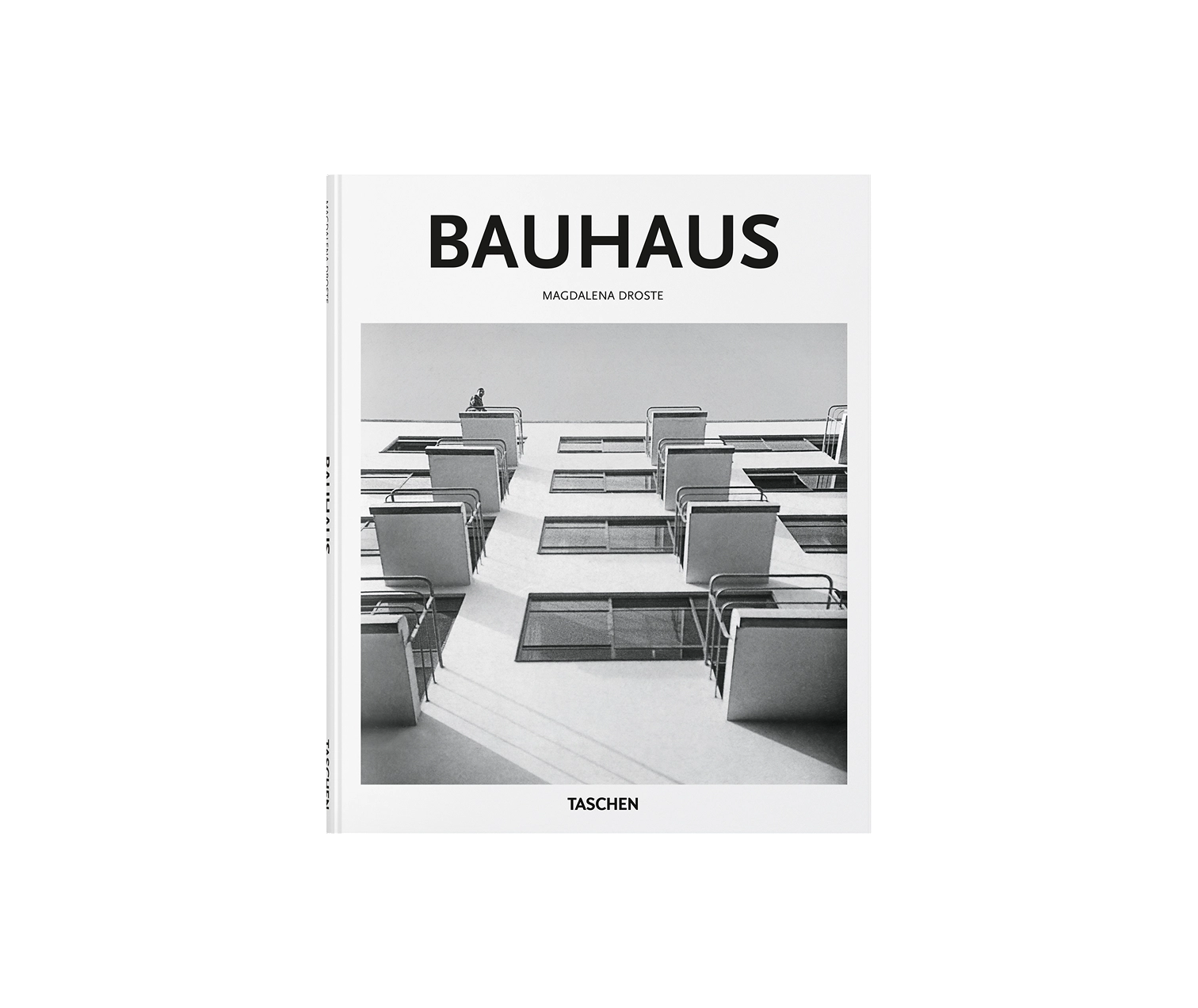
Taschen's Bauhaus is Magdalena Droste's 96 page account of how one small school managed that, and Droste is the right person to ask: she worked at the Bauhaus-Archiv in Berlin from 1980 and then taught art history at BTU Cottbus. Walter Gropius founded the school on the idea that fine art, craftsmanship and technology belonged in the same building, which explains the spread. Squeezed between two world wars, it moved twice, from Weimar to Dessau to Berlin. The staff and student list reads like an index of modernism: Josef and Anni Albers, Wassily Kandinsky, Paul Klee, Oskar Schlemmer, Gunta Stölzl, Marianne Brandt and Ludwig Mies van der Rohe all passed through. Droste follows two threads at once, the Bauhaus as a trailblazer of modern design and the Bauhaus as a way of teaching art, with teachers and students trading ideas across media in pursuit of a total work of art.
The book sits in Taschen's Basic Art series, begun in 1985 and described by the publisher as the best selling art book collection ever published. Peter Gössel edited it; he also edits Taschen's Basic Architecture titles and wrote its monographs on Julius Shulman, R. M. Schindler, John Lautner and Richard Neutra. The English edition is one of five, alongside German, Spanish, French and Italian.
- Published in
- Germany

- Author
- Magdalena Droste
- Publisher
- Taschen
- Materials
- Size
- 96 pages, hardcover
- Dimensions
- 21 × 26 cm
- Weight
- 0.56 kg
Figures as published by the manufacturer. Source