About
A screen bright enough for HDR is usually a screen on a timer. Push a single OLED layer hard enough to hold peak brightness across its whole surface and it degrades, which is why most tablets quote a small bright window rather than a bright picture.
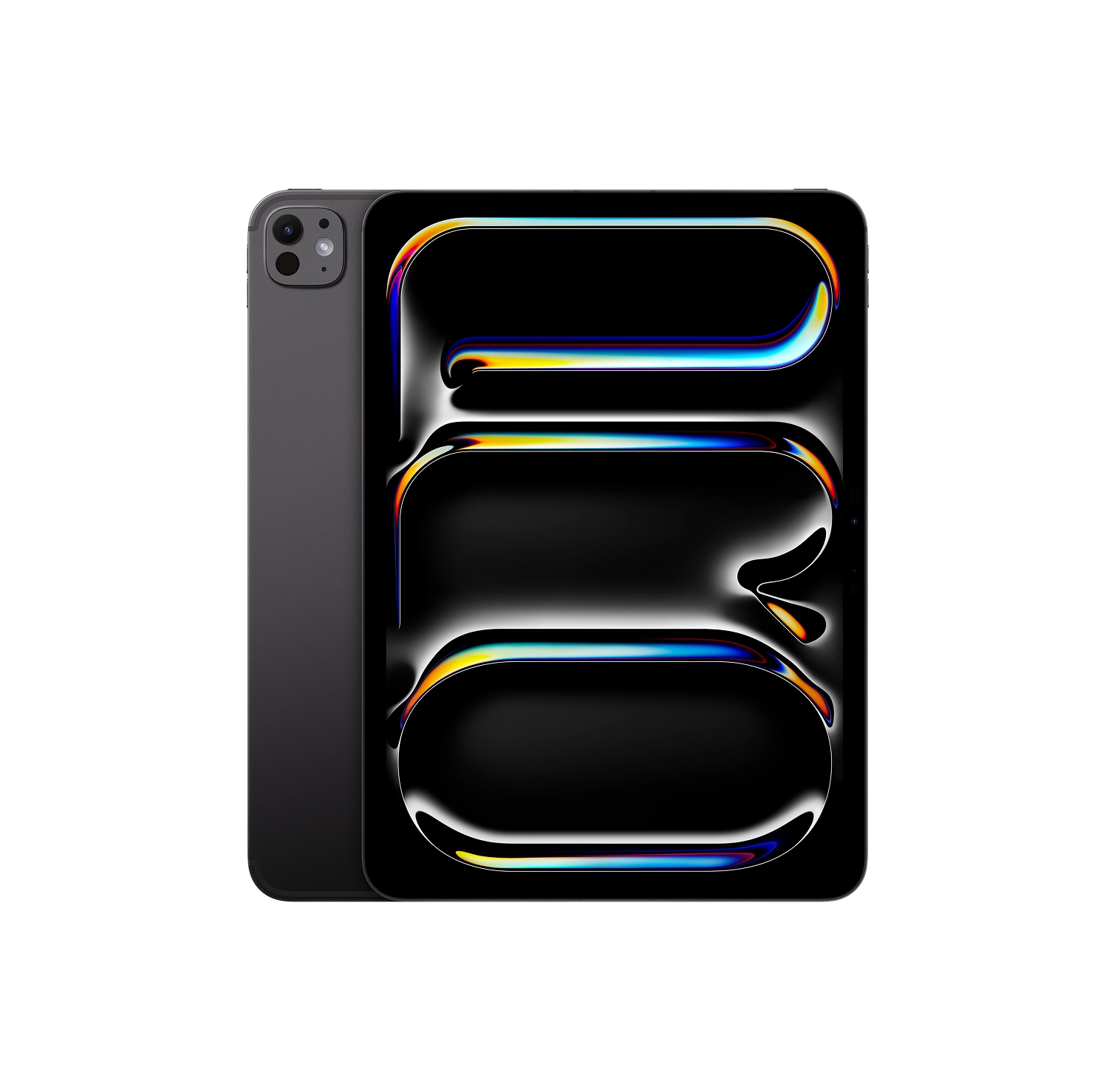
Apple's 11-inch iPad Pro gets around that with tandem OLED: two OLED panels stacked and driven as one, sharing the load so the display holds 1,000 nits across the full screen and peaks at 1,600 nits on HDR content. Contrast is quoted at 2,000,000 to 1, which is less a specification than a description of how OLED works, since the black pixels are simply switched off. ProMotion slides the refresh rate anywhere between 10 and 120 Hz depending on what is actually moving. Behind the panel, the M5 chip carries a 10-core GPU with a Neural Accelerator in every core, 153 GB per second of memory bandwidth, and 12 GB of unified memory on the 256 GB and 512 GB versions.
The radios are Apple's own silicon now too. An N1 chip runs Wi-Fi 7, Bluetooth 6 and Thread, and a second generation C1X modem handles 5G. Around them sits a body 5.3 millimetres thick that weighs 444 grams on the Wi-Fi model, with one Thunderbolt port, Face ID, a LiDAR scanner, a 12MP camera on each face and four speakers.
The enclosure is 100 percent recycled aluminium, every magnet uses 100 percent recycled rare earth elements, and the packaging is entirely fibre based. Nano-texture glass, etched at the nanometre scale to cut reflections, is the one option the storage tier decides for you: it can only be had on the 1 TB and 2 TB models.
- Designed in
- United States

- Awards
- Display
- 11-inch tandem OLED, 2420 x 1668 at 264 ppi, 10 to 120 Hz
- Storage
- 256GB, 512GB, 1TB or 2TB
- Battery
- 31.29 Wh, up to 10 hours browsing on Wi-Fi
- Fast charge
- Up to 50% in around 30 minutes with a 60W or higher USB-C adapter
- Material
- Thickness
- 5.3 mm


Figures as published by the manufacturer. Source