Staff Pick
About
Turbo lag is the tax every turbocharged car pays: exhaust gas has to build before the turbine will spin, and the gap between your right foot and the shove is the bill. Porsche has stopped paying it. There is now an electric motor inside each turbocharger.
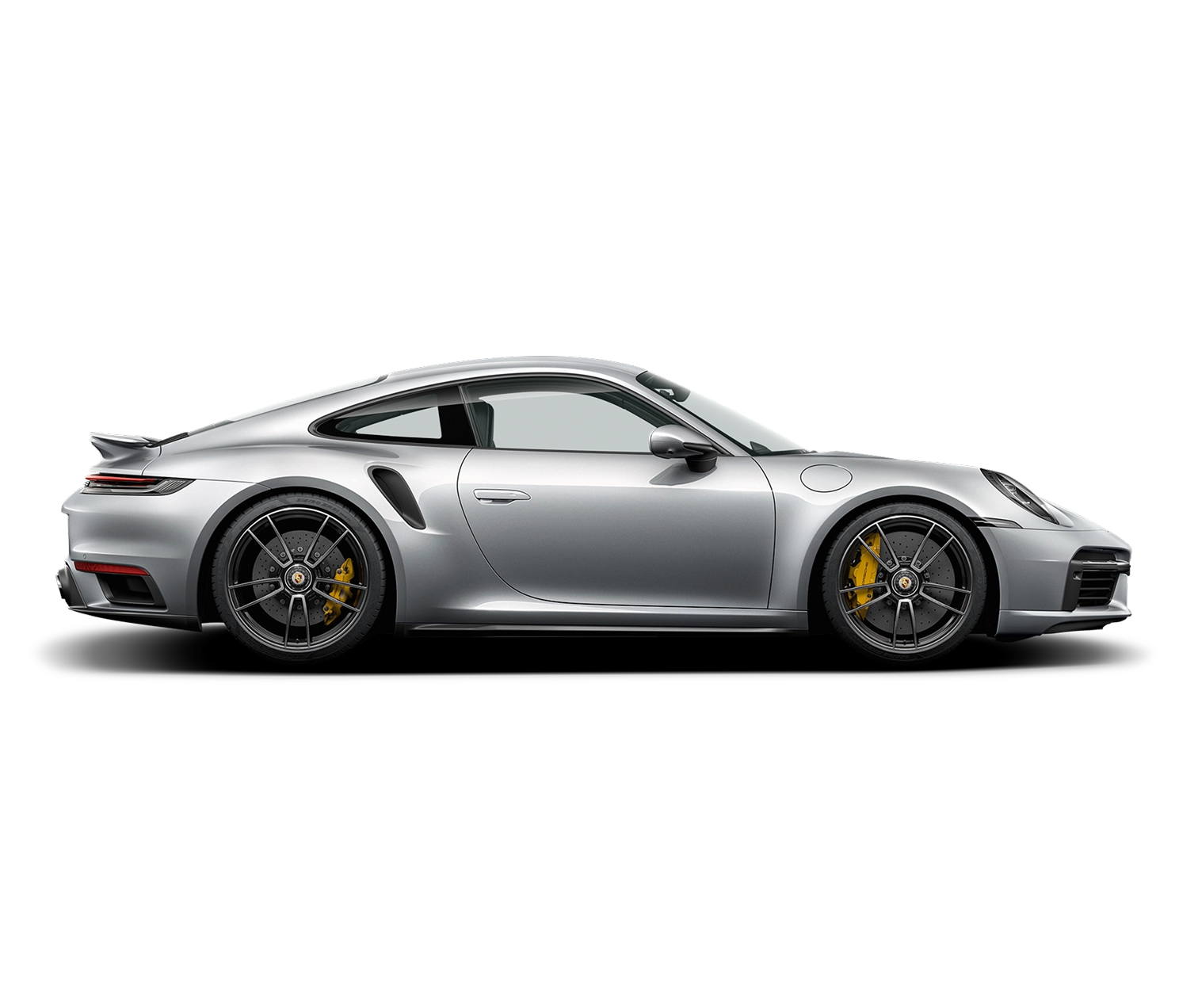
The Porsche 911 Turbo S makes 701 hp from a 3.6 litre flat six whose two turbochargers carry electric motors on their shafts, which makes it the most powerful production 911 the company has built. Each eTurbo sits its motor between turbine and compressor, spinning the shaft up before the exhaust arrives, then reversing into a generator once boost is covered so the same rotation harvests energy back. That electricity goes into a 1.9 kWh, 400 volt battery, or straight to a third motor built into the eight speed PDK gearbox. So the torque arrives early and stays: 590 lb ft held flat from 2,300 to 6,000 rpm, 60 mph in 2.4 seconds, 200 mph at the top.
The bodywork works just as hard in the other direction. Cooling flaps in the nose, an active front diffuser and spoiler, and a rear wing that extends and tilts cut drag by up to 10 per cent whenever downforce is not needed. Behind the wheels sit carbon ceramic brakes, 420 millimetre discs in front and 410 behind, the largest Porsche has ever fitted to a two door model. The titanium sport exhaust is standard rather than an option box.
The number that matters most is a lap. Around the Nürburgring Nordschleife the car runs 7 minutes 3.92 seconds, roughly 14 seconds quicker than the previous Turbo S, which at this level is an enormous margin. US deliveries begin in spring 2026.
- Designed & made in
- Germany

- Capacity
- 3.6 litre flat six, twin eTurbo
- Battery
- 1.9 kWh, 400 volt hybrid system
- Weight
- 3,829 lb curb weight
- Movement
- Eight speed PDK with integrated motor
- Sizes
- Coupé or Cabriolet
Figures as published by the manufacturer. Source