The best pens worth buying, three of them from the 1960s
Five pens worth buying and refilling for decades, from a $5 Muji aluminium body to the Lamy 2000, a 1966 design still made without a single change.
Three of the five pens here date from between 1966 and 1969, and all three are still in production without meaningful changes. Nothing else on this site can say that. A chair gets restyled, a camera gets replaced every eighteen months, and a pen that was right in 1966 is still right.
What they have in common is that the body is permanent and the ink is not. You buy the object once and feed it for years, and that is why a $5 pen and a $279 one belong on the same page: both are chassis, and the refill is the consumable. If the rest of the desk needs attention, that is in items for your next desk setup.
1.Muji Ballpoint Pen Knock Aluminium
Pros
- Aluminium body and tip at a price most people pay for a disposable
- Takes any refill in Muji's gel range, in three widths
- About 10 g, the lightest here by more than half
- No branding, no trim, nothing to date it
Cons
- Sold as a body only, so the refill is a separate purchase
- The knock mechanism feels its price, and there is no weight to the pen at all
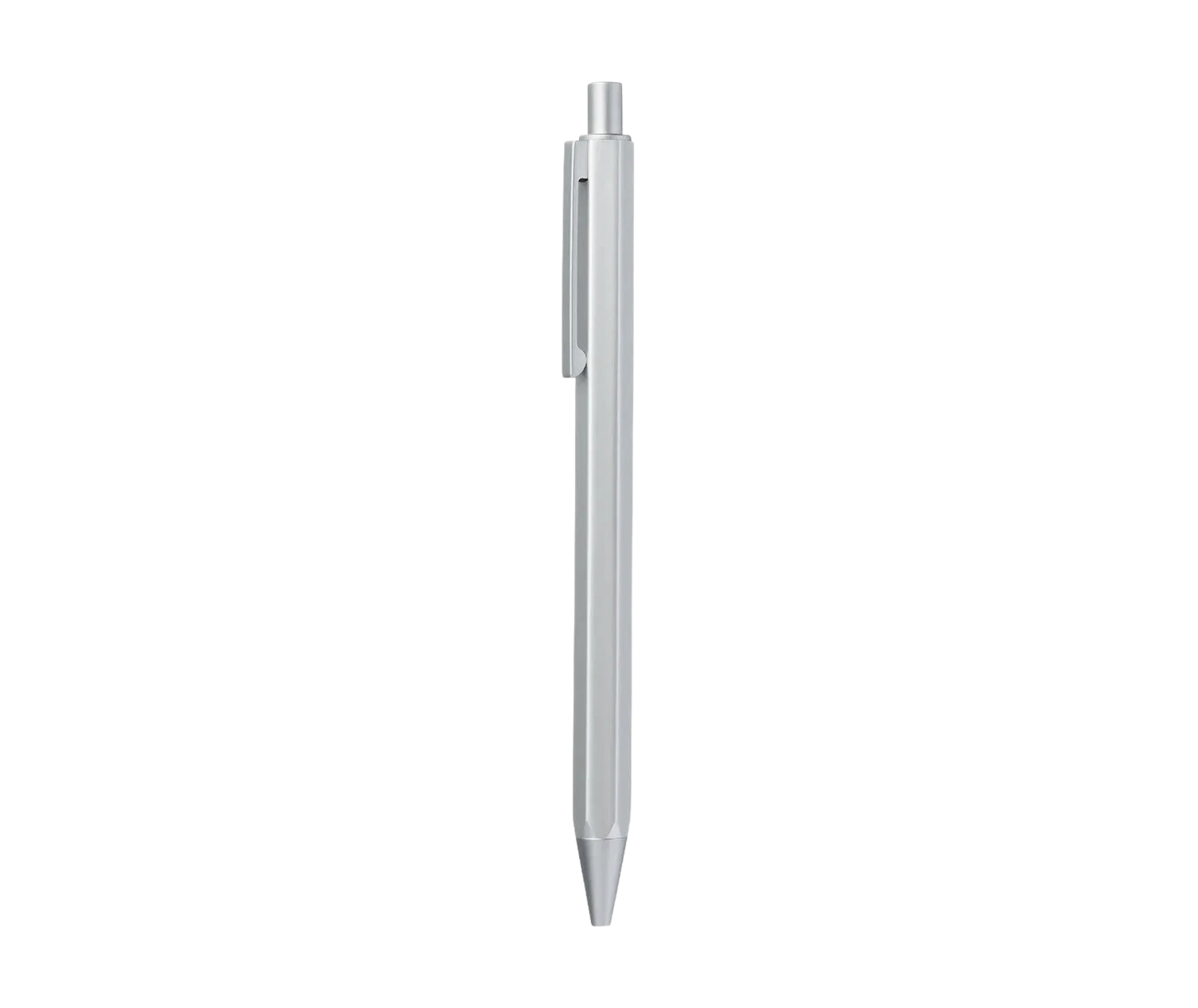
Muji sells this as a body with no ink in it, which tells you exactly what they think you are buying.
The aluminium knock body is 100% aluminium, including the tip, with a steel spring and screw inside. It weighs about 10 grams. There is no branding, no colour and no trim, and at five dollars there is no argument to have about any of it.
Sold empty is the interesting part. Muji treats the refill as a separate purchase from the same shelf, and any pen in their gel range fits: 0.38, 0.5 or 0.7 millimetre, in whichever colour. The chassis outlives dozens of them.
That approach makes a five dollar pen worth writing about. A disposable pen is a body you throw away when the ink stops, and the ink is most of what you paid for. This inverts it. The aluminium lasts indefinitely and the running cost is a refill roughly the price of a coffee, ordered from the same place every time.
The limits are honest ones. The knock is plastic-sounding, the clip is thin, and there is no weight to it, which some people want in a pen and others cannot stand. Ten grams is the lightest thing here by a factor of two.
- Body
- 100% aluminium body and tip, steel spring
- Weight
- Approx. 10 g
- Mechanism
- Knock, retractable
- Refill
- Any Muji gel refill, 0.38, 0.5 or 0.7 mm, sold separately
- Ink
- Gel
Specifications as published by the manufacturer. Source
2.Fisher Space Pen Bullet
Pros
- Writes at any angle, underwater and over grease, because the cartridge is pressurised
- 3.75 inches closed, short enough to disappear into a coin pocket
- Posts out to 5.25 inches, so it writes like a full-sized pen
- In the permanent collection of the Museum of Modern Art, and unchanged since 1966
Cons
- Pressurised ink lays a heavier, draggier line than gel
- The cap has to go somewhere while you write, and posting it is the only answer
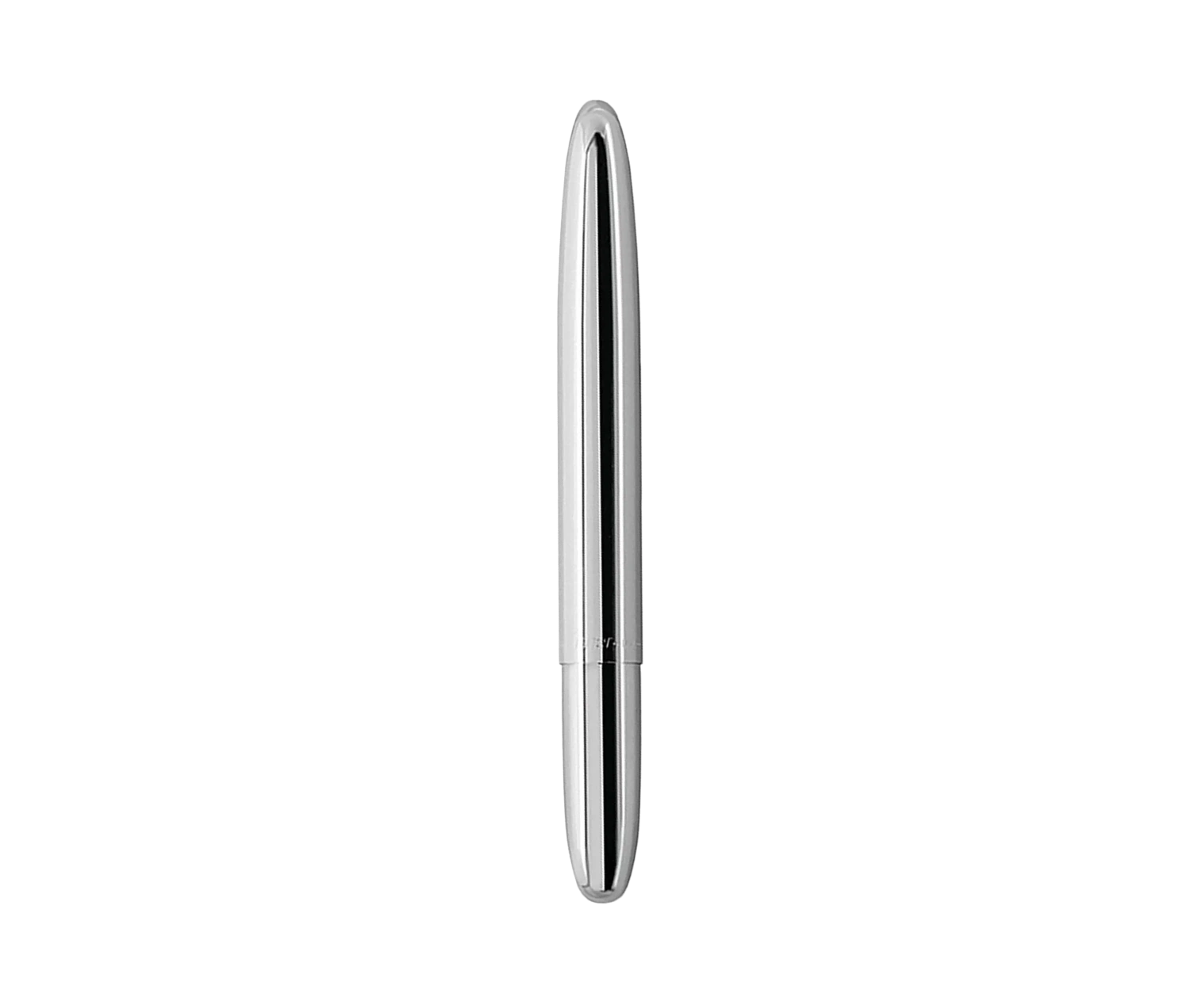
The cartridge carries its own pressure, so gravity has nothing to do with whether it writes.
Every other pen on this page relies on gravity pulling ink toward the tip. The Bullet pushes instead. Nitrogen at 45 psi sits behind a thixotropic ink, a fluid that stays solid until the rolling ball shears it into liquid, so the pen writes upside down, underwater, over grease and at any angle at all.
The working range runs from -30°F to +250°F. Fisher had the design ready in 1966 and it first left the atmosphere aboard Apollo 7, and the shape has not changed since. It is in the permanent collection of the Museum of Modern Art, which is not a claim many pocket tools can make.
Closed it measures 3.75 inches, which is short enough to disappear into a coin pocket. Posted, the cap goes on the back and it opens out to 5.25 inches, so it writes like a full-sized pen. Those two numbers together are the entire product.
The compromise is the ink. Pressurised ballpoint ink is thicker than gel and lays down a slightly heavier, slightly draggier line, and no amount of engineering fixes that. You are trading the way it writes for the certainty that it will.
- Refill
- Fisher pressurised cartridge, 45 psi nitrogen
- Ink
- Thixotropic pressurised ballpoint
- Mechanism
- Cap, posts to the barrel to extend
- Length
- 3.75 in closed, 5.25 in posted
- Range
- -30°F to +250°F, any angle, underwater
Specifications as published by the manufacturer. Source
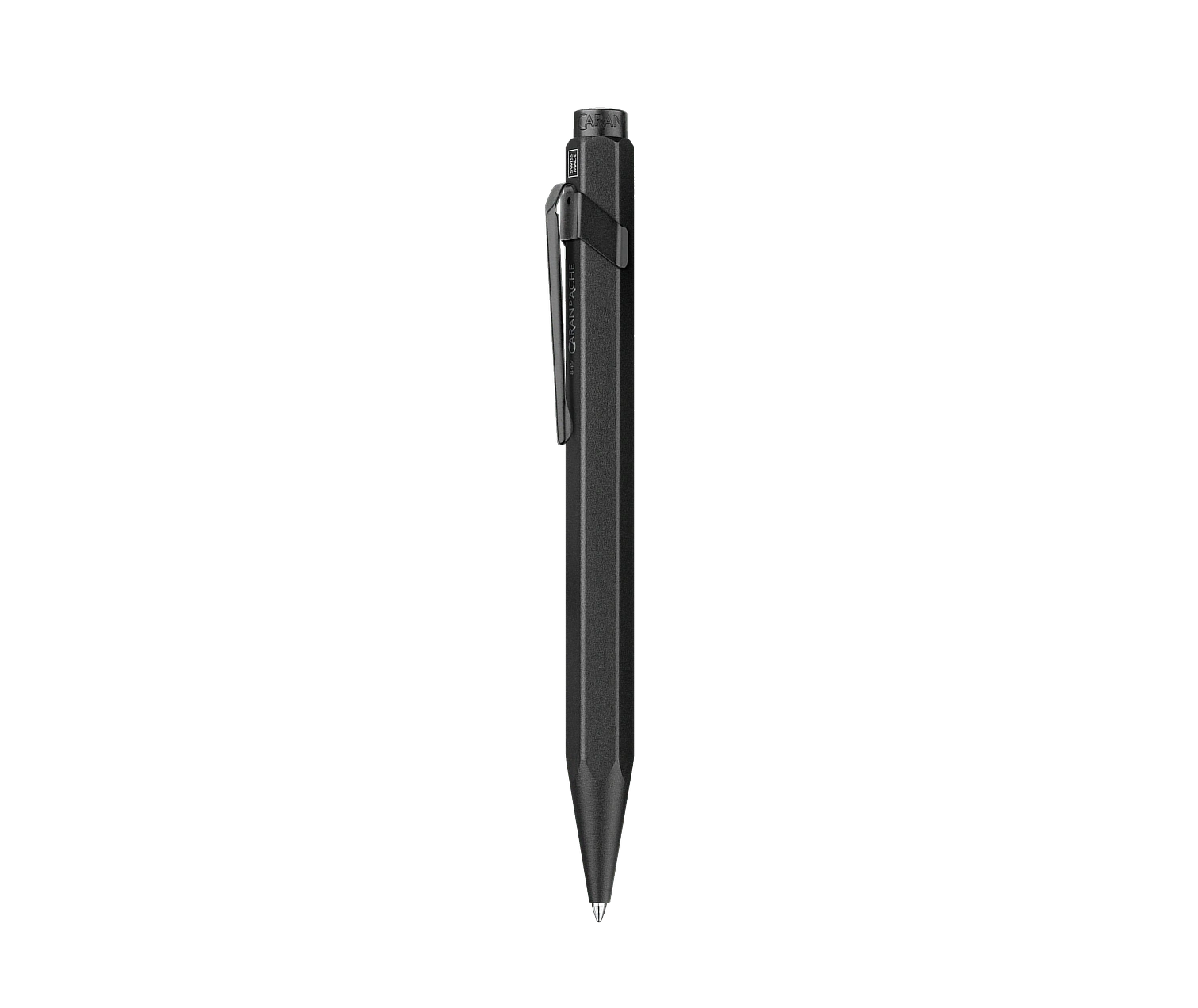
3.Caran d'Ache 849 Black Code
Pros
- One Goliath refill covers roughly 600 A4 pages, so the running cost disappears
- Hexagonal barrel sits like a pencil and will not roll off a sloped desk
- Still made in Geneva, with the same profile since 1969
- A firmer, quieter click mechanism than the price suggests
Cons
- Ten times the Muji for the same basic arrangement, executed better
- Aluminium picks up marks on the flats over time
One Goliath refill covers about 600 A4 pages, or roughly eight kilometres of line.
That figure reframes the price. Fifty dollars for a pen sounds like a lot until the refill inside it writes eight thousand metres, which is several years of ordinary use for most people and puts the running cost somewhere below negligible.
The 849 arrived in 1969 and has kept the same hexagonal aluminium barrel since. Hexagonal is a functional choice before an aesthetic one: the flats give a pencil's grip, and nothing hexagonal rolls off a sloped surface. Caran d'Ache still makes them in Geneva, and the Black Code version drops the chrome for matte black throughout.
The clicking mechanism is the other thing people mention. It is firmer and quieter than the price suggests, which matters on an object you operate several hundred times a week without thinking.
Against the Muji it is ten times the money for a similar idea, executed properly. Against the Grovemade below it is half the money and half the weight. The middle of the page in every sense, and the one most people would be glad to receive.
- Body
- Hexagonal aluminium, Swiss made
- Introduced
- 1969, unchanged in profile since
- Mechanism
- Push-button click
- Refill
- Goliath, approx. 600 A4 pages or 8,000 m of line
- Ink
- Ballpoint
Specifications as published by the manufacturer. Source
4.Grovemade Desk Pen
Pros
- Three flats stop it rolling off a desk that is not level
- Takes a standard Schmidt P8126, not a proprietary refill
- Machined from one piece of aluminium, so there are no joints to loosen
- Sold with an optional walnut or maple stand
Cons
- Solid metal makes it the heaviest here, which suits a desk and tires a pocket
- A twist mechanism is slower than a knock when you are writing in bursts
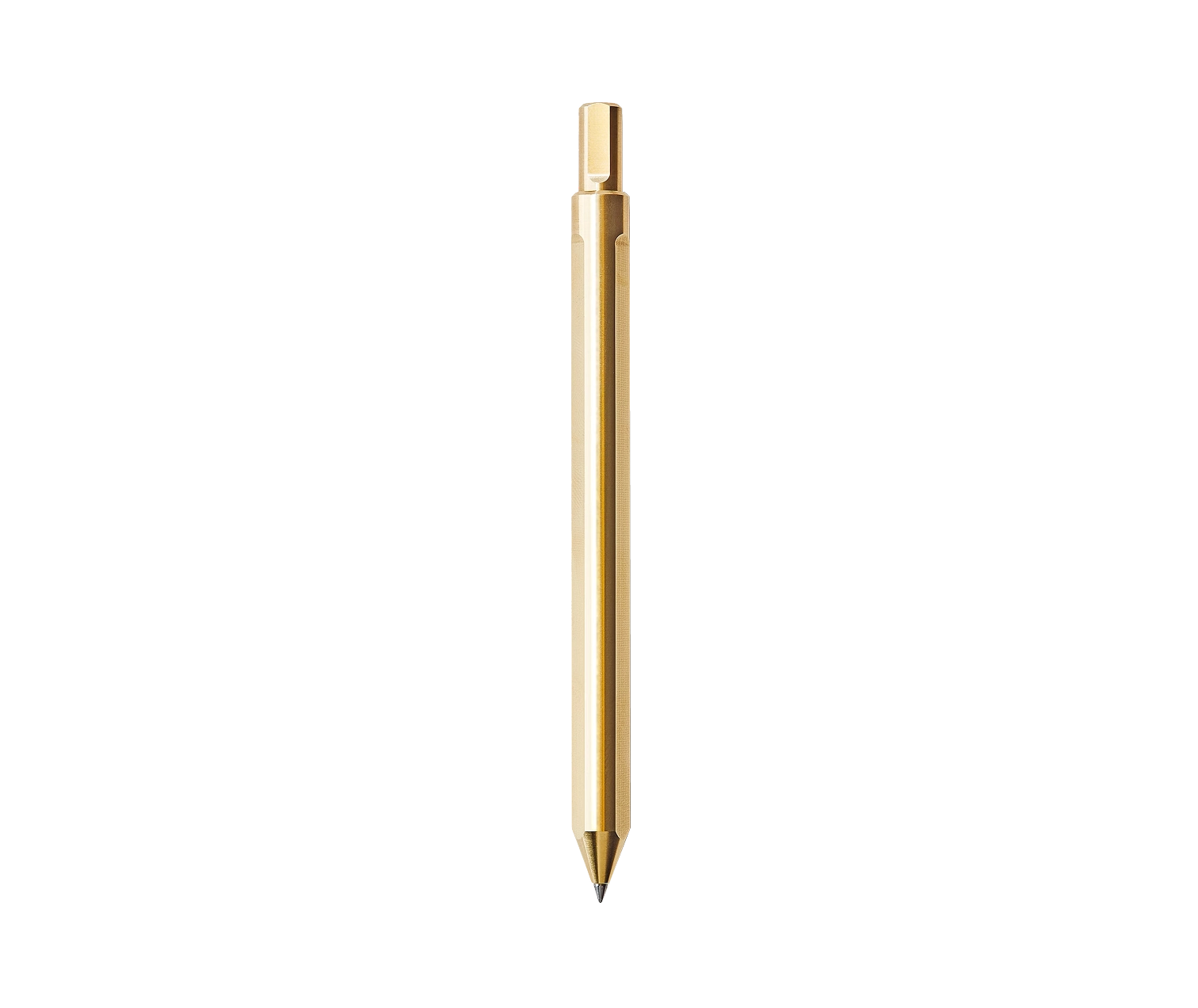
Three flat facets down the barrel, so it will not roll off a desk that is not quite level.
Almost no desk is level, and almost every round pen eventually finds that out. Grovemade machined the Desk Pen from one piece of solid aluminium with a trilobe profile, which solves the rolling and gives a slimmer grip than a round barrel of the same volume. An anodised finish, and the whole thing cut in the Portland area.
The refill is a Schmidt P8126 rollerball at 0.6 millimetres, a standard part and not a proprietary one. That matters more than it sounds: a pen tied to a refill only its maker sells is a pen with an expiry date attached to that company.
Weight is the point of difference. Solid metal gives it noticeably more mass than anything above it here, and a heavy pen is pleasant on a desk and tiring in a pocket. Grovemade know this, which is why it is sold with an optional walnut or maple stand and called a desk pen rather than a pen.
Buy it for a desk you sit at. It is the wrong object for a jacket, and it is the only pen on this page that is honest about being furniture as much as a tool.
- Body
- Single piece of solid aluminium, anodised, trilobe profile
- Mechanism
- Twist
- Refill
- Schmidt P8126 rollerball, 0.6 mm
- Ink
- Rollerball
- Made
- Machined in the Portland area
Specifications as published by the manufacturer. Source
5.Lamy 2000 Fountain Pen
Pros
- Sixty years in continuous production, so parts and repairers both exist
- A piston filler takes bottled ink, the cheapest refill on this page per page written
- The hooded nib slows evaporation when the pen is left uncapped
- Makrolon and steel joined closely enough that the seam takes effort to find
Cons
- Bottled ink, occasional flushing and the habit of capping it are all required
- Fine or medium only, with no other nib widths offered
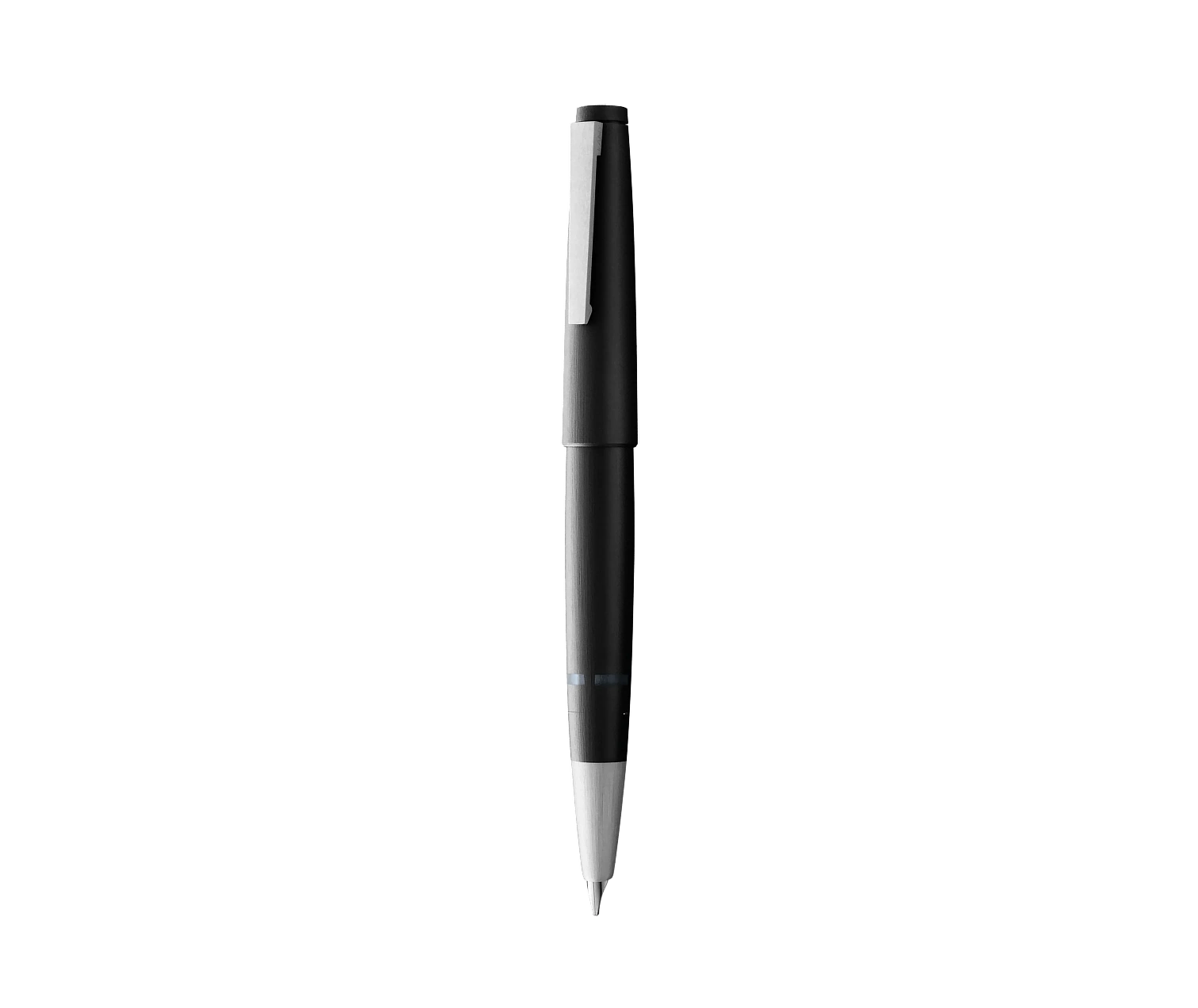
Gerd A. Müller drew it in 1966 and Lamy has changed nothing, which after sixty years stops being conservatism and starts being evidence.
The 2000 is Makrolon, a polycarbonate, brushed along its length and joined to stainless steel so precisely that finding the seam takes effort. That single detail is what the money buys and what photographs never convey.
The nib is 14 carat gold with a platinum coating, and hooded, so the body shrouds all but the tip. Hooding was a practical decision: less exposed metal means less evaporation, so the pen is slower to dry out when someone leaves it uncapped on a Friday. It comes in fine or medium and nothing else, which is Lamy declining to invent a choice nobody needed.
It fills by piston. Unscrew the back, draw ink up through the nib from a bottle, and carry on: no cartridges, no proprietary consumable, and a far larger capacity than any cartridge system. Closed it is 13.8 centimetres, posted 15.2, and it weighs 25 grams.
Sixty years of continuous production is the specification that matters. Parts exist, every repairer knows it, and the design has survived every trend that arrived after it.
- Body
- Brushed Makrolon polycarbonate and stainless steel
- Design
- Gerd A. Müller, 1966, in production ever since
- Nib
- 14 carat gold, platinum coated, hooded, fine or medium
- Mechanism
- Cap, piston filler
- Refill
- Bottled ink, drawn through the nib
- Ink
- Fountain
- Size
- 13.8 cm closed, 15.2 cm posted, 25 g
Specifications as published by the manufacturer. Source
What to consider before buying a pen
The refill decides the running cost, and sometimes the lifespan
Four of these five take a refill you can buy from more than one source, and the Lamy takes bottled ink, which is the cheapest of all per page. A pen locked to a proprietary refill is only as serviceable as the company that makes it. Check what goes inside before you buy the outside, because that is the part you will purchase twenty more times.
Weight is a preference, not a quality
Ten grams for the Muji, twenty-five for the Lamy, and appreciably more for the machined Grovemade. Heavier pens feel substantial on a desk and become tiring in a shirt pocket over a day. Neither end is better made. Decide where the pen lives first, then pick the mass that suits it.
Hexagonal and faceted barrels exist for a reason
The Caran d'Ache is hexagonal and the Grovemade has three flats, and both shapes stop the pen rolling off a desk. Round barrels look calmer and roll. A small thing, until the fourth time you pick a pen up off the floor.
A fountain pen is a different commitment
The Lamy needs bottled ink, an occasional flush, and a habit of capping it. In exchange it writes with less pressure than a ballpoint, which is the reason people with long writing sessions move to one. If none of that sounds appealing, the four ballpoints and rollerballs above are not a compromise, and this is the wrong page to talk you into a hobby.
Which one, and where it lives
The Muji, if the pen should be nearly free and completely replaceable while the body outlasts the ink. The Fisher, for a pocket, a coat or anywhere writing has to work at a bad angle. The Caran d'Ache, if one pen has to do everything and look considered doing it. The Grovemade, for a desk you sit at daily and would like to furnish. The Lamy, if you write enough for the nib to matter.
Notice how little separates the top and bottom of this list functionally. All five put ink on paper reliably for years. What the money buys is materials, mass and the sense that somebody solved a problem instead of styling a shape, and three of these five solved it before 1970 and never had to look at it again.
All 5 compared
Muji Ballpoint Pen Knock AluminiumSold empty- Refill
- Muji gel
- Mechanism
- Knock
- Ink
- Gel
Fisher Space Pen Bullet PenWrites upside down- Refill
- Pressurised
- Mechanism
- Cap and post
- Ink
- Ballpoint
Caran d'Ache 849 Black Code Ballpoint Pen600 pages a refill- Refill
- Goliath
- Mechanism
- Click
- Ink
- Ballpoint
Grovemade Desk PenWill not roll- Refill
- Schmidt P8126
- Mechanism
- Twist
- Ink
- Rollerball
Lamy 2000 Fountain PenPiston fill, gold nib- Refill
- Bottled ink
- Mechanism
- Cap, piston
- Ink
- Fountain
The refill row is the one to read. Four of these take a part you can buy from more than one supplier and the Lamy takes bottled ink, so none of the five depends on a single company continuing to make a proprietary cartridge. That is what separates a pen you keep from a pen you replace.
How we chose
We picked these five on what happens after the ink runs out, because at this end of the market every pen writes and the difference is whether it is worth refilling. Muji, Caran d'Ache and Lamy publish the figures quoted here. Grovemade does not serve its specification page to an automated reader, so the Desk Pen is sourced to its own product page as read by Gear Patrol's coverage of the launch, and Fisher's Bullet is sourced to JetPens, an authorised retailer, with the cartridge figures cross-checked against Fisher's own refill documentation. Prices exclude refills, which is worth saying plainly for the Muji, since it is sold as an empty body.
Common questions
Yes, because they are the same kind of object. Both are a body you keep and a refill you replace, which is the opposite of a disposable pen where the ink is most of what you paid for. The Muji aluminium body is sold empty and takes any refill in Muji's gel range, so the running cost is a pound or two a year and the chassis lasts indefinitely. What the extra $274 buys is materials, mass and a nib, not a fundamentally different arrangement.
It removes gravity from the equation. An ordinary ballpoint relies on ink falling toward the tip, which is why writing on a wall or lying down fails. Fisher pressurises the cartridge to 45 psi with nitrogen behind a thixotropic ink, a fluid that stays solid until the rolling ball shears it into liquid. The pen then writes at any angle, underwater, over grease, and between -30°F and +250°F. The trade is a slightly heavier line than gel.
Longer than most people expect, and it varies enormously. Caran d'Ache quotes about 600 A4 pages for the Goliath refill in the 849, which works out at roughly 8,000 metres of line and several years of ordinary use. That figure reframes the purchase price: fifty dollars for the pen, then a refill every few years. Always check what refill a pen takes before buying, because a proprietary one ties the pen's lifespan to one company.
Only if you write by hand for long stretches. A fountain pen needs less downward pressure than a ballpoint, which is the practical reason people move to one, and the Lamy 2000's hooded nib helps it survive being left uncapped. Against that it wants bottled ink, an occasional flush and the habit of capping it. If none of that appeals, the ballpoints and rollerballs above are not a lesser choice.
About the author

Justin Farrugia
Founder & Editor of Curated Supply
Justin Farrugia is the founder and editor of Curated Supply, a design-led directory to things worth owning. He has personally curated over 1,000 products across workspace, carry, coffee, audio, and the home, each judged against one standard: design intent, material quality, and the restraint that lets a thing last.