Iconic designer chairs, from the Wassily to the Togo
Seven iconic designer chairs still in production, from Breuer's 1925 Wassily to the 1973 Togo, with what each is made of and how to tell it from a copy.
Iconic designer chairs are the handful that never went out of production, and the seven here span almost fifty years of it: Marcel Breuer's steel-tube Wassily in 1925 to Michel Ducaroy's frameless Togo in 1973. Five are still made by the company that first put them into production. The other two, the Wassily and the Barcelona, have been made by Knoll since it acquired the rights.
Read in order, they are a history of materials. Bent steel tube, then welded steel and leather, then hand-woven paper cord on oak, moulded plywood, a foam shell, one piece of plastic, and finally foam with no frame at all.
Every one of them is also widely copied, and the copies are sold under the same names. Six of the sections end with the marks the licensed maker puts on the chair. Office chairs, including the Aeron, have their own post on ergonomic chairs for long hours. For the hundreds of chairs that did not make this list, Taschen's 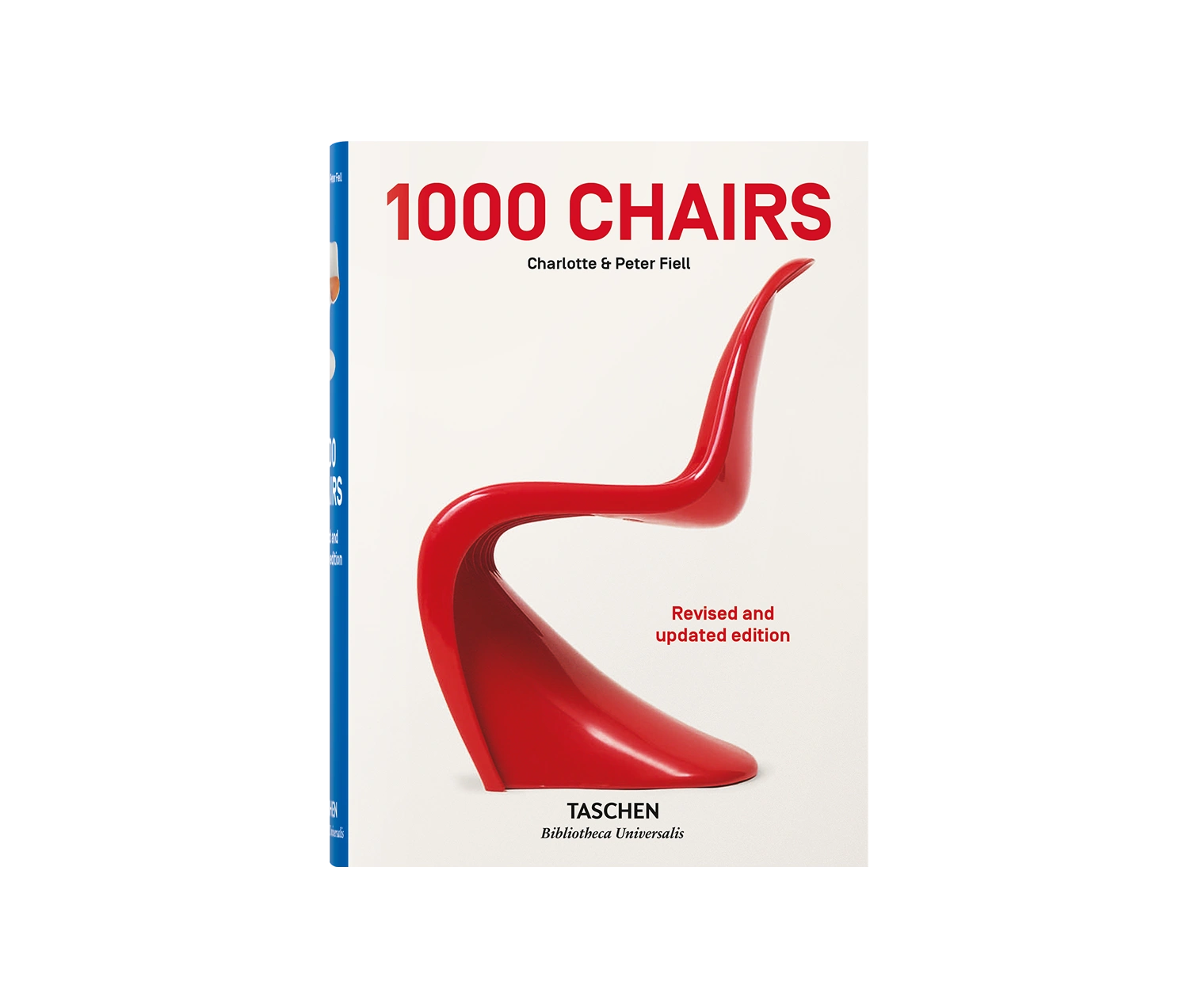 1000 Chairs is the reference.
1.Wassily Chair – $4,373

The oldest design here, drawn in 1925 at the Bauhaus, and the chair that put bent steel tube into the living room.
Breuer said the idea came from the tubular handlebars of his bicycle. Museums repeat the story as his own account, and it fits the object: a frame of chrome-plated tube that outlines a club armchair, with the seat, back and arms reduced to taut slings stretched across it. You sit on the slings, never on the steel.
It was not called the Wassily until the early 1960s, when the Italian firm Gavina reissued it and named it after Wassily Kandinsky, who had admired the chair when Breuer was teaching at the Bauhaus. Before that it was the model B3. Knoll took the design over in 1968 when it bought Gavina, and has made it since.
The first slings were Eisengarn, a waxed cotton thread woven into a hard-wearing cloth. The leather version came later, from Gavina. Knoll now makes it with slings in cotton canvas, belting leather in ten colours or haired hide, on a frame in polished chrome, gold plate or a matte powder coat. It measures 31 inches wide, 27 deep and 28¾ high, with a 16½ inch seat. MoMA has owned one since 1934.
The Wassily is a light, upright chair you can see straight through, and it takes up far less of a room than its footprint suggests. The slings stay firm, so it never sinks. Knoll stamps its logo and Breuer's signature into the frame.
2.Barcelona Chair – $7,995

Designed for a king and queen in 1929, and upholstered today in about 40 separately welted and tufted leather panels.
Ludwig Mies van der Rohe and Lilly Reich made it for the German Pavilion at the Barcelona International Exposition, where it was meant for the King and Queen of Spain at the opening. Knoll's own account says they never sat down. Reich's part in it was long underplayed. MoMA's catalogue of Mies's furniture calls her influence on all his later furniture decisive, and says separating who did what is nearly impossible.
The frame is a pair of crossed steel curves, the shape of an X seen from the side. It was originally bolted together from pieces. In 1950 it was redrawn in stainless steel as a single piece with no visible joins, which is the version made now. Leather straps run across it to carry the two cushions.
The cushions are where the hours go. Each is built from separate panels, hand-welted and button-tufted into the grid of squares that reads as the chair's signature, and Knoll cuts all of them from one hide so the colour and grain match. The chair measures 29½ inches wide, 30 deep and 30¼ high, with a 17 inch seat.
It sits low and wide, and suits a room where people look at it as often as they sit in it. Knoll makes it in fabric as well as leather, on a chrome or matte black frame. The Knoll logo and Mies's signature are stamped into the frame, which also helps date a used chair.
3.CH24 Wishbone Chair – $860

The only dining chair here, and the only one made by the same company every year since 1950.
Hans J. Wegner designed it in 1949, the last of a series of chairs he drew from Chinese seating, and Carl Hansen & Søn has made it without a break since. The name comes from the Y-shaped back splat, which joins the curved top rail to the seat and lets the rail do the work of a full back.
Carl Hansen puts the making at more than 100 steps, most of them by hand. The joints are mortise and tenon, a peg of wood glued into a slot cut to fit it, so no screw holds the frame together. The seat is woven from more than 120 metres of paper cord, which takes a weaver about an hour per chair. Paper cord is twisted paper, and a seat worn through by years of use can be rewoven on the same frame.
It comes in oak, beech, ash or walnut, oiled, soaped, lacquered or painted, with natural or black cord. It is about 55 cm wide with a seat 45 cm high, so it sits at an ordinary dining table without fuss.
Of the seven, it is the one to own in multiples. Four round a table is the usual way to live with it, and it looks as right in a kitchen as in a dining room. Original chairs carry Carl Hansen's branding and Wegner's signature under the seat.
4.Eames Lounge Chair and Ottoman – $8,700
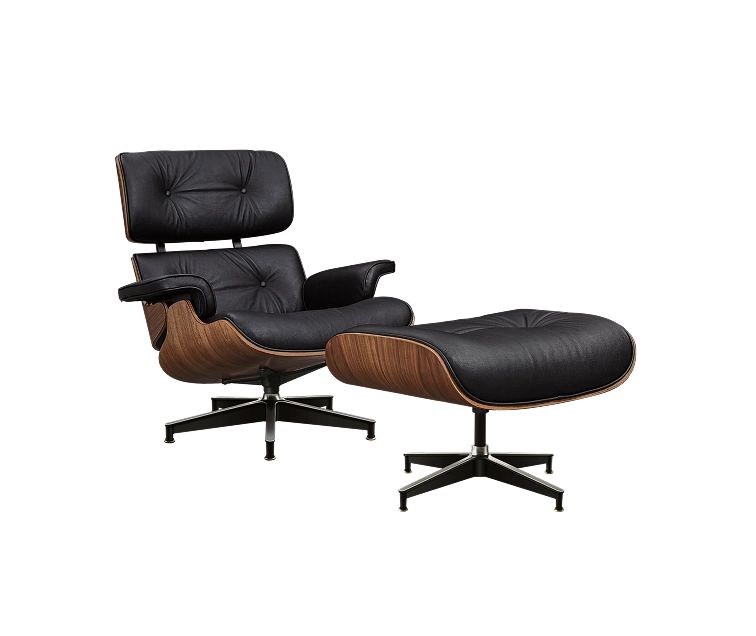
Launched on American television in 1956, and in continuous production at Herman Miller ever since.
Charles and Ray Eames introduced it on NBC's Home show, presented by Arlene Francis. Charles said he wanted it to have "the warm, receptive look of a well-used first baseman's mitt", and that is a fair description of the leather cushions sitting in their wooden shells.
There are three shells, for the seat, back and headrest, each moulded from plywood. They began as five layers of veneer and are seven today. Aluminium braces join them through rubber shock mounts, so the chair gives slightly as you lean back. It turns on a die-cast aluminium base.
The original outer veneer was Brazilian rosewood, dropped in the early 1990s. Herman Miller now veneers it in walnut, palisander, ash or white oak, and makes a Tall version for longer bodies. The standard chair is 33½ inches wide and 35 deep, with a 16 inch seat. MoMA was given one by Herman Miller in 1960.
It is a reading chair and a napping chair, built for sitting back with your feet up, and the ottoman is half of that. In Europe, Vitra has made it under licence since 1957. A Herman Miller chair carries the company's medallion on the underside.
5.Egg Lounge Chair – $10,500

Drawn by an architect for the lobby of his own hotel, and one of the first chairs built on a moulded foam shell.
Arne Jacobsen designed it in 1958 for the SAS Royal Hotel in Copenhagen, which he was building at the time. The Egg was made for its lobby and reception, a chair with high sides for a large open room.
What made it possible was a strong inner shell of moulded foam, a technique Fritz Hansen had secured the rights to in the mid-1950s. Fritz Hansen reinforces the foam shell inside, then pads and upholsters it, so the whole seat is one continuous surface with no frame showing. It sits on a four-star aluminium base that swivels, and its tilt mechanism adjusts to the sitter's weight.
It stands just over a metre tall and is 86 cm wide. Fritz Hansen still makes it, in leather or fabric, and has since the start. The V&A holds one in its collection.
The Egg is the most enclosing chair here. The sides wrap round far enough to cut off the view to either side, which is the reason to put it in a corner and the reason it fills a small room. Look for Fritz Hansen tags sewn into the chair and its cushion, and an ID number on the base.
6.Panton Chair – $555

The first chair made entirely of plastic in a single piece, and it stacks.
Verner Panton sketched it at the end of the 1950s, a cantilevered S that runs from the floor to the top of the back with no legs and no joints. It took a decade to find a way to make it. Vitra developed it for serial production in 1967, and the material has changed several times since: fibreglass-reinforced polyester at first, then rigid polyurethane foam, then a thermoplastic called Luran-S through the 1970s, then painted foam again in the 1980s. The current version, made since 1999, is polypropylene dyed through, so a scratch shows the same colour underneath.
The cantilever lets the seat flex slightly as you sit. It is 50 cm wide and 61 cm deep, with a seat 44 cm high. Vitra rates it for outdoor use on a seasonal basis, stored somewhere dry and sheltered the rest of the year. A glossy painted version, the Panton Chair Classic, is still made for buyers who want the 1970s finish.
It is the only chair here that works as a set of six round a table and then stacks away, and the only one that can go out on a terrace for the summer. MoMA, the Met and the Vitra Design Museum all hold one.
7.Togo Loveseat – $6,575

There is no frame inside it at all, only foam, and it has been made in France without a break since 1973.
Michel Ducaroy designed the Togo for Ligne Roset, and it was first shown at the Salon des Arts Ménagers in Paris in 1973, where it won a design prize. Ducaroy described it as a tube of toothpaste folded back on itself like a stovepipe and closed at both ends, which is still the most exact description of the shape.
Inside are three densities of polyether foam, layered so the firmer foam does the structural work a frame would do in another sofa. Over it goes a quilted cover filled with polyester, sewn into the deep horizontal pleats. Ligne Roset makes it in its workshops at Briord, east of Lyon, and covers it in dozens of fabrics, velvets, wools and leathers.
The loveseat is the two-seat version without arms: 51 inches wide, 40 deep and 27 high, with a seat 15 inches off the floor. With no frame it weighs about 15 kg, light enough for one person to move. For its 50th anniversary in 2023, Ligne Roset released limited editions in Kvadrat and Pierre Frey fabrics, and it has sold well over a million pieces.
It is the lowest seat here by some way, a floor-level, sink-in sofa that is better for lounging than for sitting upright. Since March 2025 every Togo carries a stitched QR code that opens a certificate of authenticity. Older ones have a black Ligne Roset label in the seam at the base of the back and a blue-and-white striped ticking underneath.
How we chose
We chose chairs that have stayed in production for decades, so every one here can be bought new from the company that holds the rights. We picked one chair per material and put them in date order, so the list reads as a history: steel tube, welded steel, paper cord, moulded plywood, a foam shell, one-piece plastic and frameless foam. Office chairs are left out; they have their own post. Dates, materials and dimensions come from each maker's own page, checked against a museum record, the designer's estate or a second independent source. Where two sources disagreed, as on the Panton Chair's design year and when Knoll took over the Barcelona Chair, the post says only what both support. These are bought for how they look and what they stand for, so there is no comparison table.
Common questions
The ones most often named are Marcel Breuer's Wassily Chair (1925), Mies van der Rohe and Lilly Reich's Barcelona Chair (1929), Hans J. Wegner's CH24 Wishbone Chair (1949), Charles and Ray Eames's Lounge Chair and Ottoman (1956), Arne Jacobsen's Egg (1958), Verner Panton's Panton Chair (1967) and Michel Ducaroy's Togo (1973). All seven are still in production.
Knoll makes the Wassily and the Barcelona, Carl Hansen & Søn the Wishbone, Herman Miller the Eames Lounge Chair (Vitra in Europe), Fritz Hansen the Egg, Vitra the Panton Chair and Ligne Roset the Togo. Five of the seven are still made by the company that first put them into production.
Each licensed maker marks its chairs. Knoll stamps its logo and the designer's signature into the frames of the Wassily and the Barcelona. Herman Miller puts a medallion under the Eames Lounge Chair. Fritz Hansen sews tags into the Egg and engraves an ID number on the base. Since March 2025, every Togo carries a stitched QR code that opens a certificate of authenticity.
Marcel Breuer designed it at the Bauhaus in 1925 as the model B3. It took the name Wassily in the early 1960s, when the Italian firm Gavina reissued it and named it after the painter Wassily Kandinsky, who had admired the chair. Knoll bought Gavina in 1968 and has made it since.
No. Ligne Roset builds the Togo from three densities of polyether foam, layered so the firmer foam does the structural work, under a quilted cover. The two-seat loveseat weighs about 15 kg as a result.
About the author

Justin Farrugia
Founder & Editor of Curated Supply
Justin Farrugia is the founder and editor of Curated Supply, a design-led directory to things worth owning. He has personally curated over 1,000 products across workspace, carry, coffee, audio, and the home, each judged against one standard: design intent, material quality, and the restraint that lets a thing last.