Floor and table lamps for every room
Six floor and table lamps, from an $80 Hay you can leave out in the rain to the Castiglioni Arco, and what changes once the light stops coming from the ceiling.
Floor and table lamps solve the problem a ceiling fitting creates, which is light arriving from eight feet up, in one colour, at one brightness, for everyone in the room at once.
A ceiling light is a decision made by whoever wired the building. It sits in the middle of the ceiling because that is the middle of the ceiling, not because that is where anyone sits. It comes on at full and goes off at nothing. Every room where people say the lighting feels wrong is a room lit from a single point above head height.
Six here, three that stand on the floor and three that sit on a surface, running from a Hay you can carry into the garden to a Castiglioni that takes two people to lift. The desk is a separate argument with its own numbers, and premium task lights covers it.
1.Flos Arco Floor Lamp

A ceiling light that stands on the floor, which in 1962 was a genuinely new idea.
Achille and Pier Giacomo Castiglioni wanted light directly over a dining table in a flat whose ceiling they could not touch. Their answer was a stainless steel stem that arcs seven feet sideways from a block of Carrara marble, putting the shade above the table with the weight standing well clear of it. The marble is not decoration. At 141 pounds it is the counterweight, and it holds the arc up by being heavier than the reach.
Holes run all through the stamped aluminium reflector, so light leaves downward through the open face and sideways through the metal at the same time. A table under it is lit without the room around it going black, which is the failure of most pendant lights. The shade swivels and slides up and down the stem, and the telescopic stem shortens, so you set the height over the table once and leave it.
The LED version draws 28 watts at 2700 K, dimmed by a switch on the cord. That is a warm evening colour and it does not change, which is the honest limit of a sixty year old design.
The Castiglionis drilled a hole through the centre of gravity of the marble so two people could slide a broom handle through it and carry the base between them. Sixty years later that hole is still there, and it is still the only way to move the thing.
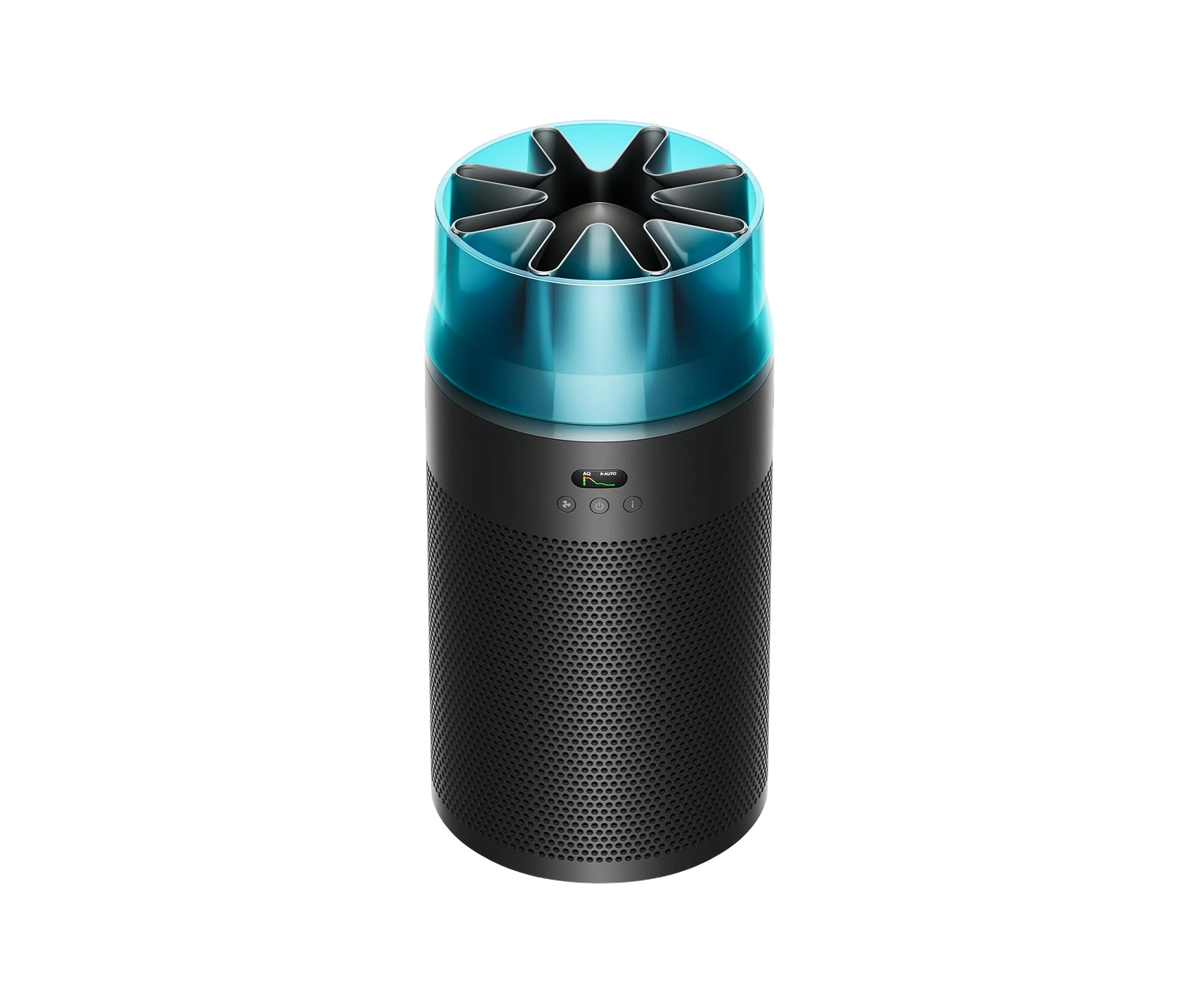
2.Dyson Solarcycle Morph Floor

The only lamp here whose light changes through the day without anyone asking it to.
Dyson gives it the date, the time and where you live, and it tracks what daylight is doing outside. Undocked, the head runs from 2700 K to 6500 K, which spans a candle-warm evening to a bright working afternoon. Nothing else here moves at all. Slide the head down into the stem and it docks magnetically, and the range drops to 1800 K to 3400 K, warm enough that it stops interfering with going to sleep.
That docking is what makes it four lamps. Head up and aimed down, it is task light. Head docked and glowing, it is ambient light for a corner. Aimed at a wall it is indirect, and aimed at a shelf it lights an object. One frame does all four because the head slides and pivots instead of bolting in one place.
The numbers behind it are unusually public for this category. Colour rendering is 90 minimum, output 850 lumens, and Dyson rates the LED at 181,000 hours, which is the lamp outliving the person who bought it. It stands 1,250 mm tall and weighs 6.1 kg.
What you take on is a lamp with software. It has an app, presets, a wake-up mode and a twenty minute boost, and everything clever about it depends on Dyson keeping that app alive. The Arco next to it will still work in 2090.
3.Vitra Akari 10A

Paper, bamboo and wire, and the softest light in this list by a distance.
Isamu Noguchi went to Gifu in 1951, a town that had made paper lanterns and parasols for centuries, and spent the next thirty years designing more than a hundred of these. The Ozeki workshop made them then and makes them now. Mulberry bark is beaten into washi paper, cut into strips, and glued over a bamboo rib that spirals around a wooden form. The form is then taken out and the shade collapses flat.
The 10A stands 48 inches on three thin steel legs, so it reads as a floor lamp but takes up the visual space of a vase. Light leaves through the paper across the whole surface, which is why there is no glare anywhere in the room and no bright spot to look away from. A 4 watt bulb is enough, because the shade is doing all the work.
It is genuinely fragile. Paper is paper. Paper tears, a cat can end it, and the shade yellows slowly over years the way paper does. Replacement shades exist and are not expensive, which is the point: this is a lantern, and lanterns were always consumable.
Every diffuser in this list is trying to hide its bulb. This one hides it inside the only material that was already solving the problem before electricity.
4.Grau Fire

A battery, mouth-blown glass, and no cord to decide anything about.
Grau builds it in Germany from an aluminium body and a glass head blown by mouth, so no two heads scatter light in quite the same pattern. One aluminium switch runs everything. Press it for on, hold it to dim, and the light warms as it goes down instead of just getting dimmer, which is what a fire does and what an overhead dimmer never does.
Double click and a thirty minute sleep timer starts, easing the light down to nothing while you stop reading. Grau calls the dimming curve Sunset Dimming and builds it around the point where blue light stops being useful in an evening.
Fully dimmed it runs about 50 hours, and around 15 hours in its liveliest mode, so a week of evenings between charges is an ordinary result. It charges from empty in two hours over USB C, and a small LED on the shaft shows what is left.
The reason to own one is that it goes where no socket is, which turns out to be most of the interesting places in a house: a garden table, the end of a bath, a windowsill in a stairwell, the middle of a dinner where the overhead light would have flattened everybody at it. No wire. No compromise about the seating. Everything else here negotiates with the position of a plug, and the negotiation is usually the reason a room ends up lit badly.
5.Audo JWDA Table Lamp

Eleven inches tall, and enough to change the character of a room after dark.
Jonas Wagell built it around an old oil lamp, which is visible the moment you look at it. A weighted base in marble, travertine, steel or brass. A mouth-blown opal glass shade sitting directly on top. Nothing between them. The G9 bulb sits inside the glass rather than behind it, so the shade glows evenly and the eye cannot find the source, which is the whole reason 300 lumens reads as ambient light instead of a bright point on a sideboard.
The brass knob is the switch and the dimmer at once. Turn it and the light comes up. There is no inline box halfway down the cord, no app, no second gesture. The cord is two metres of fabric, long enough to reach a socket without a loop of slack lying across the surface.
At 2700 K it stays warm and does not move, which suits a bedside table, a hallway console or the corner of a kitchen counter after the overheads go off.
The marble version weighs 4.7 pounds against 3.9 for the metal, and the extra weight matters more than it sounds. A small lamp that slides when you turn its knob is annoying every single evening.
6.Hay PC Portable Lamp

Eighty dollars, twelve ounces, and rated for rain.
Pierre Charpin designed it for Hay as a lamp you pick up and carry, with no ambition past that, and the restraint is what makes it good. A cylinder, a cap, a translucent shade. Twenty two centimetres tall, fourteen across, light enough to lift with two fingers.
It is IP44, which is the rating for splashing water from any direction. That covers a garden table in light rain, a bathroom shelf, and a balcony left out overnight by accident. Nothing else in this list can leave the house.
The touch dimmer has three positions instead of a continuous sweep, running from bright downlight through the open bottom to a soft ambient glow through the shade. Three settings is the right number for a lamp you move around, because tapping beats hunting for a level.
The battery runs about ten hours and charges over USB C. The body is 95 percent post-consumer recycled ABS and the shade is entirely recycled polypropylene, which on an eighty dollar object is unusual enough to be worth saying.
Buy two. They cost less together than one shade for anything else here, and a pair of small lights at table height beats one bright light overhead in almost every room.
How to choose, room by room
Where the light comes from, and where it lands
The single most useful question is what height the light leaves at. Above head height it lights the room and flattens everyone in it. At table height it lights the people and lets the corners go dark, which is what a room looks like when it feels good. The Arco is the exception that proves it, because the arc puts light high and aims it at one table, not at the room.
Warm and cool through the day
Colour temperature runs in kelvin, and low is warm. 2700 K is an evening, 6500 K is a bright overcast noon. Four of these six sit at one warm setting and are better for it. Only the Dyson moves, and it earns the money in a room used at nine in the morning and again at nine at night.
The cord is a decision about the room
Every corded lamp puts a line across the floor from the object to the nearest socket, and that line decides where the object can go. Deciding where the thing will stand before falling for it saves the particular disappointment of unpacking an Arco, standing it beside the dining table, and discovering that the nearest socket is on the far wall behind a bookcase.
A knob, a touch strip or an app
A knob you can find in the dark. A touch strip needs a look. An app needs a phone, and a phone at bedside is the thing most people are trying to get away from. Nothing here is wrong, but the number of steps between deciding and dimming is worth counting before buying.
What a battery buys you
Not portability exactly. What a battery buys is the freedom to light a spot that has no socket near it, and most rooms have several. Two cordless lamps at opposite ends of a room do more for how it feels than one expensive fixture in the middle of it.
How we chose
We started from the lamps in the catalogue that no post had covered, then cut the ones that belong to a different decision. Desk task lights came out first, because lumens, colour rendering and reach decide those and a separate post already argues them. Wake-up lights came out next, since a lamp bought to run a sunrise on a schedule is a sleep product that happens to emit light. Smart colour-changing lamps came out for the same reason in reverse: the appeal there is the app, not the object. What was left had to spread across real prices and real rooms, and it had to spread across makers. Flos alone could have filled four of the six slots, and a list that reads as one brand's catalogue is a shopping page, not a recommendation. Every figure in the write-ups comes from the maker's own specification, or from an authorised dealer printing it where the maker's site blocks automated access.
Common questions
Three is the number most rooms settle at, and it has nothing to do with brightness. One lamp gives you a bright spot and a dark room around it, which is why a single side lamp never feels finished. Three small pools at different heights, one on a low table, one at standing height, one against a wall, fill the space without any of them working hard. Three lamps of 300 lumens each read as a lit room. One lamp of 900 reads as an interrogation.
2700 K for anything used in the evening, which is where four of these six sit and where the warm end of most bulbs lands. It reads as candle and low sun, and it is warm enough that your body stops treating the room as daytime. Above about 4000 K a room starts to feel like an office at night. The exception is a room that also gets used at nine in the morning, and that is the argument for the Dyson, which runs to 6500 K when the sun outside is doing the same.
The ones here are, at close range. Portable lamps run small batteries, so they are built to light a table rather than a room, and both the Grau and the Hay put enough on a page at arm's length. What they cannot do is light a chair from across the room. If reading is the whole purpose, a corded lamp beside the chair is the honest answer, and the cordless one is for the dinner table, the garden and the bath.
Replicas exist at a tenth of the price and they get the shape right, which is the part that photographs. What they usually get wrong is the marble, and the marble is the engineering. A base that weighs less than the arc it holds up will creep, tip or need bracing, and the reason the original is 141 pounds of Carrara is that anything lighter does not stand. If a replica publishes a base weight near the original's, the physics is at least honest. Most do not publish one at all.
You need it for finding a dropped earring and for cleaning, and almost never otherwise. The useful move is to stop thinking of it as the room's light and start thinking of it as the room's floodlight: wired to its own switch, used deliberately, off the rest of the time. Everything in this list exists because the ceiling fitting is in the wrong place for sitting down.
About the author

Justin Farrugia
Founder & Editor of Curated Supply
Justin Farrugia is the founder and editor of Curated Supply, a design-led directory to things worth owning. He has personally curated over 1,000 products across workspace, carry, coffee, audio, and the home, each judged against one standard: design intent, material quality, and the restraint that lets a thing last.