Sayl
$900
About
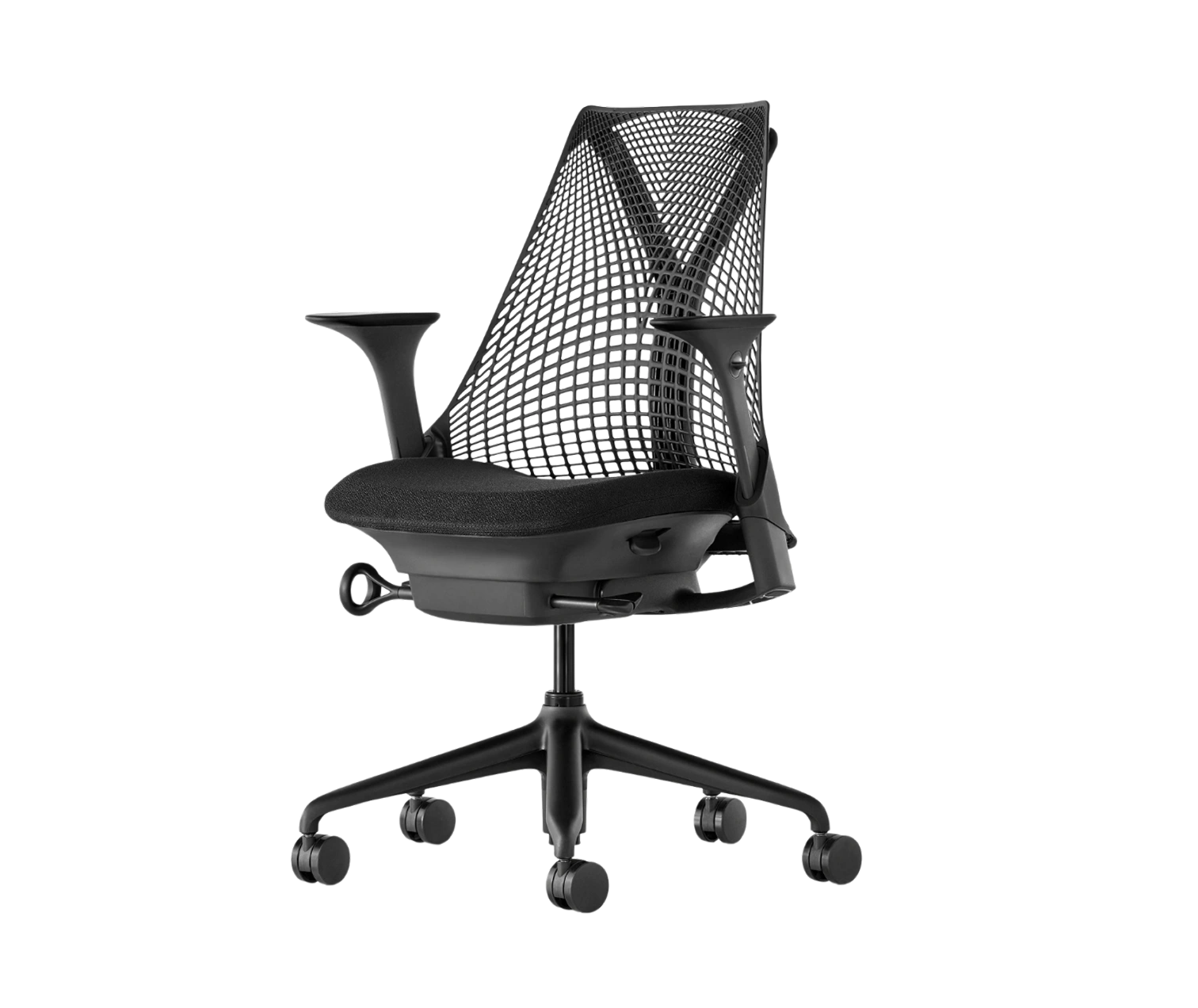
Most office chairs solve the problem of holding up a back by moulding a shell and bolting a frame around it. Yves Béhar looked out at San Francisco instead, at the Golden Gate Bridge, and asked whether a suspension bridge's engineering could hold up a person rather than traffic.
The brief from Herman Miller was an affordable chair that still delivered the ergonomics the brand is known for. A suspension bridge carries its load through cables in tension rather than a solid beam, which is why it needs so little material to cross so much space, and the Sayl borrows that principle exactly: a single support column, the Y-Tower, carries an unframed back of stretched elastomer instead of a moulded plastic shell. The elastomer pulls tightest where the spine needs support and slackens everywhere else, so leaning and twisting moves the back with you rather than working against a fixed surface. Seen side-on, the silhouette resembles a sailboat's mainsail, which is where the name comes from, with the "i" swapped for a "y" as a nod to the tower underneath. Lumbar support is optional, on both the standard and fully upholstered versions.
Herman Miller builds the Sayl on three continents, which shortens the distance between factory and buyer, and says the materials are PVC-free and almost entirely recyclable. For a chair whose back is mostly air, that is a reasonably consistent argument: less material to make, less material to deal with later.
- Designed & made in
- United States

- designer
- Yves Béhar
- Awards
- Materials
- Fits
- Sitters up to 350 lb (159 kg)
- Range
- 4 in (10 cm) lumbar adjustment
- Body
- Single Y-Tower support column


Figures as published by the manufacturer. Source
Alternatives
More from Herman Miller
You might also like
More in Workspace
See all

Staff Pick
k•no•b•1
$439