Designer coffee tables and side tables, from glass to marble
Designer coffee tables and side tables from Noguchi's glass and walnut original to Audo's marble Plinth, with the height and size that decide if one fits.
Designer coffee tables get chosen by eye, but the figure that decides whether one works in a room is its height, and the six here run from 27 cm to 51 cm. Three are coffee tables in the usual sense: Isamu Noguchi's glass and walnut table for Herman Miller, the round Madrid from BoConcept, and the long marble Plinth Low from Audo. The other three are side tables, and one of them is sold as a coffee table while standing taller than every table on the list.
Each uses a different material, so the list also works as a guide to what lives well under a mug: plate glass, ceramic, marble, powder-coated steel and raw aluminium. The chairs that tend to sit around tables like these have their own post on iconic designer chairs, and what goes on top has a post of its own in coffee table books every home should have.
1.Noguchi Coffee Table – $2,745

Pros
- Signed on the glass and on a medallion under the base, so a real one is easy to check
Cons
- A clear top puts whatever is under the table on show, rug included
Three pieces and nothing else: a ¾ inch plate-glass top resting on two curved wooden legs that interlock into a tripod.
The table began as a private commission. In 1939 A. Conger Goodyear, the first president of the Museum of Modern Art, asked Noguchi for a coffee table, and the sculptor made him one. The version sold today came out of a quarrel. The Victoria and Albert Museum records that the designer T. H. Robsjohn-Gibbings used a scale model of a Noguchi table in an advertisement without his permission, then told him that "anybody could make a three-legged table". Noguchi redrew the design and took it to Herman Miller, which introduced it in 1948.
Herman Miller has not made it without a break since. The V&A notes that production stopped for at least the decade from 1973 to 1983. Its own example, made between about 1947 and 1955, has a birch base. Herman Miller now makes the base in solid walnut, one of the original woods, as well as white oak, white ash and a black finish.
The top is 50 inches wide and 36 deep, about 127 by 91 cm, on a rounded, freeform outline with no straight edge anywhere. The table stands 15¾ inches high, and the whole thing weighs 155 lb, so it stays exactly where it is put.
Because the top is clear, the base is what you see from every angle, including from above, along with whatever rug lies under it. Herman Miller marks the real ones in two places. Noguchi's signature appears on the longest edge of the glass and on a medallion under the base, and his initials sit stamped into the wood beneath the medallion.
- Top size
- 50 × 36 in (127 × 91 cm), freeform glass
- Height
- 15¾ in (40 cm)
- Material
- ¾ in plate glass on a solid wood base
- Weight
- 155 lb (70 kg)
Specifications as published by the manufacturer. Source
2.Madrid Coffee Table – $2,199

Pros
- The ceramic top is closed to the wine and lemon juice that etch marble
Cons
- The veining is printed, so every Madrid looks the same
A ceramic top made to look like dark marble, which means a wet glass or a splash of wine leaves nothing behind.
Morten Georgsen designed it for BoConcept as a single round disc, 99 cm across and 41 cm high, or 39 by 16¼ inches. The base is a matt black lacquered structure set well back from the edge, so from a sofa the top appears to sit on nothing. Of the three coffee tables here, it is the only round one, which matters more in a room than it sounds: there are no corners to walk into, and nobody on the sofa gets the short end.
The top is what sets it apart. Marble is mostly calcium carbonate, and acids dissolve calcium carbonate, so lemon juice, wine and some cleaning sprays leave dull marks called etching, even on sealed stone. A ceramic top goes through a kiln at high temperature and comes out with a hard, closed surface that those things cannot get into. It is the marble look with none of the upkeep, and it takes a hot pot better than natural stone does.
BoConcept makes it to order, and the Madrid range includes other tables in the same language, so two can sit layered at different heights.
It is the most practical of the six to live with every day, and the one least likely to need a coaster. The veining is a printed pattern, so every Madrid looks the same. That will suit anyone who wants to know exactly what will arrive.
- Top size
- Ø99 cm (Ø39 in), round
- Height
- 41 cm (16¼ in)
- Material
- Dark marble-effect ceramic top on a matt black lacquered base
Specifications as published by the manufacturer. Source
3.Plinth Low – $3,245

Pros
- At 27 cm it works as a pedestal for books and objects as well as a table
Cons
- Sealed marble still etches, so drinks want coasters
The lowest table here by 11 cm: a long box of marble slabs, 100 cm by 60, standing 27 cm off the floor.
Norm Architects drew it for Audo. Jonas Bjerre-Poulsen and Kasper Rønn founded the studio in Copenhagen in 2008, and some shops still sell the table under Menu, the company's earlier name. The Plinth Collection is a set of plain marble volumes, meant to work as tables, podiums or sculpture.
The weight tells you how it is made. The Plinth Low weighs 82 kg. A solid block of marble that size would weigh more than 400 kg, so what you see is a box assembled from solid slabs, with the joints doing the work of making it read as one piece of stone. Audo hones the surfaces, grinding them to a soft matte instead of a polish, and then seals them.
Audo cuts it in several stones: brown Emperador, white Carrara, rose Calacatta Viola, grey Kendzo, black Nero Marquina and Kunis Breccia, a pale stone with darker fragments. Marble is natural, so the veining on the one delivered will differ from the photograph.
At 27 cm it sits closer to the floor than to a sofa seat. It suits books, a bowl or a sculpture better than a cup reached for every few minutes, which is why Audo describes it as a table and a pedestal at once. Sealing slows staining but does not stop the etching described above, so drinks want coasters. Delivery wants two people.
- Top size
- 100 × 60 cm
- Height
- 27 cm
- Material
- Solid marble slabs, honed and sealed, in six stones
- Weight
- 82 kg
Specifications as published by the manufacturer. Source
4.Androgyne Side Table Ø63 – $590
Pros
- Wide and low enough to stand in for a coffee table in a small room
Cons
- The listed price is for the base; the top is a separate purchase
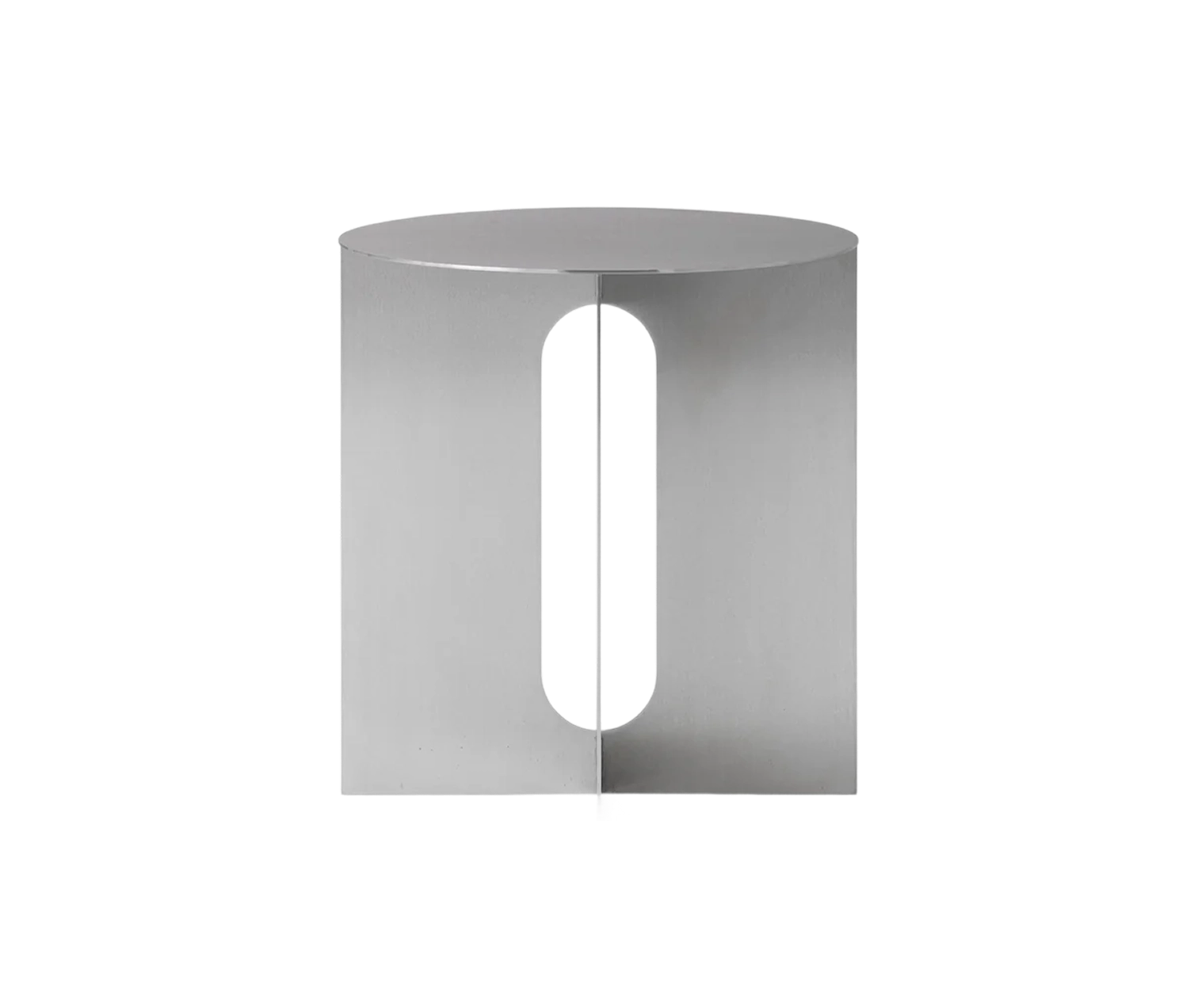
Base and top are sold separately: a metal base 63 cm across, and a 65 cm top that overhangs it by a centimetre all round.
Danielle Siggerud, a Norwegian architect who trained at the Royal Danish Academy and founded her Copenhagen studio in 2016, designed it for Audo. The name refers to the mix of hard and soft at its centre. The base is two curved metal plates that meet in the middle, each cut through with a tall, round-ended opening, so the light passes through a table that looks solid from across the room.
That 1 cm overhang is the whole design. It is enough to throw a thin shadow line under the top, so the top seems to hover over the base instead of capping it. It is also why the two are sold apart. Audo makes the base in black, ivory and steel, and matches each finish to its own tops, including marble in Emperador, Calacatta Viola, Nero Marquina and Crystal Rose. The painted bases are powder-coated at a low sheen, a baked-on finish that resists scratches and fading better than liquid paint.
The price above buys the base. The top is a separate purchase from Audo, so the finished table costs more than that figure.
At 38 cm high and 65 cm wide, it sits between a coffee table and a side table, and Audo calls it a lounge table. It is broad enough for a tray and two cups beside an armchair, and low enough to pair with a sofa in a small room where a full coffee table would crowd the floor. The collection also includes a larger size and a dining table, so two Androgynes can stand together at different widths.
- Top size
- Ø65 cm top, sold separately, on a Ø63 cm base
- Height
- 38 cm
- Material
- Metal base in black, ivory or steel, with matched tops including four marbles
Specifications as published by the manufacturer. Source
5.Plinth Cubic – $1,650

Pros
- No front or back, so it can turn to show its best face
Cons
- Sealed marble still etches, the same as the Plinth Low
A 40 cm cube of marble with no front and no back, so you can turn it to show its best face.
It comes from the same Plinth Collection as the Plinth Low, by the same studio, built the same way from solid marble slabs joined into a closed box. At 40 cm on every side it is the same height as the Noguchi, which makes it a side table for a sofa or an armchair, a bedside table, or a stand for a single object. The one pictured is Kunis Breccia, a stone made of broken fragments bound back together, which reads almost like terrazzo. The other stones match the Plinth Low's, so the two can be bought as a set.
The cube is the shape that shows marble best. Every face is a slab large enough to carry a full run of veining, and because the four sides meet at sharp corners, the pattern on one face stops cleanly where the next begins. A round table shows its stone mostly on top. This one shows it on five sides at once.
The family has a third member, the Plinth Tall, a 30 cm square column 51 cm high, for a lamp or a plant that wants to stand above the furniture around it.
Of the side tables, it is the one that reads as an object first and a table second. With a lamp on it, it looks like furniture. Bare, it looks like something waiting for a sculpture. A full glass on marble needs the same care as on the Plinth Low, and its weight means it goes in one place and stays.
- Top size
- 40 × 40 cm
- Height
- 40 cm
- Material
- Solid marble slabs, honed and sealed, in six stones
Specifications as published by the manufacturer. Source
6.Neowise Terra Coffee Table – $395

Pros
- 7.2 kg, so one person carries it across the room with one hand
Cons
- Sold as a coffee table, but sized like a side table at 51 cm high
Sold as a coffee table and built like a side table: 40 cm across and 51 cm tall, the tallest here by 10 cm.
Ramūnas Minkevičius designed it in 2024 for Kismas, which makes it in Lithuania. It is a round aluminium top on a set of vertical panels that slot into each other at right angles, with black rubber O-rings holding them together, the same kind of ring used to seal a pipe. Assembly takes a few minutes and needs nothing but hands.
The panels are cut from raw aluminium sheet by milling, a rotating cutter that shaves the metal away, instead of by laser. Kismas says milling is slower and more expensive, and it leaves a smoother, more precise edge, which matters on a table that is all edges. Where the panels cross they form four open bays under the top, sized for magazines, a few books or a plant.
It weighs 7.2 kg, or 15.9 lb, about a tenth of the Noguchi. That makes it the only table on the list one person can lift with one hand and carry to the other side of the room. Raw aluminium is left unpainted, and Kismas asks for mild soap and a soft cloth, never an abrasive sponge.
At 51 cm the top meets your hand at the height of an armchair's arm or a bed's mattress, so it works best at the side of a seat or as a nightstand. In front of a low sofa it would stand too tall to be a coffee table in the usual sense. The name says coffee table. The dimensions say side table, and the dimensions are the ones to trust.
- Top size
- Ø40 cm (Ø15¾ in)
- Height
- 51 cm (20 in)
- Material
- Milled raw aluminium sheet, black rubber O-rings
- Weight
- 7.2 kg (15.9 lb)
Specifications as published by the manufacturer. Source
All 6 compared
Herman Miller Noguchi Coffee TableThe 1948 original- Top
- 127 × 91 cm
- Height
- 40 cm
- Material
- Glass, wood
BoConcept Madrid Coffee TableCeramic, so no etching- Top
- Ø99 cm
- Height
- 41 cm
- Material
- Ceramic
Audo Plinth LowLowest here- Top
- 100 × 60 cm
- Height
- 27 cm
- Material
- Marble
Audo Androgyne Side Table Ø63Top and base sold apart- Top
- Ø65 cm
- Height
- 38 cm
- Material
- Metal, marble
Audo Plinth CubicMarble on five faces- Top
- 40 × 40 cm
- Height
- 40 cm
- Material
- Marble
Kismas Neowise Terra Coffee TableTallest and lightest- Top
- Ø40 cm
- Height
- 51 cm
- Material
- Aluminium
Heights run from 27 cm to 51 cm. The Androgyne's 65 cm top is sold separately from its 63 cm base.
How we chose
We chose tables that a design-minded buyer would recognise by maker or designer, and that each use a different material, so the list covers glass, ceramic, marble, powder-coated steel and raw aluminium. Three are coffee tables and three are side tables, and we ordered them that way. Because height decides whether a table works beside a particular sofa or chair, every pick carries its height and top size, taken from the maker's own page and checked against a second source: the V&A's record or Design Within Reach for the Noguchi, BoConcept's regional pages for the Madrid, Finnish Design Shop and other authorised dealers for the Audo tables, and Urban Outfitters' listing for the Neowise Terra. Weights appear only where two sources agree.
Common questions
Herman Miller lists it at 15¾ inches high, 50 inches wide and 36 inches deep, about 40 by 127 by 91 cm. The glass top is ¾ inch thick and the whole table weighs 155 lb.
Herman Miller marks the licensed table in two places. Isamu Noguchi's signature appears on the longest edge of the glass top and on a medallion under the base, and his initials are stamped into the wood beneath the medallion.
For everyday use, it is easier to live with. Marble is mostly calcium carbonate, so acids such as lemon juice and wine etch its surface even when it is sealed. A kiln-fired ceramic top, like the one on BoConcept's Madrid, has a closed surface those liquids cannot get into. Marble's veining is unique to each piece; a ceramic top's is a printed pattern.
Mostly height and footprint. In this list the coffee tables are wide and low, 27 to 41 cm high, and meant to sit in front of a sofa. The side tables are smaller and range from 38 to 51 cm, meant to stand beside a chair or a bed. The Neowise Terra is sold as a coffee table but, at 40 cm across and 51 cm high, it is sized like a side table.
It weighs 82 kg because it is built from solid marble slabs. It is still far lighter than a solid block of marble the same size, which would weigh more than 400 kg, so the Plinth is a closed box of slabs rather than one piece of stone.
About the author

Justin Farrugia
Founder & Editor of Curated Supply
Justin Farrugia is the founder and editor of Curated Supply, a design-led directory to things worth owning. He has personally curated over 1,000 products across workspace, carry, coffee, audio, and the home, each judged against one standard: design intent, material quality, and the restraint that lets a thing last.