Dieter Rams designs you can still buy new, from Braun to Vitsoe
Dieter Rams designs still made new: the Braun ET66 calculator behind the first iPhone's, two Braun clocks from the 1980s and Vitsoe's 606 shelving from 1960.
Most Dieter Rams designs you can still buy new cost less than a dinner out, and the one that does not has been in production since 1960. Braun reissues his calculator and two of the clocks his department drew in the 1980s for under $70 each, and Vitsoe still makes the 606 shelving system he designed at 28. Most of the rest of his Braun work, the radios, the record players, the SK 4 radiogram, now trades as vintage.
A word on credits, because the shop listings blur them. Rams joined Braun in 1955 and ran its design department from 1961 to 1995, and most of what came out of it was drawn by a small team working to his rules. Dietrich Lubs is the name that recurs on the clocks and calculators. Each section below says who drew what, so the "Dieter Rams" on a box can be read for what it is.
The order runs from the smallest object to the largest, and the last pick is the book that holds the rest of his work. More objects in this spirit are in Minimalist Objects.
1.Braun BNE001 Calculator

A reissue of the ET66, drawn by Dieter Rams and Dietrich Lubs in 1987. Apple modelled the first iPhone's calculator app on it.
The keys are the design. Each one is a small convex dome, round in plan and curved upward, so a fingertip lands in the middle of it without looking. Numbers are black, the operation keys brown, and the equals key is the one yellow circle on the face, because it is the key pressed most. Round buttons in three colours are what turned up on the iPhone's calculator in 2007, and the link was no secret: Jony Ive sent Rams one of the phones.
The body is ABS plastic with an eight-digit LCD, and it slides into a hard case that covers the keys and display in a bag. Power comes from a single 1.5 volt button cell, and the calculator switches itself off when left alone, which is why the cell lasts so long. Braun brought the ET66 back in 2013 under the BNE001 name, with the shape unchanged from 1987.
The colours were not new in 1987 either. Braun's ET 22 of the 1970s already set white symbols on brown operation keys and a black equals sign on yellow. The ET66 kept that palette and settled the shape.
It is the cheapest Rams design here, and probably the one used most. It lives flat on a desk beside a keyboard, and the slide case means it can go in a bag without the keys pressing themselves.
2.Braun BC22 Classic Analogue Alarm Clock

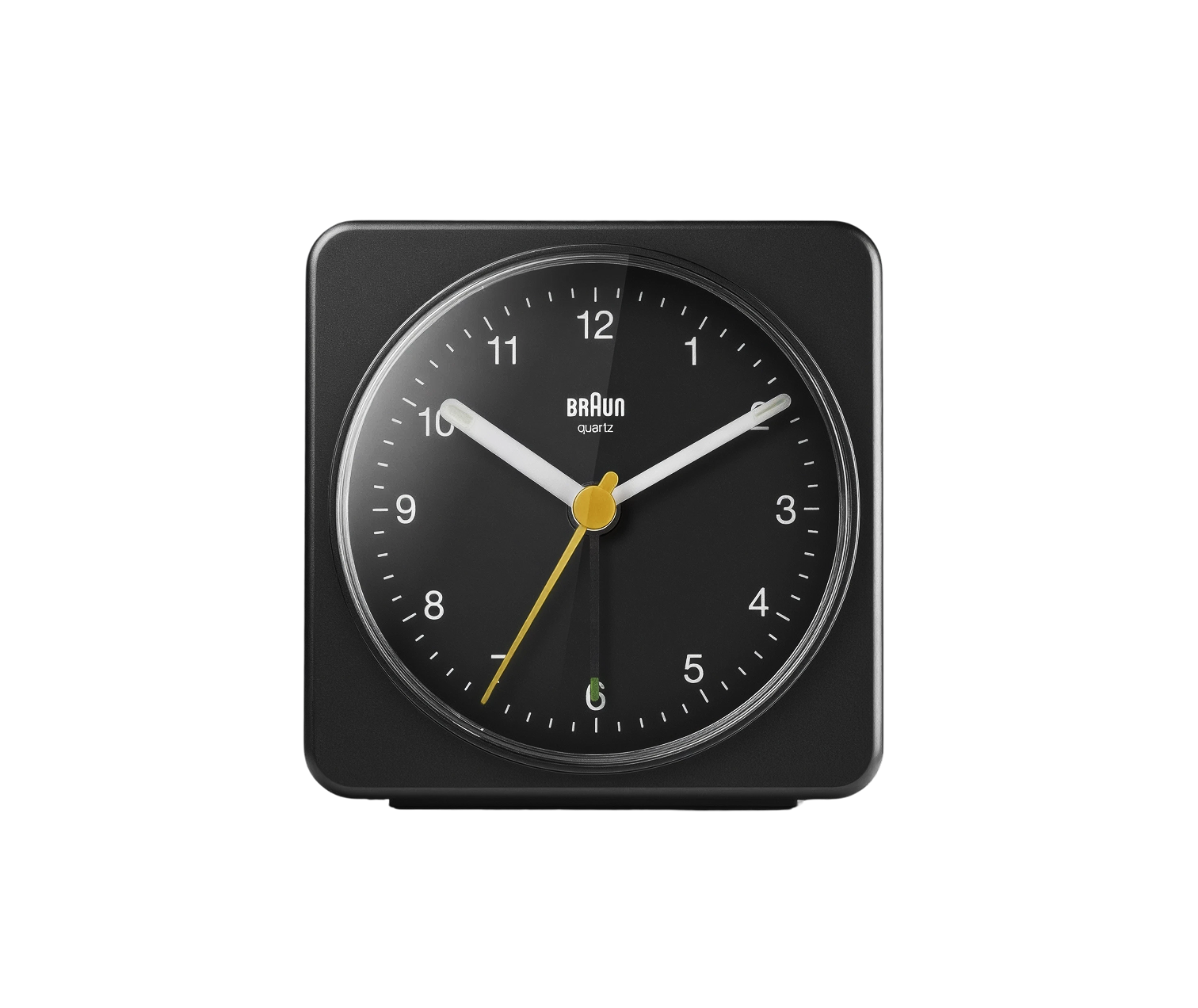
The shape of the AB 2 of 1984, a dial standing on two short legs, which Braun and MoMA's shop credit to Rams, and Core77's history of Braun clocks to Rams with Jürgen Greubel.
The AB 2 did away with the box most desk clocks sat in. The dial is the whole clock, and the sides of the case stretch back into a pair of feet, so it stands on the desk the way a photograph frame does. The BC22 keeps that silhouette at 97 mm tall, 85.6 mm wide and 42 mm deep.
The alarm is a crescendo beep that starts quiet and builds. The button on top does two jobs: it snoozes the alarm and lights the dial. A green marker shows on the face once the alarm is armed. A slider on the back can leave the light on whenever the room is dark, at the cost of battery life. The second hand is Braun yellow, the same yellow as the equals key on the calculator above, and the hands carry luminous tips.
It does as well on a desk as by a bed, and the alarm can stay off for good. The time is set from two knobs at the back, and each one turns in one direction only. The minimalist alarm clocks post covers its sibling, the smaller BC03, and the other bedside options.
3.Braun BC17 Wall Clock

The one pick here credited to Lubs alone: a reissue of his ABK 30 wall clock of 1982, drawn while Rams ran the department.
The BC17 is 30 cm across and about 4 cm deep, with the face of the original: plain numerals, plain hands, and nothing on the dial in colour except the yellow second hand. A hardened glass lens covers it, and the case is matt plastic in black or white.
The difference from the original is the movement. A standard quartz clock jumps its second hand once a second, and that jump is the tick you hear in a quiet room. The BC17's movement sweeps the hand round in a continuous glide, so the clock makes no sound. In a bedroom or a quiet office, that silence is what separates it from the cheaper clocks it resembles.
It runs on one AA cell, set from a knob at the back, and the instructions rule out rechargeable batteries. At 30 cm the hands are legible from the far side of a kitchen, the size a wall clock above a desk or a table needs to be.
4.Vitsoe 606 Universal Shelving System

Designed by Rams in 1960, when he was 28, and made by Vitsoe ever since, so a shelf bought this year fits a system bought in the 1960s.
The 606 is a rail on the wall and everything that hangs from it. The rail is the E-Track, an aluminium strip fixed to the wall, and shelves, cabinets and desks hook onto it with pins. Nothing needs a tool to move, and where a wall cannot take screws, the rail goes onto posts that stand on the floor or brace against the ceiling. A shelf goes up or down for taller books, and Vitsoe's children's desk is raised as the child grows. Shelves come in two widths, about 65 and 90 cm, and four depths from 16 to 36 cm.
The colours stay fixed on purpose. Vitsoe sells off-white, black, silver and beech, and says they will stay available, so a system can grow over decades without the new parts looking new. It sells direct, charges architects the same price as everyone else, and holds no seasonal sales, on the reasoning that stock that never goes out of date never needs clearing.
The price in the buy row is a starting point, since every 606 is planned for its wall. No other pick here needs planning, and none can grow into a whole wall of books, records and a desk. Vitsoe's planners, who work on no commission, draw it up with you.
5.Less and More: The Design Ethos of Dieter Rams

The catalogue of the Less and More retrospective that opened at the Suntory Museum in Osaka in 2008 and travelled to Tokyo, the Design Museum in London, Frankfurt and San Francisco, with every major object on the shelf above and the hundreds that are not.
It runs to 808 pages, in German and English in one volume, with a PVC cover in a slipcase, which is how the first edition was bound. Klaus Klemp and Keiko Ueki-Polet edited it, and Gestalten first published it in 2009 and reprinted it in 2015. The reason to own it is the sketches. Most Rams books show the finished objects on white; this one prints the sketches beside them, in colour and in black and white, so each object can be read as an argument worked out on paper first.
It also shows the scale of the work that the calculator, the clocks and the shelving above stand in for: radios, record players, shavers, lighters, projectors, the SK 4 radiogram and the Vitsoe furniture, over four decades at one company.
There are two other Rams books on this blog. The Complete Works from Phaidon is the illustrated register of everything he designed, and Less But Better is in the design books post. Less and More is the one built around the drawings.
How we chose
We looked for objects that came out of Dieter Rams's own hands or his Braun design department and are still made new today, by Braun under licence or by Vitsoe, the company that has made the 606 since he drew it. Vintage originals were left out, and so were objects that only borrow the look. That left four, from a $30 calculator to a shelving system planned wall by wall, and we added one book for the work that is no longer made. Because shop listings credit nearly everything to Rams, each section names the designer the sources agree on, and where they disagree, as on the AB 2 clock the BC22 copies, both credits are given. Sizes and dates come from two independent sources each: Braun's own listings, Vitsoe's site, museum records and design retailers. Where those disagreed, as on the calculator's measurements, the figure was left out. These are bought for their design history and how they look in a room, so there is no comparison table.
Common questions
Yes. Braun reissues the ET66 calculator as the BNE001, and sells clocks drawn in the 1980s under Rams, including the BC22 alarm clock from his AB 2 of 1984. Vitsoe has made his 606 Universal Shelving System continuously since 1960, along with his 620 chair and 621 side table. Most of his Braun electronics, like the SK 4 radiogram, are only available vintage.
Not directly. The calculator app on the first iPhone in 2007 was modelled on the Braun ET66, which Rams and Dietrich Lubs drew in 1987: round keys, the operations set apart by colour, and a single highlighted equals key. Braun has reissued the ET66 as the BNE001 since 2013.
A Braun designer who worked in the department Rams ran, and the name behind many of its clocks and calculators. He drew the ABK 30 wall clock of 1982, reissued today as the Braun BC17, and co-designed the ET66 calculator with Rams in 1987.
Every 606 is planned for its wall and built from an aluminium rail with shelves, cabinets and desks hung on it, so there is no fixed price. Vitsoe sells direct, charges everyone the same, holds no sales, and keeps the same colours available so a system bought now can be added to decades later.
It depends what you want from it. Less and More, edited by Klaus Klemp and Keiko Ueki-Polet, is the 808 page catalogue of his 2008 retrospective and prints the sketches beside the products. Phaidon's Dieter Rams: The Complete Works lists every product he designed, and Less But Better is the short book in his own words.
About the author

Justin Farrugia
Founder & Editor of Curated Supply
Justin Farrugia is the founder and editor of Curated Supply, a design-led directory to things worth owning. He has personally curated over 1,000 products across workspace, carry, coffee, audio, and the home, each judged against one standard: design intent, material quality, and the restraint that lets a thing last.