Staff Pick

About
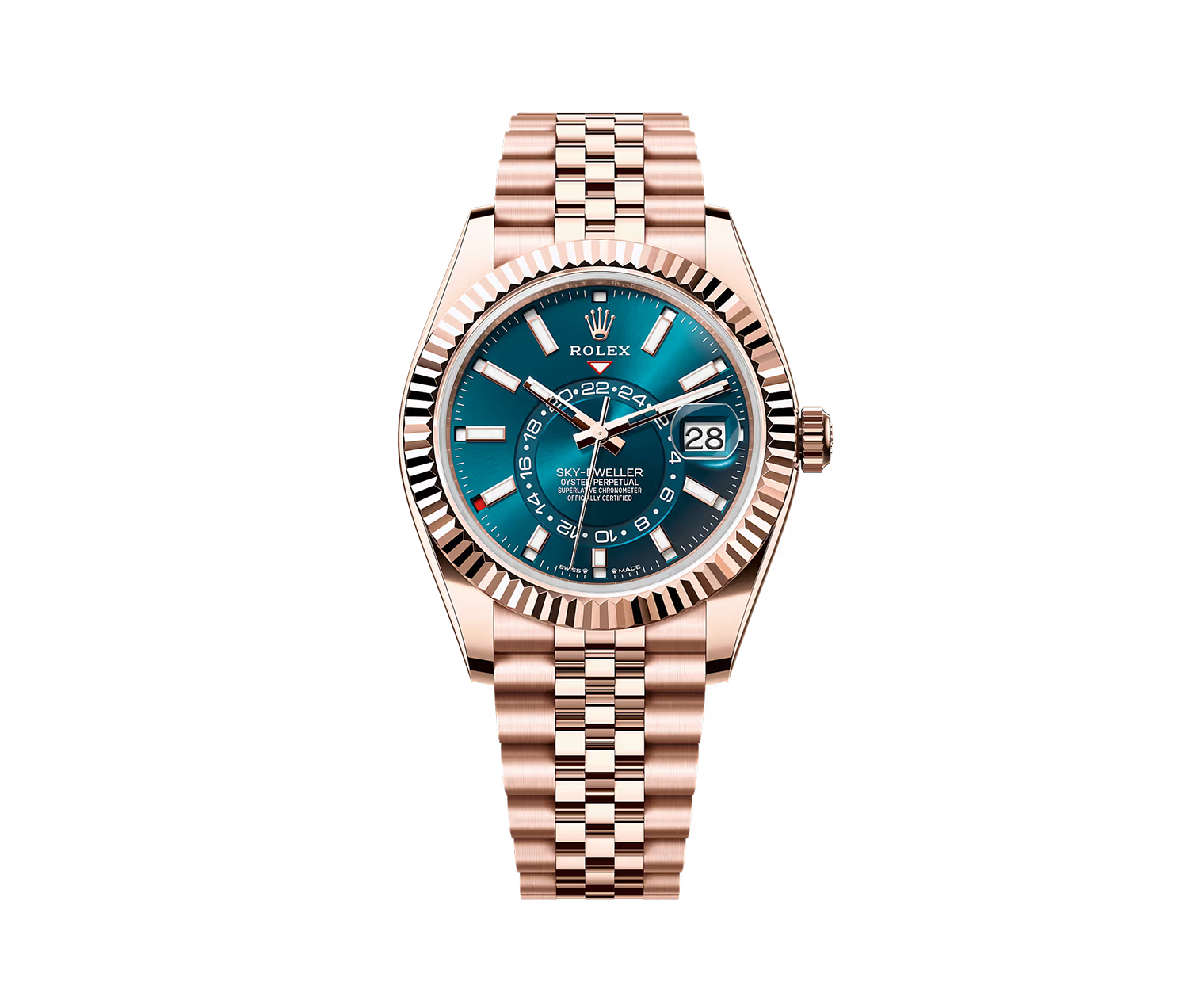
Most of what people read as Rolex styling started out as engineering. The fluting on a Datejust bezel was not decoration but grip: the notches gave a Rolex tool something to bite on while screwing the bezel down onto the case for waterproofness, which is why the same fluting appears on the case back, where nobody was meant to admire it.
The Rolex Datejust arrived in 1945 as the first watch to bring together a chronometer-certified self-winding movement, the waterproof Oyster case and an automatically changing date in a window at 3 o'clock. The date mechanism is instantaneous. Rather than creeping forward through the small hours, the disc jumps to the next number in a single motion, and the Cyclops lens set into the sapphire crystal magnifies it, a feature Rolex invented for no other reason than making the date readable at a glance. The current 36 millimetre reference runs calibre 3235, wound in both directions by a Perpetual rotor.
Every Datejust is a Superlative Chronometer, which means it is tested for accuracy after the movement has been cased rather than on its own, and held to -2/+2 seconds a day in that finished state. The Jubilee bracelet, the supple five-piece-link design most Datejusts wear, was drawn up specifically for the 1945 launch and has never really left. Cases come in Oystersteel, in gold, or in Rolesor, the steel-and-gold pairing Rolex has been building since the early 1930s and trademarked in 1933. Churchill, Eisenhower and Martin Luther King all wore one, which tells you less about the watch than about the century it spent being the default answer to the question of what a watch should be.
- Designed in
- Switzerland

- Case
- Oyster, 36 mm, screw-down crown and case back
- Movement
- Calibre 3235, self-winding, -2/+2 sec/day
- Power reserve
- About 70 hours
- Water resistance
- 100 metres (330 feet)
- Crystal
- Sapphire with Cyclops date lens
- Materials
- Oystersteel, gold or Rolesor
Figures as published by the manufacturer. Source