Royal Oak
 Staff Pick
$21,500
About
Steel is what a watch brand reaches for when it wants to sell you something cheaper. In 1972 Audemars Piguet reached for it and charged 3,300 Swiss francs, more than the 2,990 francs one of the firm's own gold watches sold for that same year.
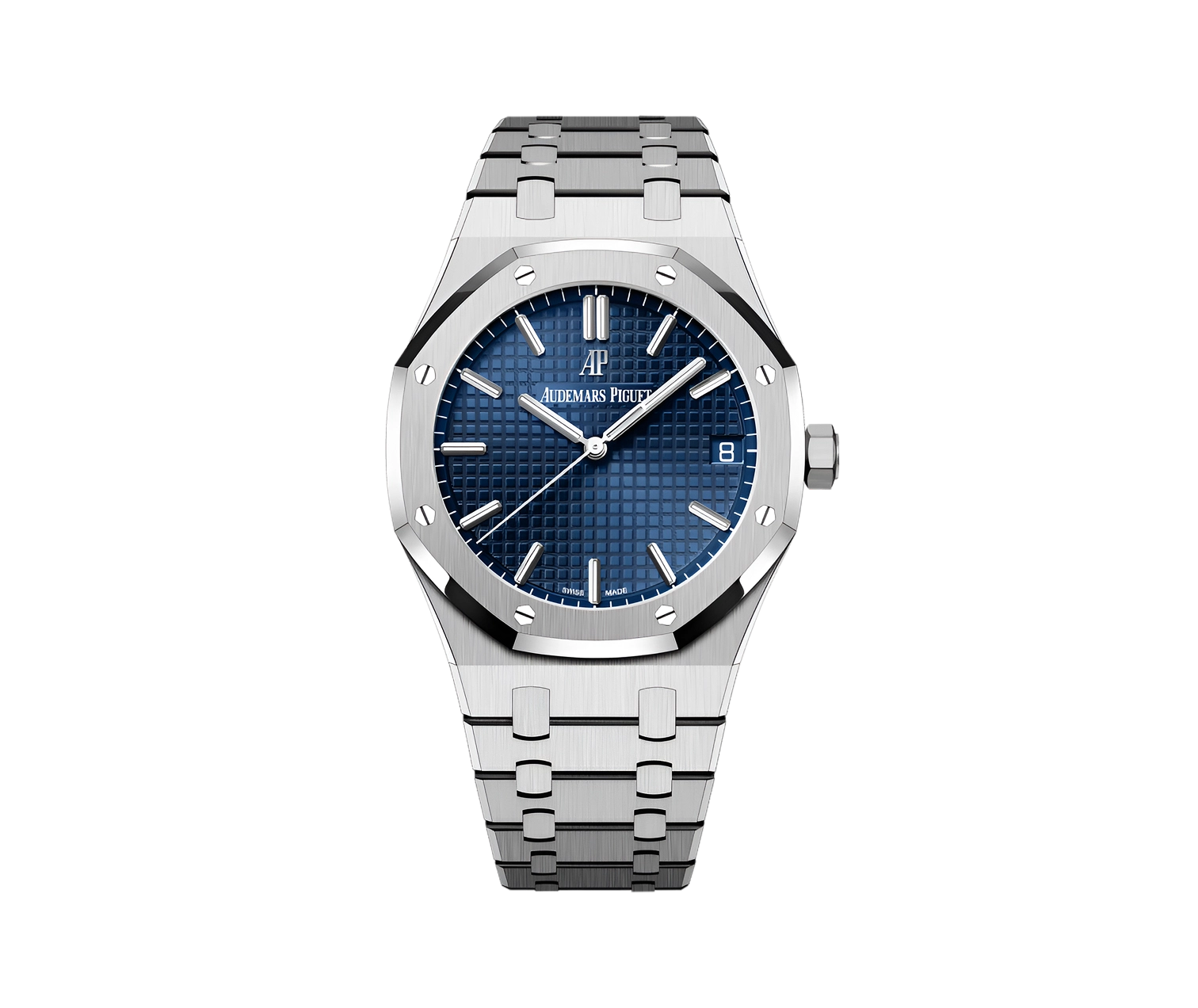
Fine watches then were small, round and precious. Audemars Piguet asked Gerald Genta, a jeweller by training, for a steel sports watch of a kind nobody had built, and he drew it in a single night: an octagonal bezel held down by eight visible hexagonal screws, the water-resistance gasket left in plain sight rather than hidden under the crystal, and a bracelet tapering straight out of the case instead of hanging off lugs. None of it was easy to make. The case went to Favre & Perret, the dial's pattern of truncated pyramids to Stern Freres, and the bracelet, 154 components in 34 different sizes, to Gay Freres in Geneva. Inside sat calibre 2121, at 3.05 millimetres the thinnest selfwinding movement then made. It launched at the Basel Fair in April 1972 and 490 were sold before the year was out.
The steel Royal Oak Selfwinding 41 millimetre carries that recipe forward in a case 10.5 millimetres thick, water resistant to 50 metres, with the Grande Tapisserie dial in the original's Bleu Nuit, Nuage 50 shade and white gold hour markers. The selfwinding calibre 4302 keeps running for 70 hours once you take it off. More than 500 versions have followed the first one, which is a lot of variation on a shape drawn overnight, and the argument the Royal Oak started, that a material can be luxurious because of how hard it is to finish rather than what it costs by the gram, is one the watch industry has been repeating ever since.
- Designed & made in
- Switzerland

- designer
- Gerald Genta
- Materials
- Case
- Stainless steel, 41 mm
- Movement
- Selfwinding calibre 4302
- Power reserve
- 70 hours
- Water resistance
- 50 m
- Thickness
- 10.5 mm
- Colour
- Bleu Nuit, Nuage 50 Grande Tapisserie dial
Figures as published by the manufacturer. Source