Luxury dress watches, from Tudor to Jaeger-LeCoultre
Luxury dress watches from the Tudor Monarch to the Jaeger-LeCoultre Master Control Perpetual Calendar, four of them new for 2026, compared on movement and fit.
Luxury dress watches had an unusually busy 2026. Four of the six here were introduced this year, and between them they show what the money buys as it climbs: first a better movement, then a stricter certificate, then a precious metal, and at the very top a complication that does arithmetic you would otherwise do yourself.
A dress watch is traditionally thin, quiet and made to sit under a shirt cuff. The six here stretch that from a 9.2 mm perpetual calendar to a 14 mm travel watch that Rolex files under its classic collection. The thinnest is not the cheapest, which says something about where the difficulty actually lies.
Every one is mechanical and self-winding, and every one carries a chronometer certificate of some kind. What those certificates mean is in the guide after the picks.
1.Tudor Royal
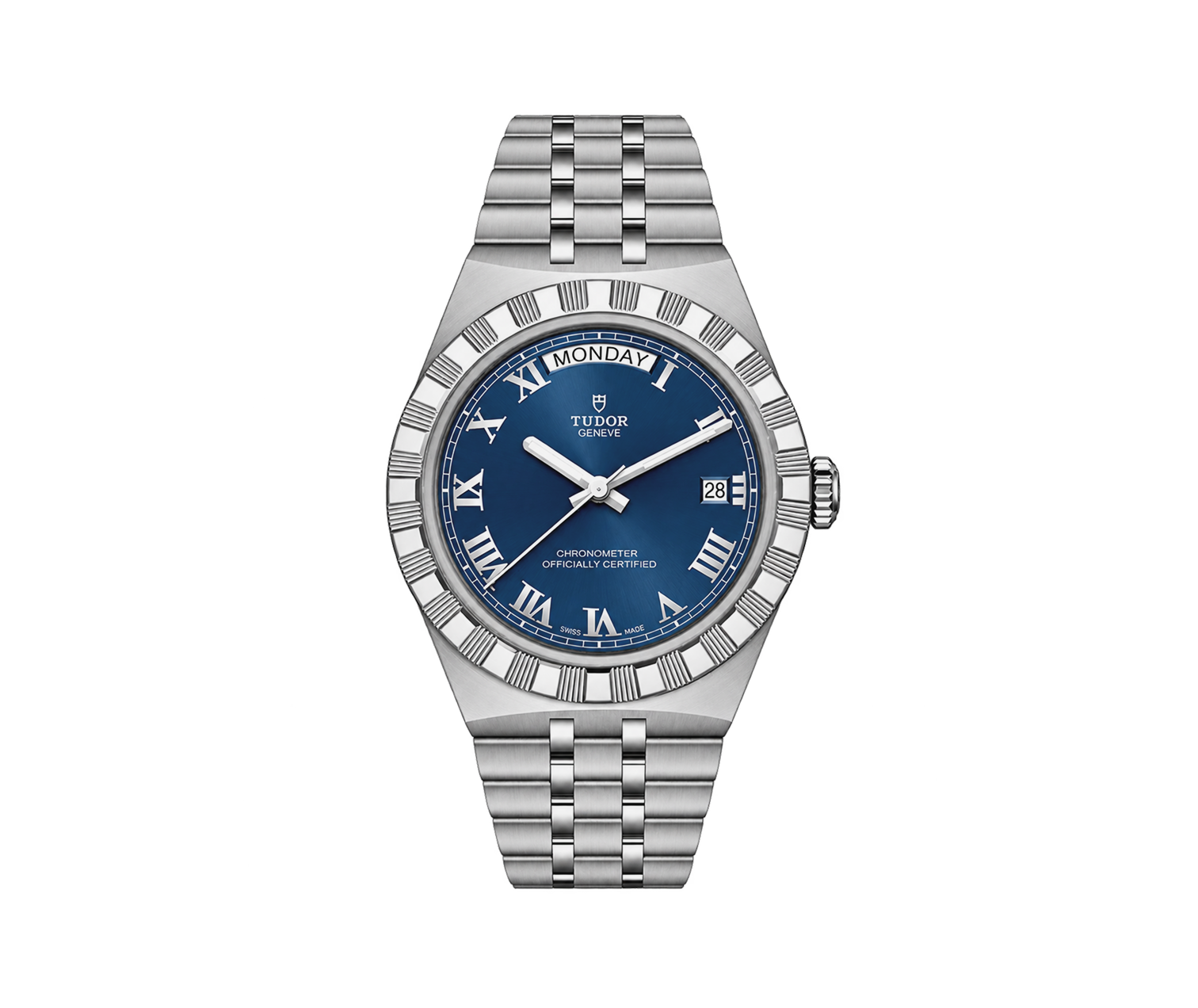
An integrated five-link bracelet on a 40 mm case, with the day spelled out at twelve and a 70-hour movement under it.
Tudor rebuilt the Royal for 2026 in three sizes, and each size gets its own function and its own calibre. The 30 mm tells the time, the 36 mm adds a date, and the 40 mm, the one pictured, adds the day. It runs Tudor's manufacture MT5633, certified by COSC and then regulated by Tudor to between two seconds slow and four fast a day, tighter than the COSC standard of minus four to plus six.
The movement uses a silicon hairspring, which magnetism cannot bend out of shape, and a balance bridge fixed at both ends for shock resistance. A phone, a laptop lid or a handbag clasp carries enough magnetism to make an ordinary steel hairspring run fast, so this matters more in daily life than the certificate does.
The bracelet is the part Tudor reworked most. The 2026 version redesigns the end links so the bracelet never touches the case, which stops the two rubbing each other dull, and the clasp is Tudor's T-fit. The bezel carries polished notches that catch light at the edges. Water resistance is 100 m, and the case measures 11.4 mm thick by press measurement, since Tudor does not publish the figure.
Tudor's guarantee runs five years and transfers to the next owner with no registration. A Roman dial on a steel bracelet, rated to 100 m: it is the one here that goes to the beach as easily as to dinner.
- Reference
- M2840D1A0-0002, blue dial
- Movement
- Tudor MT5633, automatic, day and date
- Power reserve
- About 70 hours
- Certification
- COSC, regulated by Tudor to -2/+4 seconds a day
- Case
- 40 mm, stainless steel
- Water resistance
- 100 m
Specifications as published by the manufacturer. Source
2.Omega De Ville Prestige

A 41 mm small seconds on black leather, 10.77 mm thick and rated to only 30 m, which is dress-watch territory in the strict sense.
The De Ville Prestige has been in Omega's catalogue since 1994, and the current one is its third generation. The model pictured is reference 434.13.41.20.02.001, a silver dial with the running seconds in their own small dial above six and a date at three. Its movement is the self-winding calibre 8802, and the whole case stays slim enough to sit beneath a cuff.
The certificate is the strict one. Omega's Master Chronometer standard is tested by METAS, the Swiss federal metrology institute, across eight tests: the cased watch has to run between zero and five seconds fast a day and keep doing it after exposure to a 15,000 gauss magnetic field. That is far beyond anything a phone, a speaker or a bag clasp produces. The escapement is Omega's Co-Axial, which cuts the sliding friction at the heart of an ordinary lever escapement and lets service intervals stretch further apart.
Power reserve is 55 hours. Sapphire on both sides, the front domed and treated against reflection on the inside, so the outside keeps its hardness.
The Prestige range is wider than the photograph suggests. Quartz versions at 27.5 and 30 mm start lower and last four years on a battery, and automatics run from 40 mm. This one is the model the range was built around.
- Reference
- 434.13.41.20.02.001, silver dial, leather
- Movement
- Omega Co-Axial Master Chronometer 8802, small seconds
- Power reserve
- 55 hours
- Certification
- METAS Master Chronometer, 15,000 gauss
- Case
- 41 mm, 10.77 mm thick, stainless steel
- Water resistance
- 30 m
Specifications as published by the manufacturer. Source
3.Tudor Monarch
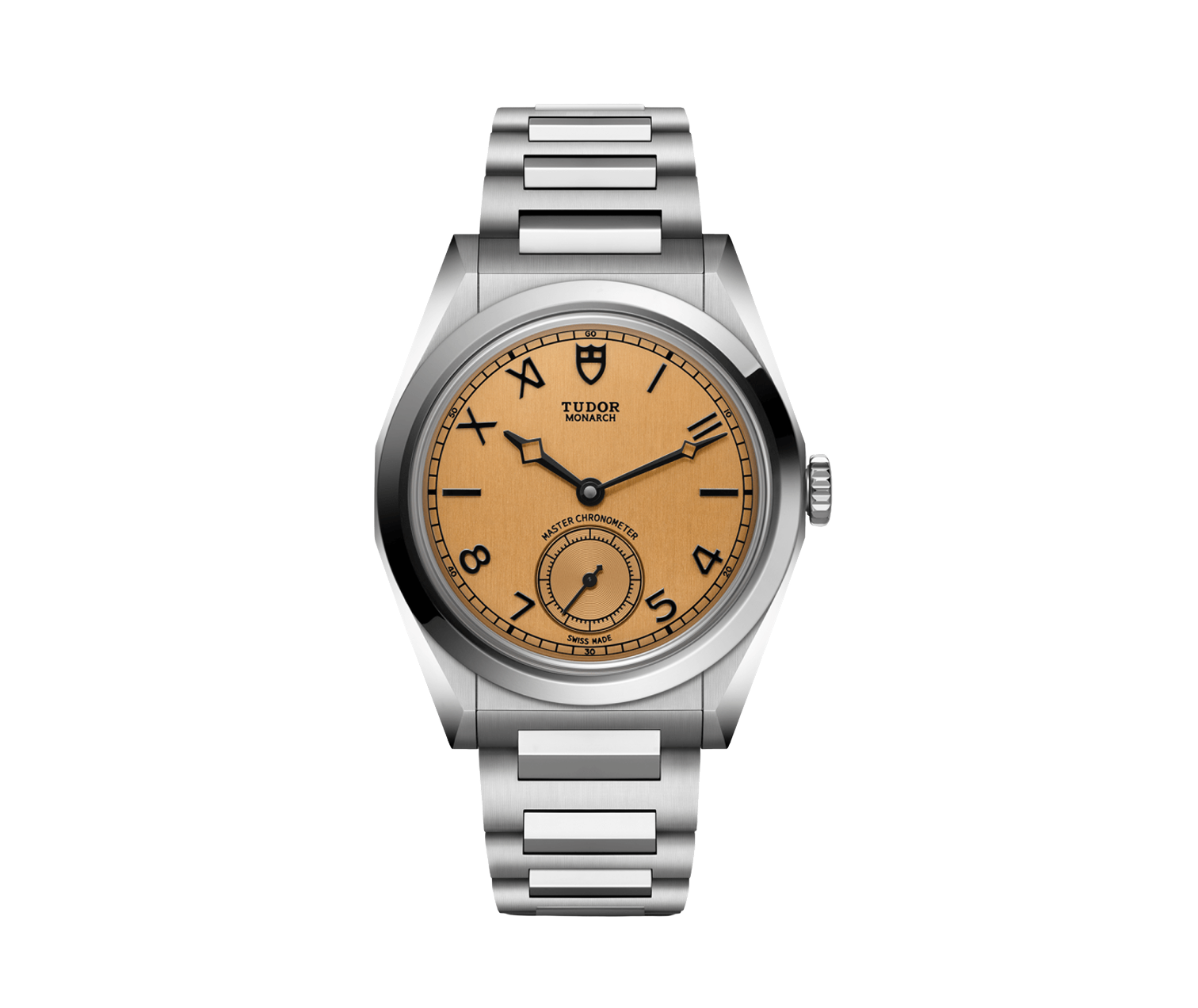
Roman numerals from ten to two and Arabic from four to eight, a mixed layout collectors call a California dial.
The Monarch launched at Watches and Wonders 2026 for Tudor's centenary. The name was registered for Rolex founder Hans Wilsdorf in 1926, and the watch shares only that name and the shield at twelve with the Monarchs of the 1990s. The case is 39 mm in faceted steel, with box-shaped sapphire crystals front and back, the stepped shape vintage plexiglass crystals had.
Tudor likens the champagne dial's colour and grain to papyrus. The small seconds sits above six. Inside is the MT5662-2U, certified twice: by COSC as a chronometer and by METAS as a Master Chronometer, the same standard as the Omega above, resistant to 15,000 gauss. Power reserve is 65 hours, which Tudor calls weekend-proof: take it off on Friday evening and it is still running on Monday morning.
The movement behind the display back is the most finished Tudor has shown. It carries Côtes de Genève stripes and perlage, with an 18 ct gold inlay on the rotor, decoration Tudor usually leaves to its parent company. One reviewer singled out a stamped pallet fork bridge as the place the finishing stops.
At 11.9 mm thick and 100 m water resistant it wears closer to a sports watch than the Omega does. The clasp adjusts 8 mm across five positions without tools, for the days a wrist swells in the heat.
- Reference
- M2639W1A0U-0001, champagne dial
- Movement
- Tudor MT5662-2U, automatic, small seconds
- Power reserve
- 65 hours
- Certification
- COSC and METAS Master Chronometer
- Case
- 39 mm, faceted stainless steel
- Water resistance
- 100 m
Specifications as published by the manufacturer. Source
4.Omega Constellation Observatory
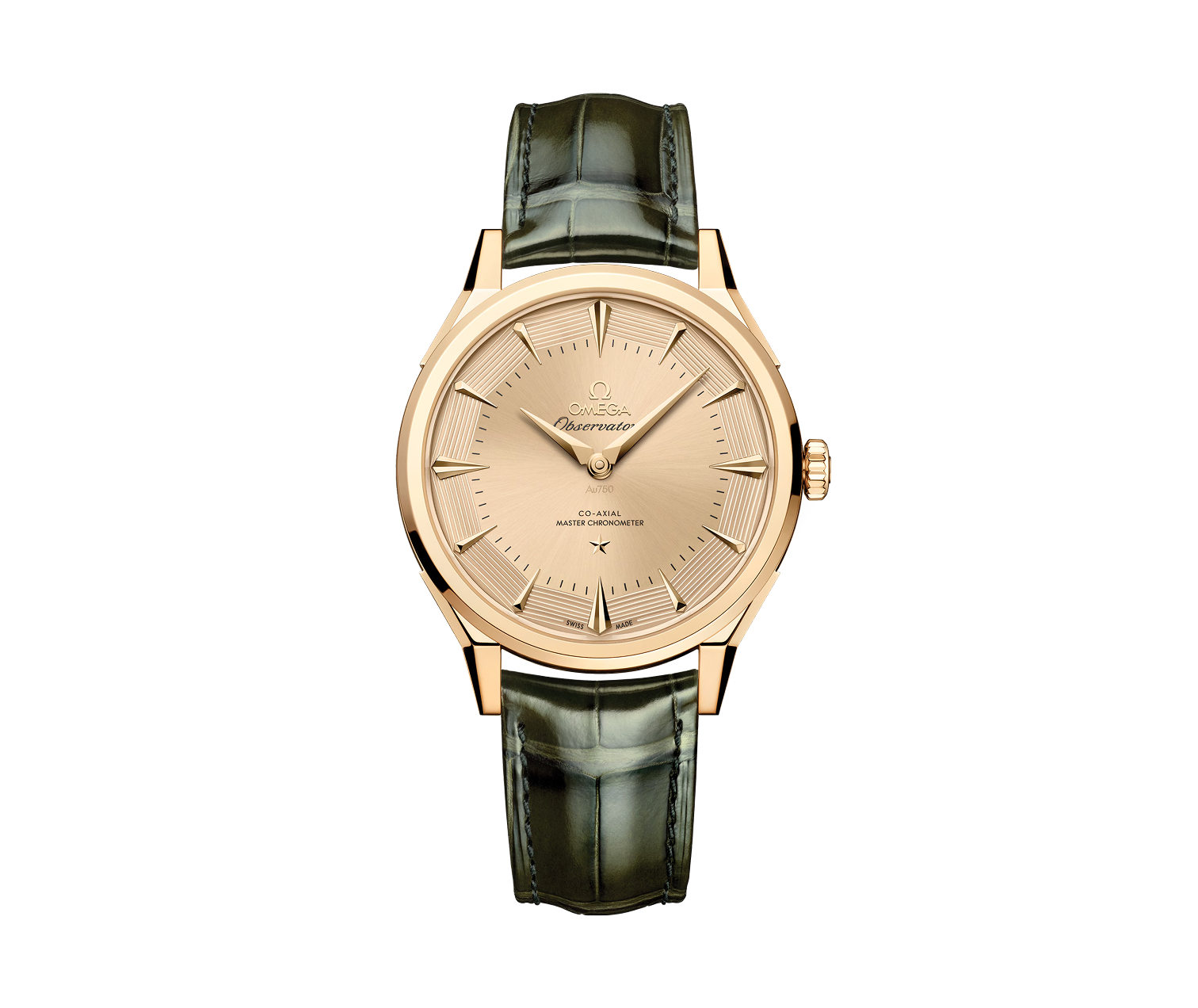
The first two-hand watch to pass Master Chronometer certification, which meant inventing a way to time a watch with no seconds hand.
Chronometer testing normally reads the seconds hand. The Constellation Observatory has only hours and minutes, so Omega's Laboratoire de Précision developed a method that times the movement by listening to it, then ran 25 days of its own testing on top of METAS. The calibre is the 8915, with two barrels in series and 60 hours of reserve. The hour hand also jumps on its own without stopping the watch, so changing time zone takes a few seconds.
The design is a collage of the line's own history, each piece dated. The pie-pan dial, faceted like an upturned dish, comes from 1952, the year the Constellation launched; the guilloché facets from 1953; the dog-leg lugs from 1956; the two-hand layout from a 1948 model. The observatory emblem and its eight stars record Omega's chronometer trial wins between 1933 and 1952.
The case is 39.4 mm and 12.23 mm thick in Moonshine gold, Omega's own 18 ct alloy of gold with silver, copper and palladium, paler than classic yellow. It is also the first time Omega has used Moonshine gold inside a movement, on the skeletonised rotor and the balance bridge. The same watch exists in steel with the 8914 calibre. What separates the two is the gold in the case, the dial, the hands and the movement.
It sits on green alligator and is rated to 30 m, a watch for the evening in the old sense.
- Reference
- 140.53.39.21.99.001, Moonshine gold
- Movement
- Omega Co-Axial Master Chronometer 8915, hours and minutes
- Power reserve
- 60 hours
- Certification
- METAS Master Chronometer plus 25 days of Omega's own testing
- Case
- 39.4 mm, 12.23 mm thick, 18 ct Moonshine gold
- Water resistance
- 30 m
Specifications as published by the manufacturer. Source
5.Jaeger-LeCoultre Master Control Chronometre Perpetual Calendar
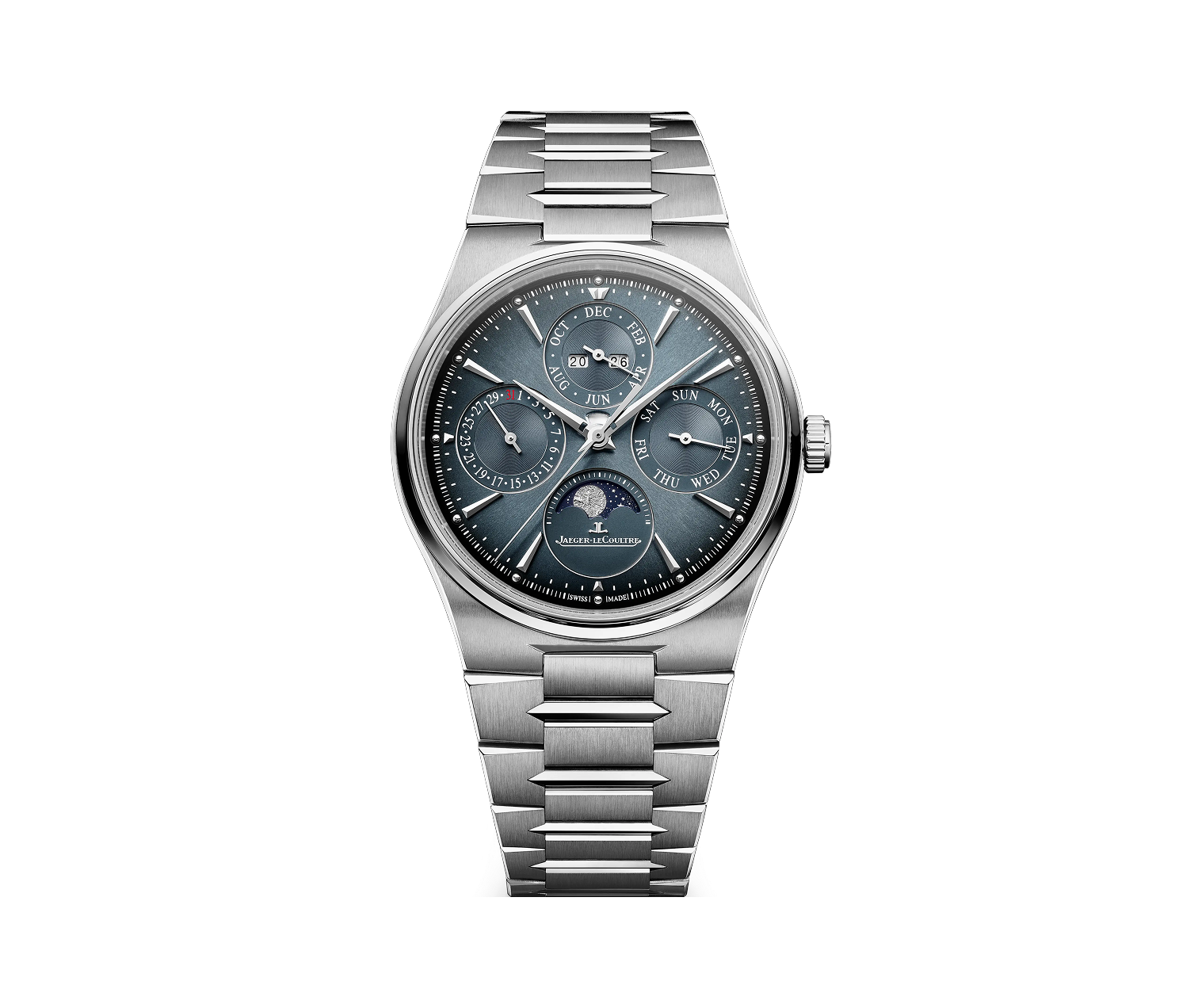
A perpetual calendar in a case 9.2 mm thick, the thinnest watch here and the most complicated.
A perpetual calendar knows how many days each month has, including February in a leap year, so the date never needs correcting. This one is programmed to stay right until 2100, when the Gregorian calendar skips a leap year. Jaeger-LeCoultre fits that into calibre 868, 332 components in a movement 4.72 mm thick, and shows it on four sub-dials: month and leap year at twelve, day at three, date at nine, moon phase at six. A single corrector on the case side adjusts everything.
The Master Control name dates to 1992 and the 1,000 Hours Control, a test of finished, cased watches when most makers tested only the movement. The 2026 version carries COSC certification and JLC's High Precision Guarantee, three days of simulated wear on the cased watch: wrist positions, pressure, temperature and shocks, with two weekdays and a weekend day in the cycle.
The case is 39 mm in steel on an integrated three-row bracelet, with a buckle that lengthens slightly for summer. Even in steel the open-worked rotor is 22 ct pink gold, visible through a sapphire back, and reserve is 70 hours. Water resistance is 50 m.
It is new this year and listed for pre-order, so availability at authorised dealers is thin. It is the one watch here that hides how much is inside it.
- Reference
- Q4178180, steel
- Movement
- Jaeger-LeCoultre 868, automatic perpetual calendar, 332 parts
- Power reserve
- 70 hours
- Certification
- COSC plus Jaeger-LeCoultre High Precision Guarantee
- Case
- 39 mm, 9.2 mm thick, stainless steel
- Water resistance
- 50 m
Specifications as published by the manufacturer. Source
6.Rolex Sky-Dweller
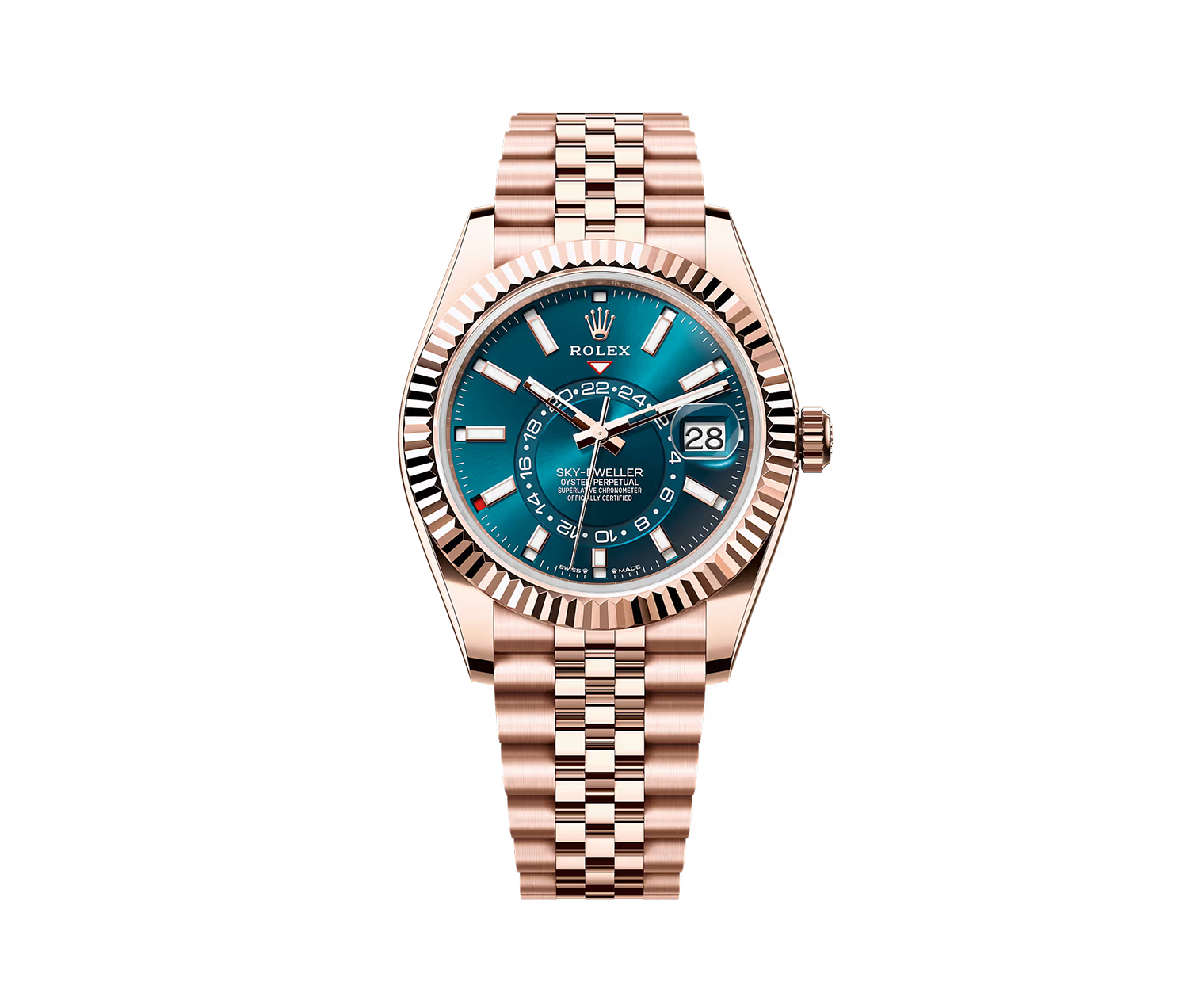
A second time zone and an annual calendar, both set from a turning bezel, in solid Everose gold from case to clasp.
The Sky-Dweller arrived in 2012 as Rolex's watch for frequent travellers, and it stretches the idea of a dress watch. Rolex files it in its Classic collection beside the Day-Date. It is also 42 mm across and about 14 mm thick, with a screw-down crown and 100 m of water resistance, so it reads as a statement worn with a suit more than a watch hidden under one.
The calendar is the clever part. Rolex calls it Saros, and it needs correcting once a year, on 1 March, because it knows the length of every month except February. The month shows as a red window in one of twelve apertures around the dial edge. The home time zone runs on an off-centre disc, read against a fixed red triangle, so there is no arithmetic. Turning the fluted bezel, which Rolex calls Ring Command, chooses whether the crown sets the date, the local time or the home time.
Calibre 9002 replaced the 9001 in 2023 and runs about 72 hours. Rolex certifies it as a Superlative Chronometer, two seconds either way a day after casing, the tightest standard here. Everose is Rolex's own pink gold, cast in its own foundry since 2005, and this 2024 version was among the first Sky-Dwellers on a precious-metal Jubilee bracelet, with ceramic inserts inside the links to stop wear.
The same watch exists in steel and white gold. This one is gold from the case to the last link of the Jubilee.
- Reference
- 336935, Everose gold on Jubilee
- Movement
- Rolex 9002, automatic, second time zone and annual calendar
- Power reserve
- About 72 hours
- Certification
- Superlative Chronometer, -2/+2 seconds a day after casing
- Case
- 42 mm, 18 ct Everose gold
- Water resistance
- 100 m
Specifications as published by the manufacturer. Source
What the certificates actually mean
COSC
The Swiss chronometer testing office checks the uncased movement over 15 days in five positions and three temperatures. The standard is minus four to plus six seconds a day. Every watch here passes it or something stricter.
METAS Master Chronometer
METAS tests the finished, cased watch, which COSC does not, to zero to plus five seconds a day, and after exposure to 15,000 gauss. The Omegas and the Tudor Monarch carry it.
Maker standards
Rolex's Superlative Chronometer is plus or minus two seconds a day after casing. Tudor regulates the Royal's movement to minus two to plus four. Jaeger-LeCoultre's High Precision Guarantee simulates three days on a wrist. Each is a maker grading its own work, published and checkable.
Thickness and the cuff
Under a shirt cuff, thickness matters more than diameter. Around 10 mm slides under most cuffs. Past 12 mm, a fitted cuff starts to catch on it. The Jaeger-LeCoultre at 9.2 mm and the Omega Prestige at 10.77 mm are the two here that disappear.
Dress watches under four figures, from the Timex Easy Reader to the Seiko Presage, are in dress watches under $1,000.
All 6 compared
Tudor RoyalDay-date on a bracelet- Movement
- MT5633
- Reserve
- 70 h
- Case
- 40 mm
- Water
- 100 m
Omega De Ville PrestigeThin, strict dress watch- Movement
- Calibre 8802
- Reserve
- 55 h
- Case
- 41 mm
- Water
- 30 m
Tudor MonarchCentenary, California dial- Movement
- MT5662-2U
- Reserve
- 65 h
- Case
- 39 mm
- Water
- 100 m
Omega Constellation ObservatoryTwo hands, Moonshine gold- Movement
- Calibre 8915
- Reserve
- 60 h
- Case
- 39.4 mm
- Water
- 30 m
Jaeger-LeCoultre Master Control Chronometre Perpetual CalendarThinnest and most complicated- Movement
- Calibre 868
- Reserve
- 70 h
- Case
- 39 mm
- Water
- 50 m
Rolex Sky DwellerTravel complication, solid gold- Movement
- Calibre 9002
- Reserve
- 72 h
- Case
- 42 mm
- Water
- 100 m
Thickness is in the prose and the panels only where the maker publishes it: Tudor and Rolex do not, so their figures come from press measurements and stay out of the table.
How we chose
We chose these six to show what each step up in a luxury dress watch actually buys: a better movement, a stricter certificate, a precious metal, then a complication. Every one is mechanical and certified. Each figure is quoted from the maker's own page for the exact reference pictured and checked against watch press or an authorised dealer. Tudor and Rolex do not publish case thickness, so those numbers are labelled as press measurements in the prose and left out of the specifications.
Common questions
Traditionally a thin case that slides under a shirt cuff, a simple dial, modest water resistance and a leather strap or a fine bracelet. Around 10 mm thick is the usual threshold. The Jaeger-LeCoultre Master Control here is 9.2 mm and the Omega De Ville Prestige 10.77 mm; the Rolex Sky-Dweller, at about 14 mm, is a dressy travel watch.
COSC tests the uncased movement over 15 days to minus four to plus six seconds a day. METAS Master Chronometer tests the finished, cased watch to zero to plus five seconds a day and after exposure to a 15,000 gauss magnetic field. The Omegas and the Tudor Monarch carry both.
A calendar mechanism that knows the length of every month, including February in leap years, so the date never needs correcting. The Jaeger-LeCoultre Master Control Chronometre Perpetual Calendar is programmed to stay right until 2100. An annual calendar, like the Rolex Sky-Dweller's, needs one correction a year, on 1 March.
Rolex files it in its Classic collection beside the Day-Date, and makes it in solid gold on a Jubilee bracelet. It is also 42 mm, about 14 mm thick and rated to 100 m, and Rolex markets it first to travellers. It is the statement end of a dress collection more than a watch that hides under a cuff.
The Tudor Royal in its new 30, 36 and 40 mm sizes, the Tudor Monarch for Tudor's centenary, the Omega Constellation Observatory and the Jaeger-LeCoultre Master Control Chronometre Perpetual Calendar. The Everose Sky-Dweller on a Jubilee bracelet dates from 2024.
About the author

Justin Farrugia
Founder & Editor of Curated Supply
Justin Farrugia is the founder and editor of Curated Supply, a design-led directory to things worth owning. He has personally curated over 1,000 products across workspace, carry, coffee, audio, and the home, each judged against one standard: design intent, material quality, and the restraint that lets a thing last.