Coffee table books about cars, from Porsche to Ferrari
Five Porsche and Ferrari coffee table books, from teNeues' 192-page 911 Book to Type 7's Artifacts, which photographs the parts instead of the cars.
Porsche and Ferrari coffee table books divide into two kinds, and the divide is not price. Most of them photograph the cars. One photographs the parts, the ledgers and the tools that built them, and it is the most interesting book of the five.
Four of these are marque books. The fifth is a survey that puts both makes among six hundred others, which is a useful corrective if you only ever look at two. The wider shelf sits in coffee table books that work on any surface.
1.TeNeues The Porsche 911 Book

Six decades of one shape, shot in the same studio light, which is what makes the generations genuinely comparable.
René Staud works in a controlled studio instead of on location. That choice is the whole book. A location photograph records the weather, the tarmac and the time of day along with the car, and all three change between shoots. Strip them out and what is left on the page is shape alone, so a 1963 original and a current 992 can be read against each other line for line.
192 pages, published by TeNeues as a revised version of a 2013 book, with text by Jürgen Lewandowski. It runs in English, German and French in the same volume, which is why the captions are short. Three languages on one page leaves room for a caption and not for an essay.
Check the ISBN before you order. The original 2013 printing sold around 40,000 copies and is still listed everywhere, so the two sit side by side in search results at similar prices. Only the revised edition, 9783961713097, reaches the 992. Buy the older one by accident and the last decade of the car is missing.
At 240 by 195 millimetres it is the only book here you can hold in one hand, and at thirty-five dollars it costs under a tenth of the Type 7 volume. That combination matters more than it sounds. This one gets pulled down and opened, which is a different kind of ownership from the books below.
2.Welbeck A Dream in Red
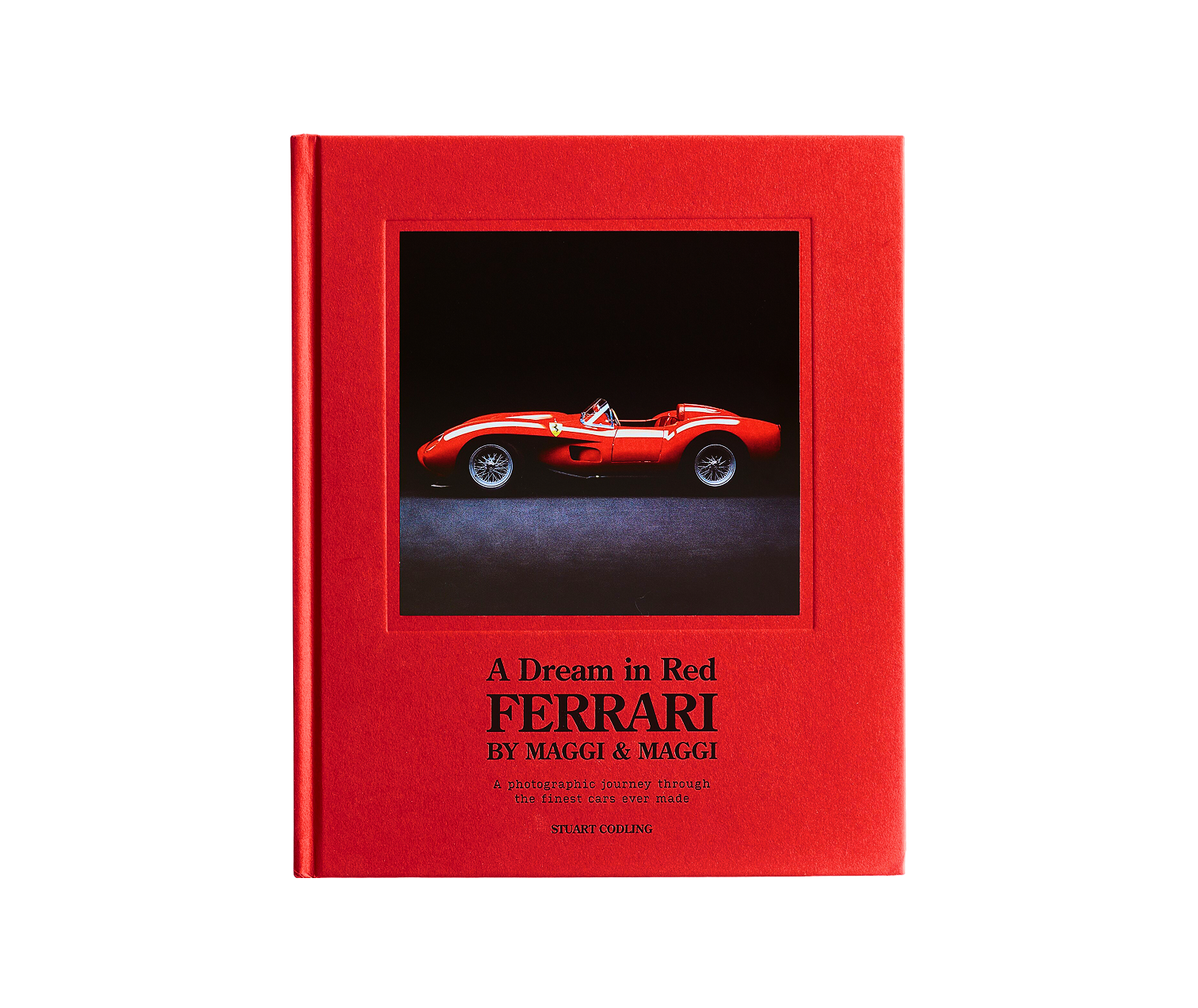
Built from a forty-year project to photograph every Ferrari model, an archive of roughly 100,000 images.
The distinction that matters is between a commissioned book and an archive book. A commissioned book starts with a shot list. A Dream in Red starts with the Maggi & Maggi archive, so its shape follows what forty years of shooting actually produced, and the sequence begins where the marque does, at the 125 S of 1947.
320 pages from Welbeck, with the model-by-model text written by Stuart Codling. Just over 300 images cover more than 150 cars, which is a ratio worth pausing on: roughly two photographs per car, selected out of an archive of a hundred thousand. Almost everything got cut. The images carry the book and the writing stays out of their way.
The range is what fifty dollars buys. It opens at the 125 S of 1947, the first car to wear the name, and runs through the 250 GTO, the F40 and the Enzo to the modern cars. Books that pick a decade go deeper on it. This one is the only volume here that will answer a question about a Ferrari you have not thought of yet.
It is the most marque covered per page of anything on this list, and the one to buy if you want the whole of Ferrari in a single volume.
3.Phaidon The Atlas of Car Design

Organised by country first and by decade second, so national design habits become visible where marque histories hide them.
That structure is the argument. Group cars by manufacturer and you get a set of brand stories that never touch. Phaidon groups them geographically then chronologically, which sets a French car from the 1930s beside the cars it was actually competing with, and the shared assumptions of a place and a decade come out of the page on their own.
568 pages and 750 illustrations covering more than 650 designs, from over 190 manufacturers across more than 30 countries, assembled by Jason Barlow with Guy Bird and an introduction by Brett Berk. It starts in 1893 and runs to the present, which means the first hundred pages are about cars that had not yet agreed on where the engine goes.
Phaidon publishes it in two versions and they are easy to confuse. The Onyx Edition is 9781838665999, black-jacketed, and the one linked here. The standard edition is 9781837290659. Same contents, different jacket, and the listings rarely say which is which.
At 340 by 240 millimetres this is the volume that earns a table instead of a shelf. It is also the only book here that is not about Porsche or Ferrari, and the one that will change how you look at the other four.
4.Taschen Ferrari

688 pages at 28 by 37.4 centimetres, the largest book here that one person can still carry.
Format is what you are paying for. A full-bleed car at 37 centimetres holds detail that a 24 centimetre page throws away: panel gaps, the weave in a seat, the way light travels down a wing. That is the entire case for XL publishing and Taschen makes it better than anyone.
Edited by Pino Allievi, first published as a signed Collector's Edition and now sold unlimited. It weighs 5.94 kilograms. One thing worth knowing before you buy: Taschen also publishes a numbered Art Edition of this title, limited to 250 copies, at thirty thousand dollars. The edition linked here is the unlimited one.
Every stack has an anchor and this is it. Nothing else on the list is going on top of it.
5.Type 7 Artifacts: Porsche Motorsport

It photographs the parts, the paperwork and the tools instead of the cars, which is the only unaltered record left.
Teams rebuild a racing car continuously. They replace panels, swap engines and repaint liveries between seasons, so the car that survives is rarely the car that raced. Nobody rebuilds the parts bin or the paperwork. Artifacts works from that: 550 pages covering more than 250 individual items, shot at Weissach and Flacht with Porsche Motorsport, the Porsche Museum and the Porsche Corporate Archive.
Flacht is the detail most people skip past. It is where Porsche's motorsport programme started, and it is not a museum. Somebody filed this material away instead of displaying it, and most of it had never reached print before this book.
The object follows the idea. Type 7 bound it in embossed red vinyl copying the archival ledgers Porsche used to catalogue racing parts in the 1960s, closed it with a belt and buckle, and had Andy Cruz of House Industries draw the typefaces for the project. Every one of those decisions points at a filing system, not at a racetrack.
The book is 27.5 by 34.5 centimetres and the slipcase is 35.5 by 43.5. Together they weigh 7.7 kilograms, against 5.94 for the Taschen, and the Taschen is already a book you carry with two hands. You put this somewhere once.
Which one, and where it goes
Scale decides placement more than subject does. The 911 Book is a shelf book you take down. The Atlas needs a table and rewards being left open. Artifacts arrives in a slipcase and stays where you set it.
Buying advice for the category is short. Check the structure before the subject. A contents page listing years is a catalogue of what the maker built; a contents page listing ideas means somebody edited it, and that is the book still worth opening in ten years.
If the shelf needs breadth beyond two marques, design books every creative needs covers the other end of it.
How we chose
These five came out of the whole books shelf, filtered to Porsche and Ferrari and then cut to what survives a second reading. We kept one book per reason: the cheapest way to see every 911 generation under identical light, an archive assembled over forty years, the survey that puts both makes among six hundred others, the largest format one person can carry, and the only volume that photographs parts and paperwork instead of finished cars. Every number above comes from the publisher's own page, and where a publisher lists nothing we have left the figure out.
About the author

Justin Farrugia
Founder & Editor of Curated Supply
Justin Farrugia is the founder and editor of Curated Supply, a design-led directory to things worth owning. He has personally curated over 1,000 products across workspace, carry, coffee, audio, and the home, each judged against one standard: design intent, material quality, and the restraint that lets a thing last.