About
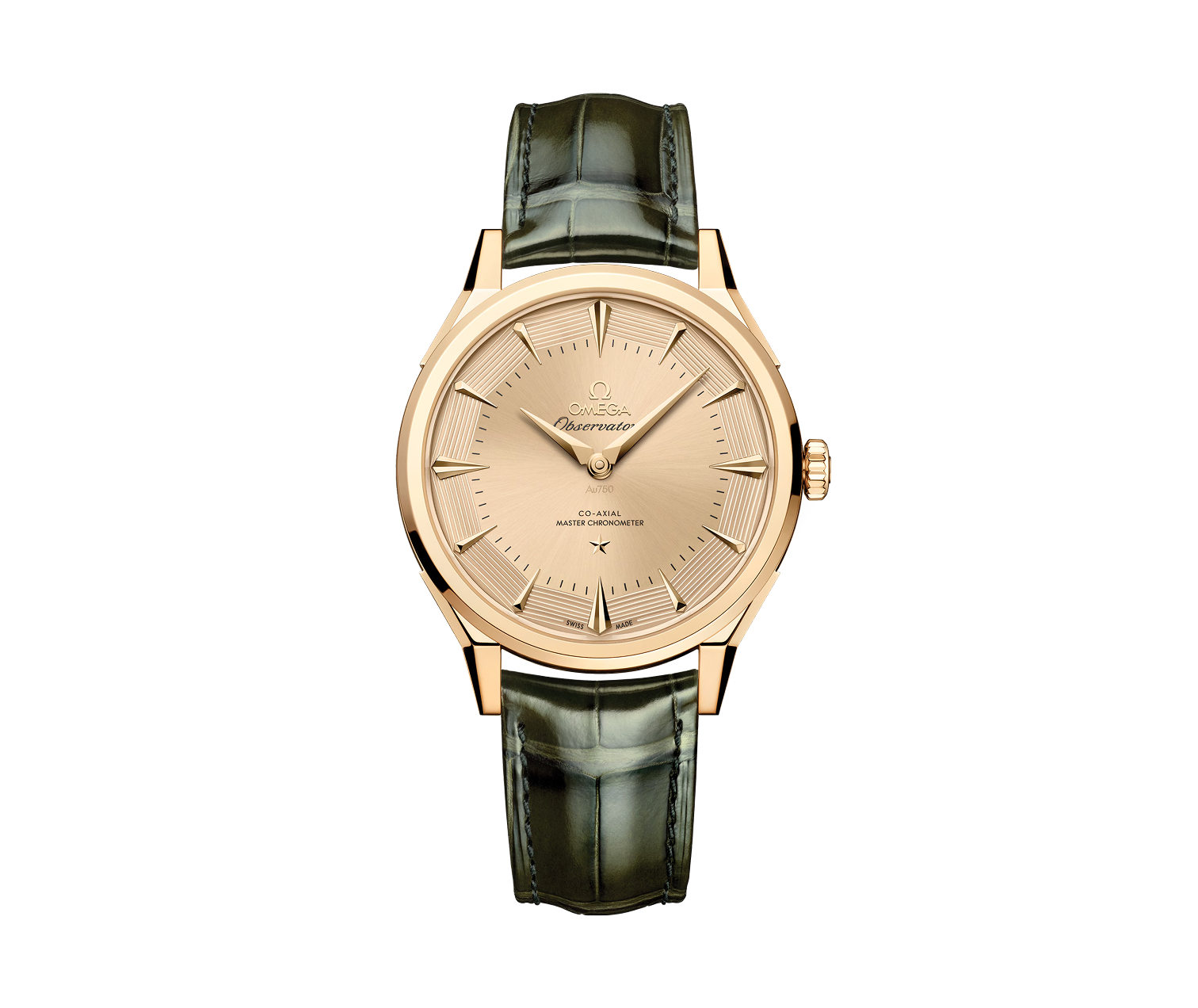
A chronometer test normally listens to a seconds hand. The Constellation Observatory has only two hands, so Omega had the testing changed to suit it.
The Omega Constellation Observatory is the first two-hand watch tested by the Laboratoire de Précision, which uses Dual Metric Technology to capture the acoustic signature of each movement across 25 days of continuous testing, tracking temperature, position and atmospheric pressure. METAS grants Master Chronometer certification on the strength of those measurements, including resistance to magnetic fields of 15,000 gauss. Inside is calibre 8915, a Co-Axial movement with a silicon balance spring and two barrels mounted in series, beating at 3.5 Hz, with an hour hand that jumps between time zones without stopping the watch.
This reference is the first time Moonshine gold has gone into an Omega movement: the skeletonised rotor is 18K Moonshine, seen through a sapphire case-back. Omega created the alloy in 2019, using silver, copper and palladium for a paler hue than traditional yellow gold. The case and the dial are Moonshine too. The dial is a dodecagonal pie-pan after the original 1952 Constellation, with a sun-brushed centre, opaline facets and eight hand-guilloché grooves, set with diamond-polished kite indexes and dauphine hands.
The eight stars of the Constellation medallion stand for six first-place awards and two world records at observatory chronometer trials between 1933 and 1952. The faceted dog-leg lugs carry a yellowish green alligator strap on a Moonshine gold pin buckle.
- Designed & made in
- Switzerland

- Case
- 18K Moonshine gold, 39.4 mm
- Crystal
- Domed sapphire, anti-reflective both sides
- Movement
- Automatic, calibre 8915
- Power reserve
- 60 hours
- Water resistance
- 3 bar (30 m)
- Thickness
- 12.23 mm
Figures as published by the manufacturer. Source