Designer vases for the living room, from Alvar Aalto to Argument
Designer vases worth a living room, from the mouth-blown Alvar Aalto vase and Vitra's eight-tube Nuage to two angular aluminium pieces from Argument.
Designer vases get looked at twice: once with flowers in them and once without, and a vase spends most of its life without. The five here were chosen on the second test. Each one starts from a single idea about how a vase should hold a stem, and that idea is visible from across the room whether anything is in it or not.
They move from soft to hard. The first is glass shaped by a breath and a mould, ninety years old and still made in Finland. The second is earthenware with one dent pressed into it. The third is a length of extruded aluminium with eight holes through it. The last two, both from the studio Argument, have no curves at all. Prices run from $235 to $955.
1.Alvar Aalto Vase – $260
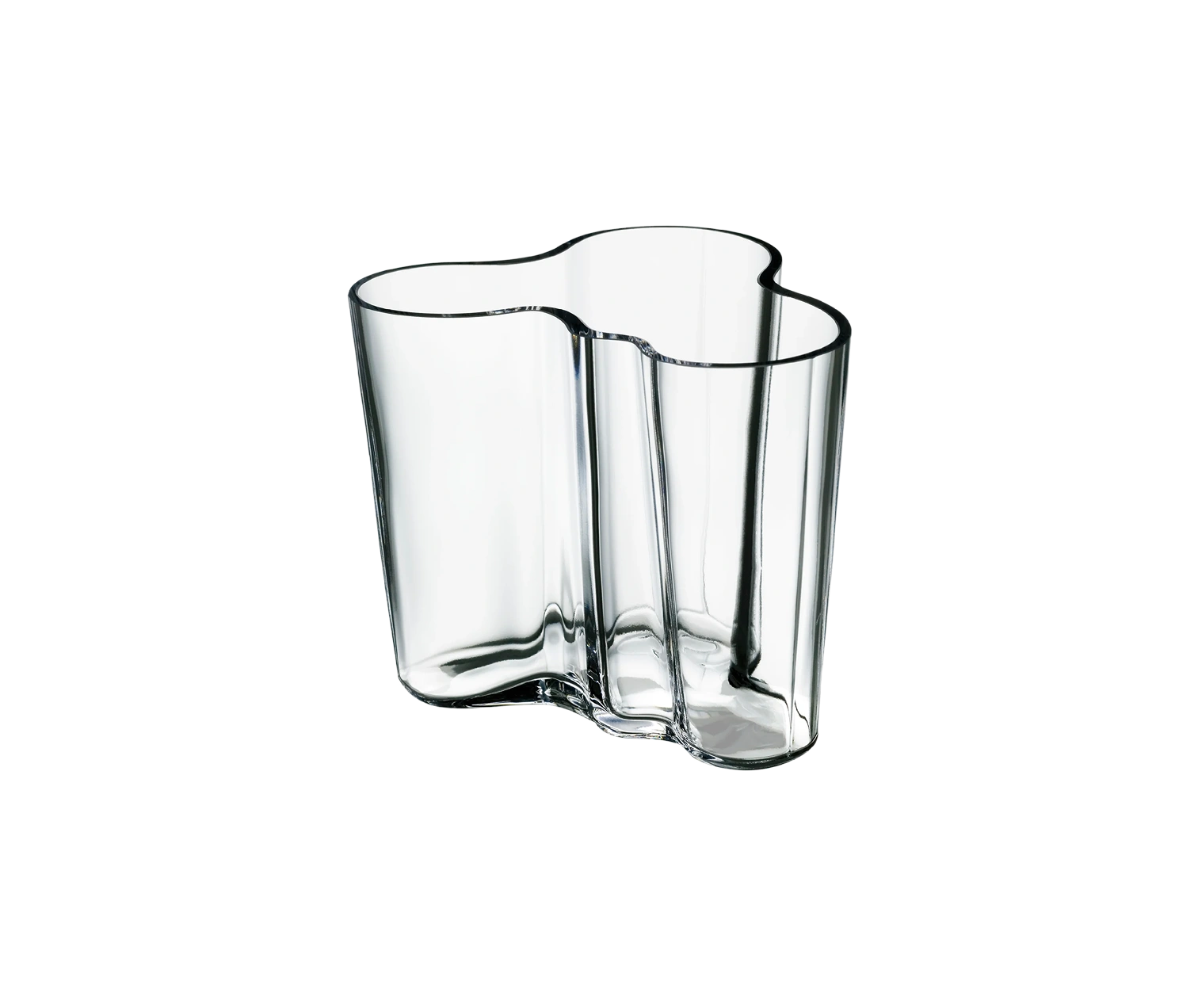
The outline is a shoreline, and no two of them come out of the factory quite the same.
A pressed glass vase leaves its mould finished. This one leaves it barely started. Iittala still makes it at its own glass factory in Finland the way it was first made: each vase is mouth-blown into a mould that sets the wave, then cut by hand and put through several rounds of polishing. The mould only gets the glass part of the way. A person finishes it, which is why the wall thickness and the line of the rim shift slightly from one vase to the next, and why Iittala treats that variation as part of the design.
Alvar Aalto drew the shape freehand in 1936, for a glass design competition run by the Karhula and Iittala works, and it won. A year later it went to the Paris World Fair. The name it is often sold under, Savoy, comes from the Helsinki restaurant whose interior Alvar and Aino Aalto designed at the same time. Aalto is the Finnish word for wave, and Iittala says the curves were drawn from the lakes of his own country.
What makes it work with flowers is the plan, seen from above. The deep inward curves make separate bays in one vessel, so a few stems lean into different corners instead of collapsing together at the centre. It comes in several heights and colours. The clear glass shows the water line and the stems below it, so it looks best with fresh water.
2.Muuto Ridge Vase – $235

One long dent down the front does two jobs: a handle on the outside and a stem rest on the inside.
Tall vases are awkward to move with water in them. You wrap a hand around the widest point and hope. The Ridge Vase from Muuto has a single vertical groove pressed down most of its face, and fingers hook into it, so a full vase lifts and turns with one hand. Inside, the same fold leans inward, and cut stems rest against it and stand up instead of splaying across the mouth the way they do in a plain cylinder.
The shape started as paper. Studio Kaksikko, a design practice in Helsinki, folded the first models by hand, then sent them to João, a mould maker who has worked for more than forty years from a workshop in Alcobaça, Portugal. He turned the folds into the handmade moulds the vase is cast from.
Muuto glazes the earthenware inside so it holds water, and left raw on the outside, which keeps it matte. That raw surface is also why Muuto says to clean it with a soft, uncoloured brush, like a nail brush, and never a scouring sponge: grit catches in fired clay and stays there. It is not dishwasher safe. The tallest size stands 48.5 cm, with a 35 cm version below it, and it is flat front to back, so it fits on a narrow shelf or a window sill that a round vase of the same height would not.
3.Vitra Nuage Vase – $385

Eight separate tubes in one body, so every stem stands in its own channel.
Ronan and Erwan Bouroullec drew the cloud outline in 2002, and it was not a vase. It was a plastic shelf module, with eight round cavities running through its flat faces and shaping its edge. In 2016 they stood the same drawing on end for Vitra. The vase is an extruded aluminium profile: the metal is pushed through a die cut in the shape of the cloud, so the section is identical along its whole length and can be cut off at any height. That is how the small, medium and large all come off one tool, at 13, 24 and 30 cm tall, all with the same 19.5 by 11 cm footprint. Rubber stoppers close the bottom of each tube.
What you look down into is that cut face: eight open circles with the wave running between them. A handful of stems put into a normal vase will lean together and cross at the neck. Here they cannot, because each one has its own tube, so a few grasses or single flowers stand apart and upright, spaced by the drawing. It suits sparse arrangements better than a full bunch.
The anodised finish puts the colour into the metal's own oxide layer, so the curved surface reads as stripes of light and shadow along its length. Because the outline is exact, two or three vases fit together with no gap, and Vitra sells them on that basis, calling the groups cloud formations. Vitra makes a ceramic Nuage as well.
4.Argument A 004 Vase – $515

No curves at all: sharp edges and right angles, arranged so the vase looks like several bodies passing through each other.
Most vases begin as a soft curve, because a curve is what a potter's wheel or a glassblower's breath makes. Argument starts from flat aluminium. The A 004 is a tall rectangular tube for the water, crossed by flat fins at the base and along one side, so the planes seem to intersect. Walk around it and the silhouette changes completely, from a narrow slab side-on to a cross from above.
The material is anodised aluminium. Anodising grows a hard oxide layer on the metal and takes colour down into that layer where paint would only sit on top, so the surface stays matte and even and does not chip at an edge. On an object made almost entirely of edges, that matters. It comes in silver, rosé, black and dark green, and colour changes a flat-sided shape more than a rounded one, because each plane catches the light as one block of tone.
Argument calls it a statement piece, and it is the A 004's case that the vase works empty, as a small sculpture on a sideboard or a coffee table. Put something soft in it, a single branch or a few loose stems, and the contrast between the cut metal and the plant is the arrangement. The tube is narrow, so it takes a few stems rather than a bunch.
5.Argument A 006 Vase – $955

The same language as the A 004, stretched into a floor vase.
Argument sells the A 006 as a floor vase, and that is the difference between it and the A 004: not a new idea, but the same idea at a height where it stops sitting on furniture and stands on the floor beside it. A long rectangular tube rises from a cross of flat fins, and at this height the fins read as feet, the way the base of a column does.
It shares everything else with the smaller vase: anodised aluminium, the same four colours of silver, rosé, black and dark green, and a silhouette that is a thin blade from one side and a broad cross from the other. Argument publishes a downloadable CAD file for both, which is how architects and interior designers place objects in drawings before they buy them, and it says something about who the studio has in mind.
A floor vase has a different job from a table vase. It is seen from standing height and from across the room, so it needs one strong line more than detail, and it suits branches better than flowers. Long cut stems of eucalyptus, olive, or a single dried branch suit the narrow tube. In a corner, by a doorway or at the end of a sofa, it fills the space a plant would, and needs no light and no watering when it is left empty. It is the only piece here that does not need a surface to stand on.
How we chose
We chose vases on how they look empty, because that is how a vase spends most of its time, and on whether each one has its own answer to holding a stem: a wave with separate bays, a dent that stems lean on, eight tubes that keep them apart, and a narrow metal tube that takes a single branch. That gave a run from hand-finished glass to cut aluminium, and from $235 to $955. Facts come from the makers' own pages and fact sheets, checked against retailers where a figure is given. Argument publishes its dimensions only on its own site, so we describe its two vases as the maker does, as a table vase and a floor vase, and leave the measurements out.
About the author

Justin Farrugia
Founder & Editor of Curated Supply
Justin Farrugia is the founder and editor of Curated Supply, a design-led directory to things worth owning. He has personally curated over 1,000 products across workspace, carry, coffee, audio, and the home, each judged against one standard: design intent, material quality, and the restraint that lets a thing last.