Turntables for a first proper vinyl setup
Five turntables, from a fully automatic Audio-Technica to the $2000 AT-LPA2, and the second purchase a proper vinyl setup quietly assumes you will make.
Turntables are the one part of a proper vinyl setup that arrives as four separate machines pretending to be one. A motor holds a speed. A bearing keeps the platter from wobbling around its own axis. An arm holds a stylus at a fixed angle while the groove drags it sideways. And a cartridge turns a needle shaking by fractions of a millimetre into a signal measured in thousandths of a volt. Get any one of those wrong and the other three cannot cover for it.
Which is why the useful question at this end of the market is not which deck sounds best. It is which deck arrives finished. All five here ship with a cartridge already mounted and aligned, so none of them needs a protractor and an afternoon before the first record plays. What separates them is the part nobody puts on the box: a phono stage, the small amplifier that lifts a cartridge's output to the level everything else in the room expects. Two of these five have one inside. The other three assume you already own one, or are about to go and buy one, and they do not say so on the front page.
So the ladder below runs from $349 to $2,000, and the real spread is wider than that once you add what each one still needs. Pair any of them with speakers chosen the same way and nothing else is missing.
1.Audio-Technica AT-LPA2
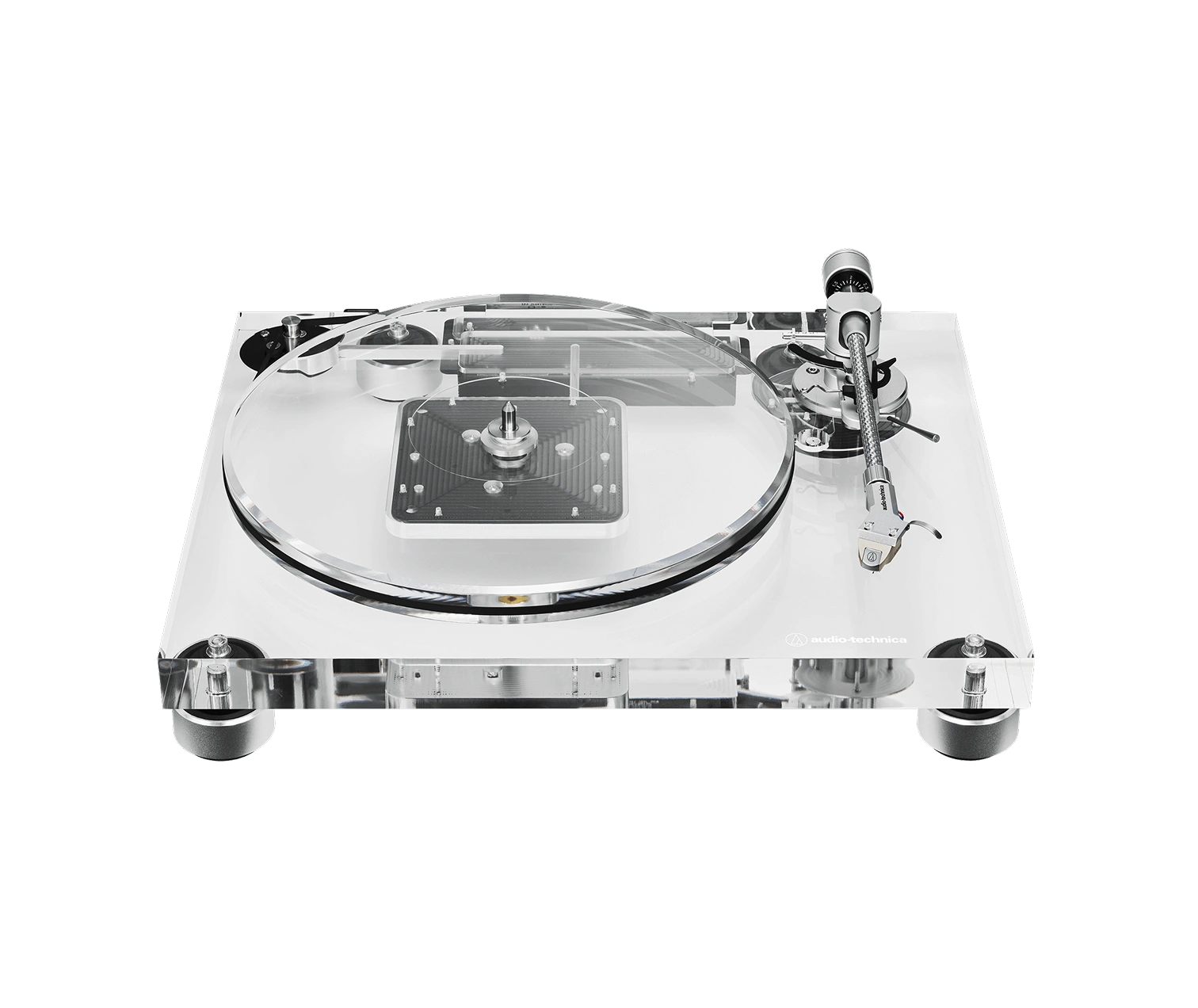
Thirty millimetres of acrylic under the platter, and no phono stage anywhere in the box.
Acrylic is the material choice that explains the rest of the deck. A record is a vinyl disc, and vinyl and acrylic ring at similar frequencies, so an acrylic platter sitting under an acrylic plinth gives groove noise nowhere flattering to resonate. Audio-Technica cuts the chassis 30 mm thick and the platter 20 mm, then leans on that mass instead of a suspension.
Speed comes from an optical sensor under the spindle that watches the platter turn and corrects the motor as it goes. Wow and flutter measures under 0.12 percent. The motor and its electronics live in a separate control unit that sits off the plinth entirely, which keeps the one component generating a magnetic field away from the one reading a magnetic signal.
The 8.8 inch carbon fibre arm adjusts in every direction that matters: vertical tracking angle across an 8.5 mm range, azimuth, and a thread-suspended anti-skate calibrated from 1.3 g to 3.0 g. Two counterweights ship with it, a light one and a heavy one, covering cartridges from 6.1 g to 13.9 g.
It comes with the AT-OC9XEN moving coil already fitted, a cartridge that sells for $399 on its own. That is the sting in the price and also the catch. Moving coil cartridges put out roughly a tenth of what a moving magnet does, and the AT-LPA2 has no preamp of any kind inside it. Budget for a phono stage that handles moving coil, or a step-up transformer, before this plays a note.
- Cartridge
- AT-OC9XEN moving coil, nude elliptical
- Phono stage
- None built in, and moving coil needs a matched one
- Wow and flutter
- Under 0.12 percent at 33 RPM
- Drive
- Belt, DC servo motor in a separate control unit
- Speed control
- Optical sensor under the spindle
- Plinth and platter
- 30 mm acrylic chassis, 20 mm acrylic platter
- Tonearm
- 8.8 inch static balanced carbon, 223.6 mm effective
- Adjustments
- VTA, azimuth, thread anti-skate from 1.3 g to 3.0 g
- Signal to noise
- Over 60 dB
- Weight
- 8.4 kg deck, 1.1 kg control unit
Specifications as published by the manufacturer. Source
2.Transparent Turntable
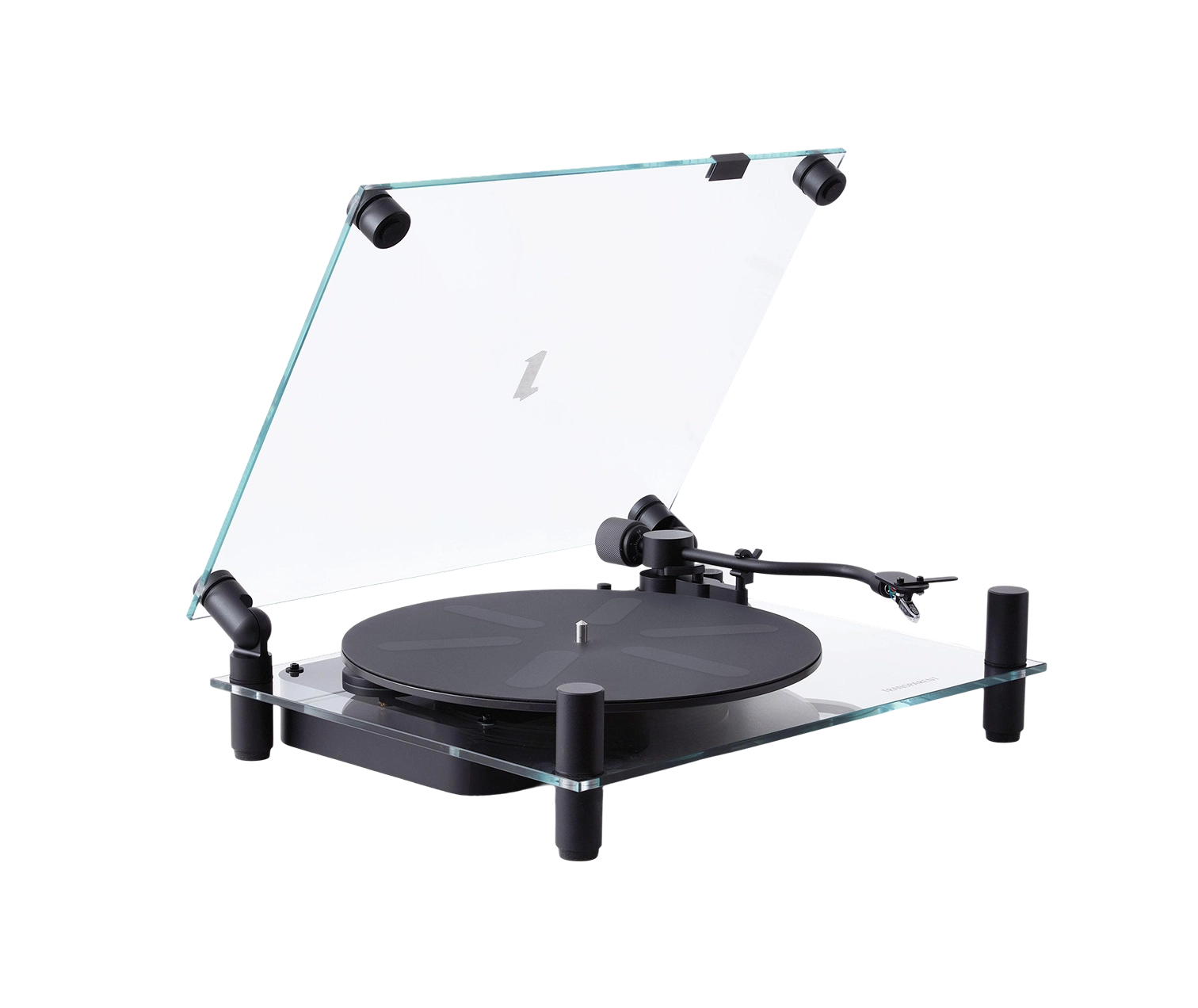
The only one here that needs nothing but a pair of Bluetooth speakers.
Everything else on this list treats the phono stage as somebody else's problem. Transparent puts one inside, on a switch, and then adds Bluetooth 5.0 with aptX Low Latency on top, which keeps the delay under 40 milliseconds. It transmits and receives, so the deck can feed a wireless speaker or borrow the speaker's amplifier for a phone. For anyone whose living room has no hi-fi rack in it, that removes two boxes and a run of cable.
The construction is aluminium and tempered glass, 6.5 kg of it, and the glass is doing structural work, not decoration: you can see the belt, the motor and the tonearm bearing from across the room, which is harder to build than a wooden box that hides them.
Belt drive, 33 ⅓ and 45 RPM, wow and flutter of ±0.25 percent. The arm measures 220 mm effective length and carries a pre-mounted Ortofon OM5E with an elliptical diamond, set to track at 1.75 g.
What keeps the Transparent Turntable from being a sealed appliance is the mount. It takes a standard half inch cartridge and an SME headshell, so the OM5E is a starting point and not a ceiling. The wireless module is a module. Two years of warranty, and a design that expects a screwdriver.
- Cartridge
- Ortofon OM5E moving magnet, elliptical diamond
- Phono stage
- Built in, switchable
- Wow and flutter
- Plus or minus 0.25 percent at both speeds
- Drive
- Belt, 33 and 45 RPM
- Wireless
- Bluetooth 5.0, aptX LL, SBC, AAC, under 40 ms latency, transmit and receive
- Tonearm
- 220 mm effective length, 1.75 g tracking force
- Mount
- Half inch standard and SME headshell
- Materials
- Aluminium and tempered glass
- Weight
- 6.5 kg
- Warranty
- Two years
Specifications as published by the manufacturer. Source
3.Pro-Ject Debut PRO S Balanced
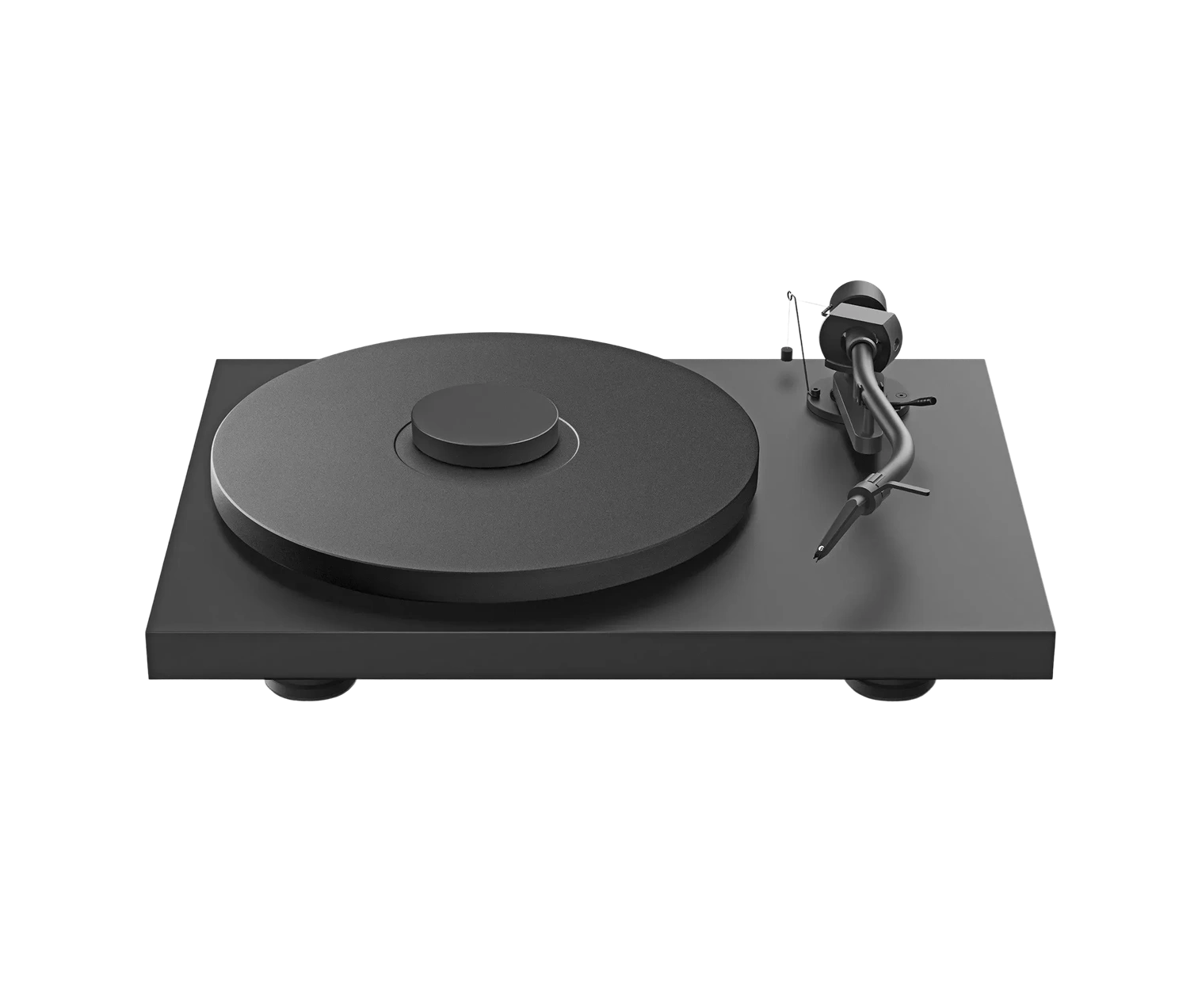
A balanced output on a turntable, which almost nothing at this price carries.
A cartridge produces a few thousandths of a volt. Everything between it and your amplifier, a metre of cable in a room full of mains wiring, is an aerial picking up hum. A balanced connection sends the signal twice, once inverted, and the receiving end subtracts one from the other. Anything picked up along the way lands identically on both wires and cancels. Studios have worked this way for decades. The Debut PRO S Balanced brings it to a domestic deck through a mini XLR socket, and it is why this model exists alongside the plain Debut PRO S.
The rest earns the price without the trick. A 10 inch S-shaped aluminium arm with an SME connector and a removable headshell, 254 mm effective length and 8 g effective mass, adjustable for both vertical tracking angle and azimuth. A 300 mm die-cast aluminium platter with a TPE damping ring under it, spinning on a stainless steel axle in a bronze bushing.
Speed changes electronically between 33 and 45, and a supplied belt takes it to 78 for anyone with shellac. Wow and flutter sits at ±0.16 percent, and signal to noise at 68 dB, the quietest figure on this page.
The supplied Pick it S2 C is a moving magnet borrowed in spirit from Ortofon's Concorde bodies, putting out a healthy 6 mV and tracking across a 2.0 to 5.0 g range. No phono stage inside, and using the balanced output means finding a phono stage with balanced inputs.
- Cartridge
- Pro-Ject Pick it S2 C moving magnet, 6 mV output
- Phono stage
- None built in, and the XLR output needs balanced inputs
- Wow and flutter
- Plus or minus 0.16 percent at 33, 0.14 at 45
- Output
- True balanced mini XLR
- Speeds
- 33 and 45 electronically, 78 with the supplied belt
- Platter
- 300 mm die cast aluminium with TPE damping and felt mat
- Tonearm
- 10 inch S-shaped aluminium, SME connector, 254 mm effective, 8 g mass
- Signal to noise
- 68 dB
- Size
- 462 mm wide, 145 mm high, 345 mm deep
- Weight
- 7 kg
Specifications as published by the manufacturer. Source
4.Pro-Ject T1 Evo
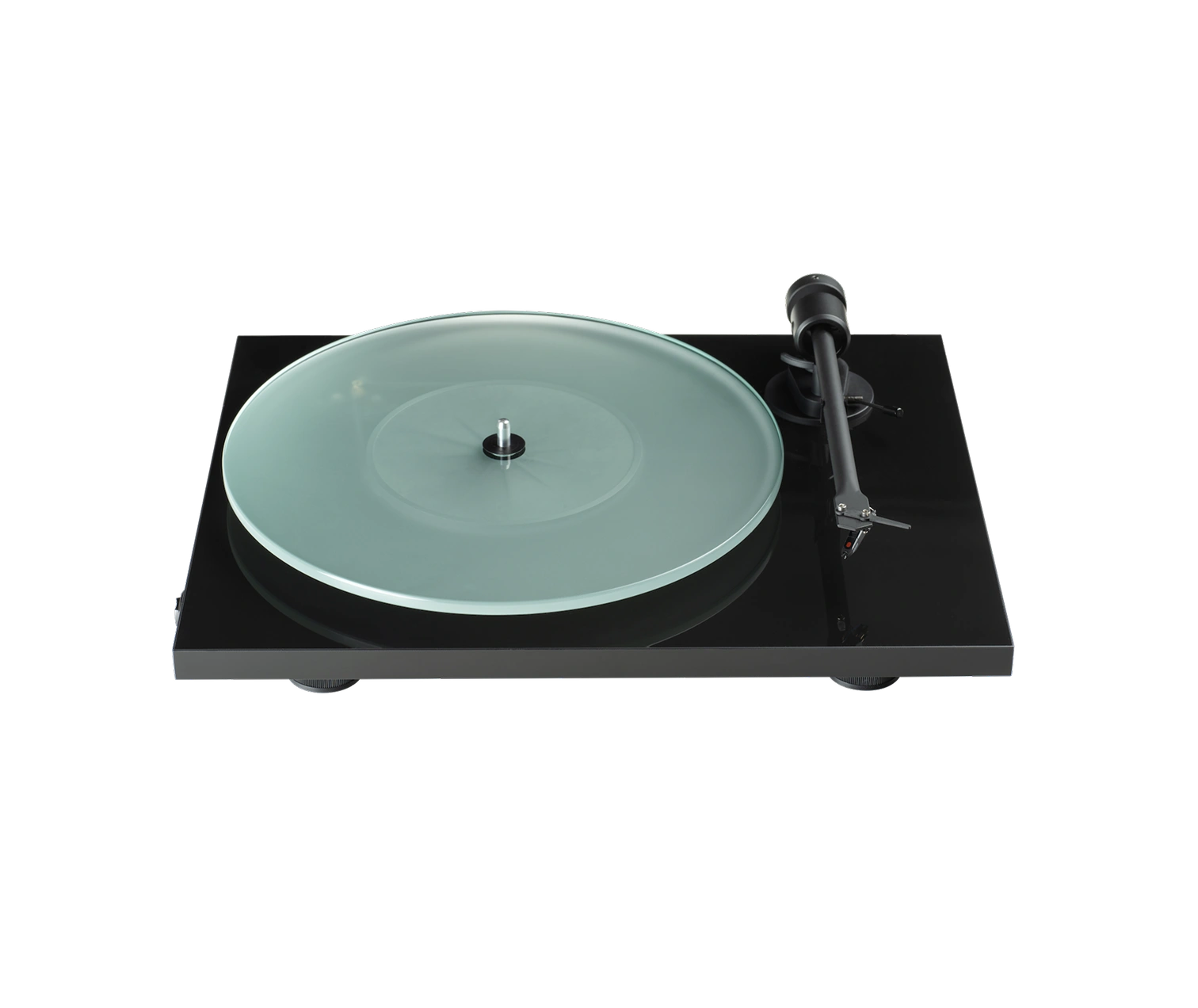
Machined wood, glass and aluminium, with nothing electronic in the signal path at all.
Pro-Ject builds the T1 Evo plinth by CNC out of solid wood, with no hollow cavities to drum, and drops an 8 mm blasted glass platter on top. Glass is heavy and inert, which is most of what a platter has to be. Underneath, the main bearing runs a hardened steel axle in brass.
The arm is a single piece of aluminium with the headshell formed as part of it. Every joint in a tonearm is a place a vibration can change direction, so removing the headshell joint removes one. It measures 8.6 inches, 218.5 mm effective, with tracking force preset at 17.5 mN, which is 1.75 g in the units the rest of the world uses.
An Ortofon OM10 with an elliptical stylus comes fitted. Wow and flutter reads 0.25 percent, signal to noise 65 dB. The whole thing weighs 3.8 kg, and Pro-Ject assembles it by hand in the Czech Republic.
Three versions exist and the difference is the only thing worth checking before ordering. Plain T1 Evo sends a raw phono signal out and nothing else. T1 Evo Phono adds a switchable stage inside. T1 Evo BT adds that stage and a Bluetooth transmitter. The plain one is the one that sits at this price, and it wants an amplifier with a phono input or a separate box.
- Cartridge
- Ortofon OM10 moving magnet, elliptical
- Phono stage
- None on this version, the Evo Phono and Evo BT add one
- Wow and flutter
- 0.25 percent at 33, 0.23 at 45
- Plinth and platter
- CNC machined wood, 8 mm blasted glass platter with felt mat
- Main bearing
- Hardened steel axle in brass
- Tonearm
- 8.6 inch one piece aluminium, 218.5 mm effective, 8 g mass
- Tracking force
- Preset at 17.5 mN, which is 1.75 g
- Signal to noise
- 65 dB
- Weight
- 3.8 kg
- Made in
- Czech Republic, by hand
Specifications as published by the manufacturer. Source
5.Audio-Technica AT-LP70XBT
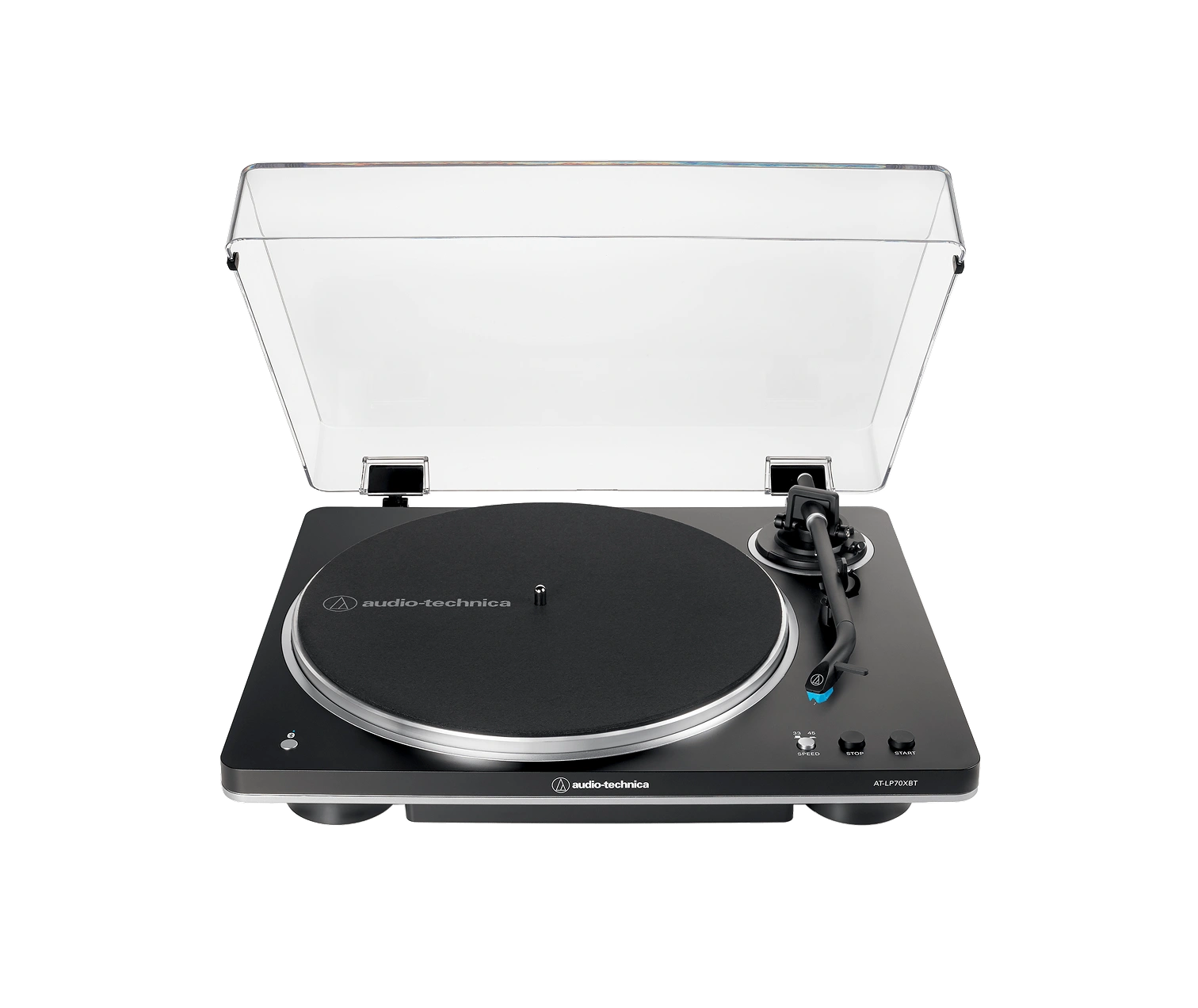
Press one button and the arm lifts itself, finds the lead-in groove and comes home at the end.
Full automation reads as a beginner's convenience and works as insurance. A stylus is a diamond tip loaded at under two grams, and the two ways people damage records both happen at the ends: dropping the needle by hand, and leaving the arm riding the run-out groove for an hour after the side finishes. The AT-LP70XBT removes both. Its J-shaped arm cues and returns on its own at 33 or 45.
The chassis comes in three bonded pieces to break up resonance, with a die-cast aluminium platter above it. The arm runs 220 mm effective length and carries an AT-VM95C, a dual moving magnet with a 0.6 mil conical stylus. Audio-Technica fixes the body in place, but the whole VM95 stylus range drops into it, so a $30 elliptical replacement is a genuine upgrade path with no alignment involved.
A switchable preamp inside gives 36 dB of RIAA-corrected gain, so it feeds powered speakers directly or a receiver's phono input when switched off. Bluetooth 5.2 handles aptX Adaptive, aptX and SBC.
Wow and flutter comes in under 0.25 percent and signal to noise above 55 dB, the loosest numbers here. At 2.9 kg it is also the lightest, and light is the honest trade for automatic: the mechanism needs room the mass would otherwise occupy.
- Cartridge
- AT-VM95C dual moving magnet, 0.6 mil conical, fixed body
- Phono stage
- Built in, switchable, 36 dB RIAA
- Wow and flutter
- Under 0.25 percent
- Operation
- Fully automatic, J-shaped arm, 220 mm effective
- Drive
- Belt, DC motor, 33 and 45 RPM
- Chassis
- Three piece anti-resonance, die cast aluminium platter
- Wireless
- Bluetooth 5.2, aptX Adaptive, aptX, SBC
- Signal to noise
- Over 55 dB
- Size
- 400 mm wide, 330 mm deep, 110 mm high
- Weight
- 2.9 kg
Specifications as published by the manufacturer. Source
What to weigh up before buying
The phono stage is a second purchase
A cartridge puts out millivolts, and it puts them out with the bass cut and the treble boosted, because that is how a record is cut in the first place. A phono stage amplifies the signal and reverses that curve. Nothing else in your system does it. Three of the five decks here have none inside, so the real price of the AT-LPA2, the Debut PRO S Balanced and the T1 Evo includes a box that is not in the box.
Belt drive and what the motor is doing
Every deck here is belt driven, which means a rubber loop stands between the motor and the platter. The belt stretches slightly under load, and that stretch absorbs the motor's small vibrations before they reach the record. The cost is that a belt is also a source of speed variation, which is why the more expensive decks spend their money watching the platter and correcting it.
The cartridge you get, and the one you can fit
Four of these five ship with a moving magnet. The AT-LPA2 ships with a moving coil, which reads finer detail and puts out about a tenth of the voltage, so it demands more from whatever comes next. More useful when buying: check the mount. A standard half inch or SME fitting means the cartridge is a component. A fixed body with a replaceable stylus, like the AT-LP70XBT, means the upgrades are cheaper but they stop sooner.
Wow and flutter, and why the numbers do not compare
Wow is slow speed drift, heard as pitch sagging across a held note. Flutter is the fast version, heard as roughness. The figures on this page run from 0.12 to 0.25 percent, but they are not measured the same way: Audio-Technica quotes a weighted figure for the AT-LPA2, House of Stereo quotes a differently weighted one for the AT-LP70XBT, and Pro-Ject and Transparent publish plain plus-or-minus deviation. Treat them as a rough ranking, not a league table.
Manual and automatic
A manual deck asks you to lift the arm, place it and lift it off. That is thirty seconds of attention twice a side, and for some people it is the reason to own records at all. An automatic deck does it with a cam and a lever, adds moving parts under the platter, and never once forgets. Only the AT-LP70XBT here is automatic. Whether that counts as the strength or the compromise is the most personal question on this list.
All 5 compared
Audio-Technica AT-LPA2Moving coil, and no preamp- Cartridge
- AT-OC9XEN (MC)
- Phono stage
- None
- Wow and flutter
- <0.12%
Transparent TurntableThe whole system in one box- Cartridge
- Ortofon OM5E
- Phono stage
- Built in
- Wow and flutter
- ±0.25%
Pro-Ject Audio Debut PRO S BalancedBalanced out, studio style- Cartridge
- Pick it S2 C
- Phono stage
- None
- Wow and flutter
- ±0.16%
Pro-Ject Audio T1 EvoWood, glass and nothing else- Cartridge
- Ortofon OM10
- Phono stage
- None
- Wow and flutter
- 0.25%
Audio-Technica AT-LP70XBTThe arm returns by itself- Cartridge
- AT-VM95C
- Phono stage
- Built in
- Wow and flutter
- <0.25%
Wow and flutter figures are not measured to a common standard. Audio-Technica weights the AT-LPA2 figure, the AT-LP70XBT figure is weighted differently again, and Pro-Ject and Transparent publish plain deviation. Read the column as a ranking, not a comparison. Audio-Technica's own site blocks automated access, so both AT figures here come from authorised dealers that print the maker's spec table in full.
How we chose
We started from the turntables in the catalogue that no post had covered, then cut the ones their own maker has stopped listing. That took out the Pro-Ject T1 Phono SB, which Pro-Ject has replaced with the T1 Evo Phono and no longer lists among its turntables, and it is why five decks are here instead of six. It also took out the MorningBlues Record 1, which reads like a turntable in a product list and is a smart display. What remains runs from $349 to $2,000 and shares one thing that matters at this end of the market: every one arrives with a cartridge already mounted and aligned, so none of them needs a protractor before the first record plays. Every figure below comes from the maker's own page or manual except where the note under the table says otherwise.
Common questions
You need one somewhere, and on three of these five it is not in the box. A cartridge produces a few thousandths of a volt, with the bass cut and the treble boosted, because that is how the groove is cut in the first place. A phono stage raises the level and reverses that curve, and nothing else in a normal system does either job. The Transparent Turntable and the AT-LP70XBT have one built in. The AT-LPA2, the Debut PRO S Balanced and the T1 Evo assume you own an amplifier with a phono input, or will buy a separate box.
Less mass at the tip, which lets the stylus follow smaller detail, and about a tenth of the output voltage as the price. Only the AT-LPA2 here ships with one, the AT-OC9XEN, and its low output is the reason that deck needs a phono stage built for moving coil or a step-up transformer in front of an ordinary one. Moving magnet cartridges put out enough signal for any phono input, cost less to replace, and on four of these five decks are what the maker chose.
It converts an analogue signal to digital and compresses it, so yes, measurably. Whether it matters depends on what receives it. Feeding a pair of wireless speakers over aptX Low Latency, as the Transparent Turntable does, the codec is nowhere near the weakest link in that chain. Feeding a good amplifier, it is pure loss, and both Bluetooth decks here keep a wired output for exactly that reason. Buy the feature because it removes cables from a living room, not because it sounds better.
The cartridge is the only part that touches the record, so it sets the ceiling. The deck sets whether that ceiling can be reached: a platter that wobbles or a motor that drifts will spoil any cartridge fitted above it. The useful way to spend is to make sure the mount is standard. A half inch or SME fitting, as on the Transparent Turntable and the Debut PRO S Balanced, means the cartridge is a component you can replace. A fixed body with a swappable stylus, as on the AT-LP70XBT, is cheaper to improve and stops sooner.
It has more moving parts under the platter and it protects your records from you. The two common ways to damage vinyl both happen at the ends of a side: dropping the stylus by hand, and leaving the arm sitting in the run-out groove long after the music stops. Automatic operation removes both. The AT-LP70XBT is the only automatic deck here, and it is also the lightest, which is the honest trade, since the mechanism needs the space the mass would otherwise fill.
About the author

Justin Farrugia
Founder & Editor of Curated Supply
Justin Farrugia is the founder and editor of Curated Supply, a design-led directory to things worth owning. He has personally curated over 1,000 products across workspace, carry, coffee, audio, and the home, each judged against one standard: design intent, material quality, and the restraint that lets a thing last.