About
A headset that puts screens in front of your eyes has one problem it cannot argue its way out of: your inner ear knows exactly how long the picture took to arrive. Apple's answer was to stop asking the main processor to deliver it.
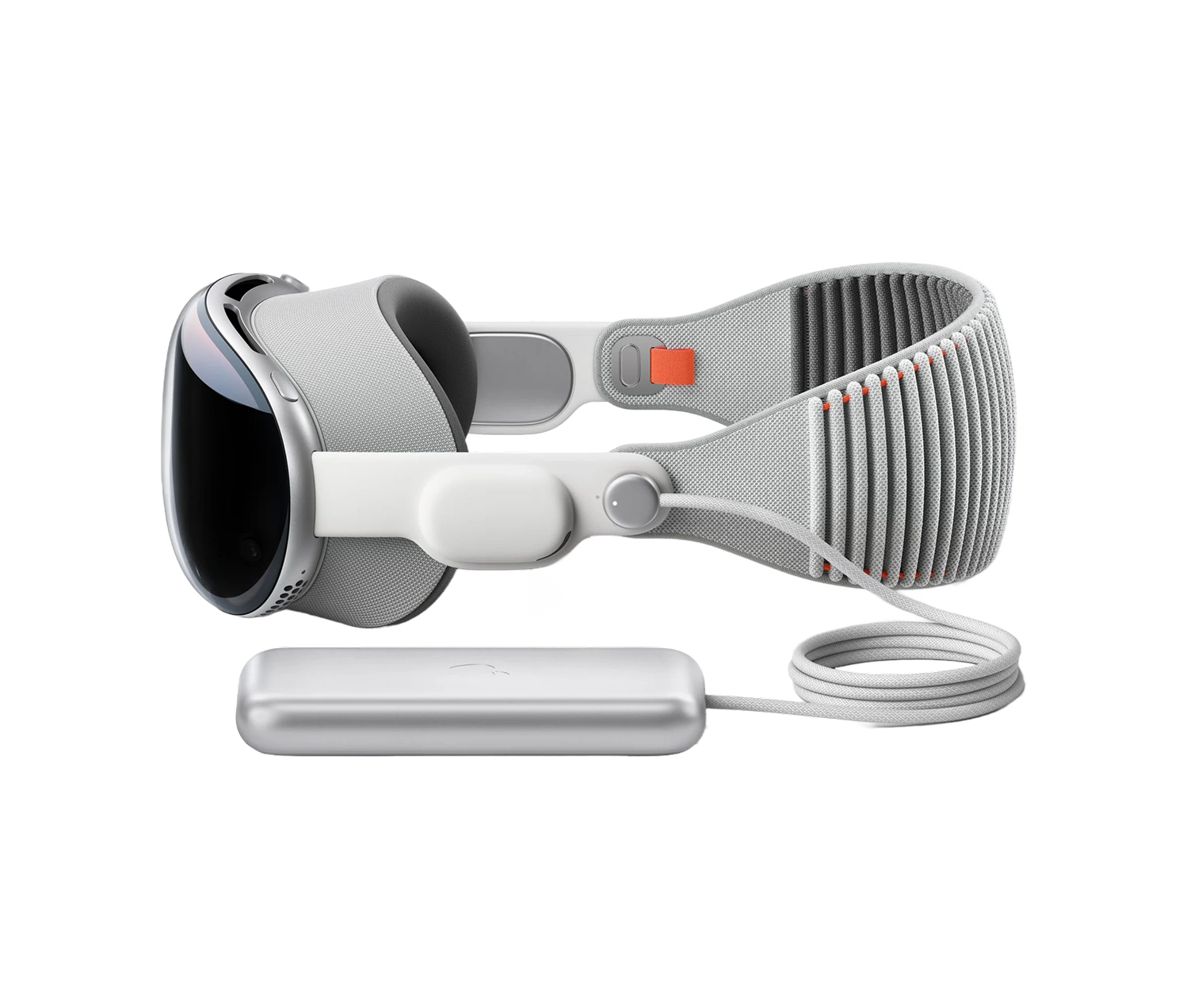
Apple Vision Pro is a spatial computer built around two chips rather than one, with an R1 chip that does nothing but carry what the cameras see to the displays in 12 milliseconds, photon to photon. A pair of high-resolution cameras on the front push over a billion pixels a second, because you are not looking through glass at the room, you are looking at a picture of it. Queue that traffic behind an operating system and the lag becomes something you feel rather than something you notice. R1 takes it instead, with 256GB a second of memory bandwidth and no other job, while M5 runs visionOS across ten CPU cores, ten GPU cores and 16GB of unified memory. The picture lands on a custom micro-OLED system with a 7.5 micron pixel pitch and refresh rates of 90, 96, 100 and 120Hz.
There are no controllers, because four cameras watch your eyes while LEDs project invisible infrared patterns onto them: looking at something is the pointer, and touching finger to thumb is the click. The Digital Crown presses to bring up the Home View and turns to dial how much of an Environment surrounds you. When a person walks up, EyeSight shows them your eyes through the front glass.
The battery does not live on your head. It is a separate aluminium case for your pocket, and both it and the frame are 100 per cent recycled aluminium.
- Designed in
- United States

- Awards
- Made in
- Vietnam

- Display
- Micro-OLED, 23 million pixels, 90 to 120Hz
- Weight
- 750 to 800 grams, plus a 353 gram battery
- Battery
- Up to 2.5 hours general use, 3 hours video playback
- Storage
- 256GB, 512GB or 1TB
- Material
- Controls
- Eye and hand tracking, Digital Crown


Figures as published by the manufacturer. Source