About
Most office chairs ask you to set the backrest tension yourself, usually with a knob under the seat that nobody ever turns twice. This one is set by the person already sitting in it.
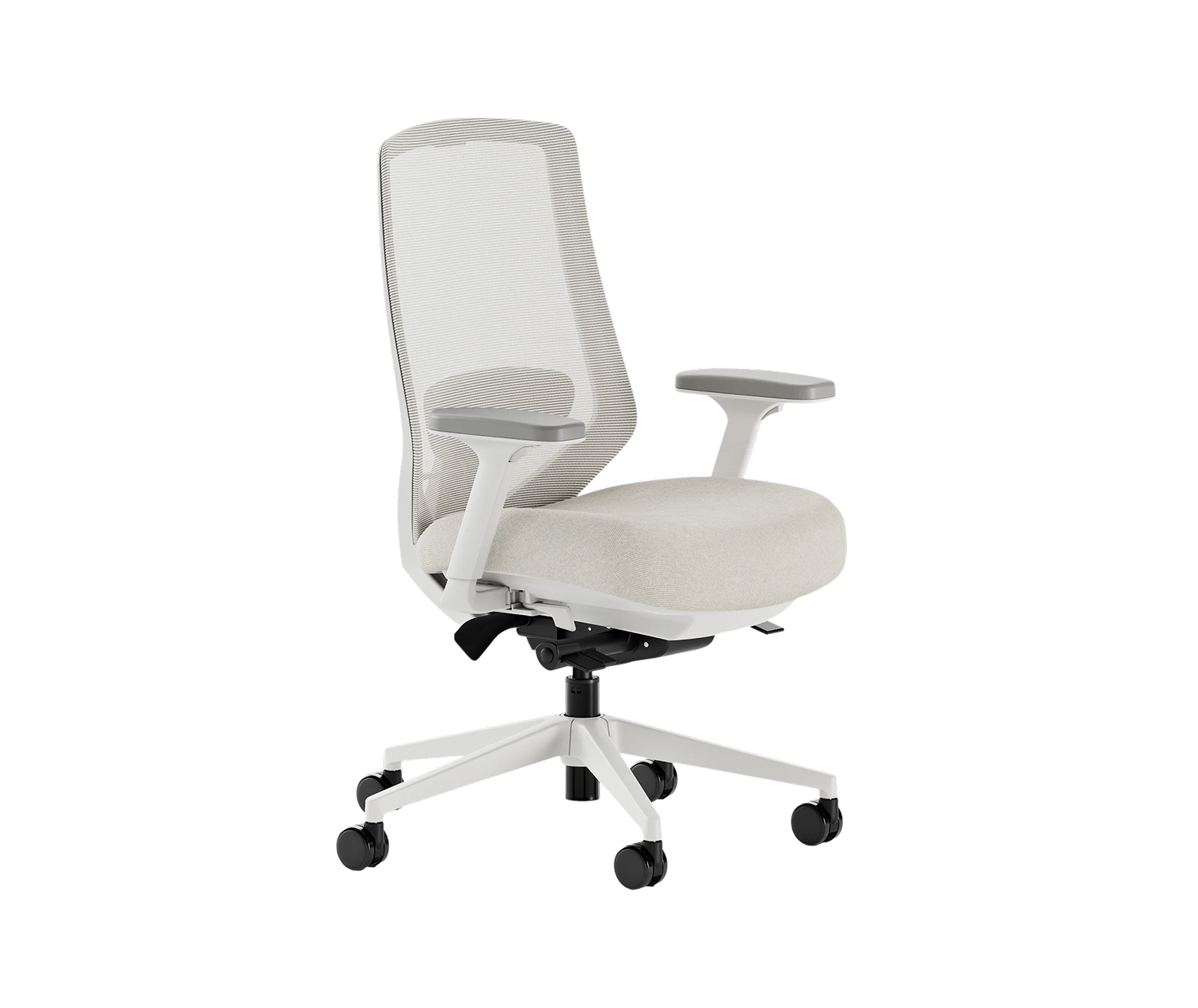
Vitra's Fauteuil Direction Pivotant puts Jean Prouvé's 1951 armchair on a five-star swivel base and tunes the backward tilt to the sitter's own weight. There are three adjustments and all of them are mechanical: a gas spring moves the seat height continuously, the tilt responds to the load on it, and the whole thing locks in the forward position when you want to stay upright for a while. No electronics, no settings to remember.
The base is bent sheet steel and tubular steel under a smooth powder coat, offered in seven colours drawn from Prouvé's own palette: Blanc Colombe, Gris Vermeer, Blé Vert, Bleu Marcoule, Bleu Dynastie, Japanese red and deep black. It rolls on double castors 60 millimetres across, hard single-colour ones for soft floors and soft two-tone ones for hard floors, and Vitra is clear that they should be swapped when the flooring changes. A version without castors comes instead on plastic glides for carpet or felt glides for hard floors.
Seat and backrest are a recyclable polyurethane foam Vitra calls V-Foam, under fabric or leather. The armrests are solid wood in oiled oak, dark stained oak or American walnut, and Vitra names the forests: oak from Western Europe or Poland, black walnut from the United States. That is an unusual level of disclosure for a pair of armrests, and it tells you which part of this chair the company considers the honest bit.
- Designed in
- Switzerland

- designer
- Jean Prouvé
- Materials
- Body
- Five-star base in bent sheet steel and tubular steel, powder-coated
- Controls
- Gas-spring height, weight-set backward tilt, lockable upright
- Colours
- Seven powder-coat colours from Prouvé's palette
- Material
- Fits
- Double castors 60 mm, or plastic and felt glides
Figures as published by the manufacturer. Source