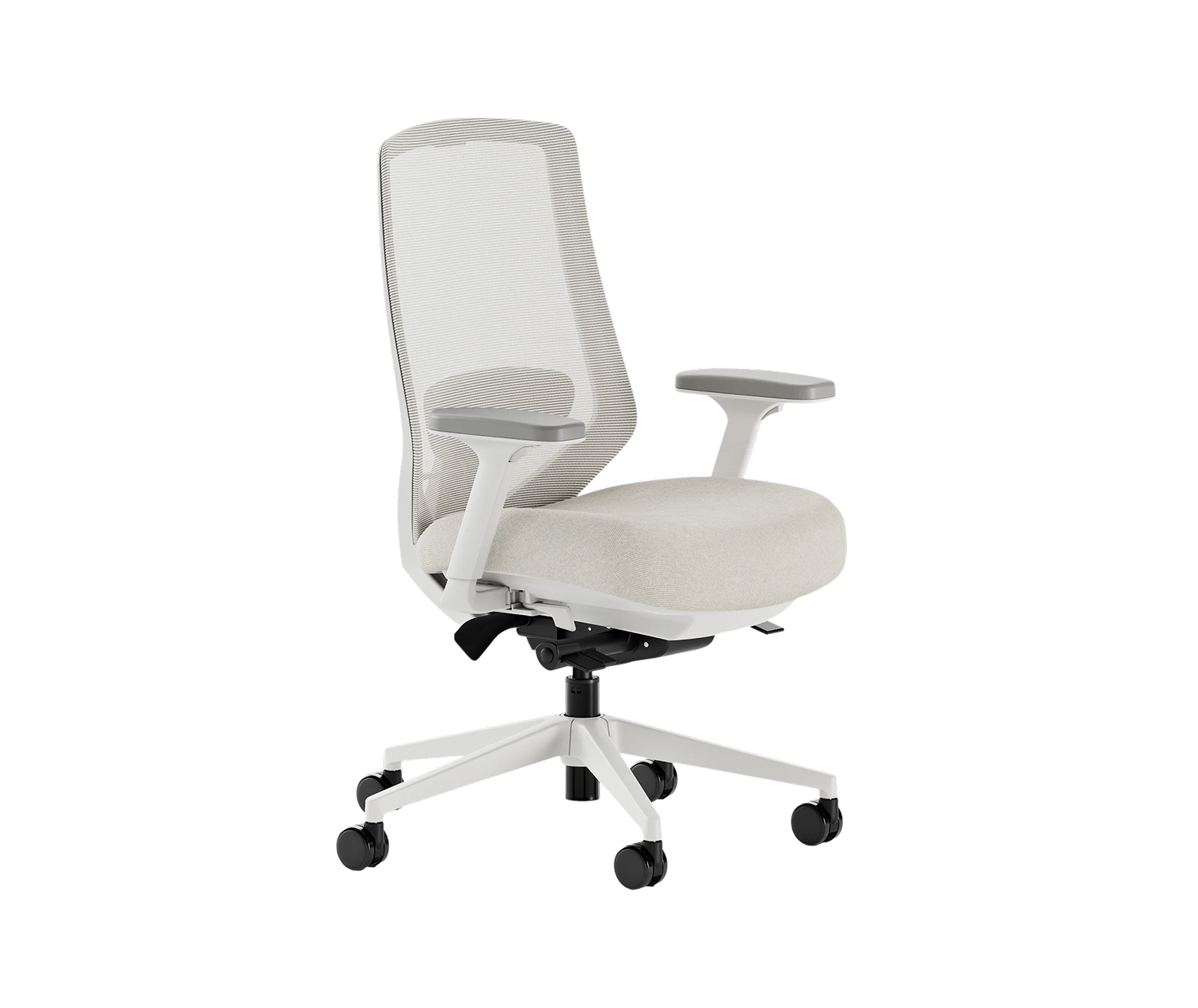
Freedom Headrest
$1,599

About
Every task chair sold on adjustability arrives with a spring tension dial, and almost nobody ever turns it. Niels Diffrient's answer was to delete it, along with the recline lever and the tilt lock, and let the sitter's own body weight do the work the springs were doing badly.
Humanscale's Freedom Headrest has no recline lever, no tension dial and no tilt lock, because the back is counterbalanced against whoever is sitting in it rather than against a setting somebody guessed at. On a conventional chair a mismatched spring either shoves you forward or refuses to move at all. Freedom simply weighs you. That is the basis for Humanscale's claim that it feels custom-made for whoever happens to sit down.
The headrest works the same way and takes no adjustment whatsoever: it travels with you through the recline instead of waiting to be repositioned behind your head. So do the arms, which are mounted to the back of the chair rather than the seat, so your forearms stay supported across the full range of movement. Height is the one thing you set, and it takes one hand.
What is underneath is built for decades rather than for a spec sheet. The chair is certified to 180 kg, which Humanscale notes is far beyond almost every other chair on the market, meaning each component is stronger than the load actually asks it to be. The gas cylinder is a patented design that seals its grease into the lower unit, away from both the user and the mechanism, and the layered Duron arm pads are rated five times tougher than a standard pad. Then there is the choice: over 300 textile shades, on a chair that is 34 per cent recycled content.
- Designed in
- United States

- designer
- Niels Diffrient
- Weight
- 17.4 kg (38.3 lb) with arms, 15.9 kg (35 lb) without
- Dimensions
- 635 mm (25 in) base width
- Materials
- Layered Duron arm pads
- Colours
- Over 300 textile shades
- Capacity
- Certified to 180 kg
Figures as published by the manufacturer. Source